Business
Column: Inside the effort by two Beverly Hills billionaires to kill a state law protecting farmworkers

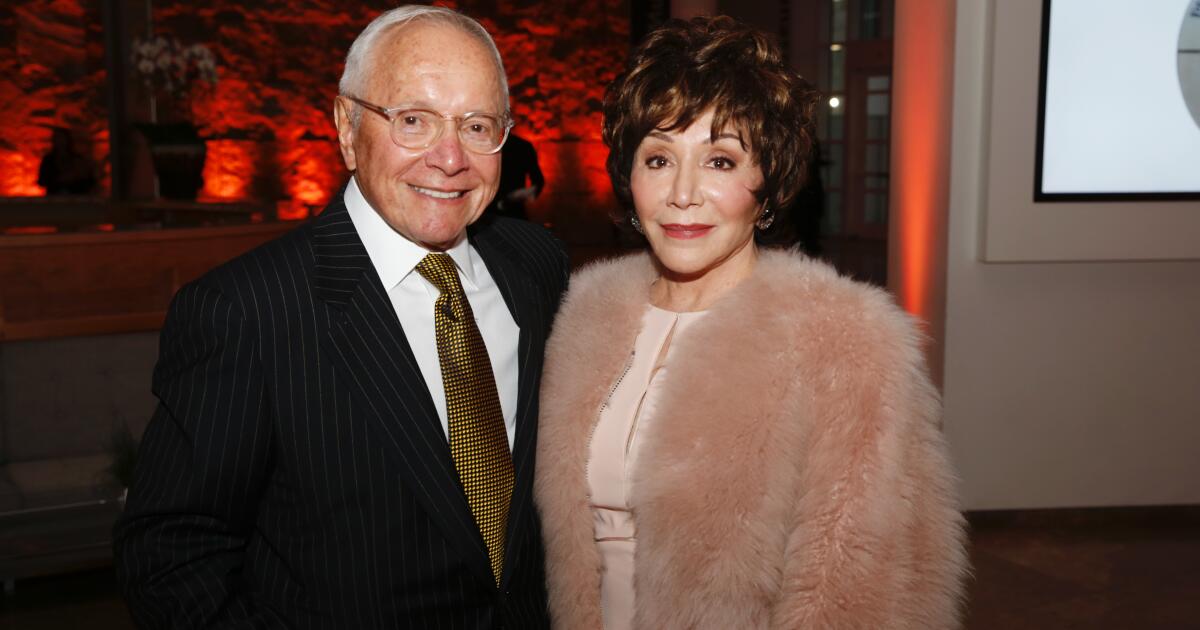
Los Angeles-based Wonderful Co. — the world’s largest pistachio and almond grower, the purveyor of Fiji Water, Pom pomegranate juice and Justin wines, and owner of the Teleflora flower service — wants you to know that it’s committed to “sustainable farming and business practices” and sees its employees as “a guiding force for good.”
Wonderful’s owners, the Beverly Hills billionaires Lynda and Stewart Resnick, say their “calling” is “to leave people and the planet better than we found them.”
Here’s another side of the company. Since February, it has been engaged in a ferocious battle with the United Farm Workers over the UFW’s campaign to unionize more than 600 Wonderful Nurseries workers in the Central Valley.
‘We ask each of you firmly not to sign an authorization card.’
— Anti-union script read to Wonderful Nursery workers by company officials
Having lost a series of motions before the California Agricultural Labor Relations Board to delay a mandate that it reach a contract with the UFW as soon as June 3 or have terms imposed by the board, Wonderful on Monday unleashed a nuclear attack: a lawsuit seeking to have the 2022 and 2023 state laws governing the unionization process declared unconstitutional.
If it succeeds, California’s legal protections for farmworkers could be rolled back to conditions that prevailed before César Chavez’s campaigns for farm unionization in the 1960s.
“This is an attack on farmworkers’ rights,” says Elizabeth Strater, the UFW’s director of strategic campaigns. Farm employers “will do everything they can to prevent workers from empowering themselves and lifting themselves out of poverty.”
The company disputes the claim and says its relationship with agricultural workers “is rooted in mutual trust, collaboration and respect,” in the words of Wonderful Nurseries President Rob Yraceburu.
Wonderful’s lawsuit takes a page from arguments made against the National Labor Relations Board by Trader Joe’s and Elon Musk’s SpaceX. Both companies, facing NLRB regulatory actions, are contending that the NLRB, which Congress established in 1935, is unconstitutional.
Wonderful contends that provisions of the state’s agricultural labor code violate its rights of due process guaranteed by both the state and U.S. constitutions.
At issue is a UFW drive to represent more than 600 Wonderful Nurseries employees that began in early 2023. The UFW ultimately presented the labor board with signed cards from more than half the employees giving the UFW authority to represent them in collective bargaining on a contract, a process known as a “card check.”
The board certified the union as the workers’ representative on March 1, triggering a tight deadline aimed at prompting the union and the company to reach a contract.
As often happens in hard-fought union campaigns, this one has generated a cross fire of allegations of unfair labor practices from both sides — the company asserting that the union defrauded workers into signing the representation cards, the union asserting that the company browbeat more than 100 workers into revoking their authorizations to drive the approval rate below the required 50%.
Accounts from the workers themselves vary. As my colleagues Rebecca Plevin and Melissa Gomez have reported, there have been complaints about poor working conditions at Wonderful along with hope that a union would help upgrade standards. Other workers say they misunderstood that signing an authorization card was tantamount to joining the UFW.
Some workers said they had second thoughts about signing the cards after meetings with a company-hired union-buster, Raul Calvo, who told them the union would take 3% of their pay for dues. In late March, some 100 Wonderful workers staged an anti-union protest at the ALRB offices in Visalia, but the UFW has alleged that the rally was the product of company coercion. Wonderful said at the time that it had no involvement in the protest and didn’t pay the workers for their time.
“These workers are so vulnerable,” the UFW’s Strater says. Many are undocumented or have other reasons to worry about job security, arguably making them receptive to management directives.
In this case, another party has weighed in — the Agricultural Labor Relations Board, an independent state agency. After an investigation, the board’s general counsel, Julia Montgomery, alleged that Wonderful trampled its workers’ unionization rights through numerous anti-union actions, including coercing them to submit declarations rescinding their authorizations. Wonderful has denied most of the allegations.
Wonderful says that the workers submitted their declarations — nearly 150 of them — voluntarily, “without any request having been made” by the company. Montgomery’s allegations, however, are mighty specific. She cites a series of meetings that were overtly aimed at persuading the workers to back away from the union.
That process began with employee meetings addressed by Calvo and proceeded to sessions in which workers met with Wonderful human resources personnel, Montgomery alleged. At those meetings, the company representatives read from a Spanish-language script stating that the union could have obtained workers’ signatures without their knowledge, that they would be deprived of the opportunity for a secret vote on unionization and encouraging them to sign a declaration revoking their authorization cards.
“We ask each of you firmly not to sign an authorization card,” the script read. In a line that sounds as if it came fresh out of the playbook of anti-union companies such as Starbucks, the script stated that the company wants “to be able to work one on one with you without the interference of a union.”
Some workers were led into a large conference room, where company representatives were assigned “to help the worker draft the declaration” revoking the authorization cards, Montgomery asserted. Some agents typed up declarations for the workers and handed them to the workers to sign.
A few words about the plaintiffs in this lawsuit:
The Resnicks are prominent philanthropists and political donors (mostly to Democrats). Their companies’ effects on the environment and California agriculture generally are checkered. Indeed, their most eye-catching charitable donation, a record-breaking $750-million pledge to Caltech in 2019 for research into climate change and “environmental sustainability,” isn’t inconsistent with a desire to “greenwash” some of their other activities.
As I previously wrote, while it might be churlish to suggest that the gift was devoid of genuine altruistic impulses, it would be naive to assume that altruism is the whole story.
A few years earlier, the Resnicks’ Justin Vineyards had been caught clear-cutting an oak forest near Paso Robles to make room for new grape plantings. The work was halted by San Luis Obispo County authorities, and the firm eventually agreed to donate the 380-acre parcel to a land conservancy.
Although the Resnicks say they are “dedicated to our role as environmental stewards,” their Fiji Water subsidiary looks like the antithesis of environmental sustainability. It profits from transporting water in plastic bottles more than 5,500 miles from the island nation to California and beyond, places that already have abundant water.
Wonderful’s pistachio and almond orchards have complicated efforts to apportion water among the state’s competing stakeholders. Because the trees require watering in wet years or dry, their acreage can’t be fallowed during dry spells.
That has made the water demand of the agricultural sector less flexible, and arguably has contributed to the devastating decline of the state’s salmon fishery and the drying out of rivers and streams that once supported a diverse population of fish and birds.
This isn’t the first time that the Resnicks have wrapped themselves in the U.S. Constitution to fend off a regulatory agency. In 2010, they asserted that the Federal Trade Commission infringed their 1st Amendment rights by holding that they made “false and misleading” and “unsubstantiated” representations about the health benefits of their Pom pomegranate juice, which amounted to unlawful marketing.
The company pitched the juice as “health in a bottle.” Wonderful put up billboards with the words “Cheat Death” next to a picture of the bottle. Its ads claimed Pom has beneficial effects on prostate cancer (“Drink to prostate health”), cardiovascular health and even erectile dysfunction — all of which claims were judged scientifically dubious by regulators. The company fought the FTC up to the U.S. Supreme Court, which rejected its appeal.
The 2022 and 2023 laws that Wonderful is challenging — indeed, the very creation of the ALRB in 1975 — reflect a reality known in California for more than a century: Bringing labor rights to farmworkers is notoriously difficult.
The first major farm union organizing drive in the state, among hops pickers in Wheatland, north of Sacramento, was broken up by four companies of the National Guard called out by Gov. Hiram Johnson in 1913. A statewide dragnet for organizers from the Industrial Workers of the World, or Wobblies, ensued, followed by hundreds of arrests. No further significant farm organizing took place for 16 years.
In 1975, a state law passed at the urging of César Chavez’s UFW gave union organizers the right to meet with workers on the farms where they toiled. But the Supreme Court, voting on partisan lines, struck it down in 2021—the law allowed organizers to “invade the growers’ property,” as Chief Justice John G. Roberts Jr. wrote.
To address the heightened difficulty agricultural unions faced, the state Legislature established the card check process in 2022 and 2023. The laws incorporated a tight timeline governing certification and contract bargaining, and stipulated mandatory mediation if no contract is reached with a set period.
The goal was to address “the basic failing of labor law both at the federal and state level, which is delay,” said William B. Gould IV, professor emeritus of law at Stanford and a former chairman of the National Labor Relations Board and the state Agricultural Labor Relations Board.
“Delay works against the interests of workers and unions, because employers hope that they’ll grow weary,” Gould told me. The tight deadlines were designed to place the burden of delay on the employers.
Wonderful maintains in its lawsuit, filed in Kern County state court, that the accelerated process has deprived employers of constitutionally protected due process rights by allowing a union to be certified by card check before the employers have a chance to object — effectively rendering the certification and the negotiating deadline faits accomplis.
That’s not quite true, however. The law allows anyone to file objections within five days of certification. After that, any certification can be revoked if the employers’ objections are later upheld at a hearing, and any mandated contract can be invalidated. Indeed, Wonderful filed its objections in time, citing the workers’ declarations; an ALRB hearing on its objections has been underway for weeks.
What appears especially to irk Wonderful is that the board has twice rejected its motions to suspend, or stay, the certification and negotiation procedure until after it rules on the company’s objections. The board responded that the law doesn’t provide for such a stay.
The company’s lawsuit thus amounts to an end run around the law. Gould is skeptical that Wonderful’s constitutionality claims will win much favor from California judges, but the case may be aimed at the notoriously anti-union U.S. Supreme Court majority.
“This Supreme Court has indicated that they want to reverse much of what was done in the 1930s,” a high-water mark for progressive labor and public interest laws, he said. In its lawsuit, Wonderful “has thrown buckets of paint against the wall in the hope that something will stick. Maybe they’ll be right on some of it.”


An aging downtown office complex will be converted into apartments as part of an ambitious plan by local real estate companies to create 4,000 affordable housing units in Los Angeles.
The first project will be a $200-million makeover of the L.A. World Trade Center, a sprawling white elephant of an office complex on Figueroa Street built in the 1970s that will be turned into 512 apartments in one of the largest affordable housing conversions to date downtown.
Future projects being planned in the central city for delivery over the next five years will include other office-to-apartment conversions and new housing built from the ground up.
The 10-story World Trade Center, right, at Figueroa and Fourth streets in downtown Los Angeles, was built in the mid-1970s.
(Myung J. Chun / Los Angeles Times)
Behind the building campaign unveiled Monday are two of the region’s largest real estate companies, Jamison and Kennedy Wilson. Jamison is the city’s most prolific converter of offices to market-rate apartments and currently has a major makeover of a downtown office skyscraper underway for tenants who can pay top rents.
Kennedy Wilson, a real estate investment company based in Beverly Hills, owns Vintage Housing, which builds and operates affordable housing using tax credits and other state and federal financing to help fund it.
Vintage Housing and Jamison’s new affordable housing division, Arden Residential, will take on the campaign to build the housing where qualified tenants will pay rents below market rates.
Rents in the World Trade Center — which will be renamed Sky Castle when it opens in early 2028 — are expected to start at $937 for a one-bedroom unit. Some two- and three-bedroom units would rent for $1,100 and $1,300 per month, respectively, developers said.
Sky Castle will have shared amenities found in more expensive modern apartments, the developers said, such as a fitness center, resident lounge and co-working space. It already has six tennis courts on the roof, which may be converted to pickleball courts, Jamison Chief Executive Garrett Lee said.
The goal is to build higher quality affordable housing by using efficient construction methods Jamison has learned through building more than 8,000 market-rate apartments in the past, Lee said. The makeover of the World Trade Center will mark Jamison’s 15th conversion of an office building to housing.
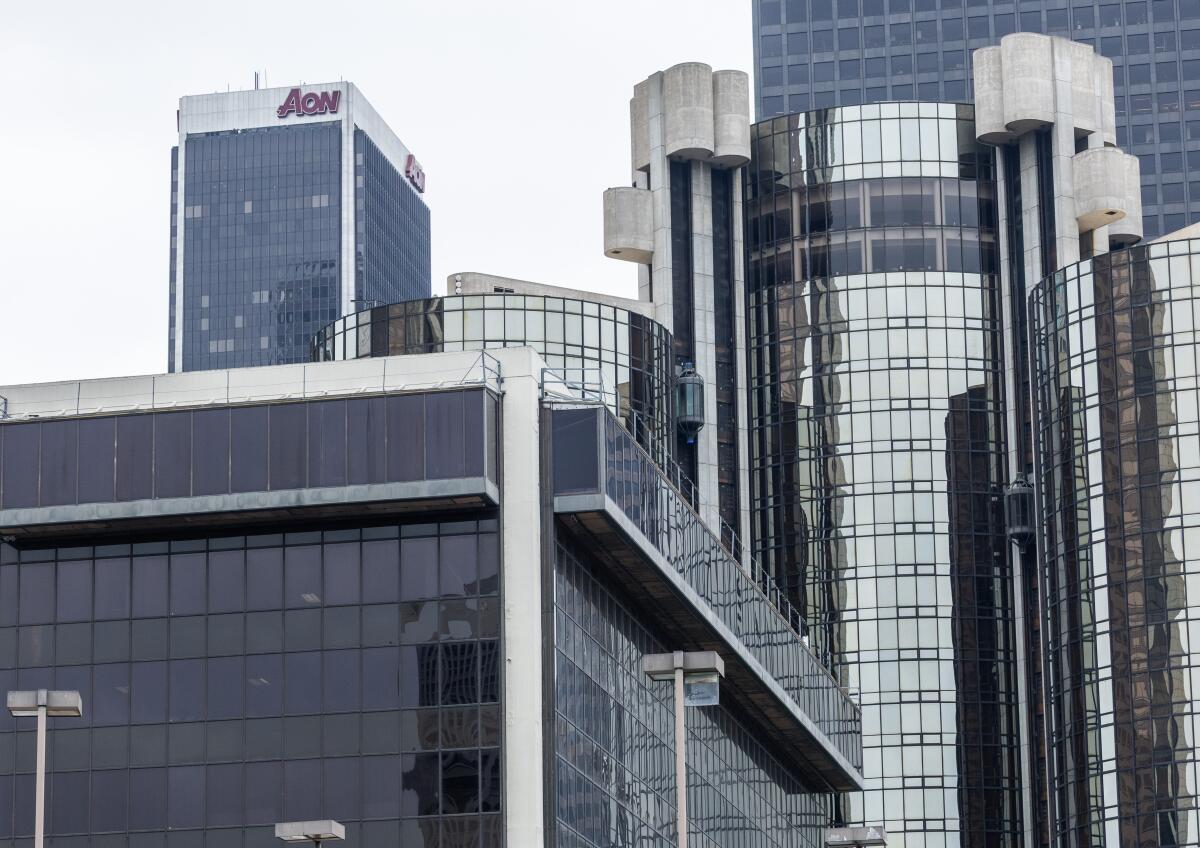
The plan to redevelop the L.A. World Trade Center, bottom left, is one of the largest affordable housing conversions to date downtown.
(Myung J. Chun / Los Angeles Times)
The 10-story World Trade Center was built in the mid-1970s to fanfare saying it would be home to international companies. In 1976, The Times described the center as a place to prepare for an overseas trip where visitors could get passports and visas, as well as exchange dollars for francs, marks, rubles and other currency. There was a language school and branches of U.S., Swiss and Japanese banks.
By the mid-1980s, the 400,000-square-foot office complex covering a city block at Figueroa and Fourth streets had lost its international flavor and was falling out of favor with corporate tenants who were moving into glossy new skyscrapers on Bunker Hill and in other locations.
The building has been cleared of remaining office tenants to allow work to begin in August, Lee said.
Kennedy Wilson is a nationwide operator of market-rate apartments that has also moved into building affordable housing in the last decade, said Nicholas Bridges, global head of capital markets at the company.
Building affordable, workforce housing “in almost all cases requires public subsidies,” Bridges said, and Kennedy Wilson has developed expertise in assembling “a cocktail of public financing sources” that includes low-income housing tax credits and tax-exempt bonds.
In the past, many housing developers have shied away from building affordable housing because assembling the subsidies needed to make construction profitable is challenging.

An artist’s rendering shows what the L.A. World Trade Center could look like after being redeveloped into affordable housing. The new complex is to be called Sky Castle.
(Ian Camarillo)
“It’s complicated,” Bridges said, “and not for the faint of heart.”
Eligible tenants must earn between 30% and 80% of the median income in the area where the housing is built.
Jamison and Kennedy Wilson will develop about 15 affordable housing projects between downtown and the 405 Freeway, Bridges said, many of them in aging office buildings such as the World Trade Center that are already owned by Jamison and are close to public transit.
Substantial potential for affordable housing lies in L.A.’s underused office buildings, he said.
“In this post-COVID world, the way people are utilizing office buildings, particularly older office buildings, has just fundamentally changed,” he said.
It makes sense for developers of conventional multifamily housing to move to building affordable housing, Lee said, because the government supports it through subsidies, zoning reform and the fast-tracking of construction permits. The city of Los Angeles also recently streamlined its adaptive reuse rules to make it easier to convert office buildings to housing.
“There are a lot of incentives pushing us in this direction,” Lee said.

Comcast is spinning off its NBCUniversal entertainment and news media businesses into a separate publicly traded company, a move that would unwind an audacious play the cable giant made for the storied Hollywood assets 15 years ago.
The plan would put broadcast networks NBC and Telemundo, NBC News, cable network Bravo, streaming service Peacock, the Los Angeles-based Universal film and television studios, Universal theme parks and British TV service Sky in a new stand-alone company.
Philadelphia-based Comcast would remain in its core business of distributing pay-TV channels, broadband internet and wireless services.
The spinoff would be the second such move by Comcast in two years. Late last year, the Brian L. Roberts-controlled company cast off most of its cable portfolio, including CNBC, USA Network, MS NOW and Golf Channel to form a new entity called Versant.
But the maneuver failed to budge Comcast’s listless stock, which has languished for years as its primary business lost thousands of broadband customers.
Comcast executives needed to make a bolder move to mollify frustrated investors.
Comcast stock peaked at nearly $26 per share Monday before closing at $24.22, up roughly 4.5% from Friday. Still, the stock remains below its 52-week high of $34.34.
The plan announced Monday would unravel Comcast’s bold decision to acquire NBCUniversal from General Electric Co. in 2011. At the time, Comcast saw tremendous value in marrying NBC’s entertainment operations, including its then-lucrative cable channels, with its cable TV distribution service that Roberts’ late father, Ralph, launched in Tupelo, Miss., in 1963.
“They were two distinct businesses,” longtime cable analyst Craig Moffett wrote in a Monday note to investors. “Having them under the same roof didn’t make either better.”
Consumers shifted to streaming, and Comcast’s attempt to build a top-tier digital service, Peacock, has fallen well short of its goal. Peacock lags behind rivals despite billions of dollars in investment from Comcast.
The concept of unwinding its NBCUniversal operation began in earnest in the fall, when Comcast joined the bidding for Warner Bros. Discovery. Comcast executives knew they could ill afford to spend billions to buy a rival; Wall Street would have pummeled the company.
So Comcast offered to spin off NBCUniversal and pair it with Warner Bros., turning two original Hollywood studios into a new media colossus.
But 43-year-old billionaire David Ellison prevailed in the bidding, agreeing to pay $111 billion to capture Warner Bros. Discovery. Losing the auction forced Comcast to find a different path forward.
On a call with investors, Roberts said the separation would bolster the two firms as they navigate increasing competitive challenges while technology companies continue to transform entertainment.
“We asked ourselves three basic questions,” Roberts said. “One, can these businesses stand alone and have the heft to stand alone in separate companies? Two, do they have a clear, viable capital allocation path to invest? And three, is now the right time? And the answer we came back with was yes to all counts.”
A free-standing NBCUniversal, home of the “Minions” and “Jurassic Park” franchises, probably would be an acquisition target, as media companies have been consolidating in an effort to get more content and mass distribution for their streaming services. Ellison’s Paramount is on track to close its Warner Bros. purchase, which would combine such media assets as HBO Max, CBS, CNN, Paramount Pictures and Warner Bros. studios.
With its Sky business, NBCUniversal has a toehold in Britain and Europe at a time when Amazon and Netflix are flexing their global distribution muscles.
Comcast would be positioned to combine with another cable and internet provider, such as Connecticut-based Charter, which owns the Spectrum television service. Charter is in the process of buying the smaller Cox cable service, which also has operations in Southern California.
Comcast is expected to complete the spinoff next year and will retain an 19% stake in the new entity.
The timetable could put NBCUniversal up for grabs by 2028 — when the company is set to broadcast the Summer Olympics, which will be held in Los Angeles.
Comcast acquired NBCUniversal in 2011. The industry-reshaping deal combined the largest distributor of TV channels with a provider of top-rated TV channels and a movie studio. But the streaming revolution has decimated the cable television business. Traditional TV viewing has been in a steady decline over the last decade. NBC has relied heavily on NFL broadcasts, and more recently, NBA and Major League Baseball games to remain relevant.
NBCUniversal has invested heavily in its streaming service, Peacock, but has been unable to reach the scale necessary for profitability. Comcast‘s stock price has struggled as a result.
Roberts, chairman and chief executive of Comcast, will continue to be involved in the leadership of Comcast and NBCUniversal, working in partnership with the CEOs of both companies.
Mike Cavanagh will remain as CEO of NBCUniversal, and Comcast’s former chief financial officer, Michael Angelakis, will return to run Comcast after the spinoff.
“Perhaps the best part of today’s welcome announcement … is that Mike Angelakis is coming back,” Moffett, the analyst, wrote. “He will now helm the cable business, [which] is unequivocally good news. With Mike Angelakis’s return, Comcast has come full circle.”
Moffett added that, despite Monday’s announcement, the 2011 combination was not a complete bust.
“The deal to acquire NBCU from GE was financially brilliant,” he said. “It was structured so that Comcast paid for just half of the acquisition and then let NBCU’s own cash flow pay for the rest.”
Over the years, Comcast has raked in billions in profit from its media holdings.
Comcast executives on the analyst call played down the notion that the two companies were being positioned for another deal.
“Absolutely not,” Roberts said. “This is the right move to put each company in the strongest position to create value, fully monetize its assets and aggressively pursue its own organic growth strategies.”
Cavanaugh, who has been running the combined company for three years, sounded more like a buyer than a seller.
“Our plan for NBCUniversal and Sky is to build and invest for growth,” he said. “We have the freedom now to explore adjacent businesses where we have the right to play, and that’s thanks to the stability of our company and management team.”
The spinoff announcement comes a week after Fox Corp. announced its deal to purchase the streaming platform Roku for $22 billion. The deal is aimed at ensuring that Fox has a means to get its portfolio of sports, news and entertainment channels into viewers’ homes as the traditional pay-TV business continues to erode.

Rocket Lab took a big step Monday to better compete with rivals SpaceX and Amazon, announcing an $8-billion acquisition of satellite communications company Iridium.
The Long Beach rocket-and-satellite maker is buying a company that provides critical communications services to pilots, mariners and others, while giving Rocket Lab a foothold in the emerging satellite-based mobile phone market.
“We are going to absorb it, optimize it and scale it into something that is really truly fantastic,” said Rocket Lab Chief Executive Peter Beck in a YouTube presentation of the deal.
Rocket Lab is paying $54 a share for McLean, Va.-based Iridium — $27 in cash and the rest in shares. Deutsche Bank and Wells Fargo are providing $3.6 billion in financing in the deal, which is expected to close next year.
Iridium’s 66 low-Earth-orbit satellites provide voice, data, navigation and other services to remote regions and across the globe to 2.55 million government, defense, aviation, maritime and commercial subscribers.
Iridium reported net income of $114 million in 2025, up 2% from the previous year. Revenue climbed 5% to $872 million.
The market for mobile cellular and other satellite-based communications is growing rapidly.
Elon Musk’s SpaceX spent $17 billion last year to acquire spectrum from EchoStar and then followed it up with a $2.6-billion purchase. The spectrum will allow its Starlink broadband satellite network to provide mobile phone service worldwide.
In April, Amazon agreed to acquire satellite operator Globalstar in a roughly $11.6-billion deal that would expand the services of its satellite system and the so-called direct-to-device smartphone market.
The competition has raised concerns about Iridium’s ability to compete.
SpaceX went public this month in the largest initial public offering ever, raising $86 billion, with the company now valued at more than $2 trillion.
In February, Iridium Chief Executive Matthew Desch said the company has shown it’s not “in decline,” dismissing concerns that it couldn’t compete with Starlink, according to Morningstar.
Founded in 2006 in New Zealand, Rocket Lab moved to the U.S. a decade ago and opened its Long Beach headquarters in 2020. It has manufacturing and mission operations in Virginia, New Mexico, Colorado, Maryland, Toronto and New Zealand.
The company manufactures a small rocket called Electron that has launched 262 satellites into space, making it the second-busiest U.S. launch provider behind SpaceX. Rocket Lab is developing a larger rocket called Neutron, and it also makes satellites, subsystems and space components.
Beck said the acquisition of Iridium will propel Rocket Lab into the satellite communications business. That would otherwise be a slow process, requiring the acquisition of spectrum, satellite development and establishment of a customer base.
“We think we’ve found a little bit of a shortcut here,” Beck said, noting the combined company will be vertically integrated, able to design, build, launch and operate its own satellites.
The deal is “very strategic” for Rocket Lab, William Blair analyst Louie DiPalma said in a note to clients, according to Morningstar.
Rocket Lab has announced multiple contracts this year.
Last week, the company said it would launch Electron rockets for three NASA missions from its New Zealand site.
In May, Rocket Lab announced a $30-million contract with Costa Mesa defense contractor Anduril for multiple hypersonic test flights in Virginia using Rocket Lab’s HASTE launch vehicle.
The company is among scores of businesses that have revitalized Southern California’s aerospace and defense industries since SpaceX was founded in 2002. SpaceX, now headquartered in Texas maintains operations in Hawthorne.
Secretary of Defense Pete Hegseth visited Rocket Lab’s headquarters in January during a stop on his tour of defense contractors in Southern California and across the country.
“This company, you right here, are front and center, as part of ensuring that we build an arsenal of freedom that America needs,” Hegseth told several hundred cheering workers. “The future of the battlefield starts right here with dominance of space.”
Iridium investors cheered the news. Its shares gained 25% to close Monday at $54.59. Rocket Lab shares jumped 16% to close at $97.95.
-

 Wyoming3 minutes ago
Free Crow Culture Program at Fort Phil Kearny
-

 Crypto5 minutes ago
UK investors sue Binance in London for £150 million
-

 Finance11 minutes ago
What the Supreme Court’s campaign finance ruling means for the 2026 election
-

 Fitness18 minutes ago
I pushed myself too hard at the gym – and ended up in the hospital
-

 Movie Reviews25 minutes ago
Young Washington (Christian Movie Review) – The Collision
-

 World36 minutes ago
Neon Closing in on Luca Guadagnino’s Sam Altman Open AI Movie ‘Artificial’ After Amazon Drops Controversial Film
-
 Lifestyle1 hour ago
‘Dead but Dreaming of Electric Sheep’ is full of beautifully written grotesqueries
-

 Technology1 hour ago
Google’s NotebookLM can sum up your research in a TikTok-style clip

