Business
Column: After a years-long pause, the FCC resurrects 'network neutrality,' a boon for consumers

In the midst of its battle to extinguish the Mendocino Complex wildfire in 2018, the Santa Clara County Fire Department discovered that its internet connection provider, Verizon, had throttled their data flow virtually down to zero, cutting off communications for firefighters in the field. One firefighter died in the blaze and four were injured.
Verizon refused to restore service until the fire department signed up for a new account that more than doubled its bill.
That episode has long been Exhibit A in favor of restoring the Federal Communications Commission’s authority to regulate broadband internet service, which the FCC abdicated in 2017, during the Trump administration.
This is an industry that requires a lot of scrutiny.
— Craig Aaron, Free Press, on the internet service industry
Now that era is over. On Thursday, the FCC — now operating with a Democratic majority — reclaimed its regulatory oversight of broadband via an order that passed on party lines, 3-2.
The commission’s action could scarcely be more timely.
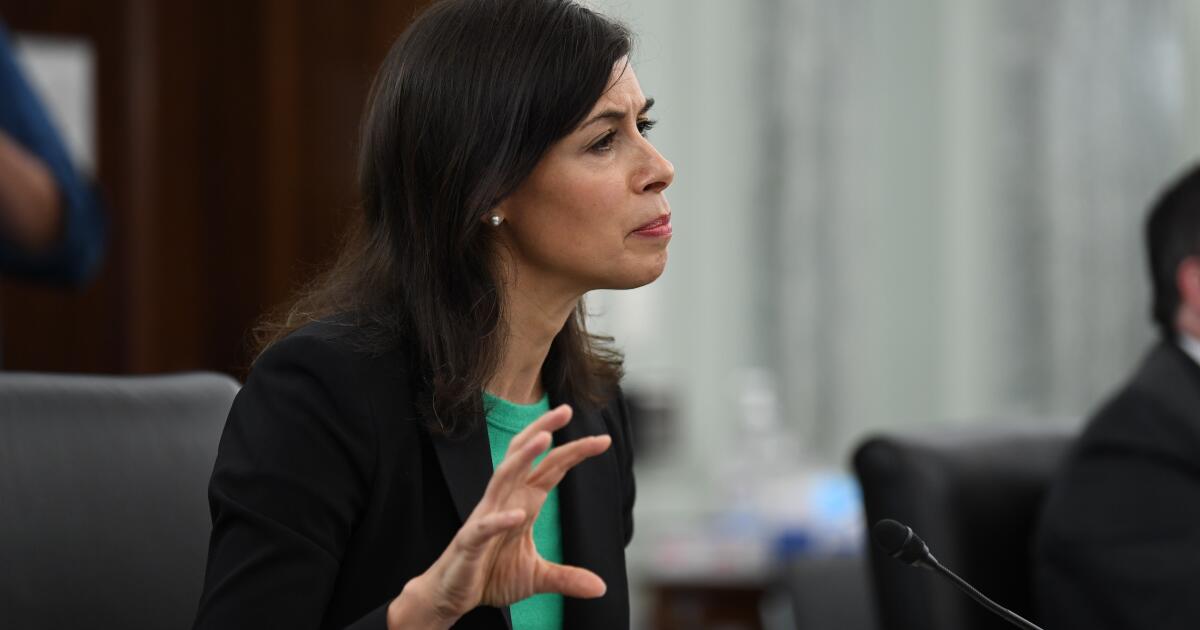
“Four years ago,” FCC Chair Jessica Rosenworcel observed Thursday as the commission prepared to vote, “the pandemic changed life as we know it. … Much of work, school and healthcare migrated to the internet. … It became clear that no matter who you are or where you live, you need broadband to have a fair shot at digital age success. It went from ‘nice to have’ to ‘need to have.’ ”
Yet the commission in 2017 had thrown away its own ability to supervise this essential service. By categorizing broadband services as “information services,” it relinquished its right to address consumer complaints about crummy service, or even collect data on outages. It couldn’t prevent big internet service providers such as Comcast from favoring their own content or websites over competitors by degrading the rivals’ signals when they reached their subscribers’ homes.
“We fixed that today,” Rosenworcel said.
The issue the FCC addressed Thursday is most often viewed in the context of “network neutrality.” This core principle of the open internet means simply that internet service providers can’t discriminate among content providers trying to reach your home or business online — they can’t block websites or services, or degrade their signal, slow their traffic or, conversely, provide a better traffic lane for some rather than others.
The principle is important because their control of the information highways and byways gives ISPs tremendous power, especially if they control the last mile of access to end users, as do cable operators such as Comcast and telecommunications firms such as Verizon. If they use that power to favor their own content or content providers that pay them for a fast lane, it’s consumers who suffer.
Net neutrality has been a partisan football for more than two decades, or ever since high-speed broadband connections began to supplant dial-up modems.
In legal terms, the battle has been over the classification of broadband under the Communications Act of 1934 — as Title I “information services” or Title II “telecommunications.” The FCC has no jurisdiction over Title I services, but great authority over those classified by Title II as common carriers.
The key inflection point came in 2002, when a GOP-majority FCC under George W. Bush classified cable internet services as Title I. In effect, the commission stripped itself of its authority to regulate the nascent industry. (Then-FCC Chair Michael Powell subsequently became the chief Washington lobbyist for the cable industry, big surprise.)
Not until 2015 was the error rectified, at the urging of President Obama. Broadband was reclassified under Title II; then-FCC Chair Tom Wheeler was explicit about using the restored authority to enforce network neutrality.
But that regulatory regime lasted only until 2017, when a reconstituted FCC, chaired by a former Verizon executive Ajit Pai, reclassified broadband again as Title I in deference to President Trump’s deregulatory campaign. The big ISPs would have geared up to take advantage of the new regime, had not California and other states stepped into the void by enacting their own net neutrality laws.
A federal appeals court upheld California’s law, the most far-reaching of the state statutes, in 2022. And although the FCC’s action could theoretically preempt the state law, “what the FCC is doing is perfectly in line with what California did,” says Craig Aaron, co-CEO of the consumer advocacy organization Free Press.
The key distinction, Aaron told me, is that the FCC’s initiative goes well beyond the issue of net neutrality — it establishes a single federal standard for broadband and reclaims its authority over the technology more generally, in ways that “safeguard national security, advance public safety, protect consumers and facilitate broadband deployment,” in the commission’s own words.
Although Verizon’s actions in the 2018 wildfire case did not violate the net neutrality principle, for instance, the FCC’s restored regulatory authority might have enabled it to set forth rules governing the provision of services when public safety is at stake that might have prevented Verizon from throttling the Santa Clara Fire Department’s connection in the first place.
Until Thursday, the state laws functioned as bulwarks against net neutrality abuses by ISPs. “California helped discourage companies from trying things,” Aaron says. Indeed, provisions of the California law are explicit enough that state regulators haven’t had to bring a single enforcement case. “It’s been mostly prophylactic,” he says — “telling the industry what it can and can’t do. But it’s important to have set down the rules of the road.”
None of this means that the partisan battle over broadband regulation is over. Both Republican FCC commissioners voted against the initiative Thursday. A recrudescence of Trumpism after the November election could bring a deregulation-minded GOP majority back into power at the FCC.
Indeed, in a lengthy dissenting statement, Brendan Carr, one of the commission’s Republican members, repeated all the conventional conservative arguments presented to justify the repeal of network neutrality in 2017. Carr painted the 2015 restoration of net neutrality as a liberal plot — “a matter of civic religion for activists on the left.”
He asserted that the FCC was then goaded into action by President Obama, who was outspoken on the need for reclassification and browbeat Wheeler into going along. Leftists, he said, “demand that the FCC go full-Title II whenever a Democrat is president.”
Carr also depicted network neutrality as a drag on profits and innovation in the broadband sector. “Broadband investment slowed down after the FCC imposed Title II in 2015,” he said, “and it picked up again after we restored Title 1 in 2017.”
Carr chose his time frame very carefully. Examine the longer period in which net neutrality has been debated at the FCC, and one finds that broadband investment crashed after a Republican-led FCC reclassified broadband as an information service in 2002, falling to $57 billion in 2003 from $111.5 billion in 2001.
Investment did decline between 2015, when net neutrality rules were reinstated, and 2017, when they were rescinded — by a minuscule 0.8%. It hasn’t been especially robust since then — as of 2002 it was still running at only about 92% of what it had been two decades earlier.
As the FCC observed in Thursday’s order, “regulation is but one of several factors that drive investment and innovation in the telecommunications and digital media markets.”
The commission cited consumer demand and the arrival of new technologies, among others. Strong, consistent regulation, moreover, opens the path for new competitors with new ideas and innovations — and can bring prices down for users in the process.
The truth is that network neutrality has been heavily favored by the public, in part because examples of ISPs abusing their power were not hard to find. In 2007, Comcast was caught degrading traffic from the file-sharing service BitTorrent, which held contracts to distribute licensed content from Hollywood studios and other sources in direct competition with Comcast’s pay-TV business.
In 2010, Santa Monica-based Tennis Channel complained to the FCC that Comcast kept it isolated on a little-watched sports tier while giving much better placement to the Golf Channel and Versus, two channels that compete with it for advertising, and which Comcast happened to own. The FCC sided with the Tennis Channel but was overruled by federal court.
Even barring a change at the White House, the need for vigilant enforcement will never go away; ISPs will always be looking for business models and manipulative practices that could challenge the FCC’s oversight capabilities, especially as cable and telecommunications companies consolidate into bigger and richer enterprises and combine content providers with their internet delivery services.
“This is an industry,” Aaron says, “that requires a lot of scrutiny.”


Ethics experts sounded the alarm Wednesday after new financial disclosure reports revealed that President Trump’s income ballooned to $2.2 billion in 2025, with $1.4 billion coming from various new cryptocurrency-related businesses.
“It’s bribery. It’s graft. It’s exploitation of public power for private financial gain,” said Kathleen Clark, a law professor at Washington University and an expert in government ethics. “Trump has — with the acquiescence of a somnolent, GOP-controlled Congress and the active assistance of John Roberts’ Supreme Court — transformed the presidency into a massive corruption racket.”
Trump reported income of over $600 million in 2024. But after he entered the White House in 2025, he reported that his income had soared to more than $2.2 billion.
The 2025 annual disclosure report filed with the Office of Government Ethics shows that Trump ramped up his real estate business in countries across the globe, particularly in the Middle East, at a time when his government was negotiating over vital issues of military aid and economic tariffs. The president also expanded his dealings in the relatively new realm of cryptocurrency.
According to the 927-page report, Trump made $635 million in royalties from Celebration Coins and more than $500 million from his World Liberty Financial crypto firm. He drew in millions from a raft of Trump-branded merchandise including God Bless the USA Bibles and sneakers depicting him with his hand raised in a fist. He also brought in $10.4 million from a property in the United Arab Emirates and $9 million from a property in Saudi Arabia.
Noah Bookbinder, an ethics expert and former president of Citizens for Responsibility and Ethics, a nonprofit watchdog group in Washington, described Trump’s business dealings while in the White House as “entirely unprecedented, certainly in modern history, but I think by most ways of measuring, in all of American history.”
“This is corruption,” Bookbinder said. “You have a president who has been quite transparently using the presidency in ways that benefit his business interests and intertwining the presidency and business interests.”
But the president and the White House brushed aside ethics concerns about the money Trump is making.
Trump told reporters Wednesday that he made a lot of money before he came to the White House, he had “big institutions” run his money, and that he had benefited, like every other American, as the stock market went up.
“We’re all profiting,” he said. “I’m profiting because I have a lot of money and a lot of cash.”
In a statement, White House spokesperson Anna Kelly said: “Neither the President nor his family has ever engaged — or will ever engage — in conflicts of interest. … All actions by President Trump and his administration are taken in the best interest of the American people.”
Although the report does not show exactly how much Trump is earning — it provides details of revenue, rather than profit — the scale of the president’s cryptocurrency dealings elevated ethics watchdogs’ long-standing concerns.
Jordan Libowitz, a vice president at Citizens for Responsibility and Ethics, said the most concerning detail of the new report is the hundreds of millions of dollars coming in from various crypto ventures partnered with companies that the American public knows little about.
“At a time when his own administration itself is setting regulation for these types of companies,” Libowitz said, “there’s just this massive opportunity for corruption when foreign governments and foreign nationals can pour tens of millions of dollars into the president’s pocket.”
As a real estate mogul, Trump has long invested in hotels, condominiums and golf courses. But cryptocurrency, Libowitz said, offers vastly more potential for corruption.
“There’s only so many hotel rooms you can book, so many rounds of golf, but there’s no limit with crypto,” Libowitz said. “You can just buy his meme coin and he gets a cut, so you kind of take out the middleman, but also the cap or the amount of money you can funnel to the president.”
Libowitz said it was also problematic for Trump to expand his real estate empire in foreign countries, particularly in the Middle East.
“Now it seems that almost all his new developments are in foreign countries, and that opens up, if you’re building this giant resort, you’re going to need help from the local government, whether it’s tax breaks or utility issues, or building a road, or speeding up permits,” Libowitz said. “These are ways that foreign governments can do favors for the American president.”
In the half a century before Trump was elected, ethics experts say, presidents from Nixon to Obama publicly released their tax returns, sold properties or put the proceeds in a blind trust managed by someone they did not know.
“They weren’t doing it because they legally had to, but because they thought it was the right thing to do,” Libowitz said.
Ever since Trump was first elected in 2016 and opted to not sell his businesses or put them in blind trusts, ethics experts have urged Congress to impose more aggressive financial oversight over money in politics.
“Congress needs to update the law, and basically, mandate blind trusts and sale of assets and disclosure of tax returns,” Libowitz said.
Noting that the Constitution’s Emoluments Clause explicitly states that the president cannot accept things of value from foreign or domestic governments, ethics experts say Trump is flouting the law and Congress has chosen to not enforce it.
Richard Painter, a law professor at the University of Minnesota and former White House ethics lawyer under President George W. Bush, said Congress needed to close loopholes that exempt presidents from federal conflict of interest laws as well as enforce the Foreign Emoluments Clause.
“Nobody holding a position of trust with the United States government can accept emoluments, profits and benefits from foreign governments, and that is flatly prohibited under the United States Constitution,” Painter said. “Now, if the United Arab Emirates put money into Liberty Financial, as I understand they did … and then Trump makes money off Liberty Financial, that’s a Foreign Emoluments Clause problem.”
Congress, he said, should empower an independent prosecutor to investigate such conflicts.
“The problem with the Foreign Emoluments Clause is how do we enforce it?” Painter said. “The founders and head of the Congress enforced it by impeaching anybody who took a bunch of foreign government money, but I guess that system’s not working. That’s a serious problem.”

The race to bring air travel to the sky is heating up as Santa Cruz-based Joby Aviation and Toyota launch a joint venture to commercially produce air taxis.
The companies said in a news release Tuesday that they will work together on productivity, quality and costs and move toward mass production of Joby’s electric vertical takeoff aircraft. Joby and Toyota were first linked when Toyota made a nearly $400-million investment in the company in 2020. It has since increased its backing of the company to $900 million.
“It’s really meaningful for us to take on this challenge together with Joby, a partner that shares the same vision,” Toyota Chair Akio Toyoda said. “We believe this strengthened relationship is an important step forward in realizing the future mobility society.”
Joby‘s all-electric vertical takeoff vehicles are designed to hold four passengers and a pilot and can travel at up to 200 mph. The vehicle uses six tilting propellers to achieve vertical takeoff before switching to forward flight.
In February, Joby announced a partnership with Uber to start service in the United Arab Emirates this year, bringing on-demand air taxi rides to the country. It plans to expand to the U.S. after the completion of its final stage of Federal Aviation Administration testing.
Prior to its full FAA certification, Joby is hoping to launch early flight operations later this year as part of a White House program that will bring flights to several states, including New York, Texas and Arizona. Flights in California will not begin until after obtaining FAA certification.
Joby has been in a fierce battle to be the first with taxis in the sky with its Northern California competitor Archer Aviation. The two companies are involved in overlapping lawsuits, with Joby alleging corporate espionage against Archer, and Archer filing a suit alleging dubious ties to China that sparked an investigation into Joby by the U.S. International Trade Commission.
“Toyota has been by Joby’s side for nearly a decade, providing invaluable guidance and support as we built the foundation for manufacturing our aircraft,” JoeBen Bevirt, Joby’s chief executive and founder, said in the news release. “Together, we share a vision of making aerial mobility an everyday reality, and we look forward to delivering on that promise together.”
Joby Aviation’s shares, which have fallen more than 30% this year, climbed 3% on Tuesday to $8.92.

Disneyland Resort in Anaheim will offer $59 tickets for select evening admission to either theme park as part of a new promotion.
The one-day, one-park evening ticket offer will allow attendees to enter Disney California Adventure at 5 p.m. or Disneyland at 7 p.m. Park reservations are still required, as has been the case since the COVID-19 pandemic.
The offer only applies for admission from July 12 through Aug. 5 on Sundays to Wednesdays.
Disneyland Resort is commemorating its 70th anniversary through Aug. 9, and has introduced new shows and additions to rides as part of the occasion.
Walt Disney Co.’s theme parks and experiences business are a crucial boost to its finances, making up about 56% of the company’s operating income last fiscal year.
During the Burbank-based company’s most recent earnings call in May, Disney executives said attendance at its U.S.-based parks was down 1% compared with the prior year, a shift they attributed to “continued softness” in international visitations. However, the company said at the time that it was starting to move past those issues.
Disney’s experiences division reported $9.5 billion in revenue in that fiscal second quarter, up 7% compared with the same period a year ago, something executives said was due to higher guest spending domestically and more capacity on its cruise line.
-

 Oregon4 minutes ago
Former Oregon corrections officer receives lifetime hunting ban, fined over $114K
-

 Pennsylvania7 minutes ago
Pennsylvania State Police trooper killed in crash along Interstate 81
-

 Rhode Island12 minutes ago
‘Real Housewives of Rhode Island’ star Liz McGraw exits show after one season
-

 South-Carolina19 minutes ago
South Carolina Lottery Powerball, Pick 3 results for July 1, 2026
-

 South Dakota22 minutes ago
Families celebrate 250th in South Dakota
-

 Tennessee27 minutes ago
Parasite-induced ‘explosive’ diarrhea cases rise in Tennessee. Here’s what to know
-

 Texas34 minutes ago
New date set for opening of Six Flags Over Texas’ Tormenta Rampaging Run coaster after delay
-

 Utah37 minutes ago
Wasatch Front cities running out of water called a ‘myth’

