Business
Column: A Trump judge eviscerates a pro-worker regulation at the request of big employers

The Biden administration’s support of worker rights and union organizing has become a byword.
President Biden has restored the National Labor Relations Board to its traditional role as protector of collective bargaining rights. He walked the United Auto Workers picket line during its ultimately successful contract negotiations with the Big Three automakers.
He has nominated and renominated the outstanding worker advocate Julie Su as secretary of Labor. And he swept a gaggle of Trump-appointed union-busters and anti-union ideologues out of a key federal agency responsible for ruling on disputes involving government union contracts.
As major companies have consciously invested in building brands…as the cornerstone of their business strategy, they have also shed their role as the direct employer of the people responsible for providing their products and services.
— David Weil, “The Fissured Workplace”
But now he has run up against a brick wall of hard-right anti-union ideology put in place by his predecessor: another Trump-appointed ultra-partisan federal judge using his perch in an obscure courthouse to make policy for the entire nation.
We’re talking about J. Campbell Barker of the U.S. District Court of Tyler, Texas. Last week Barker, ruling in a lawsuit brought by the U.S. Chamber of Commerce and 12 other business lobbies, invalidated an NLRB rule aimed at broadening the standard by which big corporations could be held jointly responsible for the welfare and unionization rights of workers employed by their franchisees.
Barker was appointed by Trump in 2019 after a career as a Texas state lawyer writing briefs to restrict voting rights and LGBTQ+ rights, supporting Trump’s travel ban on Muslim-majority nations and attacking access to contraceptives and abortion.
On March 8, he ruled that the NLRB’s joint-employer regulation, issued in October, was so broad that it would “treat virtually every entity that contracts for labor as a joint employer.”
Many workers whose wages or workplace conditions were effectively dictated by big companies that fobbed their responsibilities onto franchise owners would consider that anything but a drawback.
The NLRB is certain to appeal Barker’s decision, probably to the New Orleans-based 5th Circuit Court of Appeals, which has set its own standard for far-right judicial overreach. The board had earlier argued that Barker shouldn’t have taken the lawsuit in the first place, because by law NLRB final rules can be appealed only to the federal appeals court in the District of Columbia. Barker rejected that argument.
Big business has been fighting efforts to broaden legal interpretations of joint-employer status for decades. The plaintiffs in this lawsuit included lobbies for builders, restaurants, hotels and convenience stores.
Many of them base their business models on their ability to control workplace conditions from afar while pushing legal liability for labor violations onto franchise owners, whom they often describe (inaccurately) as small mom-and-pop operations just scraping by.
Among the plaintiffs is the Chamber of Commerce of Longview, Texas. Longview is a small city in the east Texas oil patch; presumably its chamber was recruited because the plaintiffs figured that its presence would give them standing to sue in the federal district court in Tyler, which has two judges, both appointed by Donald Trump, including Barker. They got their wish.
Another plaintiff is the Coalition for a Democratic Workplace. You might suppose that an organization bearing that name represents the whole panoply of business stakeholders, from fast-food workers to corporate employers, but no.
“Democratic” here means much the same thing as it did when “German Democratic Republic” signified a Communist dictatorship in East Germany, which was anything but a democratic workers’ paradise. The coalition comprises 600 employer groups “joined by their mutual concern over regulatory overreach by the National Labor Relations Board.”
Now let’s turn to the lawsuit itself. If you surmise that its opening brief, filed on Nov. 9, bristled with disinformation, you would be right.
The brief stated that the NLRB “rammed” the rule changes through on the claim that “the 90-year-old National Labor Relations Act has been misinterpreted for most of its existence.” (Actually, the board is only 88 years old.)
A couple of points here. First, it’s a little unclear what the plaintiffs meant by “ramming through” the new rule. The NLRB first proposed the rule in September 2022, and didn’t promulgate it until 13 months later. In the interim it put the proposal out for public comments, of which it received 13,000.
The plaintiffs implied that the NLRB’s joint-employer rules have been static since the board’s founding in 1935. Nothing could be further from the truth.
The standard came before the Supreme Court more than once, starting in 1964. The board amended it, sometimes narrowing and sometimes expanding its definition of joint employer, in 1982, 2002, 2007, 2018 and 2020, before the latest version was issued in October.
The plaintiffs wring their hands over the fact that the board reversed a rule that it “promulgated just three years ago.” You might ask yourself: Hmm, what changed in Washington between 2020 and 2023?
If you guessed that the Trump administration was turned out of office and replaced by the Biden administration, well done.
The latter gave the NLRB a Democratic majority, just as the former had given it a Republican majority. Presidents have the power to do that and most have done so when they were succeeding a president of the other party. So when the plaintiffs depict the board as an unchanging entity that reversed itself, they’re lying, possibly in the hope that a judge will be too stupid to notice their sleight of hand. Or too partisan to care.
But they can’t avoid explicitly stating their true concern with the joint-employer rule: The rule threatens employers with “billions of dollars in liability and costs.”
Defining joint-employer responsibilities has become more important in recent decades as more businesses turn to the franchise model, which gives fast-food, hotel and retailing behemoths plausible deniability over how their front-line workers are treated and paid.
“As major companies have consciously invested in building brands … as the cornerstone of their business strategy,” labor expert David Weil wrote in his 2014 book “The Fissured Workplace,” “they have also shed their role as the direct employer of the people responsible for providing their products and services.” The trend, Weil wrote, encompasses hotel maids, cable installers, commercial janitors and merchandise pickers in Amazon warehouses — all are actually on the payroll of third-party employment firms.
(By the way, Biden nominated Weil in 2021 to a high-level position at the Department of Labor, but the nomination was killed by opposition from Republicans and Big Business.)
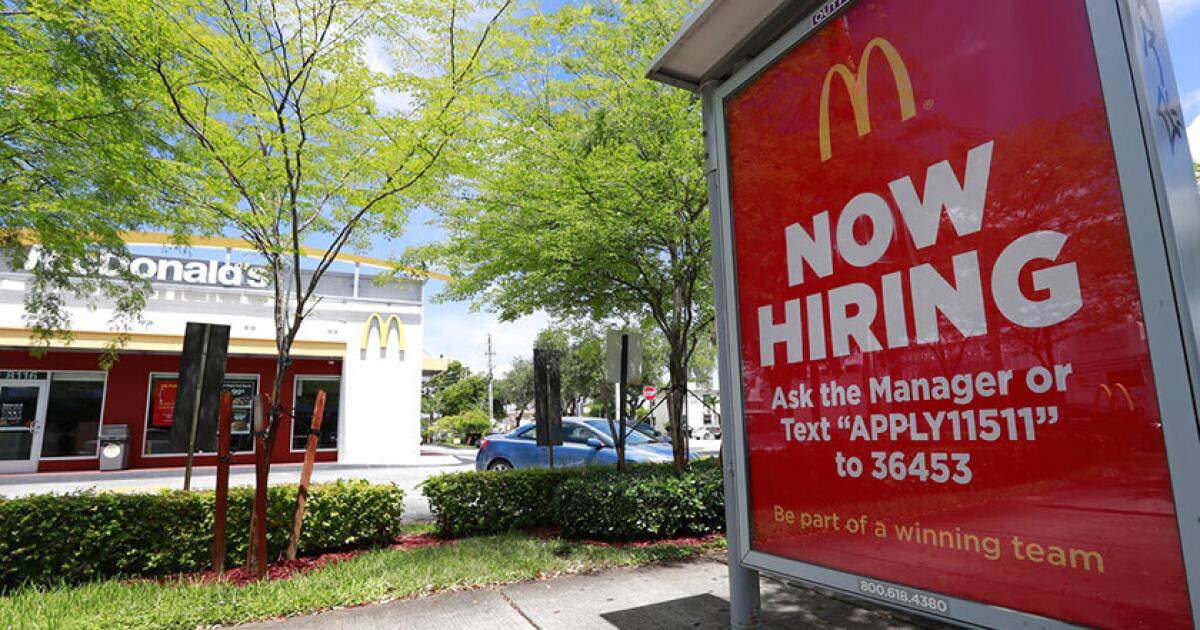
In recent years, the principal target of joint-employer cases at the NLRB has been McDonald’s. That’s unsurprising, since with more than $119 billion in overall international sales it’s the largest franchisor in the world.
The Obama-era NLRB brought a massive case against the company and 29 franchisees in 2014, which turned into what was regarded as the biggest case the board ever instituted, and the longest. The main issue was whether the company had participated in — in fact, helped to run — a nationwide attack on the Fight for $15 union campaign for a higher minimum wage at its restaurants.
Then-NLRB general counsel Richard Griffin alleged at the outset that the franchisees fired, suspended, cut work hours, threatened, spied on and interrogated employees involved in the union campaign, all of which he interpreted as illegal responses to union organizing.
Administrative Law Judge Lauren Esposito cited evidence that the anti-union response was “formulated and implemented” from McDonald’s headquarters in Chicago and that the company provided franchisees with “suggested policies” and legal training in labor relations — so much so that the company was properly regarded as the franchise workers’ joint employer.
By the time Esposito prepared to rule, Trump was president. He replaced Griffin with Peter Robb, whose record as an anti-labor lawyer was well nigh unassailable and whose hostility to the joint-employer rule was manifest. Before Esposito could rule, Robb settled the cases against the franchisees by ordering back pay for the workers who were fired or had their hours cut. But the settlements didn’t involve McDonald’s Corp., which therefore skated on the joint-employer issue.
Esposito rejected the settlements, but she was overruled by the NLRB’s new, Republican majority. The sole dissent came from Lauren McFerran, an Obama appointee who was the only Democrat then on the board.
“A finding of joint-employer status,” she wrote, “would have important collateral consequences for McDonald’s, in both unfair labor practice proceedings involving its franchisees and … if workers employed at McDonald’s franchisees sought to organize (that is, unionize).”
In other words, the Trump NLRB moved heaven and earth to keep McDonald’s from being declared a joint employer.
McFerran is now chair of the NLRB, presiding over a 3-1 Democratic majority. (One seat on the five-member board is vacant.)
The NLRB’s joint-employer rule would bring millions of workers — typically low-wage workers without health or retirement benefits and virtually no job security — under the umbrella of their well-heeled ultimate employers. It’s possible, if not certain, that they would see an improvement in their working lives, through better wages and more opportunity to unionize.
Even big franchisees or labor brokers don’t have to care about their public image — most customers don’t even know they exist. But McDonald’s, Marriott, Walmart and Amazon have a lot to lose in public esteem by getting tagged as an abuser of workers.
If the NLRB had its way, they would no longer be getting away with shedding their responsibilities. Let’s hope that Judge Barker’s ruling is a temporary obstacle to making the world work better.



Welcome to the age of AI hacking, in which the right prompts make amateurs into master hackers.
A group of cybercriminals recently used off-the-shelf artificial intelligence chatbots to steal data on nearly 200 million taxpayers. The bots provided the code and ready-to-execute plans to bypass firewalls.
Although they were explicitly programmed to refuse to help hackers, the bots were duped into abetting the cybercrime.
According to a recent report from Israeli cybersecurity firm Gambit Security, hackers last month used Claude, the chatbot from Anthropic, to steal 150 gigabytes of data from Mexican government agencies.
Claude initially refused to cooperate with the hacking attempts and even denied requests to cover the hackers’ digital tracks, the experts who discovered the breach said. The group pummelled the bot with more than 1,000 prompts to bypass the safeguards and convince Claude they were allowed to test the system for vulnerabilities.
AI companies have been trying to create unbreakable chains on their AI models to restrain them from helping do things such as generating child sexual content or aiding in sourcing and creating weapons. They hire entire teams to try to break their own chatbots before someone else does.
But in this case, hackers continuously prompted Claude in creative ways and were able to “jailbreak” the chatbot to assist them. When they encountered problems with Claude, the hackers used OpenAI’s ChatGPT for data analysis and to learn which credentials were required to move through the system undetected.
The group used AI to find and exploit vulnerabilities, bypass defences, create backdoors and analyze data along the way to gain control of the systems before they stole 195 million identities from nine Mexican government systems, including tax records, vehicle registration as well as birth and property details.
AI “doesn’t sleep,” Curtis Simpson, chief executive of Gambit Security, said in a blog post. “It collapses the cost of sophistication to near zero.”
“No amount of prevention investment would have made this attack impossible,” he said.
Anthropic did not respond to a request for comment. It told Bloomberg that it had banned the accounts involved and disrupted their activity after an investigation.
OpenAI said it is aware of the attack campaign carried out using Anthropic’s models against the Mexican government agencies.
“We also identified other attempts by the adversary to use our models for activities that violate our usage policies; our models refused to comply with these attempts,” an OpenAI spokesperson said in a statement. “We have banned the accounts used by this adversary and value the outreach from Gambit Security.”
Instances of generative AI-assisted hacking are on the rise, and the threat of cyberattacks from bots acting on their own is no longer science fiction. With AI doing their bidding, novices can cause damage in moments, while experienced hackers can launch many more sophisticated attacks with much less effort.
Earlier this year, Amazon discovered that a low-skilled hacker used commercially available AI to breach 600 firewalls. Another took control of thousands of DJI robot vacuums with help from Claude, and was able to access live video feed, audio and floor plans of strangers.
“The kinds of things we’re seeing today are only the early signs of the kinds of things that AIs will be able to do in a few years,” said Nikola Jurkovic, an expert working on reducing risks from advanced AI. “So we need to urgently prepare.”
Late last year, Anthropic warned that society has reached an “inflection point” in AI use in cybersecurity after disrupting what the company said was a Chinese state-sponsored espionage campaign that used Claude to infiltrate 30 global targets, including financial institutions and government agencies.
Generative AI also has been used to extort companies, create realistic online profiles by North Korean operatives to secure jobs in U.S. Fortune 500 companies, run romance scams and operate a network of Russian propaganda accounts.
Over the last few years, AI models have gone from being able to manage tasks lasting only a few seconds to today’s AI agents working autonomously for many hours. AI’s capability to complete long tasks is doubling every seven months.
“We just don’t actually know what is the upper limit of AI’s capability, because no one’s made benchmarks that are difficult enough so the AI can’t do them,” said Jurkovic, who works at METR, a nonprofit that measures AI system capabilities to cause catastrophic harm to society.
So far, the most common use of AI for hacking has been social engineering. Large language models are used to write convincing emails to dupe people out of their money, causing an eight-fold increase in complaints from older Americans as they lost $4.9 billion in online fraud in 2025.
“The messages used to elicit a click from the target can now be generated on a per-user basis more efficiently and with fewer tell-tale signs of phishing,” such as grammatical and spelling errors, said Cliff Neuman, an associate professor of computer science at USC.
AI companies have been responding using AI to detect attacks, audit code and patch vulnerabilities.
“Ultimately, the big imbalance stems from the need of the good-actors to be secure all the time, and of the bad-actors to be right only once,” Neuman said.
The stakes around AI are rising as it infiltrates every aspect of the economy. Many are concerned that there is insufficient understanding of how to ensure it cannot be misused by bad actors or nudged to go rogue.
Even those at the top of the industry have warned users about the potential misuse of AI.
Dario Amodei, the CEO of Anthropic, has long advocated that the AI systems being built are unpredictable and difficult to control. These AIs have shown behaviors as varied as deception and blackmail, to scheming and cheating by hacking software.
Still, major AI companies — OpenAI, Anthropic, xAI, and Google — signed contracts with the U.S. government to use their AIs in military operations.
This last week, the Pentagon directed federal agencies to phase out Claude after the company refused to back down on its demand that it wouldn’t allow its AI to be used for mass domestic surveillance and fully autonomous weapons.
“The AI systems of today are nowhere near reliable enough to make fully autonomous weapons,” Amodei told CBS News.

The iPic dine-in movie theater chain has filed for Chapter 11 bankruptcy protection and intends to pursue a sale of its assets, citing the difficult post-pandemic theatrical market.
The Boca Raton, Fla.-based company has 13 locations across the U.S., including in Pasadena and Westwood, according to a Feb. 25 filing in U.S. Bankruptcy Court in the Southern District of Florida, West Palm Beach division.
As part of the bankruptcy process, the Pasadena and Westwood theaters will be permanently closed, according to WARN Act notices filed with the state of California’s Employment Development Department.
The company came to its conclusion after “exploring a range of possible alternatives,” iPic Chief Executive Patrick Quinn said in a statement.
“We are committed to continuing our business operations with minimal impact throughout the process and will endeavor to serve our customers with the high standard of care they have come to expect from us,” he said.
The company will keep its current management to maintain day-to-day operations while it goes through the bankruptcy process, iPic said in the statement. The last day of employment for workers in its Pasadena and Westwood locations is April 28, according to a state WARN Act notice. The chain has 1,300 full- and part-time employees, with 193 workers in California.
The theatrical business, including the exhibition industry, still has not recovered from the pandemic’s effect on consumer behavior. Last year, overall box office revenue in the U.S. and Canada totaled about $8.8 billion, up just 1.6% compared with 2024. Even more troubling is that industry revenue in 2025 was down 22.1% compared with pre-pandemic 2019’s totals.
IPic noted those trends in its bankruptcy filing, describing the changes in consumer behavior as “lasting” and blaming the rise of streaming for “fundamentally” altering the movie theater business.
“These industry shifts have directly reduced box office revenues and related ancillary revenues, including food and beverage sales,” the company stated in its bankruptcy filing.
IPic also attributed its decision to rising rents and labor costs.
The company estimated it owed about $141,000 in taxes and about $2.7 million in total unsecured claims. The company’s assets were valued at about $155.3 million, the majority of which coming from theater equipment and furniture. Its liabilities totaled $113.9 million.
The chain had previously filed for bankruptcy protection in 2019.

In an expansion of its business of processing pharmaceuticals in Earth’s orbit, Varda Space Industries is renting a large El Segundo plant where toy manufacturer Mattel used to design Hot Wheels and Barbie dolls.
The plant in El Segundo’s aerospace corridor will be an extension of Varda Space Industries’ headquarters in a much smaller building on nearby Aviation Boulevard.
Varda will occupy a 205,443-square-foot industrial and office campus at 2031 E. Mariposa Ave., which will give it additional capacity to manufacture spacecraft at scale, the company said.
Originally built in the 1940s as an aircraft facility, the complex has a history as part of aerospace and defense industries that have long shaped the South Bay and is near a host of major defense and space contractors. It is also close to Los Angeles Air Force Base, headquarters to the Space Systems Command.
Workers test AstroForge’s Odin asteroid probe, which was lost in space after launch this year.
(Varda Space Industries)
Varda is one of a new generation of aerospace startups that have flourished in Southern California and the South Bay over the last several years, particularly in El Segundo, often with ties to SpaceX.
Elon Musk’s company, founded in 2002 in El Segundo, has revolutionized the industry with reusable rockets that have radically lowered the cost of lifting payloads into space. Though it has moved its headquarters to Texas, SpaceX retains large-scale operations in Hawthorne.
Varda co-founder and Chief Executive Will Bruey is a former SpaceX avionics engineer, and the company’s spacecraft are launched on SpaceX’s workhorse Falcon 9 rockets from Vandenberg Space Force Base in Santa Barbara County.
Varda makes automated labs that look like cylindrical desktop speakers, which it sends into orbit in capsules and satellite platforms it also builds. There, in microgravity, the miniature labs grow molecular crystals that are purer than those produced in Earth’s gravity for use in pharmaceuticals.
It has contracts with drug companies and also the military, which tests technology at hypersonic speeds as the capsules return to Earth.
Its fifth capsule was launched in November and returned to Earth in late January; its next mission is set in the coming weeks. Varda has more than 10 missions scheduled on Falcon 9s through 2028.
For the last several decades, the Mariposa Avenue property served as the research and development center for Mattel Toys. El Segundo has also long been a center for the toy industry as companies like to set up shop in the shadow of Mattel.
The Mattel facility “has always been an exceptional property with a legacy tied to aerospace innovation, and leasing to Varda Space Industries feels like a natural continuation of that story,” said Michael Woods, a partner at GPI Cos., which owns the property.
“We are proud to support a company that is genuinely pushing the boundaries of what’s possible, and are excited to watch Varda grow and thrive here in El Segundo,” Woods said.
As one of the country’s most active hubs of aerospace and defense innovation, El Segundo has seen its industrial property vacancy fall to 3.4% on demand from space companies, government contractors and technology startups, real estate brokerage CBRE said.
Successful startups often have to leave the neighborhood when they want to expand, real estate broker Bob Haley of CBRE said. The 9-acre Mattel facility was big enough to keep Varda in the city.
Last year, Varda subleased about 55,000 square feet of lab space from alternative protein company Beyond Meat at 888 Douglas St. in El Segundo, which it started moving into in June.
Varda will get the keys to its new building in December and spend four to eight months building production and assembly facilities as it ramps up operations. By the end of next year, it expects to have constructed 10 more spacecraft.
In the future, Varda could consolidate offices there, given its size. Currently, though, the plan is to retain all properties, creating a campus of three buildings within a mile of one another that are served by the company’s transportation services, Chief Operating Officer Jonathan Barr said.
“We already have Varda-branded shuttles running up and down Aviation Boulevard,” he said.

Britney Spears Open to Treatment Plan as Team Weighs Options

Anxiety grows among California Democrats as gubernatorial candidates rebuff calls to drop out

Owners of fire-destroyed Palisades mobile home park seek to displace residents for development deal

Fatigue a factor as early matches begin at Indian Wells
Fact check: Did French border guards mock influencers returning from Dubai amid Iran war?

Florida High School Football Rankings: Top 25 teams – Oct. 21

Cleary's 21 help Le Moyne down Central Connecticut State 69-64 in OT

How old is Bo Nix? What to know about Oregon quarterback ahead of 2024 NFL Draft

99th annual Pony Swim held in Virginia

Indiana Members Credit Union announced as new anchor tenant at Bottleworks District
Fact check: Did French border guards mock influencers returning from Dubai amid Iran war?

Iran’s fight for survival / The widening war / Trump’s nebulous goals : Sources & Methods

Map: 4.9-Magnitude Earthquake Shakes Louisiana

Paxton vows he’s ‘staying in this race’ even if Trump backs Cornyn in Texas GOP clash

Which Kurdish groups is the US rallying to fight Iran?
-

 World1 week ago
Exclusive: DeepSeek withholds latest AI model from US chipmakers including Nvidia, sources say
-

 Wisconsin4 days ago
Setting sail on iceboats across a frozen lake in Wisconsin
-

 Massachusetts1 week ago
Mother and daughter injured in Taunton house explosion
-

 Maryland5 days ago
AM showers Sunday in Maryland
-

 Massachusetts3 days ago
Massachusetts man awaits word from family in Iran after attacks
-

 Florida5 days ago
Florida man rescued after being stuck in shoulder-deep mud for days
-

 Denver, CO1 week ago
10 acres charred, 5 injured in Thornton grass fire, evacuation orders lifted
-

 Oregon6 days ago
2026 OSAA Oregon Wrestling State Championship Results And Brackets – FloWrestling