Business
Can Trump and Musk Convince More Conservatives to Buy Teslas?


After climbing into a Tesla Model S last week, President Trump pledged to buy one. The next day, the Fox News host Sean Hannity said he had bought a Model S Plaid to support the embattled company, saying a Tesla “has more American parts in it than any other car made in our country.”
In a backlash to the backlash against the tactics of Elon Musk’s Department of Government Efficiency, prominent conservatives are rallying to the side of the electric car company led by Mr. Musk. They are hoping to swing enough like-minded consumers to offset a boycott of the electric automaker by liberals and Democrats or anyone offended by Mr. Musk’s actions.
But how effective can such a rescue mission be? Analysts say it can help but only to an extent.
So many Democratic buyers appear to be fleeing Tesla that even Mr. Trump’s best sales pitch is unlikely to woo enough new customers to fill the vacuum, auto experts said. Analysts at JPMorgan predict Tesla will deliver its fewest cars in the first quarter than it had in three years.
“When you make your product unattractive to half the market, I promise you, you won’t increase your sales,” said Alexander Edwards, president of Strategic Vision, an automotive research and consulting firm.
Mr. Edwards has been surveying car buyers for decades. Since 2016, the surveys have found that electric-car owners were up to four times as likely to identify as Democrats or liberals as to identify as Republican or conservative. Among Tesla owners, the spread was consistently two to one.
The gap narrowed sharply through 2024. This year, as sales have fallen, slightly more Tesla buyers identify as Republicans than Democrats, at 30 percent versus 29 percent.
“Democrats are fleeing the brand and saying they won’t consider it in the future, so there is naturally a greater proportion of Republican and independent buyers,” Mr. Edwards said.
He said Democrats first started losing interest in Tesla when Mr. Musk bought Twitter, now X, in 2022. Then, last July, when Mr. Musk publicly backed Mr. Trump, the share of Democrats who said they would “definitely consider” a Tesla fell by half.
Overall, about 8 percent of car owners would now definitely consider a Tesla, according to Mr. Edwards’s surveys. That compares with 22 percent five years ago, when Tesla often topped rankings of luxury brands that buyers would consider.
Tesla’s slipping sales, he said, “are mostly, if not completely, attributed to the statements and behavior of Elon Musk.”
The automaker did not respond to a request for comment.
Tesla remains America’s best-selling electric vehicle brand by far with about 44 percent of the market, despite a 5.6 percent drop in U.S. sales, to about 634,000 cars in 2024, according to Kelley Blue Book. Many drivers are determined to stick with the electric vehicle pioneer, whose cars can travel several hundred miles on a charge and can be easily refueled at the company’s extensive charging network.
Josh Anders, 44, traded a gasoline-powered sport utility vehicle for a Tesla Model 3 in 2019. A resident of Fort Wayne, Ind., he was blown away by the car’s energy efficiency, technology and limited maintenance needs. He soon traded for another, and is about to take delivery of the latest Model Y S.U.V.
“Owning a Tesla was one of the best decisions I ever made, and I’m sticking by it,” Mr. Anders said. “I would love a Rivian R1S, but I can’t afford it. I’m a tech guy, and I love all the features and innovations.”
Mr. Anders, a father of four and creative director of a Christian nonprofit music and arts organization, said he leans conservative, and is uncomfortable with boycotts.
“Elon’s not perfect, and Tesla’s not perfect, but it’s a community of dreamers and doers. I appreciate a brand that’s constantly pushing the boundaries,” he said. “I don’t need every company to share my beliefs. I just need them to share a commitment to progress.”
Still, cars have a long history of becoming part of the political fray.
The Chevrolet Volt, a plug-in hybrid introduced in 2011 after General Motors received federal government assistance, was derided by some conservatives as the “Obamacar.” The fuel-sipping Toyota Prius and the gas-guzzling Hummer from G.M. were often lauded and attacked by people on opposite ends of the political spectrum.
Isaac Seliger, a business owner and grant writer in Scottsdale, Ariz., said he’d had little interest in electric vehicles even though his son, who died recently, was a devoted fan of Tesla.
Now, said Mr. Seliger, who described himself as politically independent, he is determined to buy a Tesla, because he wants to defy groupthink and polarization. A friend told him that she would stop speaking to him if he did.
“As a former lefty and antiwar guy, this all makes me want to buy a Tesla more,” Mr. Seliger, 73, said. “I’ll absolutely be making a political statement. But if I bought a Porsche Macan, that’s a statement, too, where people pigeonhole you as an obnoxious older Porsche driver.”
Mr. Seliger added that he found criticisms of Mr. Musk overblown.
“So Elon was a hero of the left, and now he’s a Nazi? That’s just crazy,” he said. “He strikes me as a smart guy who makes great stuff.”
To many people who have faith in Tesla and Mr. Musk, the company’s sales and stock price, which is down about 48 percent from a December high, will eventually recover. The stock was up 12 percent over the last four days of trading.
But some automotive experts say Tesla may struggle because the company has not regularly updated its cars or introduced new models. In addition, the company’s chargers, which once could be used only by Teslas, are opening access to nearly every major competitor, said Loren McDonald, chief analyst at Paren, an electric vehicle charging data firm. And other automakers are offering new electric models, often with notably affordable monthly payments.
“He’s rapidly losing the advantages in range, tech, value and convenience that drove people to Tesla,” Mr. McDonald said. “For a lot of people, it’s time to move on and try something new.”
Of course, most buyers don’t choose cars based on politics. But a brand’s image matters. Tesla sales slipped even as overall U.S. electric vehicle sales grew 7.3 percent in 2024, to 1.3 million. Mr. Edwards said Mr. Musk was making it too easy for people to shop elsewhere.
“People can love their Hyundai, G.M., Rivian or BMW just as much,” he said.
Republicans certainly buy electric cars, but fewer of them have made the plunge to fully electric models. Rural states, where Republicans outnumber Democrats, have fewer chargers than more urban states. Strategic Vision data shows Republicans are more likely to work outside the home, and are less willing to put up with inconveniences like long charging stops. And a 2024 Pew Research Center survey found that more Republicans than Democrats say electric vehicles cost too much and are less reliable than gasoline cars.
In the New York metropolitan area, the nation’s largest car market, new Tesla registrations fell 13 percent, to 47,000 cars, in 2024, according to S&P Global Mobility. That same year, more than 101,000 people registered a Tesla in Los Angeles, the second-largest market, a drop of 8 percent. Still, nearly one in eight new cars in Los Angeles was a Tesla. In the San Francisco Bay Area, where Tesla was founded, nearly one in five new cars was a Tesla. But sales tumbled 17 percent to 54,000 cars.
Consumers in the Houston area bought 12,000 Teslas. But Bay Area residents bought 4.5 times as many Teslas, in a smaller market for new cars overall. Some areas saw big increases, including Miami-Fort Lauderdale where sales jumped 32 percent, to nearly 23,000 cars, in 2024. Tesla sales also rose sharply in Salt Lake City, Las Vegas and St. Louis. But the company’s gains in these places could not offset steeper declines in larger, more liberal metro areas.
Experts say wealthy conservatives such as Mr. Hannity and Mr. Trump have the disposable income to make a personal automotive statement by opting for a Tesla. But they may not be able to persuade Americans of more modest means.
Mr. McDonald also noted that Mr. Trump and other conservatives had spent years vilifying electric cars, mocking climate change and criticizing former President Joseph R. Biden Jr.’s climate and auto policies.
“The messaging is inconsistent,” Mr. McDonald said. “Is the guy in Arkansas who drives a Ram pickup going to buy a Tesla now? How far can you go against your own beliefs to support Elon Musk?”



A landmarked downtown Los Angeles apartment building designed by famed Los Angeles architect John Parkinson is on the market as its owners face foreclosure.
Residences in the Metropolitan, a 10-story tower built in 1913, are nearly filled with tenants but its ground floor retail spaces on Broadway and 5th Street are unoccupied, as are other street-level stores in downtown’s Historic Core.
The historic building was once considered one of the best in the city and is owned by the Fallas family, which operated a chain of value-priced clothing stores based in Gardena including one called Fallas Paredes in the Metropolitan.
Fallas-Paredes at 449 S. Broadway, Los Angeles, CA 90013.
(Google Maps)
Around 2011, Michael Fallas, who once worked in family’s downtown store as a stock boy, converted the upstairs floors from offices to apartments while continuing to operate Fallas Paredes. The store closed more than five years ago in the wake of a 2018 filing by its parent company for Chapter 11 bankruptcy protection.
Earlier this month in state Superior Court, a special servicer representing Fallas’ lender asked for a judicial foreclosure of the property, alleging that Fallas had stopped making payments on a $32 million loan dating to 2017. After leasing the property for years, Fallas bought the building in the 1990s.
Fallas didn’t respond to requests for comment.
The location of the Metropolitan where the buildings stands was hailed in a Times story in 1912, saying “it is regarded by many realty men as the most valuable piece of real estate in Los Angeles.”
The building today is recognized as a city historic-cultural monument because “Broadway became the commercial center of the Southland, a title it retained until well after World War II,” with its development, the city said. One of the architects who designed the Metropolitan in the Beaux-Arts style was John Parkinson, who is credited with designing such well-known local structures as City Hall, the Los Angeles Memorial Coliseum and Union Station.
Notable tenants in the Metropolitan have included the Los Angeles Public Library, Owl Drug Co., variety store J.J. Newberry and real estate company Janns Investment Co., which sold the land where UCLA is built and developed Westwood Village, among other Los Angeles neighborhoods.
In recent years, the buildings around the Metropolitan have struggled to keep retail tenants after a spurt of residential conversions of historic buildings starting in the early 2000s brought commerce to the neighborhood. Many downtown businesses have struggled since the pandemic reduced occupancy in offices downtown and reduced the flow of visitors.
“The lack of bodies on the street is generally hurting downtown, and that’s one of the reasons that has building has problems,” said downtown real estate broker Hal Bastian, who lives in the Historic Core.
There are close to 1,000 residential units in historic buildings at the intersection of Broadway and 5th Street, Bastian said, but all the ground floor stores are closed. Drug stores there suffered substantial losses from shoplifting he said, and now, “our challenge on Broadway is leasing.”
The 88 apartments in the Metropolitan are 91% rented, according to a listing for the property by the Zacuto Group, which also touts its roof deck with pool, fitness center and barbecue grills. No sale price is set.
Business
January 2025 wildfire victims seek tougher penalties against State Farm over claims handling
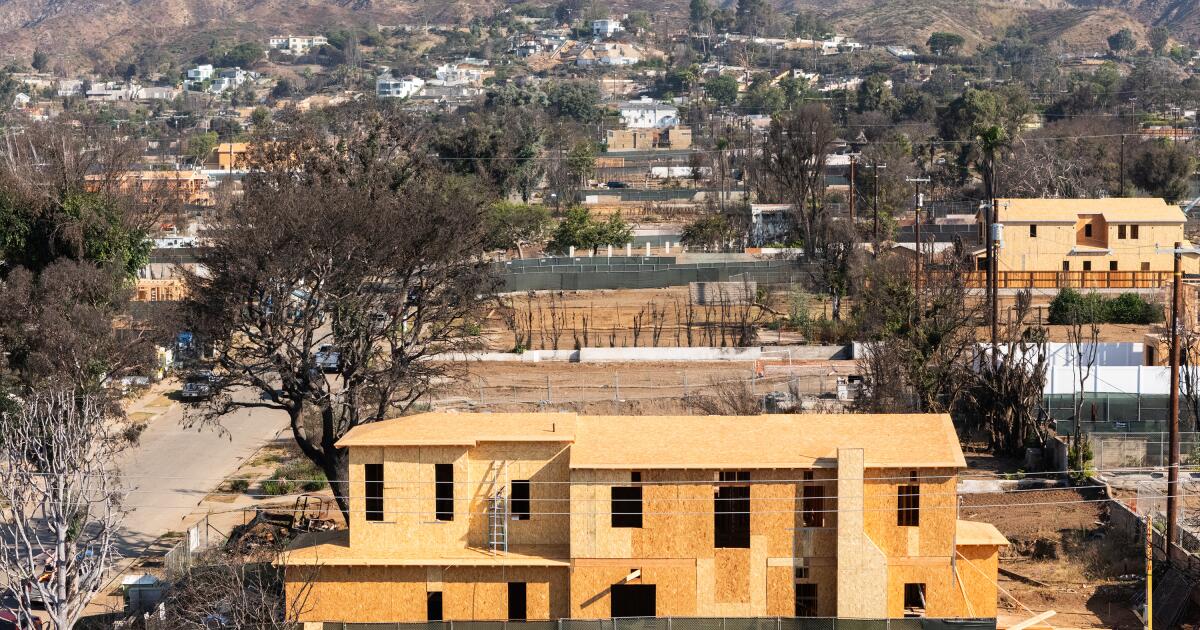
A fire survivors’ group announced Thursday it was seeking tougher penalties against State Farm over its handling of January 2025 wildfire claims.
The Every Fire Survivor’s Network said it was petitioning to join a state enforcement action announced this year against the company to make sure the case results in meaningful changes at California’s largest home insurer.
“We’re seeking a systematic review of all their claims and penalties calibrated to the actual scale of the harm — and we’re seeking the payouts that families are owed,” said Joy Chen, executive director of the group, at a Pacific Palisades news conference joined by victims of the fires.
The Department of Insurance in May filed an administrative action against State Farm General — the subsidiary of the giant Bloomington, Ill., insurer that handles California home insurance — after completing a “market conduct” exam.
The Jan. 7, 2025, fire damaged or destroyed more than 18,000 structures and killed 31 people.
State Farm has received more January 2025 claims than any other insurer — more than 13,700 auto and homeowners claims as of May 4, with payouts totaling $5.7 billion, according to the company.
The market conduct exam looked at 220 sample claims filed by the victims and found 398 violations of state law in about half of them.
Among other alleged violations, it found that the company failed in numerous cases to pursue a “thorough, fair and objective investigation” into claims, failed to come to “prompt, fair, and equitable settlements” and made settlement offers that were “unreasonably low.”
In announcing the action, Insurance Commissioner Ricardo Lara called the company’s claims handling “unacceptable” and said his department was taking “decisive action to hold them accountable.”
The state is seeking a “cease and desist” order to stop the insurer from engaging in unfair or deceptive practices.
It also has threatened to suspend State Farm’s license over the alleged violations, which each carry a penalty of up to $5,000 — or twice that figure if found to be willful. That could amount to a penalty of $2 million or more.
The threat to actually suspend State Farm’s license and its authority to write policies has been viewed skeptically by some, given its roughly 20% market share of the state’s home insurance market.
The company, which had an opportunity to include its responses in the exam report, denied fault in some cases and admitted fault in others. It often blamed problems on individual adjusters and denied systemic issues with its claims handling.
The petition filed by the wildfire survivor’s group criticizes the sample size of the market conduct exam as too small to capture all the alleged deficiencies in State Farm’s claims handling, which it claims are a “general business practice” of the company.
The group is seeking to conduct discovery, cross examine witnesses, present testimony from fire victims and bring more that 1,600 firsthand policyholder statements regarding State Farm’s practices into evidence, according to the petition.
It also wants State Farm to reopen cases in which claimants were paid too little, and it is seeking to participate in settlement discussions in order to increase any penalty State Farm would pay.
It calculated that a $2-million penalty would amount to a minute fraction of the assets of the State Farm Group.
“I submit to you that doesn’t defer bad conduct, it just allows you to continue to do it,” said Michelle Meyers, an attorney for Every Fire Survivor’s Network, at the news conference.
Consumer Watchdog, which has been a harsh critic of State Farm, also is providing legal support for victims’ effort.
Sevag Sarkissian, a spokesperson for State Farm, said the company was aware of the petition.
“We recognize that many wildfire survivors, including those that are State Farm General policyholders, continue to face difficult recovery challenges,” he said. “Our focus remains on helping customers recover.”
Michael Soller, a spokesperson for Lara, said the department is “acting with urgency to assist wildfire survivors in their ongoing recovery by investigating formal complaints filed by survivors and conducting the expedited market conduct exam that led to this enforcement action.”
He added that the department’s position is the state’s Administrative Procedure Act does not contemplate the commissioner or department staff authorizing intervention requests in the case.
He said that would be a hearing officer’s or administrative law judge’s decision when one is assigned to the case.
Meyers acknowledged the request was novel but said her reading of the law is that Lara can make the decision because no judge is yet assigned.
In response to the criticism, State Farm pledged earlier this year to improve its claims handling, including by providing single points of contact and improved communication so there are “fewer handoffs, fewer repeated explanations, and seamless support.”
It also named a new vice president of customer relations for State Farm General.

The state’s trial attorneys and Uber say they have reached a last-minute deal to scrap their dueling ballot measures and avert what was gearing up to be one of most expensive battles of the November election.
The deal, which comes a day after both measures qualified for the November ballot, has Uber agreeing to bulk up safety measures, while the trial attorneys will limit how much they can claim for lien-based medical treatment of victims who get in Uber or Lyft accidents, according to spokespeople for both sides of the campaign.
“Both sides agree: Californians deserve a system that’s safe, fair, and accountable,” read a joint statement from Uber and the Consumer Attorneys of California, a powerful attorney trade group. “This agreement protects patients from unnecessary treatment or getting overcharged, ensures access to medical care and legal representation, and strengthens safety measures.”
The agreement, finalized Thursday, means the ride-share giant will kill its ballot measure to cap how much attorneys can earn in vehicle collision cases and limit medical damages to rates based on insurance. Uber has argued that the costs for medical treatment done on a lien, which allows doctors to get paid from a cut of the plaintiff’s payout, far exceed what it would cost if the victim had used their own insurance.
In return, the Consumer Attorneys of California will cancel its competing ballot measure that sought to increase legal liability for ride-share companies if a passenger is sexually assaulted by a driver. The measure followed an investigation by the New York Times into sexual assault by drivers.
Both sides had poured tens of millions into the campaigns, plastering billboards across Los Angeles.
Lawyers claimed the fight had turned existential with the measure threatening to decimate the profit margin of many personal injury cases and leave drivers with small or thorny cases unable to find an attorney willing to take their case.
Spokespeople say the deal is predicated on their agreement being codified into a bill within the next week. Otherwise, they said, each side will move forward with its ballot measure.
-

 Missouri2 minutes ago
10 pounds of meth found during I-70 traffic stop, Callaway County Sheriff’s Office says
-

 Montana3 minutes ago
Montana State doctoral student awarded national research service grant for gut microbiome, arsenic research
-

 Nebraska10 minutes ago
Underground Railroad site reopens after 7-year closure in Nebraska City
-

 Nevada17 minutes ago
Caltech readies to build world’s most sensitive radio telescope in Nevada
-

 New Hampshire20 minutes ago
Transgender former New Hampshire state representative sentenced to 33 years for child sex abuse: report
-

 New Jersey25 minutes ago
Yellowcard Brings Ocean Avenue to New Jersey’s Own Ocean Avenue
-

 New Mexico32 minutes ago
Edgewood and Santa Fe County finalize agreement to keep emergency services going
-

 North Carolina35 minutes ago
‘Infuriating, heartbreaking’: Raccoon recovering after getting caught in leg trap at Mecklenburg County park

