Business
‘Call a Republican’: Viral phone booth connects California liberals, conservative Texans


A rather peculiar red phone booth appeared outside a San Francisco tattoo parlor this week, urging residents in one of America’s most liberal cities to “call a Republican.”
Its counterpart, a blue phone booth, sits outside a bookshop in the staunchly conservative town of Abilene, Texas, where it encourages locals to “call a Democrat.”
Together, the phone booths form a social experiment: When someone picks up the line in San Francisco, it rings in Texas, and vice versa, cultivating a unique opportunity for passersby to chat with a stranger who holds a vastly different outlook on politics and life.
The initiative, dubbed the Party Line project, is the brainchild of Matter Neuroscience, a mental health startup focused on researching the science behind happiness and creating tools to battle major depressive disorders.
The “Call a Democrat” pay phone sits outside of Seven and One Books in Abilene, Texas.
(Logan Ivey / Matter Neuroscience)
Neuroscientists know that fighting with people who hold different views leads to the release of cortisol in the brain, which increases stress, Matter co-founder Ben Goldhirsh explained. On the other hand, engaging in non-hateful, human-to-human conversation activates happiness-boosting neurotransmitters such as dopamine and cannabinoids, he said.
“We wanted to see what would happen when people had the chance to connect with people directly — would they choose to argue and fight, or would they choose to find common ground?” Goldhirsh said. “[Would they choose] the release of cortisol or the release of cannabinoids?”
Much to researchers’ delight, the vast majority of callers have chosen to seek common ground. The project launched lateSunday afternoon, and by Thursday evening researchers had recorded more than 150 conversations and voicemails.
So far the topics callers have discussed have run the gamut, including hobbies, culture and world events, Goldhirsh said. Many callers are rejecting the dichotomy of Republican and Democratic labels and are finding they have similar concerns about the state of the nation and economy.
In one recording, Steve — a San Francisco man who identifies as a liberal — asks, “Are you a Republican?” to a mother of four in Abilene.
She quickly responds “Yes, I am,” but then a moment later says, “Well, no, hmm, ummm, [I’m] probably an independent I would say as I’ve gotten older.”
Steve then asks her if she sees the world as being as crazy as he does, to which she says, “I do. It’s really worse and worse every day.”
“See? We have so much in common!” he responds.
This type of dialogue doesn’t surprise UCLA political science professor Chris Tausanovitch, who wrote a book on the polarization in American politics.
He said that while people often assume they won’t get along with a member of the opposite political party, the average American holds more moderate political views than their elected representatives.
“A lot of the dislike of the other party arises because we don’t like the public stances of whichever party we’re not aligned with,” he said. “If you’re a Democrat, you associate Republicans with the stances of people like Donald Trump, but it turns out that most people are not as extreme as the stereotype of their political party would suggest.”
Addressing the problem of polarization in politics will require significant effort from both parties, Tausanovitch said, but experiments like the phone booth are a fantastic way to get people talking across the aisle.
“There’s a good feeling from talking to another human and realizing they’re human,” he said, “and you actually can learn that there’s a tendency for people not to be as different as you assume that they are in terms of real policy and beliefs.”
From a mental health expert’s perspective, Goldhirsh said he was not surprised that the majority of the conversations have been positive, inquisitive and often led to heartwarming discoveries of shared interests and experiences.
“People are complex, nuanced individuals,” Goldhirsh said, “and really enjoy engaging as such and do it with a real sort of kindness and curiosity when given that chance.”
In one dialogue shared on Matter Neuroscience’s Instagram, Shane, a correctional officer in Texas, chats with Chris, who works at sandwich shop and DJ studio in San Francisco.
Shane opens up about the good and bad aspects of his job, sharing the horror of watching an inmate be murdered and the fulfillment he recently found chatting with inmates about the Bible.
The pair quickly find common ground — Shane’s brother is called Chris and Chris’ mother lives in San Antonio.
“I love this experiment here,” Shane says at the end of the conversation. “We’re already connected, dude,” Chris adds.
The San Francisco phone booth is set up outside of Black Serum Tattoo studio in the Mission District. Owner Brucius von Xylander said he agreed to let Matter Neuroscience set up the phone outside of his studio because he thought it would be a great medium for people across the political spectrum to engage in civil discourse.
“It seemed like a good idea to me, because it’s fun connecting with a stranger somewhere knowing that they might talk about something that is hard to speak about on social media or elsewhere,” Von Xylander said.
Von Xylander said the response to the phone had been overwhelmingly positive both online and in person.
Meanwhile, some 1,600 miles away in Abilene, the owner of Seven and One Books, Arlene Kasselman, also has been delighted with the response to the phone outside her store.
When she first saw the bright blue phone with the “Call a Democrat” sign, she was a little nervous about how the conversations would go. But so far they have been amazing, she said, as people discuss baking, basketball, politics and more.
From her perspective, the goal is to see what it looks like to “not just be a keyboard warrior in the comments section, but to view people as human.”
“We are certainly biologically more similar than dissimilar,” she added. “So how can we reach across the aisle?”
In our increasingly polarized society, Kasselman said she’s excited to facilitate an experience in which people can have positive interactions with strangers from different backgrounds.
Tausanovitch believes meaningful conversations across party lines, in which people connect over shared interests, can wake voters up to the price they are paying because of our extreme political climate. He said everyone suffers when parties are more focused on winning an election than they are on working together on policies that benefit all Americans.
“This kind of thing can help people see that [polarization] is a race to the bottom and a problem that is worthy of being addressed directly,” he said.
Goldhirsh also is delighted with the initial response and said Matter Neuroscience had been flooded with requests to bring the phone booths to other parts of America. For example, Los Angeles rapper the Game sent a message saying the team should install phones in Bloods and Crips territories, allowing members of the enemy gangs to converse.
“We’re going to continue pushing for dialogue,” Goldhirsh said, “because connecting on common ground is better for happiness than, you know, finding joy in the cortisol of the fight-or-flight experience.”



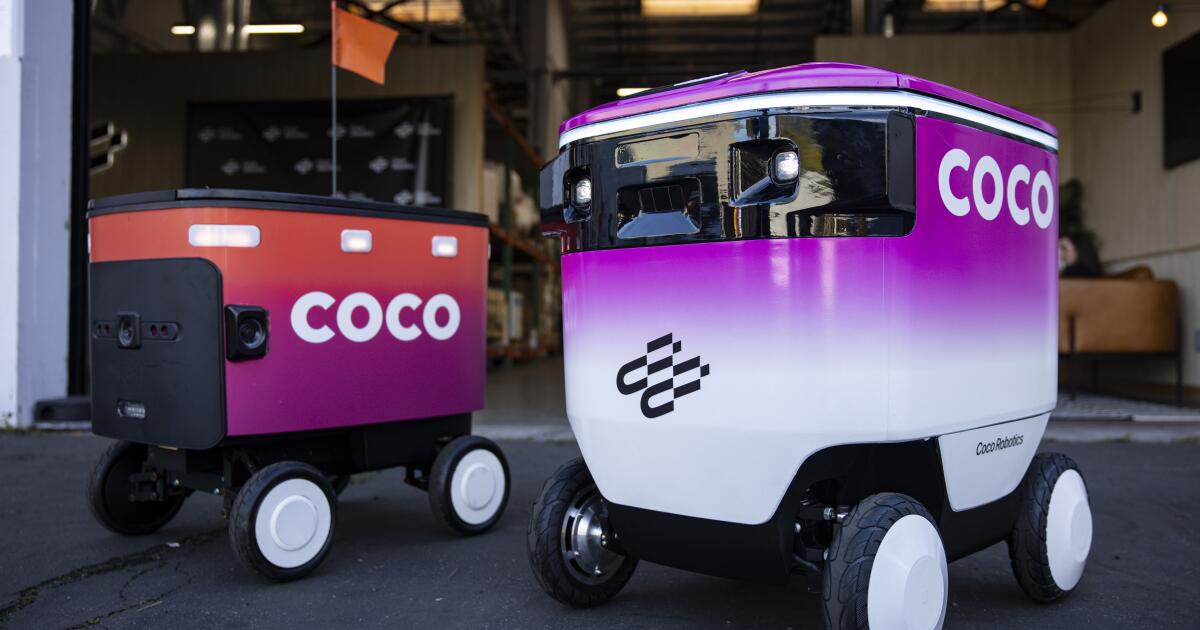
The rolling robots that deliver groceries and hot meals across Los Angeles are getting an upgrade.
Coco Robotics, a UCLA-born startup that’s deployed more than 1,000 bots across the country, unveiled its next-generation machines on Thursday.
The new robots are bigger, tougher and better equipped for autonomy than their predecessors. The company will use them to expand into new markets and increase its presence in Los Angeles, where it makes deliveries through a partnership with DoorDash.
Dubbed Coco 2, the next-gen bots have upgraded cameras and front-facing lidar, a laser-based sensor used in self-driving cars. They will use hardware built by Nvidia, the Santa Clara-based artificial intelligence chip giant.
Coco co-founder and chief executive Zach Rash said Coco 2 will be able to make deliveries even in conditions unsafe for human drivers. The robot is fully submersible in case of flooding and is compatible with special snow tires.
Zach Rash, co-founder and CEO of Coco, opens the top of the new Coco 2 (Next-Gen) at the Coco Robotics headquarters in Venice.
(Kayla Bartkowski/Los Angeles Times)
Early this month, a cute Coco was recorded struggling through flooded roads in L.A.
“She’s doing her best!” said the person recording the video. “She is doing her best, you guys.”
Instagram followers cheered the bot on, with one posting, “Go coco, go,” and others calling for someone to help the robot.
“We want it to have a lot more reliability in the most extreme conditions where it’s either unsafe or uncomfortable for human drivers to be on the road,” Rash said. “Those are the exact times where everyone wants to order.”
The company will ramp up mass production of Coco 2 this summer, Rash said, aiming to produce 1,000 bots each month.
The design is sleek and simple, with a pink-and-white ombré paint job, the company’s name printed in lowercase, and a keypad for loading and unloading the cargo area. The robots have four wheels and a bigger internal compartment for carrying food and goods .
Many of the bots will be used for expansion into new markets across Europe and Asia, but they will also hit the streets in Los Angeles and operate alongside the older Coco bots.
Coco has about 300 bots in Los Angeles already, serving customers from Santa Monica and Venice to Westwood, Mid-City, West Hollywood, Hollywood, Echo Park, Silver Lake, downtown, Koreatown and the USC area.

The new Coco 2 (Next-Gen) drives along the sidewalk at the Coco Robotics headquarters in Venice.
(Kayla Bartkowski/Los Angeles Times)
The company is in discussion with officials in Culver City, Long Beach and Pasadena about bringing autonomous delivery to those communities.
There’s also been demand for the bots in Studio City, Burbank and the San Fernando Valley, according to Rash.
“A lot of the markets that we go into have been telling us they can’t hire enough people to do the deliveries and to continue to grow at the pace that customers want,” Rash said. “There’s quite a lot of area in Los Angeles that we can still cover.”
The bots already operate in Chicago, Miami and Helsinki, Finland. Last month, they arrived in Jersey City, N.J.
Late last year, Coco announced a partnership with DashMart, DoorDash’s delivery-only online store. The partnership allows Coco bots to deliver fresh groceries, electronics and household essentials as well as hot prepared meals.
With the release of Coco 2, the company is eyeing faster deliveries using bike lanes and road shoulders as opposed to just sidewalks, in cities where it’s safe to do so. Coco 2 can adapt more quickly to new environments and physical obstacles, the company said.

Zach Rash, co-founder and CEO of Coco.
(Kayla Bartkowski/Los Angeles Times)
Coco 2 is designed to operate autonomously, but there will still be human oversight in case the robot runs into trouble, Rash said. Damaged sidewalks or unexpected construction can stop a bot in its tracks.
The need for human supervision has created a new field of jobs for Angelenos.
Though there have been reports of pedestrians bullying the robots by knocking them over or blocking their path, Rash said the community response has been overall positive. The bots are meant to inspire affection.
“One of the design principles on the color and the name and a lot of the branding was to feel warm and friendly to people,” Rash said.
Coco plans to add thousands of bots to its fleet this year. The delivery service got its start as a dorm room project in 2020, when Rash was a student at UCLA. He co-founded the company with fellow student Brad Squicciarini.
The Santa Monica-based company has completed more than 500,000 zero-emission deliveries and its bots have collectively traveled around 1 million miles.
Coco chooses neighborhoods to deploy its bots based on density, prioritizing areas with restaurants clustered together and short delivery distances as well as places where parking is difficult.
The robots can relieve congestion by taking cars and motorbikes off the roads. Rash said there is so much demand for delivery services that the company’s bots are not taking jobs from human drivers.
Instead, Coco can fill gaps in the delivery market while saving merchants money and improving the safety of city streets.
“This vehicle is inherently a lot safer for communities than a car,” Rash said. “We believe our vehicles can operate the highest quality of service and we can do it at the lowest price point.”

President Trump on Friday directed federal agencies to stop using technology from San Francisco artificial intelligence company Anthropic, escalating a high-profile clash between the AI startup and the Pentagon over safety.
In a Friday post on the social media site Truth Social, Trump described the company as “radical left” and “woke.”
“We don’t need it, we don’t want it, and will not do business with them again!” Trump said.
The president’s harsh words mark a major escalation in the ongoing battle between some in the Trump administration and several technology companies over the use of artificial intelligence in defense tech.
Anthropic has been sparring with the Pentagon, which had threatened to end its $200-million contract with the company on Friday if it didn’t loosen restrictions on its AI model so it could be used for more military purposes. Anthropic had been asking for more guarantees that its tech wouldn’t be used for surveillance of Americans or autonomous weapons.
The tussle could hobble Anthropic’s business with the government. The Trump administration said the company was added to a sweeping national security blacklist, ordering federal agencies to immediately discontinue use of its products and barring any government contractors from maintaining ties with it.
Defense Secretary Pete Hegseth, who met with Anthropic’s Chief Executive Dario Amodei this week, criticized the tech company after Trump’s Truth Social post.
“Anthropic delivered a master class in arrogance and betrayal as well as a textbook case of how not to do business with the United States Government or the Pentagon,” he wrote Friday on social media site X.
Anthropic didn’t immediately respond to a request for comment.
Anthropic announced a two-year agreement with the Department of Defense in July to “prototype frontier AI capabilities that advance U.S. national security.”
The company has an AI chatbot called Claude, but it also built a custom AI system for U.S. national security customers.
On Thursday, Amodei signaled the company wouldn’t cave to the Department of Defense’s demands to loosen safety restrictions on its AI models.
The government has emphasized in negotiations that it wants to use Anthropic’s technology only for legal purposes, and the safeguards Anthropic wants are already covered by the law.
Still, Amodei was worried about Washington’s commitment.
“We have never raised objections to particular military operations nor attempted to limit use of our technology in an ad hoc manner,” he said in a blog post. “However, in a narrow set of cases, we believe AI can undermine, rather than defend, democratic values.”
Tech workers have backed Anthropic’s stance.
Unions and worker groups representing 700,000 employees at Amazon, Google and Microsoft said this week in a joint statement that they’re urging their employers to reject these demands as well if they have additional contracts with the Pentagon.
“Our employers are already complicit in providing their technologies to power mass atrocities and war crimes; capitulating to the Pentagon’s intimidation will only further implicate our labor in violence and repression,” the statement said.
Anthropic’s standoff with the U.S. government could benefit its competitors, such as Elon Musk’s xAI or OpenAI.
Sam Altman, chief executive of OpenAI, the company behind ChatGPT and one of Anthropic’s biggest competitors, told CNBC in an interview that he trusts Anthropic.
“I think they really do care about safety, and I’ve been happy that they’ve been supporting our war fighters,” he said. “I’m not sure where this is going to go.”
Anthropic has distinguished itself from its rivals by touting its concern about AI safety.
The company, valued at roughly $380 billion, is legally required to balance making money with advancing the company’s public benefit of “responsible development and maintenance of advanced AI for the long-term benefit of humanity.”
Developers, businesses, government agencies and other organizations use Anthropic’s tools. Its chatbot can generate code, write text and perform other tasks. Anthropic also offers an AI assistant for consumers and makes money from paid subscriptions as well as contracts. Unlike OpenAI, which is testing ads in ChatGPT, Anthropic has pledged not to show ads in its chatbot Claude.
The company has roughly 2,000 employees and has revenue equivalent to about $14 billion a year.

new video loaded: The Web of Companies Owned by Elon Musk

By Kirsten Grind, Melanie Bencosme, James Surdam and Sean Havey
February 27, 2026

How much exercise is enough? A local doctor says you only need 15 minutes a day – WTOP News

Movie review: Ballet-themed erotic drama ‘Dreams’ dissipates in finale

Takeaways from AP’s report on the ICE detention center holding children and parents

2 Survivors Describe the Terror and Tragedy of the Tahoe Avalanche

‘The Fall and Rise of Reggie Dinkins’ falls before it rises — but then it soars

Florida High School Football Rankings: Top 25 teams – Oct. 21

Cleary's 21 help Le Moyne down Central Connecticut State 69-64 in OT

How old is Bo Nix? What to know about Oregon quarterback ahead of 2024 NFL Draft

99th annual Pony Swim held in Virginia

Indiana Members Credit Union announced as new anchor tenant at Bottleworks District
2 Survivors Describe the Terror and Tragedy of the Tahoe Avalanche

Iran fires missiles at US bases across Middle East after American strikes on nuclear, IRGC sites

Israel strikes two schools in Iran, killing more than 50 people

Anthropic CEO says he’s sticking to AI “red lines” despite clash with Pentagon

ICE blasts Washington mayor over directive restricting immigration enforcement
-

 World3 days ago
Exclusive: DeepSeek withholds latest AI model from US chipmakers including Nvidia, sources say
-

 Massachusetts3 days ago
Mother and daughter injured in Taunton house explosion
-

 Montana1 week ago
2026 MHSA Montana Wrestling State Championship Brackets And Results – FloWrestling
-

 Louisiana5 days ago
Wildfire near Gum Swamp Road in Livingston Parish now under control; more than 200 acres burned
-

 Denver, CO3 days ago
10 acres charred, 5 injured in Thornton grass fire, evacuation orders lifted
-

 Technology1 week ago
YouTube TV billing scam emails are hitting inboxes
-

 Technology1 week ago
Stellantis is in a crisis of its own making
-

 Politics1 week ago
OpenAI didn’t contact police despite employees flagging mass shooter’s concerning chatbot interactions: REPORT