Business
California climbers train for Mt. Everest from the comfort of their own beds

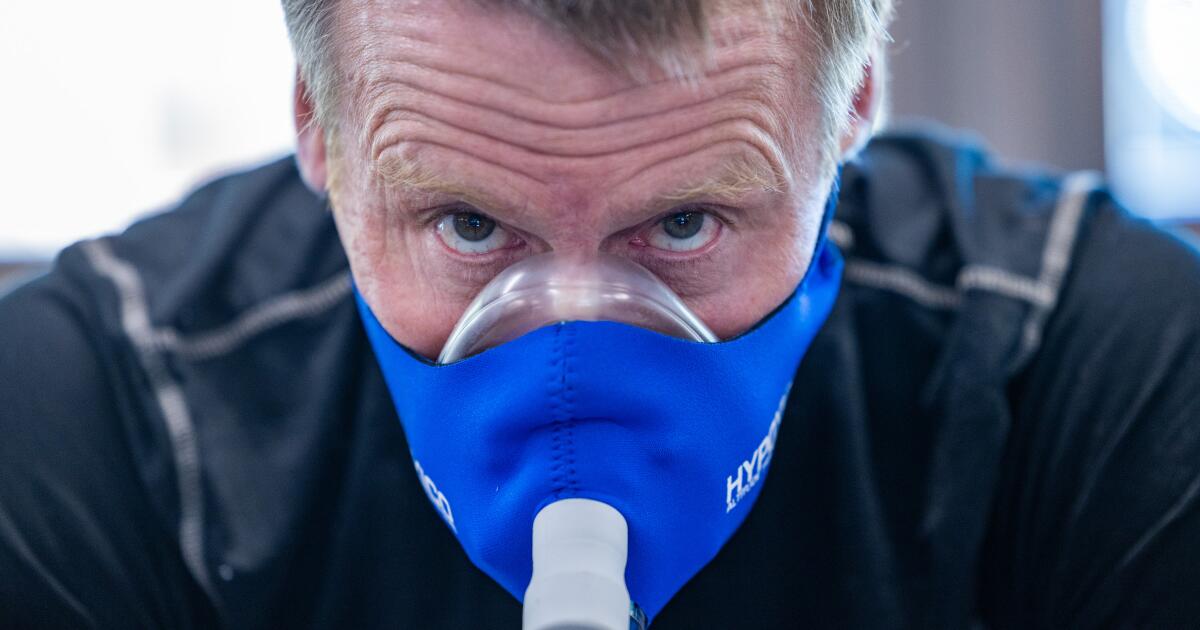
Graham Cooper sleeps with his head in a bag.
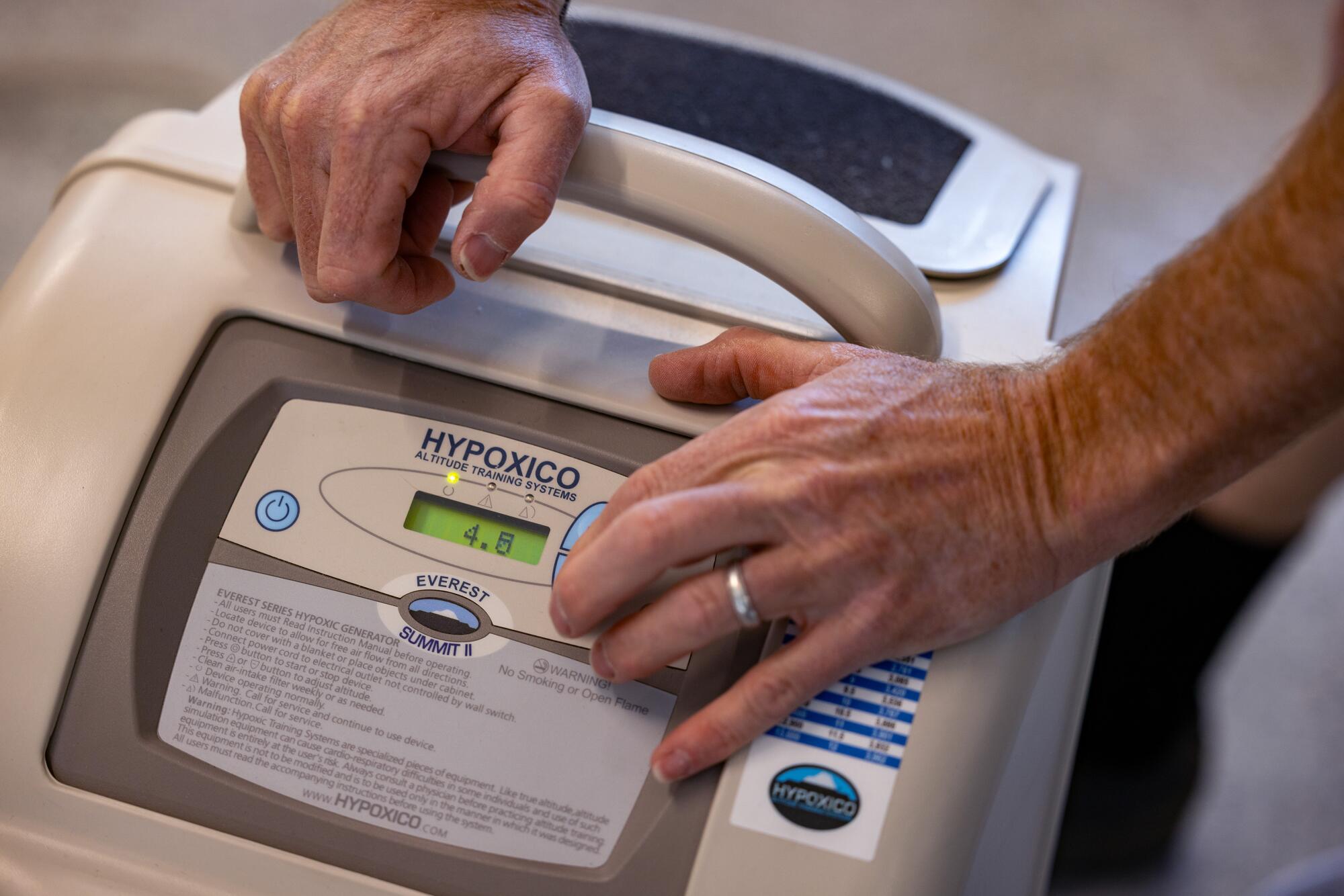
Not just any bag. This one has a hose attached to a motor that slowly lowers the oxygen level to mimic, as faithfully as possible, the agonies of fitful sleep at extreme altitude: headaches, dry mouth, cerebral malaise.
“It’s not all bad,” Cooper insisted, nodding to the humming motor. “That’s like white noise.”
Cooper, 54, an Oakland biotech executive who has handled finance for a number of companies, including one that sold for $7 billion, isn’t a masochist, exactly. He’s acclimatizing, in the bedroom of his second home near Lake Tahoe, for an attempt to climb Mt. Everest in May.
Graham Cooper uses a pulse oximeter to check his blood oxygen levels and pulse rate at his Truckee home.
He has signed up with an Olympic Valley-based guide service whose founder, Adrian Ballinger, is breaking with decades of tradition to create what he believes are better and more ethical ways to climb the world’s tallest mountain.
Ballinger said he was appalled by the risks, filth and ballooning crowds on the traditional southern trek up the mountain in Nepal. That’s the route familiar from countless documentaries and books, including the 1997 classic “Into Thin Air.”
So he decided to take clients up on the north side, a journey that starts in Tibet.
“It’s colder, the route is more difficult, and the bureaucracy of dealing with China and getting the permits is a complete nightmare,” Ballinger said. “But despite those things, the Chinese are attempting to regulate, so once you get on the mountain, it’s safer, it’s cleaner, and it’s much less busy.”
Ballinger is also pioneering a technique he calls “rapid ascent,” which cuts the duration of the expedition roughly in half: from about two months to about one. That suits his clients, who usually have more spare money than time. And it buys Ballinger more time to spend at home with his wife and newborn son.
The catch? You have to spend a few months before the trip with your head in the bag.
“It’s not great, I’m not gonna lie,” Ballinger said with a laugh, but the technology is improving.
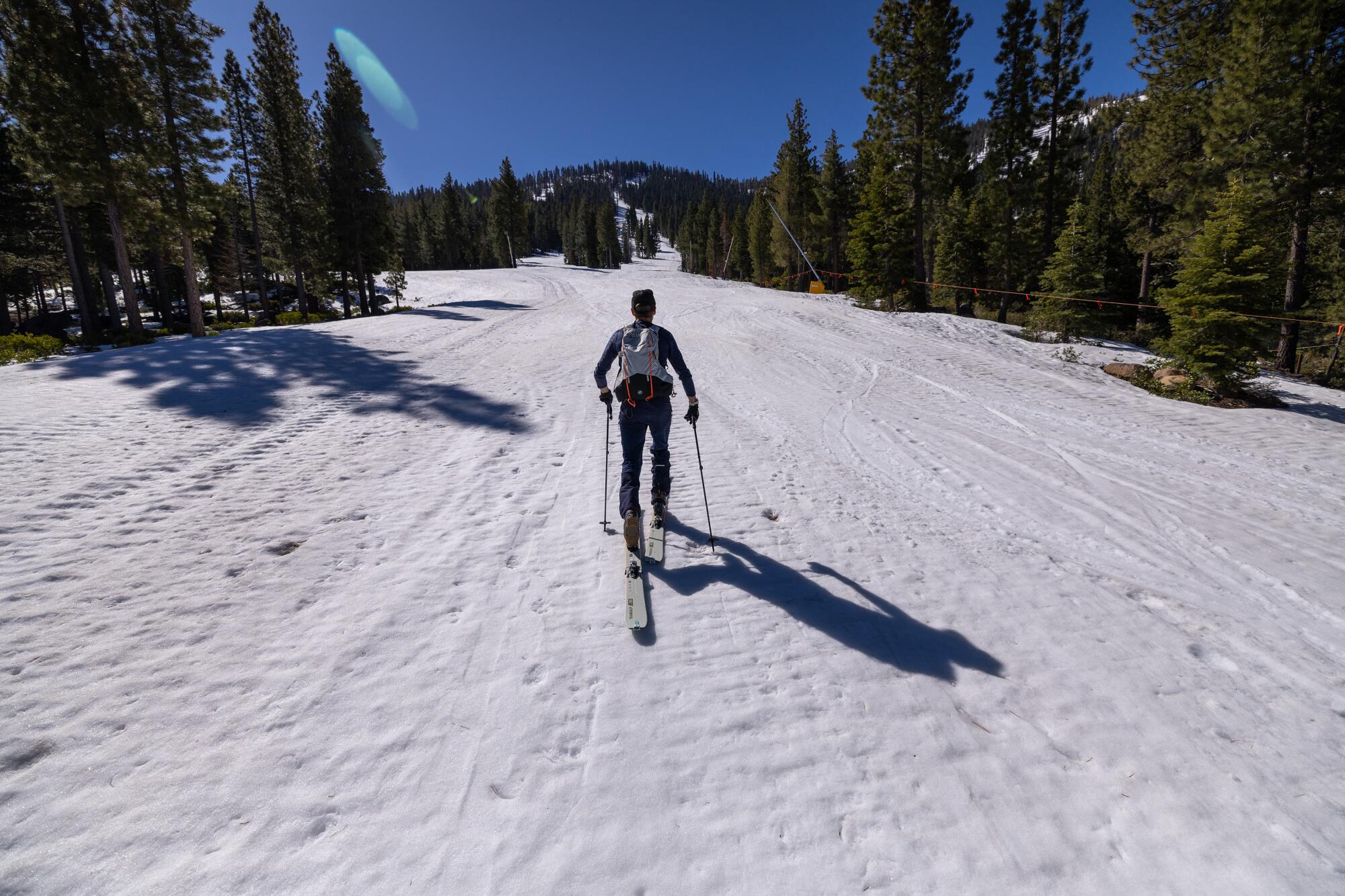
Graham Cooper has been diligently training for his Mt. Everest climb, a regimen that includes skiing laps up and down the slopes near his Truckee home.
(Brian van der Brug / Los Angeles Times)
“Hypoxic tents,” as they’re called, have been used by other endurance athletes for years. In their original form, they would cover a client’s entire bed. That led to difficult conversations with spouses and partners about the necessity of sleeping at progressively higher simulated altitudes until they reached the height of Everest’s base camp, roughly 18,000 feet, where there’s about half the oxygen available at sea level.
As you can imagine, some clients wound up relegated to a couch with their bizarre-looking contraptions.
Cooper, who used one of the enormous old tents preparing for a 2015 trip to climb the highest peaks in Antarctica and South America, confessed he had no luck sweet-talking Hilary, his wife of 28 years, into sharing the adventure. He got bounced to a guest room.
“It was a lonely boy-in-the-bubble experience,” he said. But he has fond memories of the looks on his kids’ faces as they trooped into his little dungeon to kiss him good night.

Graham Cooper relaxes with a book inside an hypoxic tent that slowly lowers the oxygen level to mimic conditions at extreme altitude.
This time around, “the bag,” as he calls it, covers just his head and upper torso and takes up about a quarter of the bed. Hilary sleeps next to him, Cooper said, and she finds the hum of the motor surprisingly soothing.
It goes without saying that the luxury of acclimatizing at home, in bed, with your partner curled up beside you, represents a profound break from the usual manner of preparing to ascend what is still one of the world’s deadliest mountains.
The traditional method starts in Kathmandu, at nearly 5,000 feet, where climbers spend a few days getting over jet lag. That’s usually followed by a quick flight to the small mountain town of Lukla, at just over 9,300 feet. The airport there — perched on a narrow Himalayan shelf surrounded by towering peaks, with a steep drop-off at the end of the runway — is regarded as one of the trickiest places in the world to land an airplane.
From there, climbers begin a long, deliberately slow 10-ish-day hike to base camp. The point is to give the body time to gradually adjust to the lack of oxygen.
Mountain guide Adrian Ballinger says employing technology that allows clients to acclimatize to high elevations at home has allowed him to cut weeks off their expeditions to Mt. Everest.
Ballinger cuts nearly two weeks from his trips by driving his bedroom-acclimatized clients from the airport in Lhasa, Tibet, straight up to the northern route’s base camp, which is also at about 18,000 feet.
For some old-school purists, eliminating the long walk borders on sacrilege, said Will Cockrell, a journalist whose recent book, “Everest, Inc.,” explores the evolution of commercial guiding on the mountain. “They’ll say, ‘You’re not a real climber; you’re not a real nature lover,’” Cockrell said.
But since the arrival of big commercial expeditions on Everest in the mid-1990s — complete with Sherpas to install climbing ropes, chefs to cook meals in camp, team doctors to monitor health, and guides to accompany clients every step of the way — Mt. Everest has ceased to be a classic off-the-grid mountaineering challenge.
“It has come to represent something completely different,” Cockrell said, “something crazy to do to shake up your life, like running an Ironman.”
Ballinger makes no apologies. “We’re not old school, we don’t spend a lot of time sitting around drinking whiskey and playing cards,” he said.
That suits his clients, who “tend to be pretty type A, pretty high performing in everything they do,” Ballinger said.
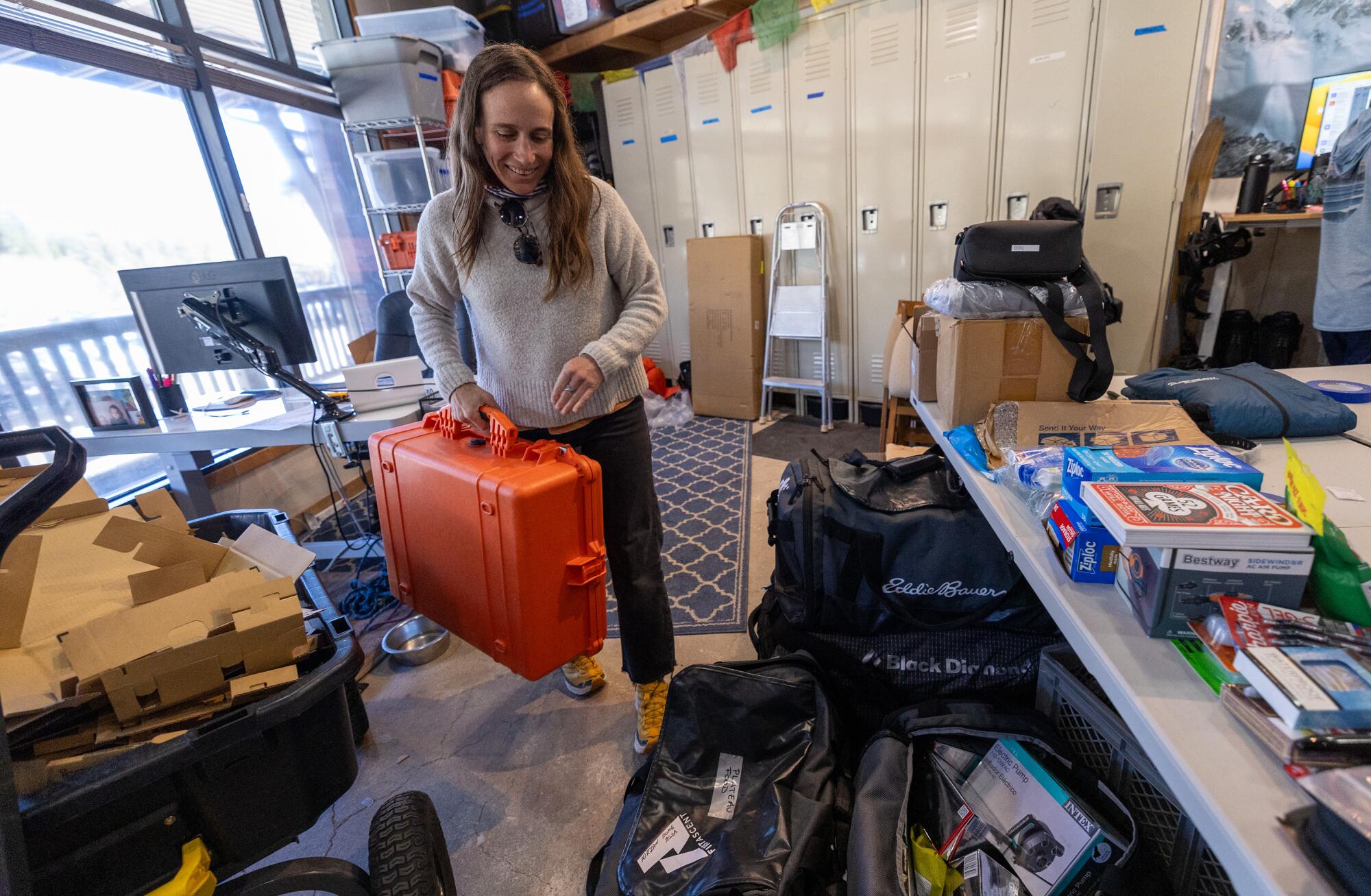
Emily Turner, Alpenglow Expeditions’ Everest base camp manager, organizes supplies for a May trip.
They’d better be. His company, Alpenglow Expeditions, charges $165,000 (before tip) for a private climb, meaning one professionally certified guide per client, and $98,000 for a group climb with three clients per guide.
“We’re proudly expensive,” Ballinger said. “I’ve spent a lot of time thinking about what it takes to run a trip safely and ethically, and this is what it takes.”
Climbing from the north side, as Ballinger does, avoids the huge crowds who flock to the southern base camp from all over the world every May, the prime climbing season on Everest, to wait for a brief window of good weather to try to make it to the summit.
Anyone who has even loosely followed events on Mt. Everest in recent years is probably familiar with the terrifying “conga line” photos of climbers stuck in the world’s highest traffic jam.
It forms just below the summit on the southern route, at the last technical obstacle, a nearly vertical 40-foot rock wall called the Hillary Step. It’s on a ridge with a 10,000-foot drop to the climber’s right and an 8,000-foot drop to the left. So, when exhausted and inexperienced climbers inevitably struggle there, everybody else waits in a single file, hanging onto a fixed rope, while the bottled oxygen they need to survive at that altitude slowly drains away.
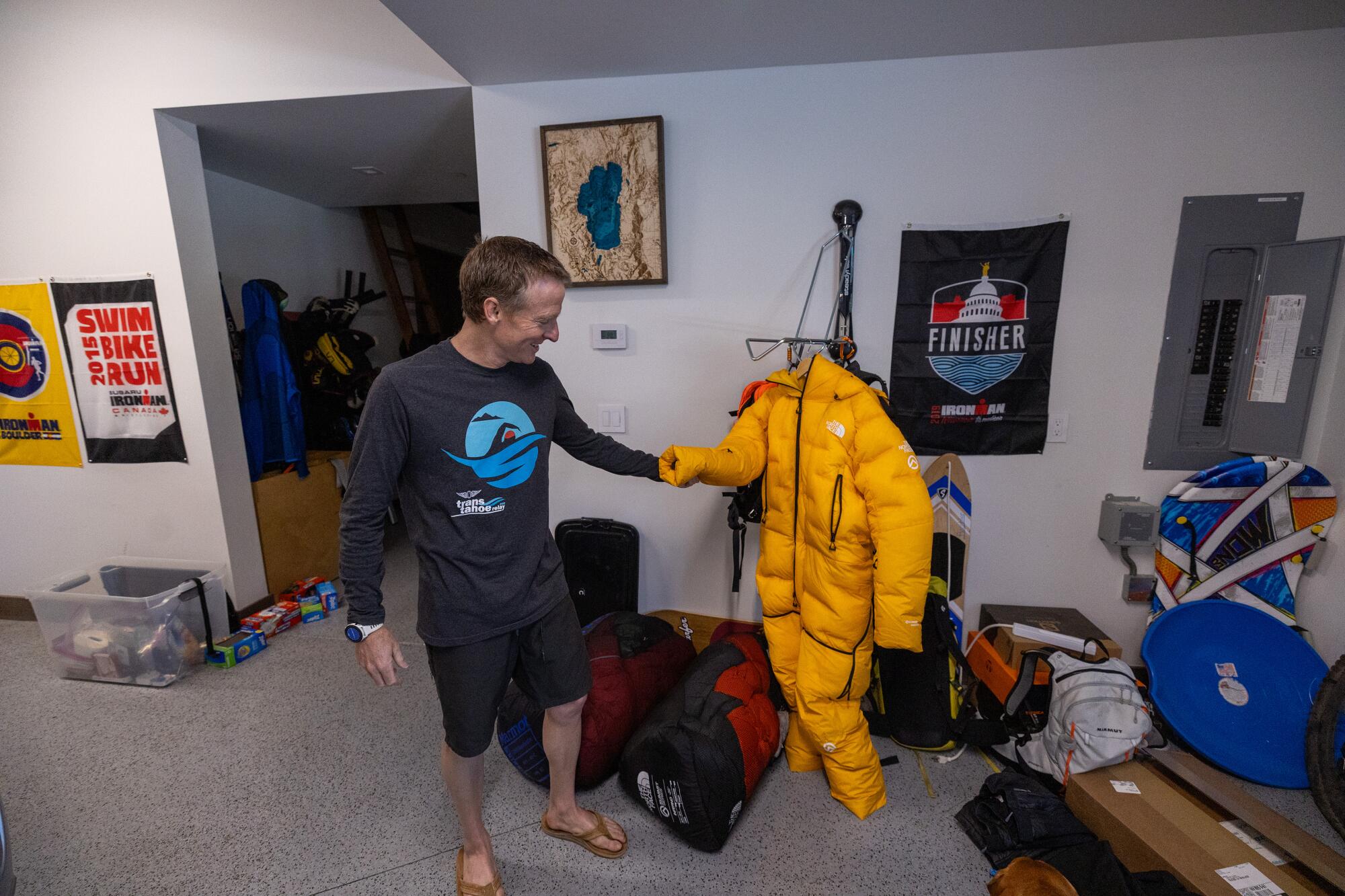
Graham Cooper is no stranger to grueling physical challenges. He has competed in the Ironman World Championship 11 times and has won the 100-mile Western States Endurance Run.
Worse is the Khumbu Icefall, a glacier just above the southern base camp. It’s best known for wide spine-tingling crevasses spanned by flimsy-looking aluminum ladders lashed together with rope. Climbers have to walk across those ladders, wearing big boots and crampons, as they make multiple trips back and forth to advanced camps to acclimatize before finally heading for the summit.
As dangerous as it is for the mostly foreign climbers and guides, the odds are even worse for the local Sherpas, who regularly traverse the Khumbu ferrying equipment — tents, food, oxygen canisters — for the climbing teams. Last year, the deadliest climbing season in Everest history, three Sherpas were killed in the Khumbu when a towering block of ice collapsed and buried them.
In six seasons climbing the southern route, from 2009 to 2014, Ballinger said he passed through the Khumbu 38 times and had two close calls. While nobody on his teams lost their lives there, he helped recover the bodies of other climbers who had not been so lucky.
Finally, he did the math and concluded there was no way he could get through a whole career — 20 or 30 years — without losing someone he was responsible for in the Khumbu.
“I just couldn’t do it anymore,” Ballinger said. “I just couldn’t justify the risk.”
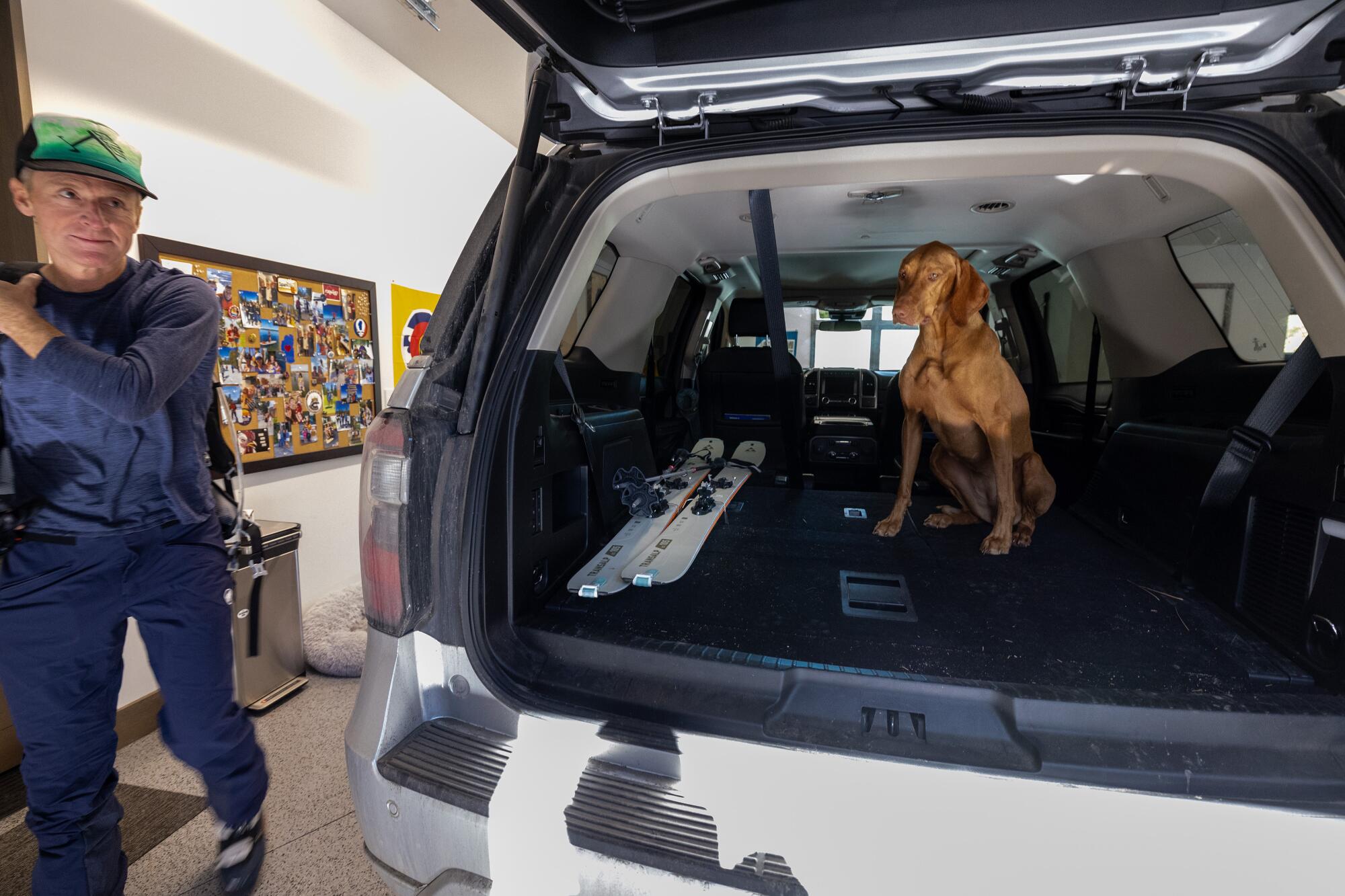
Graham Cooper loads skis into his SUV, preparing for a back-country exercise session with his loyal dog, Busy.
Ballinger’s data-driven approach and stellar track record were enough to win over Cooper.
And he has been willing to wait.
He was ready to climb Everest four years ago, but when China shut down expeditions to its side of the mountain in 2020 in response to the COVID-19 pandemic, Ballinger stuck to his principles and refused to resume climbing with the crowds in Nepal. This is the first year since the pandemic that the Chinese side has been open.
The Alpenglow team, which includes 26 clients, guides and Sherpas hoping to reach the summit, were originally scheduled to begin their expedition in late April. After a late permitting change from the Chinese government, that date has been pushed back to May 7.
Cooper has competed in the Ironman World Championship in Hawaii 11 times and has won the legendary Western States Endurance Run, a 100-mile ultra-marathon. He is not a man accustomed to sitting around. “I’m feeling ready and anxious to get going,” he texted a reporter last week.
When not trying to sleep in his hypoxic tent, Cooper has spent his training days in Tahoe on back-country skis doing laps up and down a mountain, his 3-year-old dog, a Vizsla named “Busy,” at his heels. Indoors, he straps on a hypoxic mask hooked to the same motor he uses for the sleeping tent and rides a stationary bike an hour at a time. Or climbs a StairMaster. Or throws on his mountaineering boots and a heavy backpack and trudges up and down slopes.
Why?
“I’m addicted to doing this kind of stuff,” said Cooper, who ran his first marathon when he was 13. “I just feel like a fundamentally happier person when I’m training.”
Ballinger leads clients on bucket list climbs all around the globe. Many of the treks present more interesting technical challenges than Everest. Almost all of them feel like wild outposts compared with the circus vibe on Everest’s south side.
Still, he gets poetic when he describes why so many clients are drawn to the world’s tallest summit.
“Because it’s so hard,” he said. It takes incredible fitness, mental fortitude and a heavy dose of luck to make it to the top. And no matter how many precautions you take, there’s that uncontrollable element of risk.
“It’s not just a battle for success, it’s a battle for survival up there,” Ballinger said. “That’s something that many of us have not experienced otherwise. I think that really captures people.”


A rule intended to prevent rent gouging in the wake of the Eaton and Palisades fires has lapsed in Los Angeles County, possibly exposing some renters to hikes.
The executive order that blocked rent increases was issued by Gov. Gavin Newsom amid the devastating wildfires last year. Under the order, landlords couldn’t increase rents by more than 10% above their prefire levels.
The rule, which was supposed to be temporary and was repeatedly extended, ended Friday after a vote to extend it again failed to garner enough votes. Supervisor Lindsey Horvath, whose district includes Pacific Palisades, sounded the alarm in a motion to extend price protections that failed to pass at the Board of Supervisors’ May 19 meeting.
“These price gouging protections continue to be necessary as construction and rebuilding continue, and as thousands of people remain displaced,” the motion said. “Families which signed short-term leases could face drastic price increases of 50% or more without further price gouging protection.”
Los Angeles County is home to more than 1 million rental properties, though not all of them needed protection from the new rule. There are already stricter rent increase caps for many residences, depending on the location, type and age of the building. Despite the rent control in the region, the people of Los Angeles pay among the highest rents in the country.
It is uncertain whether renters will face rapidly rising rents now that the protection has lapsed. But some real estate experts and policymakers said there was no need for the temporary rule that was part of the governor’s state of emergency.
Supervisors Kathryn Barger, Janice Hahn and Holly Mitchell abstained from voting on the motion to extend the protection, while Supervisors Hilda Solis and Horvath supported it.
“I abstained because I did not see sufficient evidence to justify extending this emergency ordinance, nor did I see evidence to eliminate it entirely,” Hahn said.
Barger’s office said she supported allowing the protections to sunset while waiting to see whether new information emerged.
“Market data already shows countywide rents are only about 2% above pre-emergency levels and rental inventory has grown,” Barger representative Helen E. Chavez Garcia said. “The Supervisor is also mindful of the burden these ongoing protections place on small property owners throughout the county.”
Mitchell did not immediately respond to a request for comment.
There haven’t been steep rent hikes in neighborhoods within three miles of the Palisades fire, according to a Times analysis of data from Zillow, the property listing company.
In ZIP Codes within three miles of the Palisades fire, rent increased 4.8% from December 2024 to April 2025. In areas around the Eaton fire, which destroyed swaths of Altadena, rent jumped 5.2% in the same period.
In L.A. County, ZIP Codes farther from the fires saw only about a 2% increase.
A landlords representative, Jesus Rojas of the Apartment Owners Assn. of Greater Los Angeles, told the supervisors during public comment at the meeting that the county’s rent-gouging rules have “long outlived the emergency they were intended to address” and are now being “wrongfully used to harm thousands of rental housing providers throughout the county.”
“There is no proof that multifamily rental housing providers are hugely increasing rents for impacted homeowners,” Rojas said.
Indeed, there are strong signs that the property market in the Los Angeles area has at last begun to cool.
L.A. metro-area rent prices recently fell to a four-year low, with the median rent slipping to $2,167 in December.
Meanwhile, condominium sales had their slowest start of the year in decades. Condo sales in Los Angeles have plummeted to a 20-year low, with fewer than 2,000 units sold in January and February — the worst start to the year since 2005.
Newsom defended the price-gouging protections shortly after they went into effect.
“In the days following the Los Angeles firestorms, we worked quickly to protect Los Angeles survivors from any form of exploitation,” he said in February 2025. “The state has the tools in place to not only block price gouging during this emergency, but also to prosecute bad actors.”
The Los Angeles County Department of Consumer and Business Affairs said it received more than 2,000 complaints after the fires, alleging that retailers and landlords were taking advantage of people put in hardship by their losses, and sent out more than 2,000 cease-and-desist letters to businesses and landlords for alleged price gouging, said Morine Merritt, who oversees department investigations into consumer and real estate fraud.
“Close to 90% of the complaints that we received involved allegations of rent increases,” Merritt said in an interview. Now that the fire-related protections have expired, existing laws and “regular market conditions determine price increases for goods and services, including rents,” she said.
Crackdowns on fire-related rent gouging have been rare, said Chelsea Kirk of the activist organization the Rent Brigade, which analyzed L.A. County’s rental market in the year after the fires. It reported 18,360 potential examples of price gouging in listings but said that few lawsuits had been filed by authorities so far.
Last week, Rent Brigade announced what it said was the first private civil lawsuit brought by a family that claimed to be rent-gouged in the aftermath of the wildfires. Plaintiffs Randall and Candy Renick, whose Altadena home was damaged, said they were charged nearly three times the maximum permitted rate for nearly 10 months. They seek restitution of $96,000 plus civil penalties and attorneys’ fees.
The rental market has probably stabilized since the fires, Kirk said, but other families may still be “locked into illegal rents” that they agreed to pay when they were in a rush to find housing after they were displaced.


Dear Mr. Pelley:
I meant what I said in my letter last week to the 60 Minutes team: joining 60 Minutes is the honor of my career and I am grateful to be working alongside the people who have contributed to the most important television journalism brand this country has ever produced. While I’m new to 60 Minutes, I’ve devoted my career to investigative journalism and storytelling. I started this job excited to collaborate and to benefit from the wisdom and experience of the 60 Minutes veterans, with you among them. For that reason, one of the first things I did in my new role was call you to talk and invite you to dinner. It is a profound disappointment that you rejected that overture and chose ambush instead. Yesterday, you hijacked my first meeting with staff to disparage me, my qualifications, and my intentions with remarkable incivility and contempt. I welcome a diversity of viewpoints and respectful debate among the team, but this was nothing of the sort. Yesterday’s performative display of hostility enacted in front of the staff instead of in a civil, private conversation-demonstrated that you have no interest in contributing to the future success of the show, or approaching my new tenure with a mind open to collaboration and progress. I am here to deliver first-in-class news programming, not to make headlines about newsroom drama. I am eager to work alongside those who share this goal.
Despite yesterday’s misconduct, I had hoped that in sitting down with you today we could find a path forward together. You made clear that you are not interested in such a path.
Your antipathy to the future of the show has come through loud and clear. And I have heard you. I therefore write on behalf of CBS News, Inc. (“CBS”) to inform you that your employment with CBS is terminated for cause effective immediately. Enclosed is your formal termination letter.
Sincerely,
Nick Bilton
Executive Producer, 60 Minutes

The co-founder of Aspiration, Joseph Sanberg, was sentenced to 14 years in prison on Monday after defrauding investors and lenders of over $248 million.
The startup, an eco-friendly digital banking company boasting fossil fuel-free investments, carbon offsets for gas purchases, and a debit card with cash-back benefits for shopping at clean companies, was founded by Sanberg and Andrei Cherny. Cherny left the company in 2022 and has not been charged.
Sanberg, an Orange County native, pleaded guilty to wire fraud in October after being arrested in March last year. Aspiration subsequently filed for bankruptcy and liquidated all of its assets by July.
Sanberg and venture capitalist Ibrahim AlHusseini, who also faces charges, together forged a series of bank statements in order to obtain loans. From 2020 to 2021, the pair forged AlHusseini’s bank statements to show millions of dollars in assets in order to obtain millions of dollars from lenders.
Additionally, they forged a letter from their audit committee stating that $250 million in funds were available, when in reality Aspiration had less than $1 million. The amount of loans defrauded exceeded $248 million.
In 2021, Sanberg artificially inflated Aspiration’s 2021 revenue by $44 million by recruiting 27 fake customers to sign letters of intent pledging tens of thousands of dollars per month for tree planting services. Sanberg himself funded the contracts and used the inflated revenue numbers to obtain more loans.
The charges sparked an NBA investigation into salary cap allegations due to Aspiration’s connections with Clippers owner Steve Ballmer.
Ballmer personally invested $60 million in Aspiration, all of which was lost. He is now the target of a civil lawsuit alleging his participation in the scheme. Ballmer denies the allegations.
The team announced a $300-million sponsorship deal with Aspiration, and Clippers player Kawhi Leonard signed a four-year, $28-million marketing contract with the company, which reportedly performed no duties. The issue has raised concerns about how players are circumventing the NBA’s salary cap.
The team lost the $300-million sponsorship deal and an additional $20 million paid for carbon offset purchases.
-

 Utah6 minutes ago
Utah’s wonderful women took Kevin O’Leary to school over his…
-

 Vermont9 minutes ago
Hundreds of housing units in the works at closely-watched project in Burlington’s South End – VTDigger
-

 Virginia14 minutes ago
Crews put out house fire in Bristol, Virginia
-

 Washington21 minutes ago
Deputies use drone to catch man wanted for damaging car in Washington County
-

 Wisconsin24 minutes ago
Racing Sausages, Wienermobile, ancient canoes all call this place home
-

 West Virginia29 minutes ago
Top Bike Adventures in West Virginia’s Mountain Playground
-

 Wyoming36 minutes ago
Wyoming Town Rivalries – Feuds & Hate
-

 Crypto39 minutes ago
Cryptocurrency is money, rules South African court – African Law & Business

