Business
Beyond 'Emilia Pérez': Inside 7 of the nastiest Oscar campaigns in history


By the time “Emilia Pérez” had garnered 13 Oscar nominations, including for best picture, Netflix’s Spanish-language musical about a transgender drug lord had already been mired in controversy. Critics skewered the film’s portrayal of trans issues and Mexican culture.
Then Karla Sofía Gascón’s old social media posts resurfaced in which the first out trans performer to receive a lead actress nod maligned Muslims, George Floyd and diversity and seemed to body-shame the singer Adele.
Gascón apologized, deactivated her X account and then went on the defensive, sometimes tearfully, in an interview with CNN en Español, on her Instagram account and in a letter to the Hollywood Reporter in which she denounced “this campaign of hate.”
After the social media storm erupted, during a talk on podcast “The Town,” Netflix chief content officer Bela Bajaria called the controversy “a bummer” that distracted from the film and its accolades. Gascón has largely been sidelined from the movie’s awards drive.
Yes, it’s Oscar season, where the road to the red carpet is often littered with unforced errors, smear campaigns, opposition research and sometimes dirty tricks in efforts to undermine if not outright torpedo the front-runners’ chances.
The Academy Awards are not just an evening of self-congratulation. In addition to prestige, an Oscar is a huge publicity generator that can translate into box office grosses, home video sales and streaming viewership.
While in years past such campaigns usually were fueled by awards consultants and frequently aimed at a single movie or actor, this season has seen controversies served upon multiple contenders.
It’s not just the professional consultants and studio marketers involved in these so-called whisper campaigns. Now small armies of amateur Internet sleuths and movie fans have joined the fray, turning gripes and teapot tempests into social media scandals.
“The big difference in the last 10 years is social media fanning the flames,” said Jason E. Squire, host of “The Movie Business Podcast” and professor emeritus at USC‘s School of Cinematic Arts. “The real question is whether it impacts Oscar voters.”
In addition to the travails of Gascón, best picture nominee “The Brutalist” has been slammed for admittedly using an AI speech tool to aid stars Adrien Brody and Felicity Jones’s Hungarian language skills. Fernanda Torres, the lead actress nominee for “I’m Still Here,” came under fire for appearing in blackface on a Brazilian television show in 2008. Torres apologized.
Then there’s “Anora,” another best picture nominee, which was lambasted for not hiring an intimacy coordinator on set. At a London screening, Sean Baker, the film’s director, said that he had offered one to the lead actors.
With this year’s Academy Awards just weeks away, we take a look at notable controversies of the past, some of which perhaps deserve their own statuettes for spite and nastiness: putting the tin in Tinseltown.
Gwyneth Paltrow and Joseph Fiennes in “Shakespeare in Love.”
(Miramax Films)
“Shakespeare in Love”
Oscar year: 1999
Backstory: Steven Spielberg’s World War II epic “Saving Private Ryan” was considered the favorite, but Miramax co-founder Harvey Weinstein, known for turning awards campaigns into a blood sport, had other plans.
Controversy: “Shakespeare in Love’s” best picture win is widely seen as the capstone to one of the most controversial award campaigns in Oscar history.
Mark Gill, then Miramax‘s L.A. president, told the Hollywood Reporter, “We used the playbook for ‘The English Patient’ — turbocharged, on steroids. It was just absolutely murderous the whole way through.”
Miramax staffers called voters to make sure they had received a VHS copy of “Shakespeare in Love.” Weinstein enlisted First Lady Hillary Clinton to host the film’s world premiere in New York, unleashed a blizzard of ads, hosted parties with the film’s stars and set up screenings and private dinners with Oscar voters.
Weinstein also was accused of badmouthing the Spielberg film, a DreamWorks release.
Terry Press, DreamWorks’ marketing chief at the time, later said that she received calls from reporters telling her that Miramax publicists were “trying to get us to write stories saying that the only thing amazing about ‘Ryan’ is the first 20 minutes, and then after that it’s just a regular genre movie.”
And the Oscar goes to: “Shakespeare in Love” won seven Academy Awards including best picture and lead actress (Gwyneth Paltrow). “Saving Private Ryan” won five, including director (Spielberg).

Russell Crowe played mathematical genius John Nash in “A Beautiful Mind.”
(Universal Studios)
“A Beautiful Mind”
Oscar year: 2002
Backstory: The life of mathematician John Nash, a Nobel laureate who triumphed over schizophrenia, was chronicled in this acclaimed Ron Howard-directed biopic, earning eight Oscar nominations, including best picture.
Controversy: A narrative caught fire with critics who began charging that the more negative parts of Nash’s life were omitted from the film. Accusations that Nash was an antisemite, adulterer and homophobe began to appear in reviews, gossip sites and news articles, prompting him to appear on “60 Minutes” to refute the claims.
Angered by the reports, Sylvia Nasar, the author of the book on which the movie was based, wrote an op-ed for The Times, rebuking journalists and saying they had “distorted” material from her book and “invented ‘facts.’”
And the Oscar goes to: “A Beautiful Mind” won four Oscars including best picture, supporting actress (Jennifer Connelly) and director (Howard).

Whoopi Goldberg in “The Color Purple.”
(Michael Ochs Archives / Getty Images)
“The Color Purple”
Oscar year: 1986
Backstory: Spielberg’s adaptation of Alice Walker’s Pulitzer Prize-winning novel earned 11 nominations, including best picture, director and adapted screenplay, and was Oprah Winfrey’s film debut, garnering her a supporting actress nomination.
Controversy: When the film was released in 1985, it immediately sparked a backlash, coming under fire for its depiction of rape and stereotypical representations of Black men, a portrayal that Spike Lee decried as “one-dimensional animals.” It also faced criticism for having been directed by a white man. During a special screening in Los Angeles, the Coalition Against Black Exploitation staged a protest.
And the Oscar goes to: “Out of Africa” took home the best picture trophy. “The Color Purple” was shut out, vying with 1977’s “The Turning Point,” which also earned 11 nods, for the most nominated film to take home zero awards.

Jessica Chastain starred in “Zero Dark Thirty.”
(Jonathan Olley / Sony Pictures Releasing)
“Zero Dark Thirty”
Oscar year: 2013
Backstory: Kathryn Bigelow directed this thriller about the decades-long manhunt for 9/11 mastermind Osama bin Laden, and the U.S. military raid on his Pakistani compound where he was killed. The film received five Oscar nominations including best picture and original screenplay.
Controversy: When it was released, the film earned plenty of critical huzzahs, with The Times calling it “cinematic storytelling at its most effective.”
But it also drew opprobrium, with detractors taking aim at the movie’s depiction of torture and questioning its veracity. The film became a flash point for partisan bickering when critics of the Obama administration claimed that the film’s planned October release was timed to boost his reelection campaign — it was later moved to December.
There also were claims by some conservative activists that the CIA provided classified information to Bigelow and her team as they researched the film, charges that were denied by the filmmakers. A Senate inquiry into the matter was later dropped, Reuters reported.
And the Oscar goes to: “Zero Dark Thirty” took home the award for sound editing. Ben Affleck’s “Argo” won the top prize.

Viggo Mortensen and Mahershala Ali in “Green Book.”
(Patti Perret / Universal Pictures)
“Green Book”
Oscar year: 2019
Backstory: The film chronicles the real-life friendship between a Black classical pianist, Donald Shirley, and Tony “Lip” Vallelonga, his Italian American driver, as they travel across the segregated South during Shirley’s concert tour in the 1960s. Directed by Peter Farrelly, it starred Mahershala Ali as Shirley and Viggo Mortensen as Vallelonga and earned five Oscar nominations including best picture.
Controversy: A swirl of charges surrounded the film, with many involving racial politics. Shirley’s family castigated the filmmakers for excluding them, saying the movie’s portrayal of Shirley as estranged from his family and the Black community was “hurtful.” They also called into question the depiction of his friendship with Vallelonga. Dr. Maurice Shirley, Donald’s brother, described the movie as a “symphony of lies.”
And the Oscar goes to: “Green Book” took best picture as well as statuettes for original screenplay and supporting actor (Ali).

Joan Crawford as Blanche Hudson, left, and Bette Davis as Baby Jane Hudson in ‘Whatever Happened to Baby Jane?”
(Silver Screen Collection / Getty Images)
“Whatever Happened to Baby Jane?”
Oscar year: 1963
Backstory: The bitter rivalry between screen legends Bette Davis and Joan Crawford helped propel this film about an aging onetime child star who torments her sister, a paraplegic former actor.
Controversy: The actresses’ discord played out offscreen as Crawford actively campaigned against Davis, who earned a nomination for lead actress — her 10th and final nod.
Crawford, who was snubbed, ended up onstage and accepted on behalf of Anne Bancroft, who won for “The Miracle Worker,” beating Davis. Bancroft was appearing on Broadway and was unable to attend the ceremony.
And the Oscar goes to: “Whatever Happened to Baby Jane” won one Oscar, for costume design.
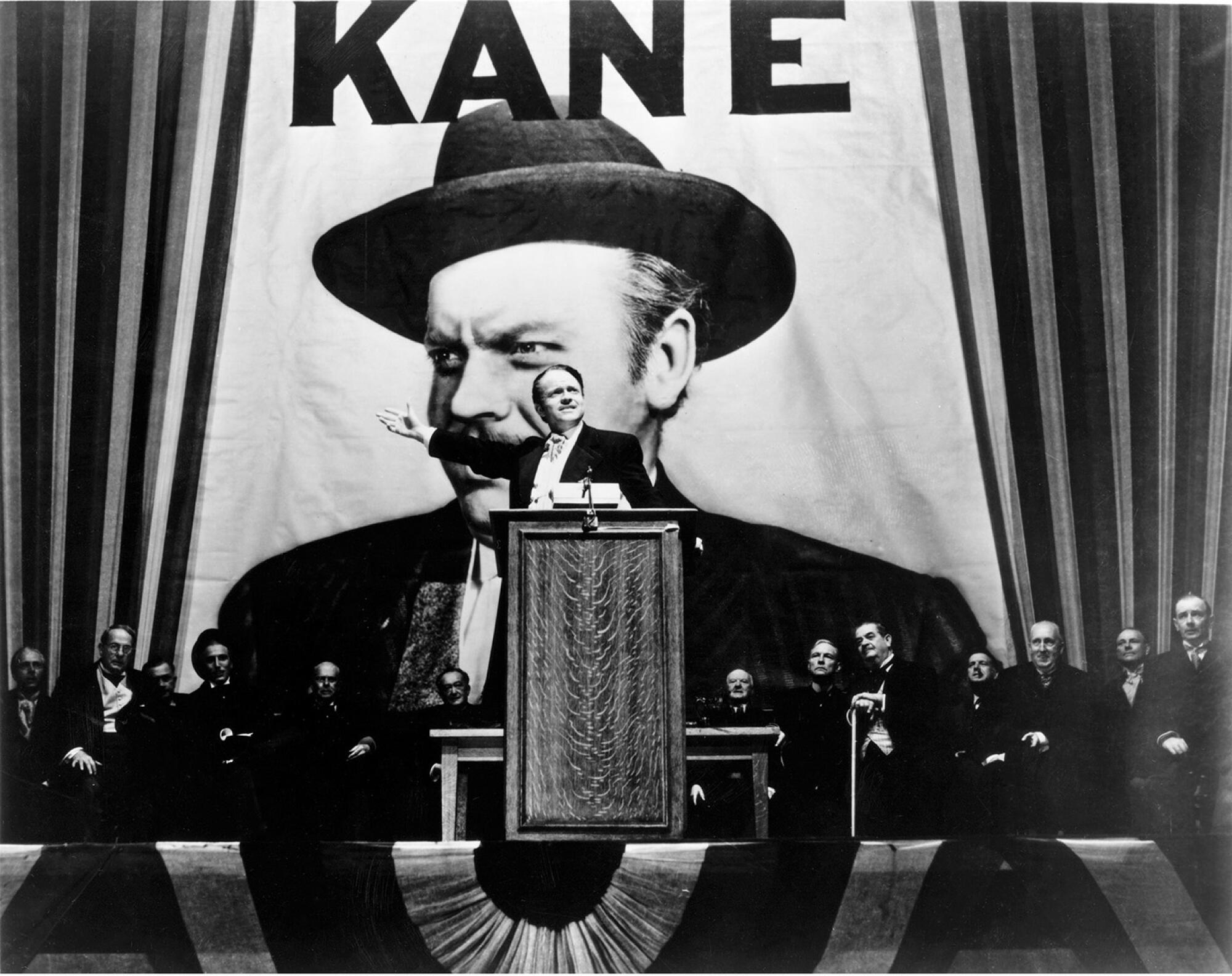
Orson Welles as Charles Foster Kane in “Citizen Kane.”
(Warner Bros.)
“Citizen Kane”
Oscar year: 1942
Backstory: Often cited as the greatest film ever made, “Citizen Kane” tells the story of Charles Foster Kane (played by Orson Welles, who co-wrote and directed), a wealthy newspaper publisher whose death becomes a global sensation. It earned nine Oscar nominations including best picture and director.
Controversy: The movie was considered a thinly veiled swipe at real-life newspaper tycoon William Randolph Hearst, who did not take kindly to the celluloid portrait. He attempted to blacklist it through negative press in his Hearst newspaper chain and, along with his defenders, pressured theaters not to show it.
And the Oscar goes to: “Citizen Kane” won a single Oscar, for original screenplay. “How Green Was My Valley” won best picture.


The luxury shopping center in Pacific Palisades will reopen next month after more than $100 million in renovations forced by the January 2025 wildfire that devastated the Los Angeles neighborhood.
Palisades Village will reopen Aug. 15, owner Rick Caruso announced Wednesday. The outdoor center survived the blaze that destroyed homes and other businesses but needed refurbishment to eliminate contaminants that the fire could have spread.
Crews are putting finishing touches on mall buildings after tearing them down to the studs, treating the wood and rebuilding the walls, Caruso said.
“Everybody’s working, and stores are moving their products in,” he said. “It’s a really cool feeling that people have really locked arms and are working together.”
An electrician installs lighting for a restaurant at Rick Caruso’s Palisades Village on Thursday. The shopping center is scheduled to reopen mid-August.
(Myung J. Chun / Los Angeles Times)
Pacific Palisades resident Allison Polhill, who is rebuilding the home of 30 years that her family lost in the blaze, said she is “thrilled” at the prospect of returning to the mall she used to frequent. Its comeback is a boost for the community, she said.
“Every single step that we make to reopen our commercial corridors is going to bring more people back into the Palisades,” said Polhill, who expects to move back into her home at the end of August.
A total of 6,822 structures were destroyed in the Palisades fire, including more than 5,500 residences and 100 commercial businesses, according to the California Department of Forestry and Fire Protection.
Caruso previously attributed the mall’s survival to the hard work of private firefighters and the fire-resistant materials used in the mall’s construction.
The $200-million shopping and dining center opened in 2018 with a movie theater and a roster of upmarket tenants, including Erewhon, which may be the only grocer in the heart of the fire-ravaged neighborhood when it opens.
Caruso’s company was able to fill the mall with tenants despite the long shutdown.
Palisades Village is 99% leased, with the majority of tenants returning, said Jackie Levy, chief financial and revenue officer. Nearly one-third of the shops and restaurants are new to the property.
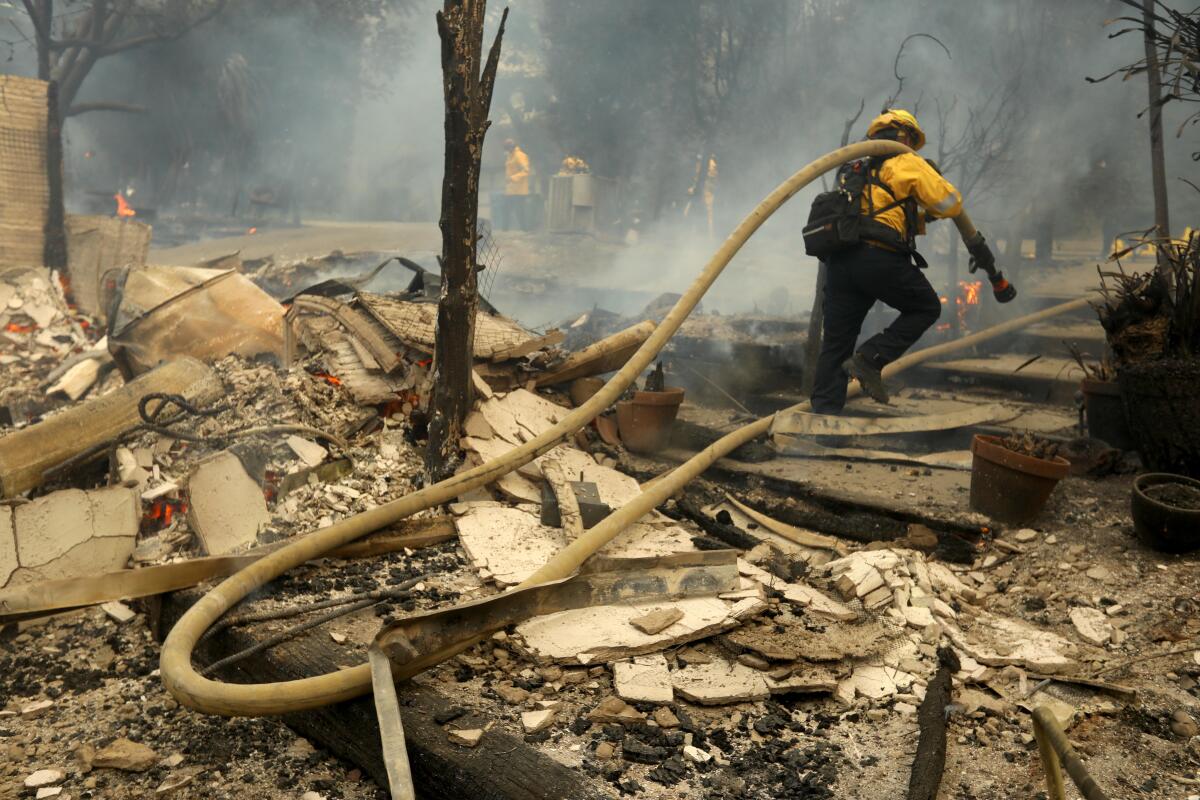
A firefighter carries a hose back to his rig while walking through a destroyed home from the Palisades fire in Pacific Palisades on Jan. 7, 2025.
(Genaro Molina / Los Angeles Times)
Last year, Pacific Palisades-based fashion designer Elyse Walker said she would reopen her eponymous store in Palisades Village after losing her 25-year flagship location on Antioch Street to the inferno.
Other neighborhood shops destroyed in the fire that are reopening at the mall include K Bakery and Loomey’s Toys, which caters to children up to age 12 and used to be across the street from Palisades Elementary Charter School.
“It’s been a journey and I’m excited because I wasn’t sure that there was going to be a place to come back to,” said toy store owner Amanda Rastegar. “Hopefully we can bring some of that magic back.”
Rastegar’s home in the Palisades survived but was damaged by the fire. The family returned about eight weeks ago. Her last memory of the fire was a burning supermarket.
“I just couldn’t wrap my brain around what was happening,” she said. “By the time I left, Gelson’s was on fire.”
Among the returning tenants is Angelini Ristorante & Bar. Well-known Los Angeles chef Gino Angelini said he will be in the kitchen next month for a return of the Italian restaurant.
“We won’t do a big celebrity open,” he said. “We want to have a very soft opening and see our customers come back.”

Construction takes place at Rick Caruso’s Palisades Village on Thursday. The shopping center is scheduled to reopen mid-August.
(Myung J. Chun / Los Angeles Times)
An elaborate celebration would not feel “correct for me,” Angelini said, because the devastation has been “very sad” for so many.
Other new tenants include local chef Nancy Silverton, who has agreed to move in with a new Italian steakhouse called Spacca Tutto. Women’s activewear retailer LESET will open its first West Coast location.
Caruso said he is optimistic that customers will return to the center, even though many Pacific Palisades residents are still dispersed. One tracking system estimated that about 30% of the Village’s customer base was impacted by the fire, he said.
“That means 70% did not get impacted, so there’s a lot of customers still left out there,” Caruso said. Historically, the center drew customers from as far away as Beverly Hills and Calabasas, as well as Malibu, Brentwood and Santa Monica.
He also hopes many will be inspired to visit the revived mall.
“I believe in the goodness of people and I believe that people are going to want to support the Palisades,” he said. “They’re going to want to be there and support the businesses that have had the courage and the heart to reopen.”

Walmart is rapidly expanding its network of electric vehicle chargers designed for customers to use while they shop.
The network could help fill gaps in EV infrastructure in states with greater need for chargers. Walmart, which has more than 5,000 locations in the U.S. and hundreds in California, says more than 90% of Americans live within 10 miles of one of its stores.
The chargers also offer an incentive for customers to choose Walmart — Walmart Plus members will receive a 10% discount off an average price of $0.46 per kilowatt-hour of energy at the company’s chargers.
Walmart chargers are already available at more than 75 locations in 17 states, with Texas boasting the most charging stations, followed by Florida and Arizona.
Matthew Nelson, Walmart’s director of energy policy, said last week on LinkedIn that the network will soon reach 29 states, including California.
“We are delivering on the promise of affordable, reliable and convenient charging,” Nelson said in his post.
According to Walmart’s website, six charging stations are coming to California soon, though the company did not offer a specific timeline.
The chargers will be installed at stores in Antelope, Brea, Fresno, Stockton, Suisun City and Vallejo.
Most charging sites in California will include eight to 16 fast-charging stalls, said Walmart spokesperson Kelsey Bohl.
The company first announced plans in April 2023 to install its own EV chargers at Walmart and Sam’s Club stores, with a goal of installing thousands of chargers by 2030. Partnering with ABB E-Mobility and Alpitronic, it added 25 new charging sites this past May and six more in June.
“Walmart is building a leading retail-integrated EV fast-charging network, focused on delivering an affordable, reliable and convenient charging experience where customers already shop,” Bohl said in an emailed statement. “Customers can charge while they shop, access stations through the Walmart app they already use, and benefit from affordable pricing.”
The charging stations already available include 612 individual charging stalls using 400-kilowatt chargers. Each stall has a dual charging cord with both Combined Charging System and North American Charging Standard connectors. The standard connectors, designed by Tesla, are smaller and lighter than the combined systems.
The primary way to pay for the chargers is through the Walmart app, but the company is also experimenting with built-in credit card readers to allow those without the app to use the stations.
Customers can check charger availability on the Walmart app. The company said the chargers will be available 24 hours a day.

Robotaxis could be turning into robocops.
A self-driving Waymo reported two teens to San Mateo, Calif., police on Monday after they were found drinking alcohol and shooting toy guns in the back of the vehicle.
According to a social media post from the San Mateo Police Department, officers detained two 15-year-olds after the Waymo they were riding in contacted the department and stopped in a parking lot until law enforcement arrived.
“Parents do you know where your teens are?” the San Mateo Police Department wrote on Facebook following the incident. “Waymo does!”
Officers removed both teens from the vehicle and determined they were using toy guns to shoot Orbeez out the windows. Orbeez are small, water-absorbing beads sold at toy stores.
“Toy guns, water guns, and BB guns all pose real dangers, especially to an untrained eye,” the Police Department said. “The simple handling of them can cause fear in [passersby].” “
A video posted on Facebook shows at least five officers and a police dog responding to the scene and approaching the Waymo with their weapons raised.
Waymo did not immediately respond to a request for comment.
Waymo vehicles have internal cameras and microphones that may be used in an emergency or to “promote safety and security,” according to Waymo’s online support page.
The cameras are also used to ensure the vehicles are clean and to help find lost items, according to the support page.
The company said it does not use facial recognition or other biometric identification technologies to identify individuals.
“In more urgent circumstances, support may access live video during a trip,” the Waymo page said.
The San Mateo Police Department’s Facebook post has garnered nearly 60 comments, with one user accusing Waymo of “snitching.”
“At least they got a designated driver?!” one user commented.
-
Business5 minutes ago
Fire-damaged Pacific Palisades shopping center sets reopening date
-
 Entertainment12 minutes ago
Rhea Seehorn celebrates her ‘Pluribus’ Emmy nomination as she waits to hear about Carol and the atom bomb
-

 Lifestyle15 minutes ago
Urban Jürgensen: Introducing Elite Watchmaking to New Audiences
-
 Politics20 minutes ago
Commentary: On Skid Row, it’s been decades of frustration. Will the next mayor have a plan?
-
 Science27 minutes ago
What’s the deal with … coffee enemas?
-
 Sports30 minutes ago
LAPD weighs canceling academy classes to get more cops on streets for Olympics
-

 World42 minutes ago
Trump ordered to pay E Jean Carroll $5.8m after failed appeal
-
 News1 hour ago
Supreme Court financial disclosures reveal how their books add to their income

