Business
As job growth in California falls back, unemployment rate remains highest in the country

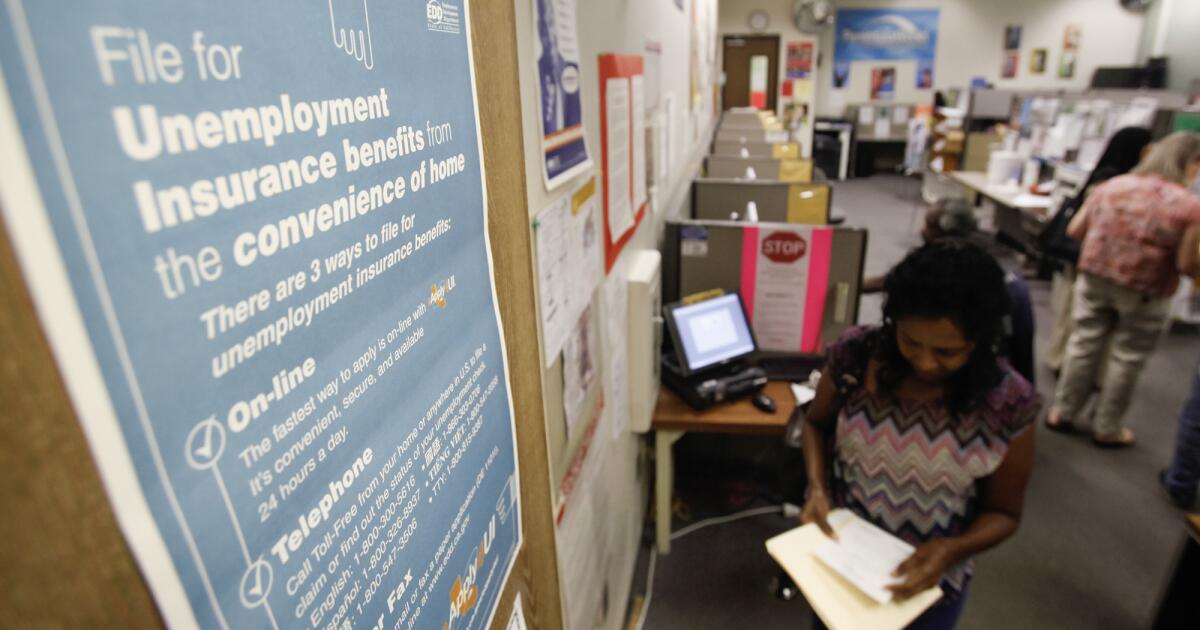
California posted another month of anemic job growth in April, keeping the state’s unemployment rate the highest in the country, 5.3%, the government reported Friday.
Statewide, employers added a net of just 5,200 jobs in April, down from 18,200 in March, according to California’s Employment Development Department.
Nationwide, employers added 175,000 jobs in April and 315,000 in March. The U.S. unemployment rate in April was 3.9%.
Major sectors of California’s economy — including manufacturing, information and professional and business services — showed job losses last month, and job opportunities aren’t as plentiful as before, even as the number of unemployed workers in the state has risen by 164,000 over the last 12 months.
In California, there were 140 unemployed workers for every 100 job openings in March, according to federal statistics released Friday. Less than two years ago, there were about two openings for every jobless person.
Carol Jackson, an unemployed worker in South Los Angeles, says she has been pounding the pavement for months, hoping to make use of her recently minted associate degree in web management and database administration. But despite sending her resume to at least 100 employers, she has not had a single interview.
“I can tell you that California is pretty brutal now,” said Jackson, 57.
Hiring in California has been lagging behind national trends, with one notable exception. The state’s healthcare and social assistance sector added 10,100 jobs last month, bringing the gains over the last 12 months to about 155,000. That’s 75% of all new jobs added since April 2023.
Hospitals and doctors’ offices have been bulking up, but the fastest growth has been at outpatient centers, home healthcare firms, nursing facilities and, especially, social assistance, which includes vocational rehabilitation and child day-care services.
“Healthcare is the big gorilla in the room; it dominates everything,” said Mark Schniepp, director of the California Economic Forecast in Santa Barbara, adding that it’s likely to keep growing robustly with new and expanded medical facilities across the state.
Leisure and hospitality businesses added 3,100 jobs last month. The gains included employment at hotels and restaurants — despite the added stress employers are feeling from a minimum wage increase to $20 an hour for fast-food workers that went into effect April 1.
While there are fears of layoffs as the food industry adopts technology to replace workers, California’s restaurants are getting a lift from a pickup in tourism. The leisure sector overall is close to fully recovering from the deep losses caused by the COVID-19 pandemic.
Public-sector payrolls also held up well last month, increasing by 2,600. Thus far, state and local government jobs seem to be showing little effects from California’s massive budget deficits.
“But clearly that will be another factor,” said Sung Won Sohn, economics professor at Loyola Marymount University in Los Angeles.
Sohn and other economists worry that there are national, cyclical and state-specific threats to California’s employment and broader economic outlook.
Key pillars of the state’s economy continue to struggle.
Motion picture producers and other employers in the information sector show few signs of breaking out of the hiring doldrums, despite the film industry’s resolution of labor strikes last fall. Los Angeles’ motion picture and recording studio industries were down by 13,400 employees, or 12%, in April compared with the same month a year earlier. And many workers in the industry say conditions do not appear to be improving.
Large parts of the farm economy in the Central Valley remain sluggish, in part due to rising costs, tighter financial conditions and ongoing climate challenges.
Despite strong investments in artificial intelligence, layoffs have persisted at high-tech firms in the Bay Area and elsewhere. Scientific and technical companies shed jobs last month, and employment at computer systems design work and related services has been gradually declining.
Nationally, economists expect job growth to slow in the coming months, the result of persistently high interest rates and an expected pullback from consumers. The outlook is particularly dim in California.
“On the ground, there are several signs of even more slowdowns,” said Michael Bernick, an employment lawyer at Duane Morris in San Francisco and former director of the state’s EDD. Among them, he said, “small businesses continue to struggle statewide with higher prices and tightened consumer spending.”
He and other experts have a similar refrain about what ails the state: high costs, excessive regulation and unaffordable home prices, among other factors.
“We just have real challenges here in California that other states don’t face,” said Renee Ward, founder of Seniors4Hire.org, a Huntington Beach-based organization that helps older workers find employment.
She said the number of job seekers registered with her service has jumped 26% so far in 2024 from a year ago.


Volvo Group North America has agreed to pay nearly $197 million to resolve allegations from California regulators that company’s heavy-duty truck engines violated California emissions standards and certification requirements.
About 10,000 diesel truck engines manufactured by Volvo were equipped with an undisclosed device, causing them to release excessive levels of smog-forming pollution across California, according to the California Air Resources Board, the state agency that regulates air pollution and greenhouse gases.
Volvo is developing a software fix to repair many of these vehicles and extend their warranties at no cost to the owners. Eligible truck owners are expected to be notified of a non-mandatory recall on these trucks next year.
CARB found inconsistencies in the Swedish automaker’s data while testing trucks with Volvo engines from model year 2010 to 2016, which resulted in the investigation and ensuing settlement.
“This case underscores why CARB’s compliance testing and strong enforcement are essential to protecting the state’s air quality and public health,” said Lauren Sanchez, chair of the state Air Resources Board. “Our responsibility goes beyond adopting regulations — we are committed to upholding them by identifying violations and holding companies accountable for meeting emissions standards.”
Under the settlement, Volvo will pay $17.5 million in civil penalties to reimburse the state for the cost of the investigation and support its vehicle-testing operations. Another $179 million will go toward investing in clean-air initiatives, such as electric vehicle incentive programs, to offset air pollution that resulted from the alleged violations.
Business
Commentary: A surge in Nevada data center construction threatens the electricity supply for 49,000 Californians

Local opposition has blocked or delayed more than a dozen huge data center projects around the country. But these Californians don’t get a vote on Nevada projects that could affect their electricity supply.
Those big data centers being built for artificial intelligence firms are in bad odor nationwide.
Seven in 10 Americans oppose projects in their local communities, according to a recent Gallup poll. More than a dozen, valued at some $64 billion, have been blocked or delayed by local opposition in recent years.
But what happens when the people directly affected by these project plans don’t get a vote?
Data centers did not influence this decision.
— NV Energy, explaining its move to end service to 49,000 California customers. But is it telling the truth?
That’s the quandary faced by 49,000 residents living on the California side of Lake Tahoe, mostly in the city of South Lake Tahoe. The surge in construction of data centers in Nevada is prompting the Nevada utility that supplies 75% of the Californians’ electricity to cut them off next year.
The California-regulated utility that carries the electricity over the state line to their homes and businesses has assured them that it will find alternative sources to protect them from losing service — but hasn’t promised that their rates won’t increase because of the transition.
“It’s like we don’t exist,” Danielle Hughes, the head of a local energy nonprofit and an advocate for the customers, told me. The crisis facing those residents is just the latest in a long line of indignities they have suffered thanks to several unique characteristics of their energy market, Hughes says.
For one thing, they are permanent residents of the community — teachers, firefighters, police, and service workers at the hotels, restaurants and resorts that bring in a tidal wave of visitors every winter. The latter, as well as vacation-home owners and renters, generate seasonal electricity demands that drive up power costs year-round.
That means that the permanent residents are in effect subsizing the visitors, even though they’re lower-income ratepayers than the generally well-heeled vacationers.
Before delving deeper into the issues for the permanent residents, let’s examine the effect of the large-scale data centers being built and proposed in Nevada, and more generally coast to coast.
Nevada has emerged as a prime location for data centers, in part due to the wide open, undeveloped acreage available for construction. More than 60 data centers have sprung up around Reno and Las Vegas, with many more slated to rise in the northern part of the state, according to a survey by the Desert Research Institute, a Nevada nonprofit.
“We’re right at the epicenter for global expansion” of data centers, observed Sean McKenna, a co-author of the report.
The existing data centers consumed 22% of Nevada’s electric generating capacity in 2024, DRI calculated. If all those under construction and on the drawing board are completed, that figure would rise to 35% by 2030. NV Energy, the Nevada utility that provides the electricity for the California side of Lake Tahoe, estimates that the electricity demand for just the 12 projects being planned would come to 5,900 megawatts — nearly three times the generating capacity of Hoover Dam.
That construction frenzy is likely to bring some of the same drawbacks that have provoked local communities to militate against data centers — not only pressure on existing electricity capacity, but also a voracious appetite for water due to the cooling needs of the computerized equipment managing the data for AI applications. Residents in the neighborhoods of data centers have also complained of incessant noise coming from their 24/7 operations.
With global warming driving up temperatures in Nevada’s semiarid and desert zones, they add, residents will find themselves in a contest with data center owners for an already inadequate supply of power in the state. DRI warns: “Local utilities and ratepayers in data center cluster regions like Northern Nevada also risk bearing the costs of subsidizing AI and computing services as power grids expand their infrastructure.”
In many communities, the result has been a vigorous and vocal backlash, including in California. They’ve packed town halls, prompted state and local political leaders to legislate limits on their growth or even to ban them.
That brings us back to the situation around Lake Tahoe.
In terms of its electric utility service, the region has long been an outlier. About 25% of its power comes from two solar farms operated by Liberty Utilities, but the rest comes from NV Energy; the reason is that it’s unconnected with the California transmission grid but accessible via a line from Nevada.
As a result, it falls into the cracks among energy regulators. Because it’s not part of the California grid, the California Public Utilities Commission has only limited jurisdiction over its service, although it has the authority to approve its electricity rates. The Nevada Public Utilities Commission doesn’t oversee the customers’ service at all, because they’re not Nevada residents.
The region is also unusual because its peak energy demand comes in the winter; most of the rest of California peaks in the summer, when air conditioners are on full blast.
Hughes and other residents have maintained that because the CPUC hasn’t modeled electricity demand for their small region, they have been paying for infrastructure that doesn’t serve them.
“We’ve been paying for assets in Nevada,” Hughes says, “without it being tracked by the state of California.”
Liberty does charge permanent residents in the Tahoe area about 2% less than the rate for part-time residents, but the discount should be much larger, Hughes says. Liberty didn’t respond to my request for comment.
Earlier this year, NV Energy informed Liberty that it would no longer serve as its wholesale energy provider after mid-May next year, and urged Liberty to make haste to secure an alternate supplier.
Liberty promised its customers in a recent statement that they “will not be left without service” as a result of the change. “This does not mean the power is shutting off,” Eric Schwarzrock, president of Liberty Utilities, said at a South Lake Tahoe City Council meeting last month, according to the news site SFGate. “Energy companies, utilities, large customers change energy supply frequently.”
Liberty and NV Energy both attributed the change to a preexisting agreement that anticipated that NV Energy would eventually cease providing power to Liberty’s customers, although their interpretations of the deal and the impetus for the change appear to be at odds.
The “long-standing agreements and planning assumptions … date back more than a decade,” NV Energy said in a May 14 statement. That was “well before data center growth became a factor,” the utility said. “Data centers did not influence this decision.”
That is, to be charitable, dubious. How do we know? Liberty said so in a March 6 letter to the California Public Utilities Commission, requesting permission to take “immediate action” to find alternative providers.
The letter stated that Liberty had expected its arrangement with NV Energy to “continue indefinitely.” During their last negotiations for an extension of the deal, however, NV Energy informed Liberty that it would cease serving Liberty on May 31, 2027, with a possible extension to Dec. 31.
“This change of stance by NV Energy was a surprise to Liberty,” the letter said. Liberty ascribed NV Energy’s decision to new “market circumstances” in the latter’s home service region. Among them: “A number of entities are seeking to add large loads such as data centers into the area.”
NV Energy says it will continue serving Liberty’s customers until Liberty secures a new supplier, even if it misses the May 2027 deadline; the ultimate deadline is Dec. 31, 2027, when NV Energy expects to complete its 350-mile Greenlink West transmission line between Las Vegas and the Reno area, part of a $4.2-billion infrastructure upgrade.
Yet that still leaves an open question that should make those customers nervous: How much will they be paying for power?
In its recent statement to customers, Liberty made only the vaguest of promises. “While no utiulity can predict the exact future cost of energy,” it said, “affordability is a primary goal” in its search for new suppliers. “With a competitive bidding process, we aim to find a cost-effective solution for your monthly bill.”
But any new supplier would have to come from outside California, because of the region’s lack of any connection with the state’s grid. And generators in nearby states face their own rising demands from data centers, drought and global warming.
The drawbacks of these massive industrial installations are beginning to be felt by their neighbors, including higher electricity prices and dwindling water supplies. They’re only going to get worse.

new video loaded: Jury Rejects Elon Musk’s Lawsuit Against OpenAI and Microsoft
transcript
transcript
Jury Rejects Elon Musk’s Lawsuit Against OpenAI and Microsoft
Elon Musk had accused OpenAI of “stealing a charity” by attaching a commercial company to Open AI, which was founded as a nonprofit. But a jury ruled that the statute of limitations had expired.
-
“The evidence that Mr. Musk’s lawsuit was an after-the-fact contrivance by a competitor was overwhelming.” “This reminds me of key moments in this country’s history. The siege of Charleston, the Battle of Bunker Hill, these were major losses for Americans. But who won the war? And this one is not over. And to sum it up, I can sum it up in one word: appeal.”

By Meg Felling
May 18, 2026
-
 Lifestyle24 minutes ago
Are psychedelics getting a tech rebrand? : It’s Been a Minute
-

 Education30 minutes ago
Video: The Police Clash with Anti-Government Protesters in Bolivia
-

 Technology36 minutes ago
Mercedes’ electric AMG GT 4-door coupe can go 0-60 in 2 seconds
-

 World42 minutes ago
WHO head ‘deeply concerned’ over ‘scale and speed’ of Ebola spread, says emergency committee will meet
-

 Politics48 minutes ago
Georgia Republicans head to runoff in secretary of state race defined by 2020 election claims
-

 Health54 minutes ago
Could Ebola spread to the US? WHO emergency sparks fears after American infected in Congo
-

 Sports1 hour ago
Lamar Jackson absent from Ravens OTA as new coach Jesse Minter downplays voluntary practice skip
-

 Technology1 hour ago
Turning 65? Month-by-month plan to protect yourself

