Business
After the fire, a crisis for Altadena's small-business owners: 'Who is going to want to come here?'


The blackened remains of the neighborhood pet store next to a bank untouched by the fires.
A burned-down museum of bunny memorabilia separated by red caution tape from a strip mall, all of its businesses still standing.
A longtime bike shop, reduced to a heap of twisted metal, steps away from a pristine Thai restaurant with a handwritten note taped to the door: “Sorry, we are closed due to power outage and extreme winds. Come back soon!”
Up and down Lake Avenue, the main commercial thoroughfare in Altadena, are stark signs of the Eaton fire’s aftermath: the businesses it subsumed and the ones it spared. More than 9,400 residential and commercial structures were destroyed by the blaze, a catastrophic loss for the tight-knit community nestled in the foothills of the San Gabriel Mountains.
All told, estimates of the total economic loss from last month’s wildfires in and around Los Angeles have swelled to more than $250 billion, making it one of the costliest natural disasters in U.S. history. Nearly 1,900 small businesses were located within the fire burn zones and were probably affected, according to an estimate from the L.A. County Economic Development Corp. Those businesses supported roughly 11,400 jobs.
Now, whether their stores survived the flames or not, small-business owners say they are facing a crisis. Those who lost their businesses are wading through insurance claims and loan applications while wrestling with whether to rebuild. For owners whose stores remain, there’s damage from smoke and ash, utilities that have yet to be restored and the fear that customers won’t return for a long time, if ever.
“There’s no community anymore,” said Leo Bulgarini, whose eponymous gelateria and restaurant narrowly escaped the fire. Just on the other side of the parking lot, the neighboring Bunny Museum burned to the ground, as did his home about a mile away.
“Who is going to want to come here?” he said. “I keep hearing, ‘Bulgarini is alive!’ It’s not alive.”
Here are three stories from Altadena entrepreneurs and the businesses they built.
Burned down but not out
When he was 14, Steve Salinas got a job at Steve’s Pet and Bike, getting paid $3.75 an hour to tinker with bicycles. The combination shop was like something out of a child’s dreamland, a place where a kid could walk in to admire a shiny Schwinn and leave with a pet turtle.
Through the years, Salinas honed his skills at bending back damaged bike frames and building custom five- and six-seater bikes, but his favorite part was the connection he forged with his customers.
Steve Salinas visits the site of his burned-down bike shop. He began working at the store when he was 14.
(Carlin Stiehl / For The Times)
The pet and bike shops eventually split into two separate businesses — one right around the corner from the other — and Salinas bought the bike side in the late 1990s.
The morning after the Eaton fire started, Salinas drove to check on his mother’s house. It was safe. He then went to a friend’s house and saw the home two doors down was engulfed, so he climbed onto the adjoining roof with a hose until a water truck arrived.
The home made it, but he soon learned that his bike shop had not.
A few days later, Salinas walked through the charred ruins in disbelief, inhaling the smell of burnt tire tubes and noticing that even items made of aluminum had been destroyed. He estimated he lost about $250,000 in tools and merchandise.
Now in his mid-50s, he is determined to rebuild the shop that has been a part of his life for four decades. Since the pandemic began, Salinas said, the company had been doing very well — he estimated that business had picked up by about 30%.
Although Salinas had general liability insurance, he didn’t have fire insurance — it would have more than tripled his premium costs, he said, to around $4,000 a year.
He has one employee, a longtime bike mechanic who started a GoFundMe for the business. Salinas said he plans to use the money to reopen in a pop-up location until Steve’s Bike Shop is rebuilt.
These days he is staying busy collecting donated bikes, tuning them up and gifting them to residents who lost their homes.
“We’ve got to keep going,” he said. “Now it’s just a matter of gearing your head toward how to move forward and try to put it back together.”
Four walls and no customers
Three weeks after the Eaton fire began, Ashima Gupta unlocked the glass doors at Code Ninjas, a learning center for kids that she bought in October for $80,000.
The center had been a cheerful place where children ages 5 to 14 would come after school and on the weekends to build Legos, practice their coding skills and design and print 3D toys on site.
To help grow the franchise location, Gupta, 45, had spent $10,000 in marketing and reached out to local companies to pitch partnerships. New members were signing up in droves, and she had six part-time employees. By the end of the year, she said, she was pulling in $15,000 in revenue a month from the center and was breaking even financially.
When the fire swept through Altadena, Code Ninjas survived along with Bulgarini and eight other strip mall tenants. But Gupta said they are “silent casualties” of the inferno: technically intact, but effectively put out of business for the foreseeable future.

Ashima Gupta, owner of Code Ninjas, stands inside the learning center.
(Carlin Stiehl / For The Times)
“Who will bring their children here? We need families, and they’re gone,” she said as she made her way through the center on a recent Tuesday morning. The utilities were still out, and a fine layer of ash coated the floor, the orange benches, the foosball table.
Scrawled in pink marker on a white board were the words, “Tuesday, January 7th. What was the spider’s New Year’s resolution?” An eerie reminder of the day everything ground to a halt.
She said 95% of her customers have already canceled. So many lost their homes and relocated to neighborhoods far from the Code Ninjas location that it didn’t make sense for them to continue paying their memberships.
Gupta herself doesn’t think the center — an untouched island in a vast landscape of wreckage — is currently suitable for young children. She wouldn’t bring her own 10-year-old daughter here, she admitted.
“I just can’t get my head around what to do,” she said.
Gupta anticipated it will take two to three years to recover. She and some of the other strip mall tenants are considering writing a letter to their landlord to ask for a reduction in their rents; an invoice just arrived for the nearly $6,000 a month she pays for the 2,500-square-foot space.

Shawn Shakhmalian, right, the owner Nancy’s Greek Cafe and adjacent bakery, visits Gupta at Code Ninjas three weeks after the Eaton fire. Both were waiting for the utilities to be restored in the strip mall plaza, which survived the flames.
(Carlin Stiehl / For The Times)
She’s also waiting on her insurance, which has been backed up with more pressing residential property claims, she said.
Since the fire, people have kept asking her: “‘Is your house burned?’ No. ‘Is your center burned?’ No,” she said. “‘Then just wait.’”
After five decades, pet shop calls it quits
Carrie Meyers started running the register of Steve’s Pet and Bike as a teenager in the 1980s.
Her uncle Steve Segner owned the shop, and she grew to appreciate the cacophonous menagerie of birds and loose crickets. In 2000, Meyers bought the pet portion of the business, officially turning what had begun as a side gig into her life’s work.
Under her ownership, Steve’s Pets sold puppies, kittens, rabbits, rodents, birds, fish — even goats and small pigs. Meyers was greeted each morning by a green parrot named Pesto, who became the shop’s mascot and would caw, “Hellllow!”
When Meyers’ children were young, they napped in a crib in the shop as she zipped around, tidying up and taking inventory. Grooming services became a bigger part of the business in recent years, as had selling organic chicken feed and dog food made from avocados.
Like many small-business owners, she found it harder and harder to compete with retail giants such as Target and Amazon. But she weathered those challenges, along with economic ones like the 2008 financial crisis and the recent Hollywood strikes, all of which hurt her sales.
“I’m still here,” Meyers would tell customers who called to check in. “I made it again. I’m lucky.”
Until last month, when the Eaton fire tore through Altadena, destroying both her home and her pet shop.
“There’s nothing left,” she said. “Nothing.”

Meyers, with her dog Jojo, said she doesn’t plan to rebuild Steve’s Pets.
(Carlin Stiehl / For The Times)
When Meyers evacuated from her home in the dark of night on Jan. 7, the fire was still a good distance from the shop and she knew shoving the animals into her car would have stressed them.
The next morning, Steve’s Pets was still standing and she drove over to evacuate the animals. On the way there, she received a call saying the shop was engulfed in flames.
All the animals, including beloved Pesto, were gone.
Distraught and grieving the losses, Meyers also had to worry about the livelihoods of her seven employees. She sent a group text encouraging them to get on unemployment, and after receiving $25,000 from insurance, she issued paychecks. Her daughter, Hannah, started a GoFundMe to help the employees.
Meyers doesn’t plan to reopen. She said she needs to focus on rebuilding her home, and at 56, she’s ready for a break.
A post on the shop’s website thanking former customers now uses the past tense: “Steve’s Pets was a family-owned and operated pet store and grooming shop in business for decades.”

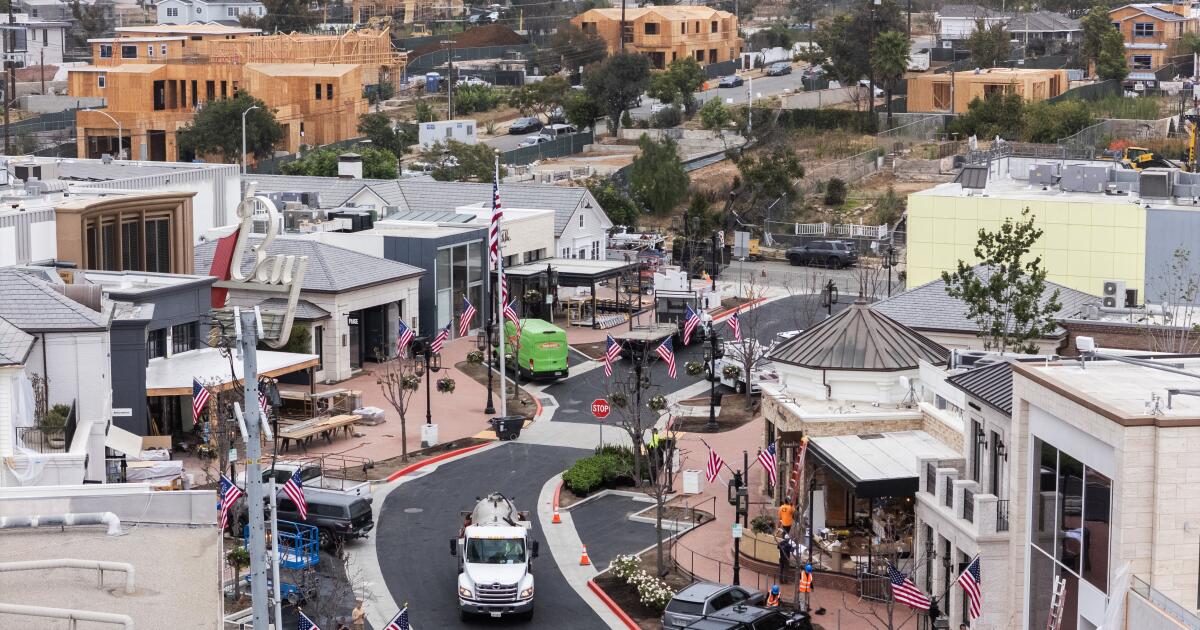
The luxury shopping center in Pacific Palisades will reopen next month after more than $100 million in renovations forced by the January 2025 wildfire that devastated the Los Angeles neighborhood.
Palisades Village will reopen Aug. 15, owner Rick Caruso announced Wednesday. The outdoor center survived the blaze that destroyed homes and other businesses but needed refurbishment to eliminate contaminants that the fire could have spread.
Crews are putting finishing touches on mall buildings after tearing them down to the studs, treating the wood and rebuilding the walls, Caruso said.
“Everybody’s working, and stores are moving their products in,” he said. “It’s a really cool feeling that people have really locked arms and are working together.”
An electrician installs lighting for a restaurant at Rick Caruso’s Palisades Village on Thursday. The shopping center is scheduled to reopen mid-August.
(Myung J. Chun / Los Angeles Times)
Pacific Palisades resident Allison Polhill, who is rebuilding the home of 30 years that her family lost in the blaze, said she is “thrilled” at the prospect of returning to the mall she used to frequent. Its comeback is a boost for the community, she said.
“Every single step that we make to reopen our commercial corridors is going to bring more people back into the Palisades,” said Polhill, who expects to move back into her home at the end of August.
A total of 6,822 structures were destroyed in the Palisades fire, including more than 5,500 residences and 100 commercial businesses, according to the California Department of Forestry and Fire Protection.
Caruso previously attributed the mall’s survival to the hard work of private firefighters and the fire-resistant materials used in the mall’s construction.
The $200-million shopping and dining center opened in 2018 with a movie theater and a roster of upmarket tenants, including Erewhon, which may be the only grocer in the heart of the fire-ravaged neighborhood when it opens.
Caruso’s company was able to fill the mall with tenants despite the long shutdown.
Palisades Village is 99% leased, with the majority of tenants returning, said Jackie Levy, chief financial and revenue officer. Nearly one-third of the shops and restaurants are new to the property.
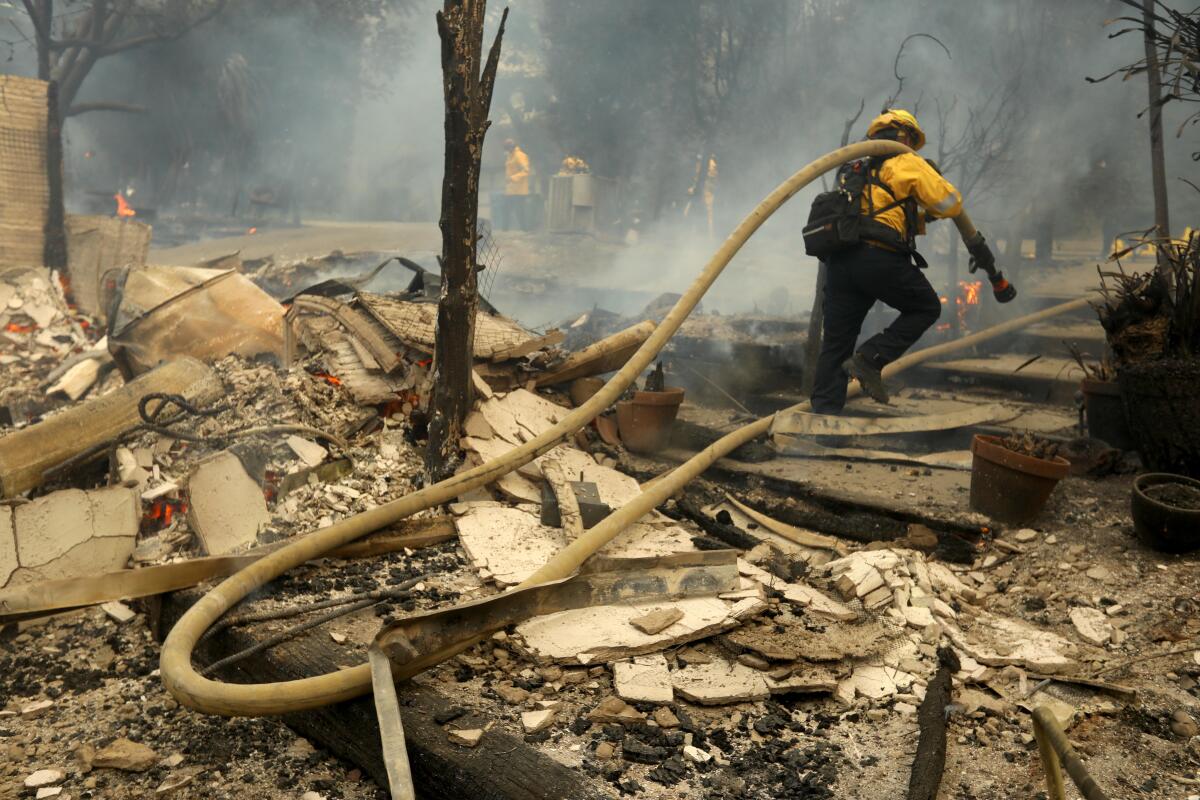
A firefighter carries a hose back to his rig while walking through a destroyed home from the Palisades fire in Pacific Palisades on Jan. 7, 2025.
(Genaro Molina / Los Angeles Times)
Last year, Pacific Palisades-based fashion designer Elyse Walker said she would reopen her eponymous store in Palisades Village after losing her 25-year flagship location on Antioch Street to the inferno.
Other neighborhood shops destroyed in the fire that are reopening at the mall include K Bakery and Loomey’s Toys, which caters to children up to age 12 and used to be across the street from Palisades Elementary Charter School.
“It’s been a journey and I’m excited because I wasn’t sure that there was going to be a place to come back to,” said toy store owner Amanda Rastegar. “Hopefully we can bring some of that magic back.”
Rastegar’s home in the Palisades survived but was damaged by the fire. The family returned about eight weeks ago. Her last memory of the fire was a burning supermarket.
“I just couldn’t wrap my brain around what was happening,” she said. “By the time I left, Gelson’s was on fire.”
Among the returning tenants is Angelini Ristorante & Bar. Well-known Los Angeles chef Gino Angelini said he will be in the kitchen next month for a return of the Italian restaurant.
“We won’t do a big celebrity open,” he said. “We want to have a very soft opening and see our customers come back.”

Construction takes place at Rick Caruso’s Palisades Village on Thursday. The shopping center is scheduled to reopen mid-August.
(Myung J. Chun / Los Angeles Times)
An elaborate celebration would not feel “correct for me,” Angelini said, because the devastation has been “very sad” for so many.
Other new tenants include local chef Nancy Silverton, who has agreed to move in with a new Italian steakhouse called Spacca Tutto. Women’s activewear retailer LESET will open its first West Coast location.
Caruso said he is optimistic that customers will return to the center, even though many Pacific Palisades residents are still dispersed. One tracking system estimated that about 30% of the Village’s customer base was impacted by the fire, he said.
“That means 70% did not get impacted, so there’s a lot of customers still left out there,” Caruso said. Historically, the center drew customers from as far away as Beverly Hills and Calabasas, as well as Malibu, Brentwood and Santa Monica.
He also hopes many will be inspired to visit the revived mall.
“I believe in the goodness of people and I believe that people are going to want to support the Palisades,” he said. “They’re going to want to be there and support the businesses that have had the courage and the heart to reopen.”

Walmart is rapidly expanding its network of electric vehicle chargers designed for customers to use while they shop.
The network could help fill gaps in EV infrastructure in states with greater need for chargers. Walmart, which has more than 5,000 locations in the U.S. and hundreds in California, says more than 90% of Americans live within 10 miles of one of its stores.
The chargers also offer an incentive for customers to choose Walmart — Walmart Plus members will receive a 10% discount off an average price of $0.46 per kilowatt-hour of energy at the company’s chargers.
Walmart chargers are already available at more than 75 locations in 17 states, with Texas boasting the most charging stations, followed by Florida and Arizona.
Matthew Nelson, Walmart’s director of energy policy, said last week on LinkedIn that the network will soon reach 29 states, including California.
“We are delivering on the promise of affordable, reliable and convenient charging,” Nelson said in his post.
According to Walmart’s website, six charging stations are coming to California soon, though the company did not offer a specific timeline.
The chargers will be installed at stores in Antelope, Brea, Fresno, Stockton, Suisun City and Vallejo.
Most charging sites in California will include eight to 16 fast-charging stalls, said Walmart spokesperson Kelsey Bohl.
The company first announced plans in April 2023 to install its own EV chargers at Walmart and Sam’s Club stores, with a goal of installing thousands of chargers by 2030. Partnering with ABB E-Mobility and Alpitronic, it added 25 new charging sites this past May and six more in June.
“Walmart is building a leading retail-integrated EV fast-charging network, focused on delivering an affordable, reliable and convenient charging experience where customers already shop,” Bohl said in an emailed statement. “Customers can charge while they shop, access stations through the Walmart app they already use, and benefit from affordable pricing.”
The charging stations already available include 612 individual charging stalls using 400-kilowatt chargers. Each stall has a dual charging cord with both Combined Charging System and North American Charging Standard connectors. The standard connectors, designed by Tesla, are smaller and lighter than the combined systems.
The primary way to pay for the chargers is through the Walmart app, but the company is also experimenting with built-in credit card readers to allow those without the app to use the stations.
Customers can check charger availability on the Walmart app. The company said the chargers will be available 24 hours a day.

Robotaxis could be turning into robocops.
A self-driving Waymo reported two teens to San Mateo, Calif., police on Monday after they were found drinking alcohol and shooting toy guns in the back of the vehicle.
According to a social media post from the San Mateo Police Department, officers detained two 15-year-olds after the Waymo they were riding in contacted the department and stopped in a parking lot until law enforcement arrived.
“Parents do you know where your teens are?” the San Mateo Police Department wrote on Facebook following the incident. “Waymo does!”
Officers removed both teens from the vehicle and determined they were using toy guns to shoot Orbeez out the windows. Orbeez are small, water-absorbing beads sold at toy stores.
“Toy guns, water guns, and BB guns all pose real dangers, especially to an untrained eye,” the Police Department said. “The simple handling of them can cause fear in [passersby].” “
A video posted on Facebook shows at least five officers and a police dog responding to the scene and approaching the Waymo with their weapons raised.
Waymo did not immediately respond to a request for comment.
Waymo vehicles have internal cameras and microphones that may be used in an emergency or to “promote safety and security,” according to Waymo’s online support page.
The cameras are also used to ensure the vehicles are clean and to help find lost items, according to the support page.
The company said it does not use facial recognition or other biometric identification technologies to identify individuals.
“In more urgent circumstances, support may access live video during a trip,” the Waymo page said.
The San Mateo Police Department’s Facebook post has garnered nearly 60 comments, with one user accusing Waymo of “snitching.”
“At least they got a designated driver?!” one user commented.
-
 Lifestyle31 minutes ago
We unpack the 2026 Emmy nominations : Pop Culture Happy Hour
-

 Technology39 minutes ago
Get a $30 credit when you reserve Samsung’s upcoming Galaxy phones
-

 World46 minutes ago
Critics say Turkey’s verbal attacks on Israel have crossed into antisemitism
-

 Politics48 minutes ago
WATCH: Dana White drops 2028 hints while raving about his favorite Trump cabinet secretary
-

 Health54 minutes ago
Katie Couric couldn’t remember the year or the president during frightening brain episode
-

 Sports1 hour ago
Justin Verlander announces he will retire after this season: ‘I’ve realized that time has come’
-

 Technology1 hour ago
Apple AI security update proves hackers move fast
-
Business1 hour ago
Fire-damaged Pacific Palisades shopping center sets reopening date

