Business
10 years since Aliso Canyon: Disaster was wake-up call for U.S. on dangers of underground gas


On an evening 10 years ago, Porter Ranch resident Matt Pakucko stepped out of his music studio and was walloped by the smell of gas — like sticking your head in an oven, he recalled.
Pakucko called the fire department. It turned out crews had already been up to the Aliso Canyon gas storage facility in the Santa Susana Mountains behind the neighborhood, responding to a report of a leak. Many of his neighbors were beginning to feel ill, reporting issues such as heart palpitations, vomiting, burning eyes and bloody noses.
“I swear I thought I was standing behind a 747 with its engines blowing — it was not just gas, it was oil smell, it was chemical smell that permeated,” recalled Pakucko, who went on to co-found the advocacy group Save Porter Ranch. “I couldn’t stay out there for 30 seconds. It tasted like f— gasoline.”
Soon it was clear that this wasn’t just a leak — it was a blowout. Over the course of 112 days, the Aliso Canyon facility would spew an estimated 120,000 tons of methane and toxic chemicals into the atmosphere. It was the worst natural-gas well blowout in U.S. history, and an environmental disaster whose effects will be unpacked for generations.
The event was widely seen as a wake-up call to the dangers of methane and underground natural gas storage. Methane, a planet-warming greenhouse gas, is about 80 times more potent than carbon dioxide and is responsible for about a quarter of all the human-caused climate change we are experiencing. A study published by UCLA researchers last month found that women in their final trimester of pregnancy who were living within 6.2 miles downwind of the blowout in 2015 had a nearly 50% higher-than-expected chance of having a low birth-weight baby.
The blowout ushered in a wave of new regulations to strengthen the governance of natural gas storage facilities in California and the United States, as well as new tools and technology to monitor methane emissions.
But 10 years later, some Porter Ranch residents say the wounds still feel fresh, and too many promises have been broken. After the disaster, then-Gov. Jerry Brown called for the permanent closure of Aliso Canyon by 2027 — a goal his successor, Gavin Newsom, called a top priority and vowed to meet even sooner.
Instead, Aliso Canyon remains open, with regulators voting in December to continue using the facility for years — probably into the 2030s — citing the need for natural gas to help maintain affordable energy rates and grid reliability in California.
The facility is a key asset for Southern California Gas. In an emailed statement, the company said the state would struggle to meet electricity demand without Aliso Canyon’s storage. The site fuels 17 power plants and helps keep the lights on during the hours that can’t yet be met by solar, wind and other renewable resources, the company said. Natural gas still represents about 40% of the state’s electricity supply.

“There’s a lot of work to do to get off natural gas and oil in California,” said Adam Peltz, senior attorney with the nonprofit Environmental Defense Fund. “That work is underway, but it’s not complete. If you’ve built an economy on fossil fuels, it takes awhile to get off of it.”
Aliso Canyon was originally drilled as an oil field in the late 1930s before SoCalGas converted it to natural gas storage in the early 1970s. Utilities often use played out crude oil fields as places to pump gas downward under pressure and hold it until it is needed.
Aliso Canyon is one of the largest natural gas storage facilities in the U.S.
In the lead-up to the blowout, SoCalGas was filling the site in preparation for the winter heating season. Crews were using tremendous force to pump gas down a well that was more than 60 years old. But a metal casing on well SS-25 had corroded, and gas began blowing out at very high volumes.
Methane is not visible to the naked eye, but aerial images captured with infrared cameras and released by the Environmental Defense Fund showed a geyser-like eruption of the flammable, climate changing gas — making it clear to the whole world the magnitude of the disaster.

Matt Pakucko, right, founder of Save Porter Ranch, and other protesters against SoCalGas hold a rally at the intersection of Tampa Avenue and Rinaldi Street on Sept. 28, 2021, in Porter Ranch.
(Irfan Khan / Los Angeles Times)
It took nearly four months for crews to stop the leak. By that time, damage was done. More than 8,000 households were temporarily displaced, businesses were shut down, and two schools were relocated for several months.
Researchers are still working to unpack the health outcomes of the event. SoCalGas, meanwhile, has paid about $2 billion in settlements and agreed to operate the facility at a lower maximum pressure.
Officials with the gas company said they have shored up the facility, including replacing the inner steel tubing on all operating wells and conducting continuous ambient methane monitoring. All wells at the site are subject to real-time pressure readings and visual inspections four times a day, among other protocols, SoCalGas said.
“Over the past 10 years, SoCalGas has conducted comprehensive safety reviews and implemented multiple safety layers that protect one of California’s most important assets for energy reliability and affordability,” the company said.
While the maximum allowable operating pressure at the site remains reduced — about 3,183 pounds per square inch compared with 3,600 pounds per square inch in 2015 — state officials recently voted to let SoCalGas increase storage at the facility to 68.6 billion cubic feet of natural gas from 41 billion cubic feet, outraging many in the community.
But experts say there are silver linings to the disaster. California overhauled its underground natural gas storage regulations to make them the strongest in the nation and among the strongest in the world, according to Peltz, of the Environmental Defense Fund. The changes include more thoughtful rules for well construction, better monitoring and risk management, and improved planning and emergency response.
Congress reacted to the disaster by requiring its regulatory agency, the Pipeline and Hazardous Materials Safety Administration, to issue safety standards for natural gas storage nationwide. In 2016, it adopted best practices recommended by the American Petroleum Institute, which were strengthened at the beginning of this month.
Many states with natural gas storage previously had no regulations at all, Peltz said.
“On a national basis, the systems will be safer as a result of that change,” he said.
There have been technological advancements too. The infrared aerial recording of the leak captured in 2015 was a relatively new technique at the time, but has now become commonplace. The California Air Resources Board conducted its first large-scale statewide aerial methane survey in 2016, identifying many of the largest methane sources in the state.
There have also been considerable advancements in the ability to observe methane super-emitters through satellites and remote sensors, according to Seth Shonkoff, executive director at the science research institute PSE Healthy Energy and an associate researcher at the UC Berkeley School of Public Health.
“The rub is that we know more than we ever have, and we’re perhaps controlling more than we would have if we didn’t have the technology to see them, but we’re still seeing more and more of these large-scale emission events all across the United States and all across the world,” he said.
Methane concentrations in the atmosphere are still rising. It is streaming, often constantly, from facilities associated with the oil and gas industry, landfills and dairy farms, among other sources.
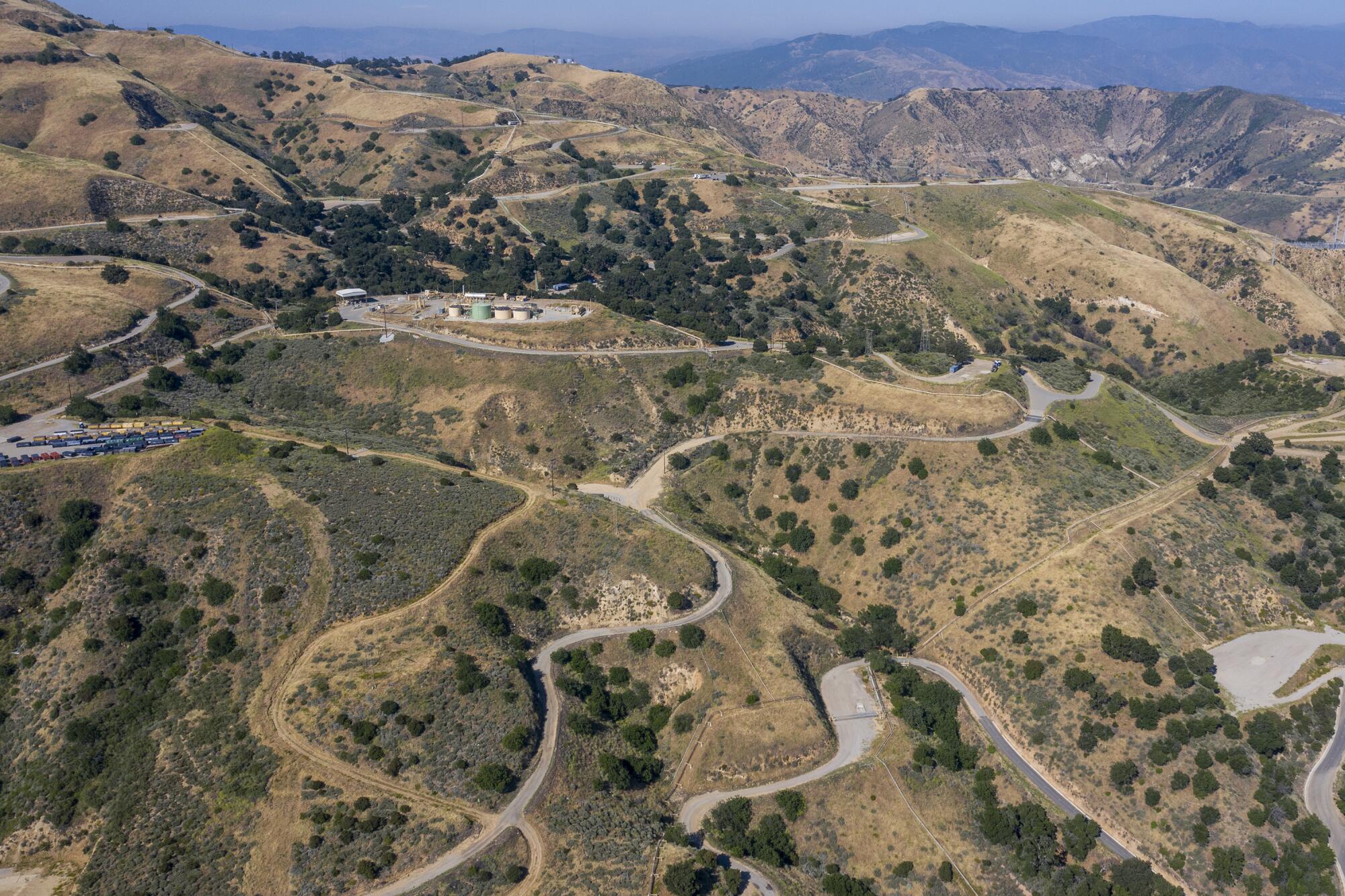
The Aliso Canyon Southern California Gas storage facility on May 28, 2020.
(Robert Gauthier / Los Angeles Times)
Methane isn’t the only concern either. Researchers now have a better understanding of what’s in the gas that blew from Aliso Canyon and that continues to be stored in natural gas facilities around the country. Although it is primarily composed of methane, roughly 99% of samples analyzed by Shonkoff and his team have contained hazardous air pollutants such as benzene, hexane and toluene, largely as a result of commingling with depleted oil and other subsurface materials.
Moving forward, he said, it will be critically important for gas companies to disclose to regulators and risk managers what their gas is composed of, so that if it leaks, responders can quickly determine the appropriate response.
“If we had had that with Aliso Canyon, we could have, within a matter of hours, understood whether people should get out of the way or stay inside, and we wouldn’t have had as many people suffering from health symptoms,” Shonkoff said.
In 2024, the Biden administration passed the first comprehensive rules to limit methane pollution by fining oil and gas developers for excessive emissions. But this year, the Trump administration revoked the rule, which it described as a tax.
At the same time, many natural gas storage facilities across the country are old and require retrofitting to meet current regulations, but such upgrades can be slow and expensive — often leaving ratepayers on the hook.
Residents near Aliso Canyon have also long feared an earthquake or wildfire in the area. The gas field sits along the Santa Susana fault and is in a high fire hazard severity zone. SoCalGas says it has numerous safety plans and procedures in place.
Perhaps the greatest tension remains between those who wish to see Aliso Canyon shuttered and the officials who say the facility is critically important to California’s energy supply, which is increasingly trying to serve power-hungry artificial intelligence data centers.

Dozens of Porter Ranch protesters chant “shut it all down,” as they demonstrate at the Aliso Canyon gas storage facility in Porter Ranch on May 15, 2016.
(Francine Orr / Los Angeles Times)
California has committed to reaching 100% carbon neutrality by 2045. But SoCalGas says it still needs Aliso Canyon.
“SoCalGas is aligned with the state of California in pursuing the technologies and infrastructure that supports California’s climate plan, including clean renewable hydrogen and renewable natural gas, that could, over time with other renewable energy projects, deliver the reliability and affordability Aliso Canyon supports today,” the utility said in a statement. However, any decision to reduce or eliminate operations at Aliso Canyon must be based on genuine reduced demand that is permanent, the company said.
Pakucko, of Save Porter Ranch, noted that the facility was offline for two years after the blowout without an interruption in service.
“Two years!” he said. “And guess what? We managed without the facility.”
For others in the area, it feels like the latest in string of broken promises.
Among SoCalGas’s settlement agreements was a $120-million consent decree with the state of California requiring the utility to fund methane mitigation projects, air monitoring and other initiatives to address alleged harms caused by the blowout. About $25 million of that went toward a long-term health study on the effects of natural gas exposure, which is being conducted by researchers at UCLA. The results are eagerly awaited.
About $26 million went to a program for dairy digesters in the Central Valley, which capture methane from cow manure before it enters the atmosphere. Many had hoped those funds would be spent closer to home, including former L.A. Mayor Eric Garcetti, who at one point envisioned the mitigation money being used to transform Porter Ranch into a net-zero community.
“That would have been so great,” said Patty Gleuck, a Porter Ranch resident who served on the community advisory group for the health study. Instead, “that money went to this dairy digester program that does not benefit this area.”
Like Pakucko, Gleuck recalled suffering health effects during the blowout, including a tightness in her chest and a metallic taste in her mouth that dissipated when she left the area and resumed when she returned.
She still suffers from a chronic cough and uses an inhaler, she said, adding that “a lot of inhalers were prescribed in the area.”
“A lot of people moved away, taking a loss on their homes because they were so sick, or their family members were sick,” she said. “I just don’t think that there has been justice.”


A proposal to build a truck parking lot near the Port of Los Angeles is facing backlash from nearby residents.
Port officials say the parking lot would provide much-needed designated space for cargo trucks waiting to pick up loads from the port, helping to ease congestion in the area.
But some neighborhood groups say the proposed staging area would only increase traffic and air pollution in Wilmington.
Gina Martinez, chair of the executive board of the Wilmington Neighborhood Council, said the land in question provides a vital buffer between port activity and residential communities.
“It’s been a bad deal from the beginning,” Martinez said in an interview. “We want open space because we’ve been promised for decades a clear separation from port activities.”
The Los Angeles Harbor Commission signed off on the project in a meeting on June 11, but it was vetoed by the Los Angeles City Council this week.
The veto does not permanently ban the project, but allows for more time to discuss the implications for stakeholders and the community.
Los Angeles City Councilmember Tim McOsker, who introduced a special motion to halt the truck plans, said he was acting on behalf of community residents. McOsker represents Harbor City, Harbor Gateway, San Pedro, Watts, and Wilmington.
“Generally, folks in the community would say, ‘we don’t want the port industrial properties to creep into neighborhoods. We want them to retract or hold the line,’” McOsker told The Times.
The John S. Gibson Truck & Chassis Parking Lot, which was originally proposed in 2023 by the Port of Los Angeles, would cover 18 acres of privately owned land and include 393 truck and chassis parking stalls.
The land is currently designated as open space, though it’s undeveloped and not available for any recreational use. The completion of the parking lot would require a Port of Los Angeles master plan amendment to switch the land’s designation from open space to maritime support.
Martinez said the land should have never been sold to private developers because it’s included in the California State Lands Commission’s tidelands trust, which says certain land near the ocean must be available for public enjoyment.
Building a truck and chassis waiting lot on that space would increase congestion on the freeways and in Wilmington neighborhoods, add particulate matter into the air and increase already-problematic noise pollution from the port, she said.
“Of all the things Wilmington needs, it is not another parking lot for trucks,” Martinez said at a Los Angeles Harbor Commission meeting earlier this month. “It is not the responsibility of our community to take on every single truck that runs through the port.”
At the same meeting, Noel Gould of the Coastal San Pedro Neighborhood Council said the council is supporting the project after working closely with the developers to reach compromises.
The parking lot would prevent port-bound trucks from idling near schools and parks, he said. The lot would also include landscaping with native coastal plants.
“We didn’t start out in a position of support, but we worked very closely with them to get to a place where we felt it was really something that would benefit the community,” Gould said at the meeting.
In an interview, McOsker said there is already space set aside for trucks to wait to access the port.
At the Los Angeles City Council meeting Wednesday, the council unanimously approved what’s known as a 245 motion, which gives the council authority to temporarily veto certain actions taken by city boards and commissions.
“The 245 gives us the opportunity to meet and confer and see if there are revisions or additions or mitigation that can better protect the full community,” McOsker said.
The motion sends the project proposal back to the Harbor Commission for further review.
Supporters of the parking lot say the land is currently uninhabited and requires consistent police presence to deter criminal activities.
The Port of Los Angeles also clashed with coastal communities last year over the possible raising of the Vincent Thomas Bridge. The bridge was already slated to be redecked by the California Department of Transportation, but Port of Los Angeles executive director Gene Seroka proposed raising the bridge height as well.
Raising the bridge would allow larger cargo ships to pass under its deck, helping create jobs and keep the port relevant, Seroka said at the time. Most painfully for local commuters and businesses, it would mean the bridge will be closed for around 28 months rather than the originally planned 16 months.
Last December, the California State Transportation agency rejected the proposal to raise the bridge.
Business
Commentary: Puncturing the myth of Alan Greenspan, whose policies gave us the Great Recession

Noah Cross, the archvillain of the movie “Chinatown,” had the definitive line on how old age brings respectability. “‘Course I’m respectable,” he tells Jake Gittes. “I’m old. Politicians, ugly buildings and whores all get respectable if they last long enough.”
I wouldn’t necessarily slot former Federal Reserve Chairman Alan Greenspan into any of those categories, but the general reaction to his death Monday at age 100 puts the lie to Cross’ observation.
As much as he was revered during his nearly two decades as Fed chairman for protecting the stock market from a series of crashes and near-crashes, his obituaries take a more measured view. The headline on the Wall Street Journal’s main take on his legacy is: “The Myth of Alan Greenspan as ‘The Maestro.’”
Stripped of its academic jargon, the welfare state is nothing more than a mechanism by which governments confiscate the wealth of the productive members of a society to support a wide variety of welfare schemes.
— Alan Greenspan, writing as an Ayn Rand cultist (1966)
The Journal blames Greenspan for fostering “the great credit mania of the mid-2000s” and observes that “the music stopped in 2008, producing the panic that did so much harm to the free-market economy that Greenspan promoted.” That was the Great Recession, which started with the 2008 crash in the housing market and persisted into 2012.
That is from a publication that was more or less in accord with Greenspan’s goals of less regulation and lower taxes. His contemporary adversaries were harsher. “R.I.P. Alan Greenspan: You were charming, thoughtful, powerful, and wrong,” writes Robert Reich, who served as Bill Clinton’s Labor secretary while Greenspan led the Fed.
The Great Recession, “in which in which millions of Americans lost their jobs, their savings, and even their homes — resulted from the deregulation of Wall Street that Greenspan advocated,” Reich wrote. But he had to admit that Greenspan’s “iron grip” over Fed policy forced Clinton “to do exactly what Greenspan wanted — which was to reduce the federal budget deficit and thereby destroy much of the agenda Clinton ran on.”
It would be unfair to depict Greenspan’s influence as invariably pernicious. Social Security advocates still think highly of his work chairing the so-called Greenspan Commission of 1982-1983, which developed a series of changes in benefits and revenues for that program to address a looming, immediate fiscal crisis.
Greenspan led the bipartisan panel “masterfully,” recalls William J. Arnone, the former chief executive of the National Academy of Social Insurance, who witnessed its deliberations as a consultant to the New York Citizens Committee on Aging.
Before the commission’s formation, “Republicans and Democrats fiercely disagreed over underlying data,” Arnone told me. “Greenspan used his expertise as an economic empiricist to convince both sides to agree on a singular, shared set of actuarial facts. Quite an accomplishment.”
To the public, Greenspan was known for his impenetrably cryptic speaking style and for the relative tranquility in the American economy during his tenure, which has been termed “the great moderation” despite recurrent short-term crises.
Greenspan was the second-longest serving Fed chair. But he may have had the weirdest background. Having grown up in an affluent New York household, he was talented enough on clarinet and saxophone to have sat in with Stan Getz’s band and attended Juilliard for a time.
He began his economics education in 1945 at New York University and got as far as a master’s degree, but by then he was already working on Wall Street, where his skill at financial analysis propelled him toward the top echelons of high finance.
Somewhere along the line he fell in with the arch-libertarian Ayn Rand, becoming part of her inner circle of economic cultists. Referring to his dour mien and predilection for charcoal gray garb, Rand called him her “undertaker.”
Greenspan provided a veneer of rigorous economic analysis for Rand’s ideology, which lionized the rich and described them as fighting a ferocious battle with the lazy and grasping hoi polloi. He contributed three essays to her 1966 anthology “Capitalism: The Unknown Ideal.”
His association with Rand was seldom highlighted during his Fed tenure, but even a casual reading of those essays exposes the Randian underpinnings — and the Randian self-contradictions — of his Fed policies.
One essay defended the gold standard, which had been discredited in the 1930s. Greenspan blamed “welfare-state advocates” for the developed world’s abandonment of the gold standard.
He wrote, “Stripped of its academic jargon, the welfare state is nothing more than a mechanism by which governments confiscate the wealth of the productive members of a society to support a wide variety of welfare schemes…. Gold stands in the way of this insidious process. It stands as a protector of property rights” — language that could have come right out of the text of Rand’s “Atlas Shrugged.”
Another essay called for the dismantling of government regulators such as the Food and Drug Administration and the Securities and Exchange Commission. Greenspan’s argument was that the consumer was adequately protected by the businessman’s profit-seeking, which in turn depended on maintaining a reputation for honesty and fair-dealing.
For drug companies, he wrote, “the loss of reputation through the sale of a shoddy or dangerous product would sharply reduce the market value of the drug company.” The same goes for securities brokers — “The slightest doubt as to the trustworthiness of a broker’s word or commitment would put him out of business overnight.”
One might ask what inspired Greenspan’s faith in, well, the faithfulness of business enterprises, given centuries of proof otherwise. Anyway, he refuted his own argument. “The guiding purpose of the government regulator is to prevent rather than to create something,” he wrote. “He gets no credit if a new miraculous drug is discovered by drug company scientists; he does if he bans thalidomide.”
He didn’t bother to question why his trustworthy drug companies had tried to market as a morning-sickness drug in the U.S. a formulation that already had been shown to produce severe birth defects in the children of mothers who took it overseas. (American families were largely saved from this tragedy by Frances Oldham Kelsey, who blocked its importation as an official of, yes, the FDA.)
To stock market investors, Greenspan’s chief legacy was the “Greenspan Put.” This was an implicit commitment by the Fed to counteract sharp declines in the market by pumping liquidity into the economy through the mass purchase of Treasury bonds.
The term comes from the options market, in which a “put” gives the holder the right to sell the underlying stock at a set price in the future, even if the market price has fallen below that price. In effect, it establishes a floor to the investor’s losses in a downturn.
The Greenspan put first appeared on Oct. 19, 1987, when the stock market suffered its greatest one-day percentage crash ever, 20.47%. Greenspan had been in office for only a few weeks, but his Fed issued a statement promising to inject liquidity into the system and cut interest rates. “We will back you,” he told bankers in a series of phone calls.
In truth, Greenspan had no legal authority to make that pledge. In any event, the market recovered the next day, and the Fed’s image as a willing bulwark against market declines was born.
The problem was that the idea that the Fed would act in a market crisis encouraged ever more flagrant risk-taking on Wall Street.
The harvest was a series of crises, notably the 1998 collapse of the hedge fund Long Term Capital Management, which was founded by Nobel economics laureates to pursue abstruse arbitrage trades. It was brought low by market moves that confounded their projections. LTCM was so deeply embedded in Wall Street trading it had to be saved with a $3.6-billion bailout the Fed orchestrated.
The Greenspan put, like so many other such grand schemes, worked well right up until it stopped working. That moment came in 2008, with a crash and a long, throbbing hangover.
Testifying to Congress in 2008, Greenspan acknowledged that maybe self-regulation, that watchword of his economic worldview, didn’t work.
“I made a mistake in presuming that the self-interest of organizations, specifically banks and others, were such that they were best capable of protecting their own shareholders and their equity in the firms…. Something which looked to be a very solid edifice, and, indeed a critical pillar to market competition and free markets, did break down.”
That, he said, “shocked me.” It was a rare admission of blame by a man who, as my former colleagues Thomas S. Mulligan and Don Lee reported in their Greenspan obituary, had told CNBC a few months earlier that he had “no regrets” about his policies.

San José tech company Cisco plans to cut 471 workers in three Bay Area offices, according to layoff notices filed to a state agency.
The company, which provides networking devices along with other services including video conferencing and cybersecurity, told employees in May that it was going to cut fewer than 4,000 jobs or less than 5% of its workforce.
The notices, processed by the California Employment Development Department this week, provide more details about what jobs Cisco will cut in California.
The artificial-intelligence boom has fueled more investments in data centers, commercial real estate and other areas. But advancements in AI tools have also been reshaping jobs, especially in Silicon Valley, the epicenter of the tech industry.
Cisco’s layoffs in California impacted workers in its San José, Milpitas and San Francisco offices. The company cut a variety of roles in software engineering, product management, design, business operations and other areas, the notices show.
Cisco said it didn’t have anything additional to share beyond what it published in May about its restructuring plans.
Tech companies have been citing various reasons for layoffs including prioritizing investments in artificial intelligence. As workers use AI-powered tools to generate code, words and other content, some executives have said they don’t need as many employees. There’s also skepticism, though, about how big a role AI is playing at companies with a large amount of workers globally.
From January to May, U.S. technology companies announced 123,653 cuts, up 66% from the same period in 2025, according to a June report from global outplacement and executive coaching firm Challenger, Gray & Christmas. The firm said that AI was the leading reason companies cited for cuts but it still isn’t the “jobpocalypse some predicted.”
Meta, Snap, Block, Oracle and Amazon are among tech companies that have announced mass layoffs this year.
Cisco markets itself as a company that “provides critical infrastructure for the AI era” and has benefited from the AI boom, reaching a record revenue of $15.8 billion in the third quarter this year. The company’s net income grew 35% to $3.4 billion year-over-year during that quarter.
Cisco Chief Executive Chuck Robbins told employees in May it’s cutting costs in certain areas while prioritizing other investments. That includes employee use of AI across the company.
He said Cisco will be among winners in the AI era, but that means “making hard decisions — about where we invest, how we’re organized, and how our cost structure reflects the opportunity in front of us.”
As of July 2025, Cisco had roughly 86,200 employees, according to its annual report.
-

 Delaware4 minutes ago
Severe thunderstorm to bring 60-mph winds, hail to Sussex County
-

 Florida11 minutes ago
From pizza to Panthers: How Simas Ignatavicius landed with Florida | Florida Panthers
-

 Georgia14 minutes ago
Ossoff, Bottoms declare ‘United for Georgia’ at first joint campaign rally – The Current
-

 Hawaii19 minutes ago
Famed Beach Is Disappearing. Should Hawaii Save It?
-

 Idaho26 minutes ago
CEI Early College Program earns national accreditation – East Idaho News
-

 Illinois29 minutes ago
Pritzker signs new Illinois law to install speed-limiters in speeders’ vehicles
-

 Indiana34 minutes ago
Its been my dream school ever since I was little Micah Mohler on receiving an Indiana scholarship offer
-

 Iowa41 minutes ago
Iowa City school board selects familiar face as interim superintendent

