Business
Commentary: Trump wants you to invest your 401(k) in crypto and private equity. Should you bite?

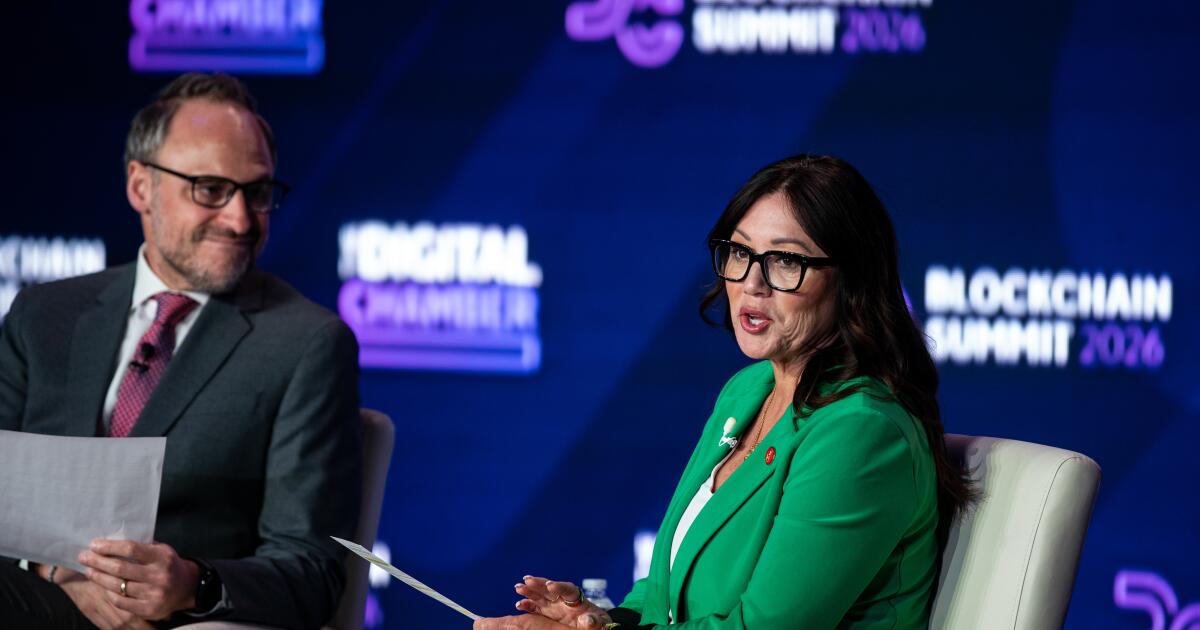
Trump is opening the door to risky ‘alternative investments’ such as crypto and private equity in 401(k) plans. But employers have had good reasons to keep them out of their plans.
If you believe Labor Secretary Lori Chavez-DeRemer, American 401(k) accounts are about to get much better.
Thanks to President Trump’s “bold new vision of a new golden age for America,” Chavez-DeRemer wrote in the Wall Street Journal on March 30, her agency is taking steps to open these crucial retirement accounts to a raft of new investment options, such as cryptocurrencies and private equity funds.
Her goal, she wrote, is to “unwind regulatory overreach and litigation abuse that have stifled innovation.” Her instrument is a proposed regulation that in effect would provide a safe harbor for plan sponsors — that is, employers — to offer those options in their employees’ plans without risking lawsuits or government scrutiny over whether they’re sufficiently prudent for workers to choose.
We have seen a number of proposals from private equity funds where the returns are really not calculated in a manner that I would regard as honest.
— Warren Buffett (2019)
Notwithstanding Chavez-DeRemer’s assertion that this change would be all to the good for workers, the truth is that she and Trump are acting at the behest of alternative investment promoters, who have long slavered for access to the nearly $14 trillion in assets held in 401(k)s and other such defined contribution retirement plans.
Far be it for me to offer anyone investment advice. But there are a few things that Trump and DeRemer aren’t telling you about these proposed new options. Namely, the dangers they present to unwary small investors.
The first clue that something is being hidden appeared in DeRemer’s op-ed, in which she blamed “Washington bureaucrats” and “plaintiff lawyers” for stifling the financial innovation that people supposedly have been clamoring to put in their retirement accounts.
You know who rails against “Washington bureaucrats” and “plaintiff lawyers”? Businesses that are fearful that government regulators and juries will clamp down on their wrongdoing. These critiques are often described as efforts to get government off the backs of the people. What they don’t explain is that once government has climbed off, big business will saddle up.
(As I’ve reported, among the businesses that have recently been demonizing plaintiff lawyers is Uber, which is pushing a ballot measure in California that would all but shut the courthouse doors to some passengers injured during Uber rides.)
So let’s examine the unacknowledged issues with “innovative” alternative investments. Private equity firms are known for buying companies that are either held privately, or are public companies due to be taken private. In many cases, they turn profits for their investors by cutting payrolls and reducing services at their portfolio companies, then draining what’s left until there is nothing left. Cryptocurrencies, as I’ve written, are a scam all their own.
We’ll start with the implicit and explicit rules guiding employers when they decide what investment choices to offer workers in their 401(k)s.
“Employers are fiduciaries, which means they must make decisions about retirement investments that are in their employees’ best interest,” observes Eileen Applebaum of the Center for Economic and Policy Research. “They must be prudent in curating a menu of retirement plan options for their workers. And they have been successfully sued for lack of prudence by workers whose retirement accounts held high fee, illiquid, risky investments that failed to perform.”
The fiduciary standards are developed in part by government bureaucrats. And the successful lawsuits? They’re brought by plaintiff lawyers.
In 2021, the Biden-era Labor Department warned that most sponsors of 401(k) plans and other defined contribution plans “are not likely suited to evaluate the use of [private equity] investments” in those plans. The administration shied away from outlawing such investments outright in 401(k)s. Nevertheless, employers understandably saw the warning as a yellow light, if not a flashing red light.
As of 2024, only about 4% of plan sponsors offered alternative investments, Applebaum reported. The threat of litigation also stayed their hand; 66 lawsuits were filed against plan sponsors that year, according to Encore Financial, a personal finance firm. High fees and other fiduciary failures were at the heart of most of the cases.
This isn’t the first time that Trump has tried to wedge private equity investments into 401(k)s. In 2020, during his first term, then-Labor Secretary Eugene Scalia issued an opinion that the mere presence of private equity investments among 401(k) choice was not in itself a fiduciary violation.
Scalia said his goal was to “remove barriers to the greatest engine of economic prosperity the world has ever known: the innovation, initiative, and drive of the American people.”
Until then, individuals were effectively barred from the investments by a Securities and Exchange Commission rule allowing only “accredited” investors — those who could show annual income of more than $200,000 or net worth of $1 million or more, not including their homes.
I didn’t offer an opinion then about the wisdom of these investments, but wrote only that “if I were inclined to invest my 401(k) money in private equity, I would hope that my family would arrange to have my head examined.”
My reasoning then was that private equity funds produce limited disclosure, or no useful disclosure at all; there are no commonly accepted formulas to measure their returns; and they’re subject to management fees immensely higher than conventional stock, bond or money market funds.
No less an experienced investor than Warren Buffett warned his own shareholders away from the sector, I pointed out.
“We have seen a number of proposals from private equity funds where the returns are really not calculated in a manner that I would regard as honest,” Buffett said at the May 2019 annual meeting of Berkshire Hathaway, which held his corporate investment portfolio.
Since then — indeed, since the Great Recession of 2007-2009 — the private equity sector has been promoting itself as a source of financial returns superior than those of conventional stock portfolios while glossing over cavils such as Buffett’s.
The promoters boast that their funds have low correlations with public markets — that is, when the public markets falter, the private markets gain; that they’re skilled at finding bargains among targeted businesses; and that they impose profit-gaining efficiencies on their acquired businesses.
In recent years, however, the private equity argument has faded. “Current data raises questions concerning these predicate assumptions,” wrote Nori Gerardo Lietz of Harvard Business School in 2024. Private equity fund performance, she observed, has “eroded materially.”
That’s true. From 2022 through the first three quarters of 2025, according to the research firm MSCI, private equity firms turned in annualized returns of 5.8%, while the Standard & Poor’s 500 index of public firms yielded 11.6%. Institutional investors such as public employee pension funds have begun to ask whether the sector deserves their money.
In the last year, the Yale University endowment and the public employee pension fund of New York City have sold off billions of dollars in private equity investments, some at a discount to their stated values. (To be fair, the California Public Employees’ Retirement System, or CalPERS, has remained a fan, attributing its recent improvement in overall returns to a strengthened investment in private equity.)
The doubts being voiced by these major investors has turbocharged the push by the private equity sector to reach into individual retirement accounts. By some measures, however, individual investors have even less tolerance for some of the features of private equity than do institutions. Unlike publicly traded stocks, these investments are illiquid, meaning they can’t be sold at will and they can’t be reliably priced.
As for crypto, the other major alternative investment being touted by Trump, its shortcomings are well documented.
In contrast to conventional stocks and bonds, they don’t represent stakes in anything concrete and as a result are extremely volatile.
Bitcoin, for instance, ran as high as $126,000 in October; as of Thursday it was priced below $72,000. Among other queasy-induced crashes, bitcoin lost 35% of its value in less than four weeks between mid-January and early February, falling from $96,929 on Jan. 13 to $62,702 on Feb. 4.
These are all factors demanding notice from small investors contemplating adding these sectors to their retirement funds. For that reason, some retirement professionals doubt that even the Trump administration’s favor will persuade many plan sponsors to open their doors to alternative investments. Trump’s regulators may be taking a hands-off approach to these sectors, but plaintiff lawyers aren’t likely to back off.
For individual investors, these are sectors that were made for the phrase “caveat emptor.” If you don’t know your Latin, it means “buyer beware.”


Netflix has long been seen as the winner in the streaming wars, with more than 325 million subscribers globally and hits like “Stranger Things” and “KPop Demon Hunters.”
For months, Netflix had been telling investors how it planned to scale its business to new heights by acquiring Warner Bros. Discovery, a potentially transformative media deal.
But after the streaming giant passed on buying the media company in February, Netflix has faced persistent questions from investors about its plans for staying on top.
Reflecting the investor unease, Netflix’s stock price, which closed Tuesday at $73.68 a share, has declined 21% this year and is down 42% from a year ago.
“Obviously, they have a very successful business,” said Ross Benes, a senior analyst at research firm eMarketer, adding that most of Netflix’s revenue comes from its subscriptions. “Your investors always want to just see more and more and more, and they mostly provide that one thing.”
Part of the reason investors are anxious is that Netflix’s share of TV viewing time in the U.S. has steadily declined in recent months as rival YouTube has gained market share, according to Nielsen data.
Netflix represented 7.8% of all TV viewing in the U.S. in April — the lowest percentage since May 2025. It was 7.5% in April 2025, Nielsen said.
By comparison, YouTube has seen its share of the streaming audience go up. YouTube’s TV viewing share in April rose to 13.4%, up from 12.4% a year earlier, Nielsen said.
Some investors fear that if viewership is down, subscribers could cancel the service, which would negatively affect the platform’s growing advertising business. It could also undercut Netflix’s ability to raise prices in countries like the U.S.
Despite the investor jitters, equity analysts estimate Netflix will have a strong second quarter, with revenue increasing 14% to $12.58 billion and net income rising 8% to nearly $3.38 billion, according to FactSet. One reason is continued growth in its advertising business and the popularity of new programming such as crime series “I Will Find You.”
Netflix will release its second quarter earnings results on Thursday. The company declined to comment for this story.
Netflix has noted that it has a low churn rate compared to competitors. The company said it has a long runway for growth, penetrating only about 5% of global TV viewing, according to a letter to shareholders in April. A number of its shows and movies appear on Nielsen’s most-watched streaming lists.
Among the company’s key priorities are broadening its entertainment offerings in areas such as live programming, games and video podcasts as well as growing its advertising business.
“A measure of our performance is engagement, which is not just the quantity of hours watched, but also the quality of that experience for our audiences,” Netflix said in its April letter, adding that its primary internal quality metric reached an all-time high in the first quarter.
“We believe we have meaningful advantages as we strive to become a must‑have service for consumers: a strong global brand, a wide range of high‑quality programming, a best‑in‑class product experience, and a frequent role at the center of culture,” Netflix said in its April letter.
Several equity analysts believe the Los Gatos-based company is still growing and remain bullish on the stock.
The last time Netflix came under major scrutiny from investors was in 2022, when it reported subscriber declines in the first quarter of that year. That pushed Netflix into pursuing other initiatives including selling cheaper subscriptions with ads, cracking down on password sharing and offering games on its service.
Last year, Netflix said it generated more than $1.5 billion in advertising and expects to roughly double that to $3 billion this year.
“We believe this is a long-term growth company,” said Jessica Reif Ehrlich, senior media and entertainment analyst at BofA Securities, who has a buy rating on the stock.
As part of its diversification, Netflix has expanded its portfolio of live programming over the years, including adding NFL games and streaming Major League Baseball’s opening day game.
But some analysts say Netflix needs to have a larger share of live sports content to draw sports fans into subscribing.
“They’re getting a lot of casual sports fans, but avid sports fans don’t need Netflix at all really, not yet,” Benes said.
Additionally, Netflix is adding new content to its platform by partnering with YouTube creators, adding video podcasts such as “The Breakfast Club” and partnering with media companies like BuzzFeed Studio to bring videos as short as three minutes to its service, which could help with viewer engagement.
“They help existing subscribers use the service more,” Benes said. “Let’s say I get in the habit of watching all these video podcasts on Netflix. It might not be the reason why I pay for it, but I might say, ‘Oh, I don’t know if I want to cancel it.’”
Some analysts think Netflix should consider other acquisitions to fuel future growth after walking away from Warner Bros. Discovery, which was scooped up by Paramount.
Comcast earlier this year announced that it plans to spin off NBCUniversal, which has properties including “Minions” and “Jurassic Park.” Some analysts speculated that Netflix could be interested in buying it.
“From our point of view, it makes a ton of sense,” Reif Ehrlich said. “Universal also has a great film and TV library. Maybe not as deep as Warner Bros., but very strong.”
Netflix executives also are considering launching live channels, including ones that are based on genres, and bundling with other streaming services, according to a person familiar with the matter who was not authorized to speak publicly. The Wall Street Journal was the first to report on the internal discussions.
Netflix launched TF1 live channels this year on its service in France in a partnership with media company TF1 Group. TF1 said its audience targets that were set for the 18-month horizon were achieved in less than three weeks.
When it comes to Netflix’s next move, anything is possible.
“Years ago, they said they wouldn’t get into advertising. They wouldn’t get into sports. They wouldn’t have theatrical releases,” Reif Ehrlich said, naming efforts that Netflix initially was adverse to doing before changing course . “So the business will continue to evolve and change.”

In a case that has become a local flashpoint, environmental groups seeking to halt a lithium operation in Imperial County until it gets further review argued before a state appeals court in San Diego on Thursday.
Controlled Thermal Resources wants to extract lithium from hot brine that will be used to power a geothermal electricity plant it plans to build. This type of lithium removal is different from traditional hardrock mining or evaporation ponds. The project also would need 6,500 acre-feet of fresh water annually for washing the mineral and cooling.
Earthworks, a nonprofit focused on the impacts of mining, and Comité Cívico del Valle, an Imperial County environmental justice group, allege the county didn’t adequately examine the project’s effects on water supply, air quality and tribal cultural resources when it granted approvals.
The groups filed suit in March 2024 and Imperial County Superior Court Judge Jeffrey Jones ruled against them in January 2025, saying the county met its legal requirements.
Before a panel of three judges for the California Court of Appeals 4th Appellate District, plaintiffs’ lawyer Doug Carstens argued that if water becomes scarcer, the project may rely on agricultural runoff that currently feeds the shrinking Salton Sea, exacerbating dust and air quality issues. He also said the environmental review did not account for future water-thirsty projects in the desert area.
“There will be a lot of straws dipping into the pool,” Carstens said.
The project, called Hell’s Kitchen, also failed to adequately involve local tribes in assessing the effect on cultural resources, he said.
Controlled Thermal Resources attorney Suzanne Varco said that the company reached out to 26 area tribes in 2021 and received no reply. She noted that one elder from Kwaaymii Laguna Band of Indians responded with concerns about mud pots and other resources in the area, but it was more than five months after the consultation period closed.
Justice Julia Kelety’s questions suggested the tribes provided names for resources in the area but failed to say how they would be affected.
Justice Truc Do said it was hard to assess fully how the project will affect the region’s water because the environmental review was unclear whether it will last 30 or 50 years. The region primarily relies on water from the overtapped and shrinking Colorado River.
The case is important because Imperial County has pegged its future to lithium, a mineral critical for electric car batteries. Two other companies are trying to reach commercial extraction near the Salton Sea. Gov. Gavin Newsom called Imperial Valley “the Saudi Arabia of lithium” in 2022, and has touted the industry’s potential to bring jobs and community benefits to one of the poorest counties in the state.
Multiple setbacks and deadline extensions later, lithium has yet to materialize even as industry job training programs graduate students into careers that have not arrived in the area. The county has blamed the lawsuit for the slow start. The boom and bust nature of mining as well as shifting federal policies have also played a role.
The court could decide within a few weeks to several months.
Earthworks and Comité Cívico del Valle have repeatedly said they don’t outright oppose lithium development in the area, but want CTR to acknowledge and minimize potential harm.
“We are not trying to stop the Hell’s Kitchen Project, we think it should be fixed, with enforceable protections for the environment, tribal cultural resources, and the health of frontline communities,” said Jared Naimark, senior manager at Earthworks.
Imperial County and CTR declined to comment on pending litigation, but Controlled Thermal Resources spokesperson Lauren Rose articulated a commitment to advancing geothermal and lithium development “as core components of our Hell’s Kitchen Project.” The company recently announced a plan to power local data centers which led some to worry about the company’s commitment to lithium.
Earlier this year the company delayed its plans for lithium production to 2028. Rose said the project is still progressing toward initial construction and will announce timing “as key development, financing, and construction milestones are achieved.”

Netflix on Thursday reported higher revenues and profit in the second quarter as it sought to assure investors about its growth prospects.
The streaming giant reported revenue of $12.6 billion in the second quarter, up 13% from a year ago. Net income during the period rose 9% to $3.4 billion.
Netflix said it expects revenue to grow 12% in the third quarter, but lowered its 2026 revenue forecast to $51 billion from $51.4 billion.
The results were roughly in line with what analysts had predicted and were driven by recent price increase and growth in advertising revenue. The latter is expected to reach $3 billion this year, the company said.
In a presentation with analysts, Netflix executives touted global expansion plans.
“We’re entertaining an audience approaching a billion people with still lots of room to grow into our addressable market on every measure,” said Spencer Neumann, Netflix’s chief financial officer, in the earnings presentation. “We believe we’ve got lots and lots of runway for solid growth ahead of us.”
Those comments appeared intended to assuage investors who’ve grown concerned that people could be spending less time on the streaming service as rivals like YouTube gain market share.
Netflix’s share of TV viewing time in the U.S. has steadily declined in recent months as rivals have gained market share, according to Nielsen data.
The streamer represented 7.8% of all TV viewing in the U.S. in April — the lowest percentage since May 2025. It was 7.5% in April 2025, Nielsen said.
By comparison, YouTube has seen its share of the streaming audience grow. YouTube’s TV viewing share in April rose to 13.4%, up from 12.4% a year earlier, Nielsen said.
Some investors fear that if viewership is down, subscribers could cancel the service, which would negatively affect the platform’s growing advertising business. It could also undercut Netflix’s ability to raise prices in the U.S. and other countries.
Those worries have caused Netflix’s stock price to plummet 41% in the last year. The stock closed on Thursday at $74.35 a share, up 1%. In after hours trading, the stock fell 8%.
“The engagement elephant continues to rear its head and investors are on edge that an earlier price hike in a seasonally tough period and lighter content slate could have driven more churn than usual,” wrote Morgan Stanley Research analysts in a research note.
On Thursday, Netflix said in a letter to shareholders it has a sophisticated understanding of its consumers and “we know not all hours are equal” and that engagement on its platform is “healthy.”
“The entertainment industry remains dynamic and competitive,” Netflix told shareholders. “We aim to stay ahead by executing against our three areas of focus: delivering more entertainment value, leveraging technology to improve every aspect of our service, and improving monetization.”
The Los Gatos-based company said it plans to allocate more than 5% of its content spend on live programming this year. Live content has been a key driver for subscriptions, accounting for six of the top 10 new member sign-up days over the last five years, the company said.
In the first half of 2026, Netflix said members watched more than 97 billion hours, up 2% from a year ago. Among the most popular shows: the crime thriller “I Will Find You,” which had 87 million views; and the romantic comedy film “Voicemails for Isabelle,” which garnered 71 million views.
Netflix has been adding new types of content to its platform, including video podcasts to help increase engagement with subscribers during the day.
As part of the diversification efforts, the platform has expanded its portfolio of live programming over the years, including adding NFL games and streaming Major League Baseball’s opening day game.
In 2022, Netflix had also faced investor pressure when it reported declining subscribers for the first time in more than a decade. That pushed the company to delve into other areas including advertising, gaming and cracking down on password sharing.
-

 Texas4 minutes ago
How a man once ordered to pay libel damages helped launch an investigation into Islamic private schools
-

 Utah10 minutes ago
Utah Jazz vs Portland Trail Blazers Summer League recap and final score
-
Vermont16 minutes ago
VT Lottery Mega Millions, Gimme 5 results for July 17, 2026
-

 Virginia22 minutes ago
Maryland, Virginia elections officials push back on Trump assertion that system is ‘broken’ – WTOP News
-

 Wisconsin34 minutes ago
Wisconsin Lottery Mega Millions, Pick 3 results for July 17, 2026
-

 West Virginia40 minutes ago
West Virginia Wesleyan College to keep Governor’s School for the Arts through 2030
-

 Wyoming46 minutes ago
Racines runs unopposed for Wyoming State Auditor
-

 Crypto52 minutes ago
‘Useless Plastic’: NSPK CEO Declares the End of Visa and Mastercard in Russia

