Fitness
3 Morning Exercises Build Core Strength Faster Than Planks After 50


Starting your day with a healthy dose of exercise can help build core strength and stability.
Many famous fitness icons believe in the power of morning exercise. Actor and fitness enthusiast Mark Wahlberg is one major fan and stays dedicated to his intense 4 a.m. workout sessions. In fact, the celeb says early morning workouts make him feel like he can “conquer the world“—they help him begin each day with a feeling of accomplishment, and science agrees.
According to Piedmont Healthcare, rising early and working out offers mental clarity, less distractions, and a boosted metabolism for the rest of the day. Having a morning routine in place is also a way to ensure it gets done. And one essential age-related item on that a.m. bucket list? Building your core. A strong core is essential for independent, active living. Your core includes your back, pelvic, and abdominal muscles, and helps you walk, lift, bend, and more. It’s also key when it comes to keeping you from slouching and remaining balanced.
We spoke with Doug Bertram, M.S., L.Ac., MTCM—Founder & CEO of Structural Elements®, a three-time Ironman triathlete, and ultramarathoner—who shares three morning exercises to build core strength faster than planks after 50. With more than 30 years of experience, Bertram has progressed the field of orthopedic wellness by focusing on the body’s structure rather than pain symptoms on their own. He developed the Structural Elements® Balancing Method, an integrative approach emphasizing postural alignment, fascia mapping, and tensegrity-based assessment.
“Core strength often declines after the age of 50 due to several factors, primarily related to the natural aging process,” Bertram tells us. “One significant factor is sarcopenia, which is the age-related loss of muscle mass. As muscle fibers decrease, the core muscles, crucial for stability and support, become weaker. This decline in core strength negatively impacts balance, increasing the risk of falls, which can be particularly dangerous for older adults. Additionally, weakened core muscles contribute to poor posture, leading to discomfort and potential back pain.”
Daily movement can become more laborsome, decreasing overall mobility, confidence, and independence. In addition to sarcopenia, stiffening of the fascia and reduced elasticity of tissues can make you less capable of distributing load.
Which Core Muscles Should Be Prioritized To Build Functional Strength?
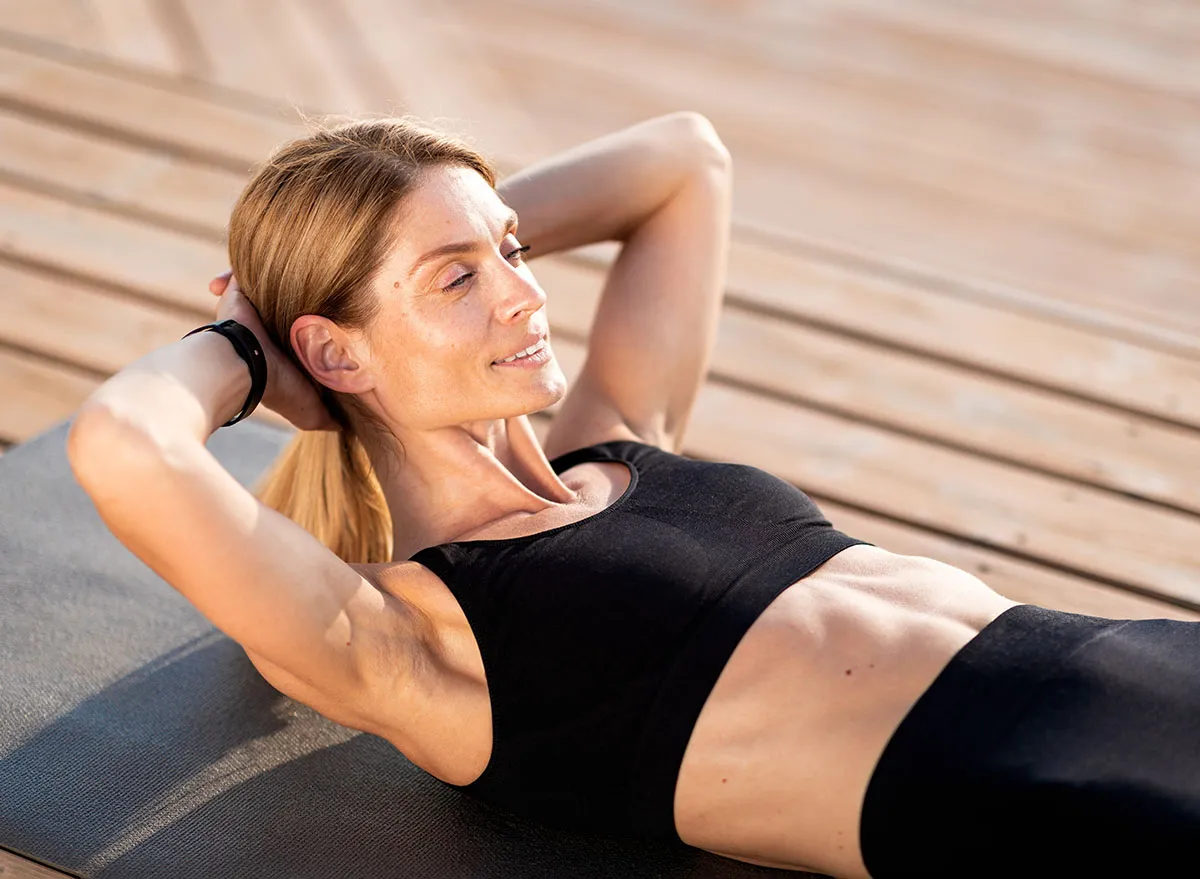
In order to build functional core strength after 50, it’s essential to prioritize specific muscle groups that contribute to overall support and stability.
“The transverse abdominis is essential for stabilizing the pelvis and spine, while the multifidus plays a crucial role in spinal alignment and stability,” Bertram tells us. “The rectus abdominis, commonly known for creating the ‘six-pack,’ is involved in overall core function. Additionally, the obliques are vital for rotational movement and lateral stability. Lastly, strengthening the pelvic floor muscles is important for core stability and can improve overall health and function, particularly in maintaining continence.”
Below, Bertram offers three morning moves that can help boost core strength more efficiently than planks. These exercises offer a safe yet effective way to strengthen the essential muscles in your core.
Bird-Dog
“The bird-dog involves starting on all fours and extending one arm and the opposite leg while engaging the core, which enhances stability and activates multiple core muscles,” Bertram says.
- Start on all fours.
- Extend your left arm and right leg, keeping your core braced.
- Hold for a moment before returning to the start position.
- Switch sides, continuing to alternate.
Dead Bug
“The dead bug is performed lying on the back with arms extended and knees bent, lowering one arm and the opposite leg without arching the back, promoting core control and stability without straining the back,” Bertram points out.
- Lie face-up on the mattress with your arms extended toward the sky and knees lifted and bent to 90 degrees.
- Press your lower back into the mattress as you gradually lower your left arm and extend your right leg.
- Return to the center.
- Then, lower your right arm and left leg.
- Continue to alternate.
Seated Leg Lifts
“Seated leg lifts entail sitting on a sturdy chair and lifting one leg off the ground while engaging the core, making it easier on the joints while effectively strengthening the abdominal muscles,” Bertram says.
- Begin seated at the edge of your chair with your legs straight out. Hold onto the sides of the chair.
- Activate your abs as you lift both legs and bring your knees toward your chest.
- Hold for 2 seconds at the top, making sure not to round your back.
- Slowly lower.
Alexa Mellardo



In addition to the psychological impact, there are physical risks associated with following online fitness trends.
The experts cautioned that some activities may not be suitable for all individuals, and may even result in over-exertion or injury for some people.
This is often due to their high intensity and specificity in the muscle groups trained.
Ms Nur Amelina Azlan, a physiotherapist at Heal360 Physioclinic, said: “For example, pilates is very postural, very focused on the core muscles, whereas something like your spin class is more cardiovascular.
“But what we need is both elements together, not just one over the other.”
MAKING FITNESS “FIT” YOU
So, if what works for other people may not be the best for different people with different needs, how does one find what works for oneself?
Mr Martin John, clinical director at Orchard Health Clinic, which offers physiotherapy among other services, said that the first step is to be honest about your starting point.
“How is your energy? How is your sleep? How stressed are you? How much do you sit? How well do you move?
“Those are important questions because exercise should match the person, not the trend.”

Most people wouldn’t mind being a little bit fitter. But the fittest? That seems unreachable. However, many argue that all-conquering CrossFit athlete Tia-Clair Toomey is, by objective measures, the fittest woman in history.
Toomey, who is an ambassador for the fitness app Pliability, has won the CrossFit Games – an annual competition to find the fittest man and woman on earth – an unrivalled six times on the trot. In 2023, she paused to have her first child, then returned in 2024 and won the competition two more times.
In the midst of her winning streak, the 32-year-old also represented Australia in weightlifting at the 2016 Rio Olympics, won gold in the same event at the 2018 Commonwealth Games, qualified for the 2022 Winter Olympics in the two-woman bobsled and completed a Hyrox doubles race in a lightning-fast 54 minutes 24 seconds.
In short: Toomey is incredibly fit. The average person might not be able to emulate her superior fitness levels, and most don’t want to – they simply want to be fit and healthy enough to thrive in everyday life. You can, however, benefit from her insights about how to approach exercise.
Read more: Do these three things each week to be fitter than most Brits
1. Don’t let perfect be the enemy of good
“You can’t be perfect at everything all the time,” says Toomey. “Trying to juggle too many things at once is where many people come unstuck, because you’re stretching yourself too thin. So it’s important to find balance.”
The aim is not to do everything immaculately, but to identify the things that are truly valuable to you – these might be your workouts, work or supporting your family – and take pride in throwing the (cluttered) kitchen sink at them.
“Even if it’s just a simple workout, you can feel really fulfilled at the end of the day knowing you gave it your best,” Toomey says. “I think a workout is a perfect place to demonstrate this.”
Read more: Walking experts reveal the number of daily steps you need to boost health – and it’s not 10,000

2. Small changes make a big difference
Most people set themselves lofty fitness (and life) goals, then fall short of them. Just look at how many New Year’s resolutions have been discarded by the time February rolls around. Toomey suggests a more manageable approach.
“If you can get 1 per cent better every day, you can’t ask for any more than that,” she says. “It’s when you create excuses, stop challenging yourself and give up on pursuing your chosen goal that you stop progressing and plateau.”
She recommends making small tweaks to improve how you feel each day, rather than obsessing over a daunting target.
For example, you could head to bed 15 minutes earlier and keep your phone out of the bedroom, drink an extra glass of water, go for a walk after dinner or eat an extra portion of fruits and vegetables. Small changes soon accumulate to make a big difference over time.
“It takes a lot of pressure off people when they break their goals down like that,” Toomey says.
Read more: Study reveals the small changes to your diet, sleep and exercise that can add years to your life

3. Be open-minded
A lot of people use the phrase “exercise isn’t for me”. This is likely linked to a less-than-pleasant experience at some point in their past.
But exercise is a very broad umbrella, and Toomey urges people to remain open-minded when approaching it. This is something she learned firsthand.
“I enjoyed my first CrossFit session, but I didn’t really enjoy the coach, so I opted not to go back for two months,” she says. “Who knows where I would be now if I never went back because of that one interaction.”
Toomey ended up trying a different gym and finding a coach who was more passionate and encouraging. “Then I was hooked and fully committed,” she says.
For the everyday exerciser, this could mean changing the variables to make your workouts more fun. For example, if you don’t like how running feels, you could swap to a lower-impact activity like swimming or cycling. Or if you find solo strength training sessions boring, you might join an exercise class.
There is no need to suffer through a certain type of exercise just because someone told you it’s the best. Take a playful approach to your workouts and continue to experiment until you find something you enjoy. Because if your exercise plans are fun, you are far more likely to stick to them.
Read more: The easiest way to strengthen your entire body, according to this expert coach

4. Put your ego aside
If you have ever watched Toomey compete, it’s hard to imagine her struggling with anything exercise-related. But, she says, when she first started CrossFit training she found it difficult to hold a barbell overhead in a stable position.
This was exposed in a CrossFit workout named “Nancy” – five rounds of a 400-metre run and 15 overhead squats (squatting while holding a 30kg barbell overhead).
“I was a runner prior to CrossFit, so I would race ahead during the 400m runs, but then the overhead squats were very challenging for me,” Toomey says.
To learn the correct technique, she started by scaling back the overhead squats, using an empty barbell rather than one loaded up with weight. Then, as she improved, she gradually increased the load on the bar.
“It’s all about building confidence,” Toomey says. “Everyone wants to go from zero to 100, but you need to put your ego aside, take your time and put the work in to actually learn a movement. That is how people evolve.”
If Toomey is willing to scale back exercises to learn them properly, the rest of us should be too. That might mean starting with goblet squats rather than barbell squats, wall press-ups rather than full press-ups, or walking rather than running.
There are exercise options to suit all fitness levels – you just have to find the appropriate ones for you and gradually progress them over time.
Read more: Sitting all day wreaks havoc on your hips and spine – here’s how to stop that from happening

5. Variety is the spice of life
What is the one exercise Toomey wishes more people would do? She struggles to pick just one before prescribing variety.
“I just love seeing people active,” she says. “But constantly doing one thing will have a lot of impact on the body. I think it’s really important to have a variety of exercises. That way you’re constantly working different muscles, building broad fitness and stimulating the mind in different ways.”
This is good advice for any exerciser. The body works on a rough use-it-or-lose-it basis, so if you don’t use a joint or muscle to its full potential, it can weaken and tighten over time. Greasing the groove on a wide range of movement patterns is the best way to prevent this and stay mobile for decades to come.
Read more: After 50 you need to train smarter – the eight rules for strength training in midlife, according to experts

6. Commit to a plan
A one-off workout cannot transform your fitness, but a progressive exercise plan can. This is why Toomey recommends finding a structured programme to follow over a longer time period than just a single session.
“That is going to help you stay motivated, particularly if it’s linked to some sort of sports or fitness goal like your first 10K, triathlon or pull-up,” she says.
“It gives you something to aim for. Otherwise people think, ‘Oh, I’m just going to keep doing this forever,’ and it can feel quite overwhelming. Following a programme helps you build healthy habits that you integrate into your daily routine and actually stick to.”
Read more: I specialise in coaching people aged 40-plus – do these six things for immediate results

7. Look after yourself
Muscle isn’t built in the gym. What you do during your workouts triggers myriad positive physiological changes, but the actual adaptations happen while you are recovering.
For this reason, Toomey places a great emphasis on sleep and nutrition, prioritising quality fuel and recovery between her training sessions.
As part of this, she regularly uses a sauna, breathwork and completes a stretching and mobility protocol via the Pliability stretching app shortly after waking each day.
“I tend to wake up feeling a bit stiff and sore from the previous day,” she says. “But I want to walk into the gym feeling strong and confident. That stretching session acts as a form of meditation as well, helping with both mobility and mental clarity.”
Read more: Swap the gym for this trainer’s six-move kettlebell workout to build full-body strength at home


It’s hard to recreate a cable machine at home—unless you have a pulley of your own, that is. Complete your bicep curls, tricep pull-downs, and cable rows with this top-rated, relatively cheap system.

“I chose this bike as a cheaper alternative to Peloton,” one Amazon reviewer explains. “For the price, I would purchase this bike again.” It doesn’t come with a monitor, meaning you can use your own tablet for classes, no pricey membership required.

With a flywheel, cage pedals, and an LCD monitor, this exercise bike seems way more expensive than it actually is. Reviewers give it a 4.4-star average on Amazon, raving about how quiet and sturdy it is. “I am very satisfied with this exercise bike and the overall quality of the product,” shared one of the 16,000-plus five-star reviewers. “It feels sturdy, smooth during pedaling, and works very well for home workouts.”

This top-rated recumbent bike is meant specifically for beginners. “Does this bike have all the bells and whistles of the ones you’d find at a gym? Of course not,” one reviewer notes. “Does it get the job done? You bet.”

This bike fits in tiny spaces, meaning even apartment-dwellers can go for a spin. “I’m SO GLAD this was my choice,” one reviewer writes. “I’m a 72-year-young woman who was able to assemble it by myself.”


This colorful set of six weights is ideal for yoga, cycling, and other exercises. “These small dumbbells are perfect for the specific, painful, diabolical exercises my rehab trainer assigned,” one reviewer says. “These are perfect for home use.”

Another Bowflex option, this adjustable kettlebell replaces the need for a set by ranging from 8 to 40 lb. It’s got a stunning 4.8-star average on Amazon, where reviewers praise its durable, space-saving design. “Adjusting the weight is the best,” shared one shopper. “Put weight in, rotate dial as it smoothly clicks at each position, pull weight out. I can’t imagine it be be done any faster, and it has a high quality solid feel when doing it. The rest of it is also high quality.”

Most stands that come with dumbbell sets (if one is included at all) are flimsy, so you’ll probably need to supply your own weight rack if you’re dedicated to strength training. This top-rated option looks like it’s right out of your old gym’s weight room. “Easy to put together, less than 30 minutes,” wrote an Amazon reviewer. “Dumbbells are off the floor and its a lovely addition to my workout space! If I need more storage, I would definitely buy another one.”

If you really want to feel like you’re back at the gym, invest in this commercial-quality treadmill from trusted brand NordicTrack. You’ll get trainer-designed workouts, a 16-inch touchscreen, a quiet design, and automatic intensity adjustments. “If you’re looking for extra content and guided runs and walks, the 1750 will be exactly what you’re looking for. All the iFit extras are what make this machine great,” added one five-star customer.

Although it doesn’t boast a fancy screen or a ton of room, this affordable, space-saving treadmill has all the essentials, including a digital monitor, a device holder, pulse sensors, and easy-to-use controls. “I’ve had this for a few months now and love it! I was looking for a small treadmill that actually folds out of the way. I’m 5’1 and run a few times a week. It runs smooth, functions well, and the incline works great. It feels really solid. I also love to use the SunnyFit app to connect with the treadmill Bluetooth to log my workouts,” one Amazon reviewer explains.

This tiny treadmill is perfect for small spaces and home offices, helping you get more exercise without having to face bad weather. “I’m honestly so impressed with this walking pad! It’s super sleek, quiet, and perfect for my daily routine. I’ve been using it while working from home and it makes staying active so much easier,” one customer wrote.

This set of five bands has earned a reliable 4.5 stars on Amazon from over 135,000 reviews, making it one of the most beloved sets available anywhere. The pack ranges from light to heavy resistance, perfect for athletes of any experience level. “Simple but effective. I’m able to pack these into almost anywhere and use them as a mini gym wherever I go,” shared one Amazon shopper. “With a little creativity, they can be used to add resistance to almost any exercise. I use them for stretches, face pulls, bicep curls, and even with squats.”

This resistance band set looks more like the equipment you’re used to at the gym. The included handles, straps, and anchor mean you’ll be able to work everything from your triceps to your knees.

TRX’s resistance set has everything you need for a high-impact workout powered simply by your own bodyweight pretty much anywhere. “It provides amazing workouts and doesn’t take up any space,” one reviewer writes.

If the past two years haven’t turned you into someone with a pull-up bar in a doorway, it’s time to convert. This bar has 4.5 stars from more than 24,000 ratings, meaning it’s worth the investment.

Stop dipping from the side of your couch—order this sturdy station that’ll facilitate dozens of full-body exercises instead. “Get them,” one buyer raves. “You won’t be disappointed.”

“There is probably nothing better out there which I would consider high-quality and at this price,” one Amazon reviewer says of this top-rated stand. Bonus: It can handle loads up to 805 lb.

To get your pull-ups and dips done in one place, treat yourself to this gym-style station. “Assembly was quite easy,” one reviewer writes, noting that it’s simple to adjust the height for multiple users, too.

These cages are perfect for replacing a ton of perks of the gym—you’ll have a space (all to yourself, of course) to work on controlled barbell strength training. This respected option is a splurge, but it’ll also send your home gym into the next dimension. “This is a great addition to any home gym you can do SO many different exercises with it and is well worth the price,” concluded one reviewer.
Watch Next

Advertisement – Continue Reading Below
Advertisement – Continue Reading Below
Advertisement – Continue Reading Below
-

 Louisiana4 minutes ago
How to watch Louisiana baseball vs Cincinnati in Starkville Regional
-

 Maine11 minutes ago
In Maine governor’s race, connection is preferable to cronyism | Letter
-

 Maryland13 minutes ago
Moore announces $3 million in aid to help small- and minority-owned business in Maryland – WTOP News
-

 Michigan19 minutes ago
Ex-NFL All-Pro unimpressed by Michigan QB Bryce Underwood — who could become backup: ‘Don’t understand’
-

 Massachusetts26 minutes ago
Mass. is getting more granny flats. But it’s still hard to build them. – The Boston Globe
-

 Minnesota29 minutes ago
Kendall Qualls wins GOP endorsement for governor
-

 Mississippi34 minutes ago
Mississippi State powers past Cincinnati, advances Starkville Regional Championship
-

 Missouri41 minutes ago
Robbie O’Connor, Carmelo Musacchia power Northeastern past Missouri State at Lawrence Regional | Whole Hog Sports

