Business
How Blocking Oil and Gas From Leaving the Strait of Hormuz Ripples Around the World


The strait is just 35 miles wide, but before the war began, a quarter of the world’s seaborne oil and one-fifth of its gas traversed through the waterway. The choking off of that supply is creating economic shocks around the world. Even nations not heavily dependent on Gulf oil and gas are contending with the consequences.
International oil prices are at their highest levels in years. L.N.G. prices have soared. Rising jet fuel costs are causing flight cancellations. From Tokyo to Vancouver, driving has become considerably more expensive. In Bangladesh, garment factories have begun to sit idle. In Pakistan, the government has established statewide school closures to conserve power.
The price shock is depleting foreign currency reserves and stoking inflation in nations already struggling with rising costs.
Experts have called the current situation a “systemic collapse” of the energy security era established in the 20th century.
Governments worldwide are deploying measures to combat shortages and high energy prices, including the largest-ever release of strategic oil reserves by the United States, Japan, South Korea and others.
For now, energy experts and economists say these stopgap measures are helping shield households and companies from the most acute disruptions, but they warn that the drag on global economic growth will compound if the war persists.
President Trump has pressed for an international naval coalition to break the Iranian blockade of the strait. Over the weekend, he threatened to obliterate parts of Iran if it did not reverse course. Tehran has said “non-hostile” ships can sail through the strait, but it is unclear if any vessels will try.
Methodology
The New York Times identified ports and energy installations in the Persian Gulf affected by the Strait of Hormuz and then used activity tracked by Kpler, an industry data firm, to measure the tonnage of individual shipments flowing out of the region in 2025, as well as their final destinations. The shipping analysis focused on seaborne trade and was limited to the following oil and gas products: crude oil and condensate; gasoline and naphtha; liquefied petroleum gas; gasoil and diesel; kero and jet; fuel oils; and liquefied natural gas. About half of the outgoing shipments made by Iran are estimated by Kpler using satellite imagery.




Hollywood’s fascination with YouTube creators is going to the next level.
Los Angeles-based investment firm Content Partners and media entrepreneur Ed Simpson announced Tuesday that they are launching a new company, Wonderloom Media, that will acquire YouTube-creator led businesses.
Wonderloom’s first acquisition is YouTube true-crime channel Dr. Insanity, which has more than 5 million subscribers and more than 1.3 billion total views.
Content Partners owns or licenses more than 800 films and more than 3,000 hours of television content. The company co-owns the “CSI” franchise.
“This is a kind of next step evolution in the type of IP we will be acquiring,” Alphonse Lordo, a partner at Content Partners, said in an interview.
The effort comes as the film industry continues to struggle to bring more people into movie theaters and has had recent success with the YouTube creator-led films “Obsession” and “Backrooms.” As studios and TV networks have shed jobs over the years, more entertainment workers are applying their expertise at major YouTube creator-led businesses, which have continued to grow their audiences.
YouTube’s audience has shifted from smartphones to TVs, on which many U.S. consumers watch YouTube videos with their families. That in turn has attracted streamers such as Netflix to partner with YouTube creators to bring their content to the same platform that has high-budget television shows and movies.
Simpson, a former TV producer who will be Wonderloom’s chief executive, said Dr. Insanity was the “perfect first acquisition” because it had a loyal audience, proven storytelling and meaningful room to expand. “True crime is an incredibly sticky genre of programming that works just as well as it does on YouTube, as it does on Netflix and linear and cable channels,” he said in an interview.
Financial terms of the deal were not disclosed.
Wonderloom, based in L.A., also will assist entrepreneurs who started YouTube channels grow their businesses.
The new company also is eyeing possible acquisitions in food, travel and general entertainment programming, added Simpson, a former chief strategy officer at Wheelhouse, a production firm behind “America’s Sweethearts: Dallas Cowboy Cheerleaders.”
“This is about building the next generation studio, so we think of this as the beginnings of Paramount, of Warner Bros., of those great studios,” Simpson said. “We see this space following in that very same pattern right now.”
Other Hollywood companies also are getting into the creator business acquisition space. Last month, Century City-based Creative Artists Agency said it was partnering with Integrated Media Co. to form a $250-million holding company called Compound Creative Holdings that will acquire and operate a portfolio of creator economy businesses.

Netflix is going bite-sized. In a pivot toward the short-form content dominating TikTok and YouTube, the streaming giant announced it will start hosting three- to 20-minute videos from top digital publishers right on its homepage starting Aug. 3.
The streamer said U.S. customers will see “fan-favorite videos” from brands run by digital publishers, including BuzzFeed Studios, Condé Nast, Hearst Magazines, PMX (a subdivision of Penske Media), People Inc. and Tastemade. The videos will cover a variety of topics, including gardening tips, travel and celebrity profiles.
The rollout comes as Netflix competes for audience time from YouTube and social media platforms such as TikTok that have viral videos that can occupy users for hours. By bringing series such as BuzzFeed Celeb’s “30 Questions,” on which celebrities provide answers, or Vanity Fair’s “Lie Detector,” on which celebrities are hooked up to polygraph machines, Netflix users can learn more information about the people they already watch on the streamer, but in shorter videos.
“Members don’t just want to watch a show or film and move on. They want to keep exploring the stories and personalities they love long after the final credits roll,” said John Derderian, a Netflix vice president overseeing the initiative. “These partnerships help us deepen fandom and create more ways for members to carry those stories with them throughout their day.”
Netflix said it will offer licensed archival and ongoing series, including Harper’s Bazaar’s “Burning Questions,” Billboard’s “24 Hrs With” and People’s “My Life in Pictures” that provide an inside look at celebrities.
The videos from digital publishers will also be available to Netflix customers in Canada, the United Kingdom, Ireland, Australia and New Zealand on Aug. 3.
The Los Gatos, Calif., streamer over time has been expanding its library of content, adding games, live programming such as boxing matches and football games, alongside movies and TV shows.
Business
Commentary: While Trump declares that U.S. is enjoying ‘best economy ever,’ manufacturing jobs have been disappearing
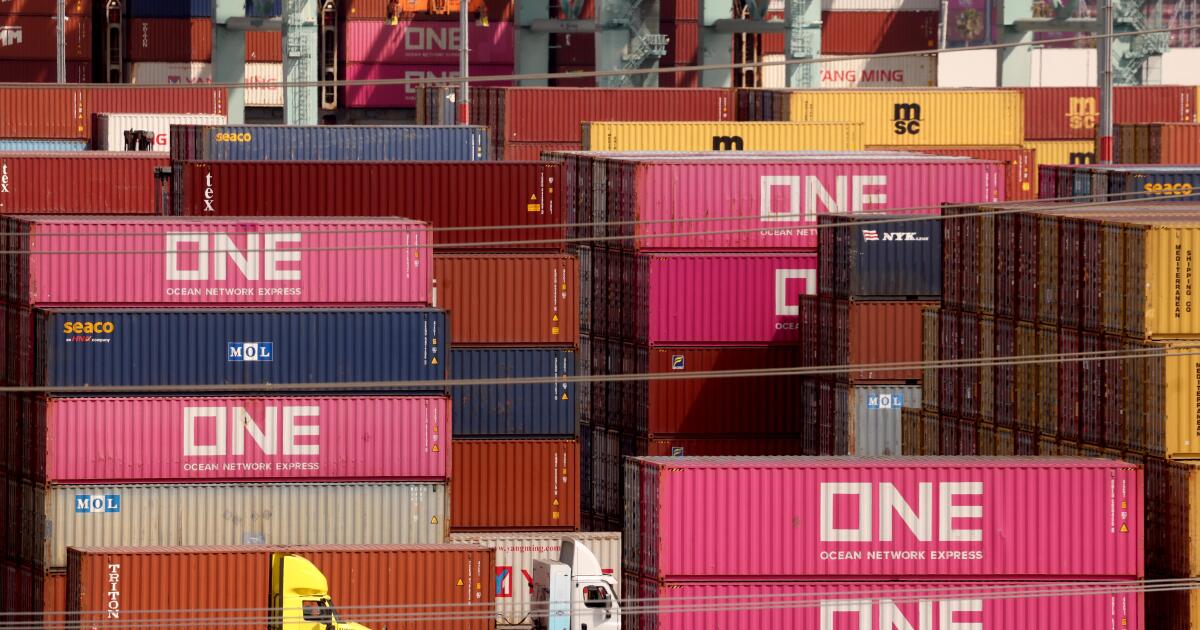
Based on the words of President Trump, America is well on the way to becoming a “global superpower in manufacturing” — indeed, as he declared in a Father’s Day social media post, we are already experiencing the “BEST ECONOMY EVER.” (Capitalization’s his.)
Here’s what the government’s own statistics tell us: Manufacturing investment has crashed during his watch, with construction spending in the manufacturing sector down 26.4% from Trump’s inauguration through May, to $174.8 billion. That’s the lowest figure since February 2023, when the economy was in the midst of a post-pandemic recovery.
White House spokesman Kush Desai told me by email that “the last two jobs reports” showed manufacturing job growth. The Bureau of Labor Statistics reported a seasonally-adjusted decline of 2,000 manufacturing workers in May and a gain of 3,000 in June. But the June 2026 figure was 38,000 jobs, or about 0.3% below the level in June 2025, and 75,000 or about 0.6% below the level in January 2025, when Trump took office.
Desai said that “thanks to President Trump’s proven agenda of tariffs, deregulation, and tax cuts, American manufacturing will continue to rebound.”
There’s little mystery about what has come between Trump’s ambition and the real world. To a large extent it’s Trump’s economic program, particularly his tariff policies and, more recently, his war with Iran. Those have injected a level of uncertainty for corporate managements pondering whether to spend money on expansion that they haven’t had to confront in years.
From where we’re standing, we are not seeing signs of a manufacturing renaissance in the U.S.
— Didi Caldwell, Global Location Strategies
The tariffs and the war have driven up manufacturers’ costs for raw materials and overseas shipping. The general economic atmosphere doesn’t help. U.S. gross domestic product growth came in at a 2.1% annualized rate in the first quarter of this year, but the Federal Reserve Bank of Atlanta expects it to have fallen to 1.3% in the second quarter ended June 30.
Meanwhile, the University of Michigan consumer confidence index reached 44.8 in May, its lowest level ever (though it improved to 49.5 in June). Wages have been rising modestly, according to the Bureau of Labor Statistics, but those gains have been eaten up by higher prices, especially for gasoline and food.
To put things another way, the actual figures show the U.S. economy to be sputtering, and the “vibe economy” as measured by consumer confidence is doing even worse.
Now that Trump’s second term is about to reach its 18-month mark, let’s unpack the factors causing the discrepancy between his ambitions and claims, and the reality.
Trump declared economic victory just as his term was starting. On March 20, 2025, he proclaimed a “manufacturing renaissance” in the U.S. That was based on what he said were “trillions of dollars in new investments” he had “already secured in tech-based manufacturing.”
A White House statement said “the list of manufacturing wins is endless.” The provided list was a roster of announcements, not groundbreakings, much less completed ventures.
Business executives quite properly have taken these pledges with mounds of salt. “Announcements are what people say they’re going to do, but dollars spent is what’s actually happening,” Didi Caldwell, chief executive of a firm that helps companies find factory sites, told the Financial Times. “From where we’re standing, we are not seeing signs of a manufacturing renaissance in the U.S.”
Indeed, at least some of these announcements have had the flavor of performative efforts to satisfy Trump’s amour propre and extract government concessions.
For example, Apple Chief Executive Tim Cook appeared with Trump at the White House in August to announce a $600-billion U.S. spending plan to take place over four years. That was a $100-billion increase over its previously-announced program.
More to the point, however, it incorporated spending with suppliers that Apple had been working with for years. Mentioned in the news announcement was a commitment to buy cover glass for iPhones from Corning. But Corning has been supplying that glass since the first iPhone appeared in 2007. In any case, the announcement appeared to secure a commitment from Trump to exempt Apple from tariffs imposed on imported chips.
Apple’s announcement Wednesday that it will spend $30 billion to buy chips from Broadcom was similarly ambiguous. The announcement didn’t provide details about the terms of the commitment or the timing of its expenditures. I asked Apple for details and whether the deal was related to a desire to remain in Trump’s favor, but didn’t hear back.
A similar phenomenon occurred during Trump’s first term; Trump had built much of his 2016 presidential campaign on a promise to increase manufacturing jobs in the United States. He blamed shrinkage in the manufacturing sector on trade agreements such as NAFTA and the policies of the Chinese, and took credit when an American manufacturer agreed to create or save jobs in the United States.
As I reported in 2019, many of those arrangements turned out to be exaggerated or bogus, or predated Trump’s claim. Some disappeared as soon as public attention turned elsewhere, or were outweighed by job cuts made elsewhere by the same companies.
Trump’s tariffs appear to have had a direct effect on manufacturing employment in the U.S. Since Trump’s inauguration, the manufacturing sector has shed about 75,000 jobs, or 0.6%. After April 2, 2025, when he announced global “liberation day” tariffs supposedly as a response to years of unfair treatment of American exports, the decline picked up pace, with a shrinkage of 68,000 manufacturing jobs.
The Supreme Court invalidated those tariffs in February, but others are still in place, including tariffs on imported steel and aluminum and on goods from China. Nor has he ceased threatening partners with trade wars. As recently as Tuesday, he said he would cut off all trade with Spain because of that country’s disagreement with him over its defense spending and its criticism of his Iran war.
As it happens, Spain is one of the few countries with which the U.S. has a trade surplus. That means that any cutoff, which trade experts think will be unlikely, would come at a cost to the U.S.
One might have hoped that Trump had learned a lesson from his first-term trade war with China. That conflict provoked a sharp contraction in the manufacturing economy, with the Institute for Supply Management’s purchasing managers index falling to 49.1 by mid-2019. (A reading below 50 signifies contraction.)
The ISM index began to recover toward the end of Trump’s term but fell again during the pandemic. Lately it has been falling again, to 53.3 in June from 54 in May.
The Iran war is another deadweight on domestic manufacturing. That’s partially the consequence of blockages of the Strait of Hormuz, the crucial thoroughfare not only for middle eastern oil, but also for such industrial inputs as fertilizer and aluminum. Cement, concrete, olive oil and spices are also among commodities produced in the region that use the strait as an outlet to reach the outside world.
Uncertainties in the region, tensions between the U.S. and China, and heightened concerns over the safety of shipping overall have driven up shipping costs between the far east and the U.S. The price of shipping a benchmark 40-foot container from China to the West Coast has nearly quadrupled to $6,687 now from about $1,700 just before the Iran war began, according to an index maintained by the cargo firm Freightos — even though shipping prices typically decline during this time of year.
There can be little doubt that the U.S. would benefit from an industrial policy — if it’s coherent. China supplanted America as the world’s leading exporter of manufactured goods in 2010, and the gap has only widened since then. China’s dominance may be hard to reverse, as it’s built on lower labor costs and transport infrastructure that enjoys focused government investment.
Tariffs could be a component of a new industrial policy, but Trump’s tariffs aren’t rationally geared to protecting domestic industries that need protection. They’re expressions of his whims, and as such they’re totally ineffective. If there are government investment policies targeting industries that need assistance, they’re not apparent to economists or industrialists.
Trump can talk as much as he likes about a golden age for U.S. manufacturing, but from his first term through this one, it’s nothing but talk. And talk, of course, is cheap.
-

 Politics3 minutes ago
Trump reveals who he’s eyeing to replace Lindsey Graham
-

 Health9 minutes ago
Notable figures who died from the same heart condition linked to Lindsey Graham’s death
-

 Sports15 minutes ago
Folarin Balogun admits that red-card reversal affected USA World Cup teammates: ‘A lot of outside noise’
-

 Technology21 minutes ago
Humanoid robots perform live surgery in world first
-
Business27 minutes ago
A ‘next generation studio’ for YouTube creators
-
 Entertainment33 minutes ago
Finn Wolfhard is taking ‘control of the narrative’
-
 Lifestyle39 minutes ago
What are your most cherished memories of the 2026 World Cup in L.A.?
-
 Politics45 minutes ago
Commentary: Two Lorenzos from Mexico. One fulfilled his American dream. ICE killed the other

