Connect with us

Northeast

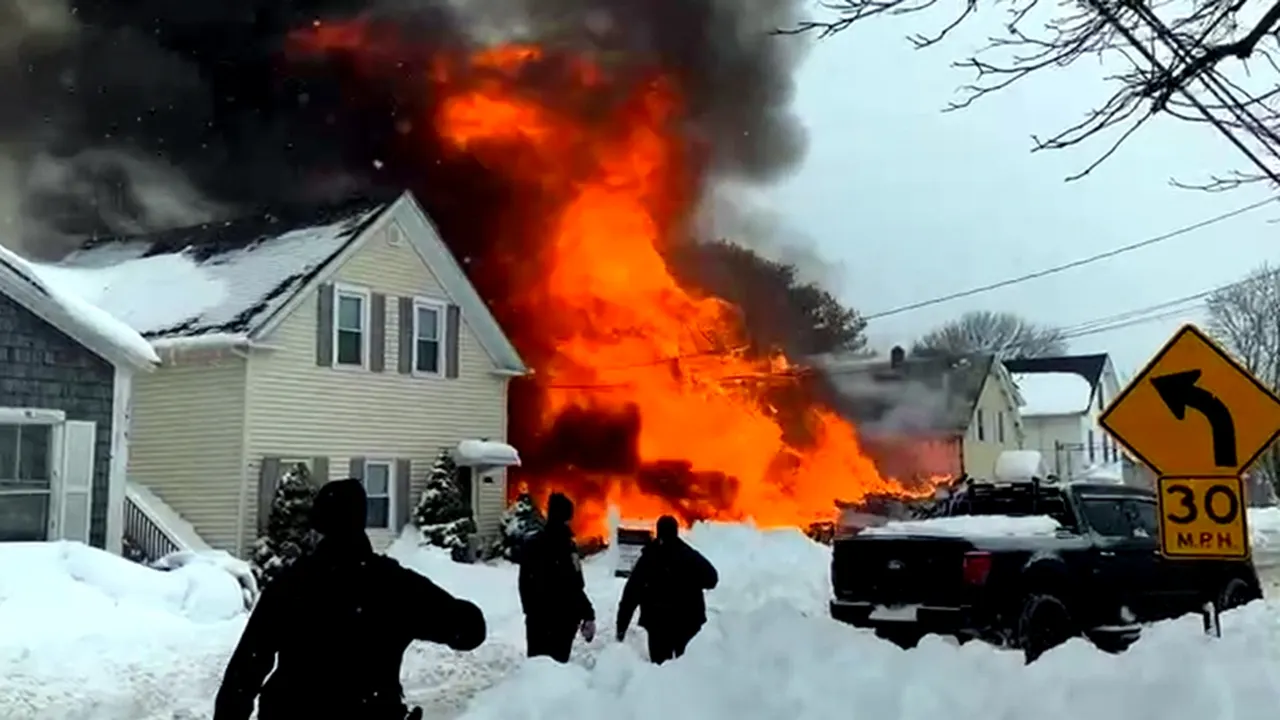
Fiery explosion destroys Massachusetts home, injures mother and 2-year-old child

Published

on

Fiery explosion destroys Massachusetts home, injures mother and 2-year-old child
NEWYou can now listen to Fox News articles!

A powerful explosion tore through a Massachusetts home Wednesday morning, leaving a 25-year-old mother with severe burns and her 2-year-old child seriously injured as the house was engulfed in flames.

The explosion rocked a snow-covered street in Taunton, about 38 miles south of Boston, just days after the city was buried under more than two feet of snow. Residents several blocks away reported hearing a loud boom.

Emergency crews rushed to the three-family home around 9:50 a.m. and found the building fully ablaze.

“The situation is now under control, but this was a very serious incident,” Fire Chief Steven Lavigne said, noting the weather conditions presented challenges for firefighters.

Advertisement

A home was engulfed in flames after an explosion on Wednesday, Feb. 25, 2026, in Taunton, Mass. (William James Shivers Jr. via AP)

The mother and her toddler were rushed to a hospital. Mayor Shaunna O’Connell said it was not immediately clear whether they were inside the home at the time of the explosion.

Fire officials declared the home a total loss. Eight residents were displaced, and two neighboring houses were heavily damaged by the blast and subsequent fire.

Firefighters respond to a home engulfed in flames on Wednesday, Feb. 25, 2026, in Taunton, Mass. (William James Shivers Jr. via AP)

William James Shivers Jr., who lives nearby, said he rushed toward the flames to help.

Advertisement

FIVE INJURED, INCLUDING FIREFIGHTER, IN CHURCH EXPLOSION FOLLOWING REPORTED GAS LEAK IN UPSTATE NEW YORK

“Neighbors helping neighbors, as it should be,” he told The Associated Press. “Taunton police and fire are amazing and I’m blessed to be a part of this community.”

A warming center was opened for displaced residents as temperatures remained frigid.

Officials said the cause of the explosion was under investigation. (William James Shivers Jr. via AP)

State police fire investigators and the state fire marshal’s office are assisting local authorities in determining the cause of the explosion.

Advertisement

CLICK HERE TO DOWNLOAD THE FOX NEWS APP

Officials urged residents to avoid the area while emergency crews continue working at the scene.

The Associated Press contributed to this report.

Related Article

2 women killed, 19 hospitalized after explosion at Pennsylvania nursing home

Read the full article from Here

Advertisement

Maine

18 jaw-dropping views from Katahdin to help you plan for warmer weather

Published

on

18 jaw-dropping views from Katahdin to help you plan for warmer weather


Editor’s note: This story was originally published in September 2022.

When it comes to Maine hiking, summiting Katahdin is the ultimate achievement.

Maine’s tallest mountain stands at 5,269 feet, and there are a number of different trails hikers can take to get up and down Katahdin. And while some are harder than others, none are easy.

Advertisement

But the views are incredible.

Whether it’s the rugged terrain of the Knife Edge or the vast landscape of the 200,000 acres that compose Baxter State Park below, here’s a look at what it’s like to climb Katahdin.

Hunt Trail

Hunt Trail traces the edge of a ridge on the west side of Katahdin known as Hunt Spur. Credit: Aislinn Sarnacki / BDN
Sara Clark (front) navigates a steep section of Katahdin’s Hunt Trail, while Sam Schipani takes a break on a boulder. Credit: Aislinn Sarnacki / BDN
Katahdin Stream Falls is one of the many scenic highlights of Katahdin’s Hunt Trail. It’s located about a mile from the trailhead at Katahdin Stream Campground. Credit: Aislinn Sarnacki / BDN

Abol Trail

A group of friends and family hiking down Abol Trail, Katahdin. (From top to bottom) Jeff McBurnie, Janet Jordan, Eve Jordan, Kerry Jordan (far right), Bruce Jordan, Joyce Sarnacki, Aislinn Sarnacki (far left), and Gary Robinson, in 2010. Credit: Photo courtesy of Derek Runnells
Hikers climb and enjoy the open views along the Abol Trail on Katahdin, the tallest mountain in Maine, on Sept. 10, 2016, in Baxter State Park. Credit: Aislinn Sarnacki / BDN

Chimney Pond Trail

Bright fall foliage surrounds Derek Runnells of Dedham as he walks along a boardwalk on the Chimney Pond Trail in Baxter State Park. Credit: Aislinn Sarnacki / BDN

Cathedral Trail

A rock formation on Katahdin called the Second Cathedral is seen from above on the Cathedral Trail on Sept. 27, 2014, in Baxter State Park. Peaking out behind the Cathedral is Chimney Pond, a pristine tarn at 2, 914 feet above sea level. The closest ridge on the right leads to Pamola Peak and is traversed via Dudley Trail. And the mountain range at the center of the view is South Turner, North Turner and East Turner mountains. Credit: Aislinn Sarnacki / BDN
Hikers approach the first Cathedral on the Cathedral Trail on Katahdin. Credit: Aislinn Sarnacki / BDN

Saddle Trail

Members of the 2015 Beyond Limits Katahdin Expedition make their way down the Saddle Trail after reaching the summit of Katahdin. Six men took 10-minute turns carrying Jacquelyn Lowman ,63, — who is paraplegic — to the summit, assisting each other along the way. The expedition took a year of planning and involved the help of about 20 people, who helped with the planning, carrying food, equipment and cooking. Eleven members of the group reached the summit with Lowman. Credit: Gabor Degre / BDN
Clouds settle over the upper reaches of the Saddle Trail, a route the leads to the peak of Katahdin, on Aug. 10, 2012. Credit: Aislinn Sarnacki / BDN

Northwest Basin Trail

BDN reporter Aislinn Sarnacki walks toward Hamlin Peak on Katahdin on the Northwest Basin Trail in Baxter State Park. Credit: Courtesy of Derek Runnells

Knife Edge

From Baxter Peak of Katahdin, hikers can enjoy a stunning view of Pamola Peak and a mile-long ridge known as Knife Edge. Credit: Aislinn Sarnacki / BDN
BDN reporter Aislinn Sarnacki hikes over Knife Edge of Katahdin on July 13, 2013. The ridge becomes just a few feet wide at some points, and the mountain drops away for thousands of feet on both sides. The trail should only be hiked in good weather. Credit: Courtesy of Derek Runnells
Hikers on the Knife Edge of Katahdin have few options for getting off trail to relieve themselves of human waste. Above treeline, Leave No Trace principles recommend planning ahead to avoid the necessity of going to the bathroom in fragile alpine areas, or getting off trail as far as possible to relieve themselves on rock or gravel. Credit: Courtesy of Brad Viles

Tablelands

A hiking trail winds through delicate alpine vegetation on the tablelands of Katahdin in Baxter State Park. Credit: Aislinn Sarnacki / BDN
The Tablelands of Katahdin, a relatively flat area between Baxter and Hamlin peaks, is visible from Cathedral Trail on Sept. 27, 2014, in Baxter State Park. Credit: Aislinn Sarnacki / BDN

South Peak

Hikers descend from South Peak on Katahdin in 2016. Credit: Courtesy of Brad Viles

Hamlin Peak

The rocky Hamlin Peak extends to the east, and beyond it are the Basin Ponds, South Turner Mountain, Katahdin Lake and the Katahdin Woods and Waters National Monument. Credit: Aislinn Sarnacki / BDN


Source link

Continue Reading

Massachusetts

Police shoot and kill man armed with knife in Lexington, DA says

Published

on

Police shoot and kill man armed with knife in Lexington, DA says


Police shot and killed a man who officials say rushed officers with a knife during a call in Lexington, Massachusetts, on Saturday.

Middlesex County District Attorney Marian Ryan said the situation started around 1:40 p.m. when Lexington police received a 911 call from a resident of Mason Street reporting that his son had injured himself with a knife.

Officers from the Lexington Police Department and officers from the Northeastern Massachusetts Law Enforcement Council (NEMLEC), who were already in town for Patriots’ Day events, responded to the call.

Police were able to escort two other residents out of the home, initially leaving a 26-year-old man inside. According to Ryan, while officers were setting up outside, the man ran out of the home and approached officers with a large kitchen knife.  

Advertisement

She added that police tried twice to use non-lethal force, but it was not effective in stopping him. The man was shot by a Wilmington police officer who is a member of NEMLEC. The man was pronounced dead on scene and the officer who fired that shot was taken to a local hospital as a precaution.

The man’s name has not been released.

Ryan said typically in a call like this where someone was described as harming themselves, officers would first try to separate anyone else to keep them out of danger, which was done, and then standard practice would be to try to wait outside.

“It would be their practice to just wait for the person to come out. In the terrible circumstances of today, he suddenly rushed the officers, still clutching the knife,” Ryan said.

The investigation is still in the preliminary stages and more information is expected in time. Ryan said her office will request a formal inquest from the court to review whether any criminal conduct has occurred, which is the standard process.

Advertisement

This happened around the same time as the annual Patriots’ Day Parade, and just hours after a reenactment of the Battle of Lexington, which drew large crowds to town.

This is a developing story. Check back for updates.


Source link

Advertisement
Continue Reading

New Hampshire

New Hampshire grapples with nuclear waste storage – Valley News

Published

on

New Hampshire grapples with nuclear waste storage – Valley News


In New Hampshire and across New England, nuclear energy is in the spotlight. But as plans for the region’s nuclear future are charted, some of the big questions that stirred New Hampshire in the 1980s remain unanswered.

Gov. Kelly Ayotte has called for New Hampshire to embrace new nuclear technology, while state legislators have introduced multiple bills to promote its development. Then, last week, Ayotte joined the rest of New England’s governors in a bipartisan joint statement calling for the region to pursue advanced nuclear technologies while championing its two existing nuclear power plants.

There are timeline and economic questions about the implementation of emerging nuclear technologies. But front-end logistics aside, some say there’s a bigger and enduring problem: How will we safely handle nuclear waste, in New Hampshire and nationwide?

Advertisement
A caution sign is shown on a road on the Hanford Nuclear Reservation on June 2, 2022, in Richland, Wash. (AP Photo/Ted S. Warren, File)

The spent fuel that nuclear reactors spit out is hot and remains dangerously radioactive for thousands of years. The U.S. Nuclear Waste Policy Act of 1982 requires it be safeguarded and separate from nearby populations for at least 10,000 years. The law also requires the United States to come up with a national system to facilitate that at a centralized location, but no plan has yet emerged.

The matter is close at hand in New Hampshire, from the hilly west of the state, where a federal proposal for a deep nuclear waste storage site once threatened to displace residents, to the Seacoast, where spent fuel from the Seabrook Station power plant is generated and stored. To activists, just how we will handle the hazardous material is a hanging question that challenges the wisdom of embarking on a new nuclear era.

“There have been efforts over several decades here in New Hampshire to raise attention to this issue, but, obviously, we haven’t seen much real movement,” said Doug Bogen, executive director of the Seacoast Anti-Pollution League.

No stranger to nuclear waste

Three hundred or so million years ago, the long, fiery process that turned New Hampshire into the Granite State began. As magma seeped up into the crust from below and began to cool, seams of grainy, crystalline granite slowly formed.

The immense pockets of stone formed through this process are called plutons. When erosion washes away the sediments and soils around them, plutons can form mountains like the 3,155-foot Mount Cardigan. That peak is the crest of New Hampshire’s largest pluton: an approximately 60-mile long and 12-mile wide stretch of granite running through western New Hampshire.

Advertisement

In the 1980s, this swath of stone attracted an unexpected visitor: the United States Department of Energy, searching for a site to excavate a long-term storage facility for the nation’s nuclear waste.

Spent fuel remains radioactive for several million years, but its radioactivity decreases with time. The period of “greatest concern,” where levels of radiation are more dangerous to humans, lasts about 10,000 years, according to the International Atomic Energy Agency.

So, to keep the waste contained over that period, the U.S. government plans to rely on a combination of engineering and favorable geology, according to Scott Burnell, senior public affairs officer with the Nuclear Regulatory Commission. A long-term storage site is envisioned underground, because certain minerals can help shield radiation.

Granite is one such mineral. That’s what drew the department to western New Hampshire in the ’80s, Bogen recalled.

In 1986, the department announced that a 78-square-mile area on the pluton, centered around the town of Hillsborough, was one of a dozen sites across the country under consideration for a potential deep storage facility. Residents understood then that a number of surrounding towns would have been partially or entirely seized by the federal government through eminent domain to make way for the facility. Many were distraught.

Advertisement

“There weren’t any Yankees that were going to take that,” said Paul Gunter, a founding member of the anti-nuclear Clamshell Alliance.

The “Clams,” as well as the New Hampshire Radioactive Waste Information Network, which Gunter also co-founded; the Seacoast Anti-Pollution League; and other environmental groups, towns, and individuals mobilized quickly. In addition to organizing demonstrations, activists also circulated a warrant article opposing the generation and dumping of nuclear waste in New Hampshire. One hundred and thirty-seven towns ultimately voted to pass it, according to the New Hampshire Municipal Association.

Their opposition was multi-pronged, Gunter said. Organizers had health and safety concerns about the management of nuclear power and highly radioactive waste, including a lack of faith that the radiation would be safely isolated from human populations. They were also concerned about the proliferation of nuclear technology and the security risks that would come along with the transport of highly enriched nuclear fuel through their region. With some pacifist Quaker roots, the Clamshell Alliance also was, and remains, deeply opposed to nuclear weapons, Gunter said. They consider the matters of nuclear power and nuclear weapons inextricable.

News that New Hampshire was under consideration for a possible dump broke in January 1986. Later that year, the New Hampshire Legislature passed a law opposing the siting of such a dump in the state. When the Department of Energy dropped New Hampshire from its list, the storm seemed to have passed.

But while the Clams and others celebrated that, they continued to oppose the issue around which they had first come together: Seabrook Station nuclear power plant. At the time, then-Gov. John H. Sununu said he believed the two matters had to be considered separately. But Gunter said opposing the generation of nuclear waste went hand-in-hand with opposing its storage.

Advertisement

To this day, he said, the issues are often discussed separately, allowing the threat of nuclear waste to take a backseat in discussions and planning around nuclear energy.

New Hampshire’s high-level radioactive waste act was quietly repealed in 2011, and a subsequent attempt by the late former Rep. Renny Cushing to reintroduce legislation on the topic, opposing the siting of a high-level waste facility in New Hampshire, was defeated in 2020.

Where we are now

Hillsborough’s story has echoes elsewhere across the country. The most progress toward a potential deep storage site occurred at Nevada’s Yucca Mountain, where excavation took place, but the site was abandoned amid opposition from the state.

In broad strokes, a similar story has repeated in other instances where a site was proposed, Burnell said. But a spokesperson for the Department of Energy, the agency charged with finding a location, said their search continues nonetheless.

President Donald Trump’s administration has taken a new tack, framing the search for a waste facility along with potential new development as a search for a “nuclear lifecycle innovation campus.” The move comes as Trump has attempted to bolster the U.S. nuclear industry, calling for a surge in nuclear generation and development with multiple executive orders.

Advertisement

“The Nuclear Lifecycle Innovation Campuses Initiative is a new effort to modernize the nation’s full nuclear fuel cycle,” a spokesperson for the department’s Office of Nuclear Energy said in an email. That would involve a federal-state partnership with funding for a nuclear technology facility where many stages of the process could be colocated, they said, naming fuel fabrication, enrichment, reprocessing, and “disposition of waste” as some of what would occur at such a site.

The deadline for states to submit “statements of interest” for hosting sites was April 1, and the spokesperson said “dozens” of responses had been filed. But they declined to say whether New Hampshire was among those, and the New Hampshire Department of Energy did not immediately respond to the same question.

In the meantime

Spent fuel generated at Seabrook Station is initially stored in 40-plus-foot-deep pools of water for preliminary cooling, then moved to steel-and-concrete casks, according to Burnell and NextEra spokesperson Lindsay Robertson. The concrete casks remain on-site on a concrete pad, Burnell said. Until another plan is developed, this is the case for spent fuel generated at reactors across the nation.

The storage facilities in use at Seabrook were tested and built to government standards, intended to withstand “extreme weather,” Robertson said. She declined to say how much spent fuel was generated or stored at Seabrook Station.

Since coming online in 1990, Seabrook Station has generated a significant portion of New England’s power without generating much news. Yet Gunter said his concerns about the station and storage of its spent fuel have not been ameliorated with the passage of time.

Advertisement

“They’ve been affirmed,” he said.

Gunter has concerns about concrete degradation and wiring at Seabrook Station and other power plants nationwide. Regarding waste, Gunter and Bogen said they worry about sea level rise affecting the storage area; Seabrook Station is located adjacent to tidal marshland. And, lacking a national plan for more long-term storage of nuclear waste, they wonder what will happen to the material currently stored on a temporary basis at Seabrook if no such plan emerges.

Gunter said his concerns about nuclear waste are part and parcel to his overall opposition to nuclear power, including those generators already in use.

“The new reactors are still on paper. The real threat is really in the day-to-day operation of aging nuclear power plants that are way past their shelf life,” he said.

Nuclear power plants are expensive to construct, creating what Bogen called the “opportunity cost” of embracing them at the expense of other sources of power generation. He and Gunter see renewable energy, principally through offshore wind, as safer and faster to deploy, and were disappointed to see politicians renew their focus on nuclear energy.

Advertisement

“It is coming back in a rebranding, which this industry is very well versed in,” Gunter said. “… Nuclear waste is going to be a persistent hazard over geological spans of time, while the electricity is going to be a fleeting benefit.”

Bogen said he wanted to see more reinforcement of the waste stored at Seabrook in a model called hardened on-site storage. But in terms of dealing with future waste, he and Gunter believe the best solution would be to stop generating it altogether.

“If you find yourself in a hole,” Bogen said, “the first thing you do is stop digging.”

Conversely, the New Hampshire Department of Energy does not see the question of nuclear waste as a barrier to further development in the state, according to an email from department Legislative Liaison Megan Stone. The nuclear roadmap that Ayotte’s March executive order directed the department to craft would include consideration of the “nuclear lifecycle,” including storage and “disposition” of waste, Stone said.

Then, she alluded to the expectation that a federal plan would emerge. “Dry cask storage is a safe and effective method of storing spent nuclear fuel until it is collected by the federal government,” she said.

Advertisement


Source link

Continue Reading
Advertisement

Trending