


The Milwaukee Brewers are headed to Cincinnati to take on the Reds in what is the first of five out of six series to be played against NL Central foes heading into the All-Star break. While any series could technically “make or break” a season, this stretch of 21 games (18 of them against the division) over the next 21 days just feels more important.
Midwest
Bureaucrats hide true price of Obama Presidential Center as taxpayers hit with infrastructure bill

NEWYou can now listen to Fox News articles!
FIRST ON FOX: Former President Barack Obama once declared that his presidential center would be a “gift” to Chicago, but taxpayers are on the hook for hundreds of millions of dollars in hidden costs related to the beleaguered project.
A Fox News Digital investigation shows taxpayers are now stuck footing the bill for surging public infrastructure costs required to support the project — and no government agency can provide an accounting of the total public cost, despite months of queries and FOIA requests.
“Illinois Republicans saw this coming a mile away. Now, right on cue, Illinois Democrats are leaving taxpayers high and dry and putting them on the hook for hundreds of millions of dollars to support the ugliest building in Chicago,” Illinois GOP Chair Kathy Salvi told Fox News Digital. “Illinois’ culture of corruption is humming along with pay-to-play deals to their allies and friends while lying to Illinois voters.”
When the project was approved in 2018, Obama pledged to privately fund construction of the expansive 19.3-acre campus in historic Jackson Park through donations to the Obama Foundation – a commitment that remains in place as the center’s construction continues to be privately financed.
But the extensive infrastructure required to make the campus operationally viable — including redesigned roads, stormwater systems, and relocated utilities — is publicly financed, and without those changes, the center could not function.
At the time, projections placed public infrastructure costs at roughly $350 million, split between the state of Illinois and the city of Chicago.
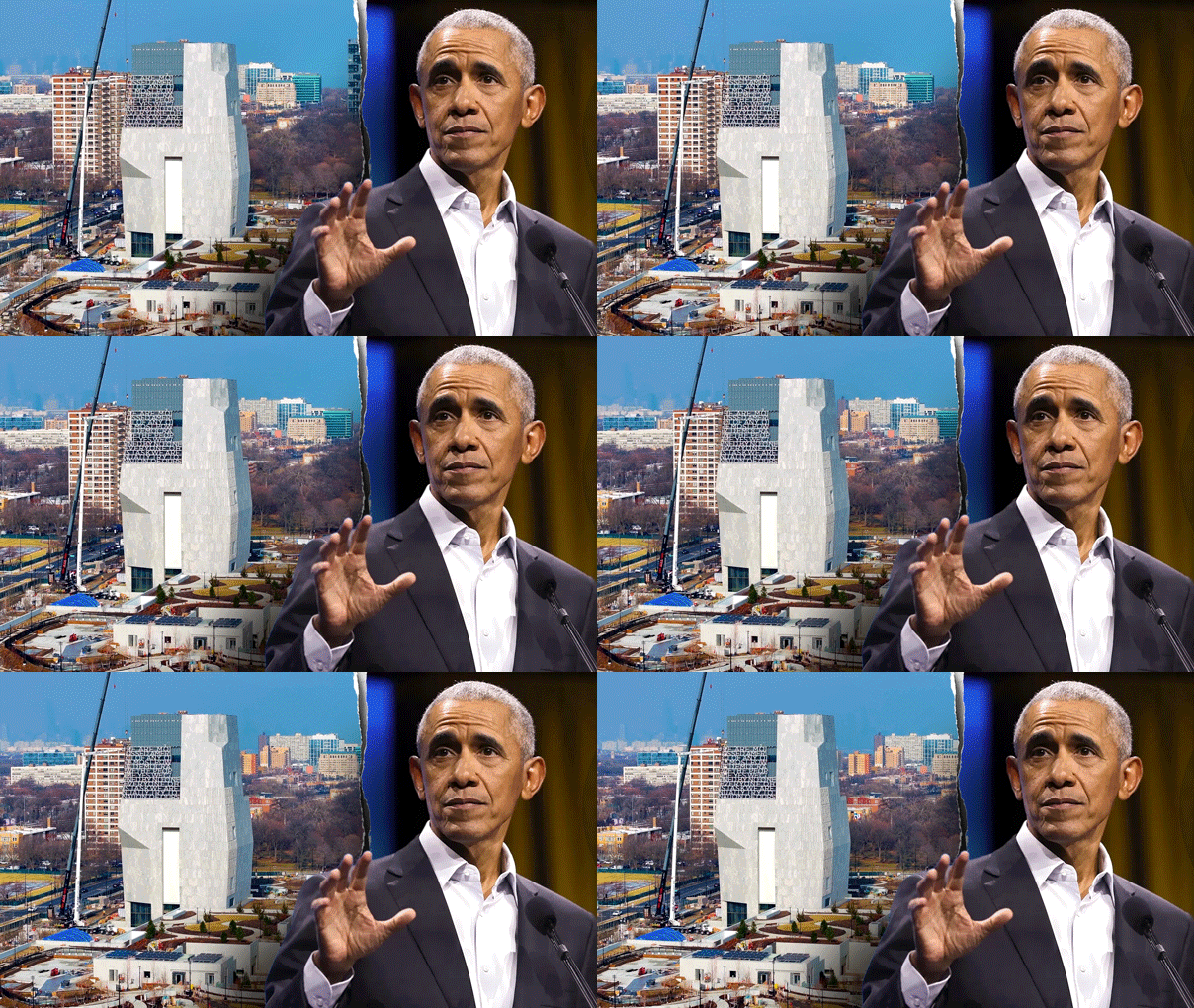
Former President Barack Obama once professed that his presidential center would be a “gift” to Chicago. Animated GIF showing the Obama Presidential Center under construction alongside a static image of former President Barack Obama. (Fox Flight Team; Getty)
Eight years later, the Illinois Department of Transportation (IDOT) told Fox News Digital that approximately $229 million in infrastructure spending was tied to the site, up from its earlier estimate of roughly $174 million.
The $229 million figure reflects state-managed spending, which may include federal transportation funds routed through IDOT.
Meanwhile, Chicago officials have failed to produce a reconciled total showing how much city taxpayers have committed or how current spending compares to the roughly $175 million discussed when the project was approved.
A paper trail without a total
Fox News Digital submitted records requests and press inquiries to every agency involved in the infrastructure work, including the Illinois Department of Transportation (IDOT), Chicago’s Department of Transportation (CDOT), the Office of Budget and Management (OBM), the Mayor’s Office and Gov. J.B. Pritzker’s administration.
Not a single office provided a unified, up-to-date accounting of total public infrastructure spending tied to the project. The investigation involved months of FOIA requests, partial disclosures and repeated follow-ups.
No single agency appears to oversee the full scope of the infrastructure work, and neither the state nor the city has assembled a reconciled accounting — a fragmentation that has made the overall public cost difficult to determine.
Instead, agencies provided partial figures, declined to clarify whether city and state totals overlap or insisted that no consolidated total exists.
The Illinois Attorney General’s Public Access Counselor (PAC) is reviewing whether multiple agencies complied with state transparency laws following Fox News Digital FOIA requests.
Exterior view of the Obama Presidential Center tower under construction in Chicago. (Fox 32 Chicago)
Construction costs soar
The center sits on 19 acres of historic public parkland carved out in a controversial transfer for just $10 under a 99-year agreement, making the question of public infrastructure spending particularly sensitive. Legal challenges to the land transfer, including lawsuits arguing the arrangement was not in the public interest, were ultimately dismissed, although the merits of the arguments were not adjudicated on.
The center — though commonly referred to as a presidential “library” — will not function as a traditional facility operated by the National Archives and Records Administration (NARA), and former President Obama’s official records will be maintained by NARA at a federal site in Maryland.
While the Obama Presidential Center in Chicago is expected to provide digital access to archival materials, it will not serve as a federally operated records repository.
Instead, the Chicago complex will be operated privately, without rent payments, by the Obama Foundation, the former president’s nonprofit organization, which oversees leadership programs and civic initiatives aligned with his values and policy priorities.
Construction costs for the facility itself have ballooned from early estimates of roughly $330 million to at least $850 million, according to the foundation’s 2024 tax filings, although these expenses are being borne by private donors.
Meanwhile, a $470 million reserve fund — known as an endowment — that the foundation promised to fill to protect taxpayers should the project go belly-up, has received only $1 million in deposits, Fox News Digital previously reported.
OBAMA LIBRARY, BEGUN WITH LOFTY DEI GOALS, NOW PLAGUED BY $40M RACIALLY CHARGED SUIT, BALLOONING COSTS
A before-and-after aerial graphic shows the footprint of the Obama Presidential Center in Jackson Park, including the removal of Cornell Drive and construction along Stony Island Avenue. (Fox News)
Roads removed, routes rebuilt
Taxpayers often fund routine improvements near major civic projects — such as turn lanes, utility hookups or upgraded traffic signals — but the scale of the work surrounding the Obama Presidential Center is far more extensive.
By comparison, other modern presidential libraries required only limited public infrastructure upgrades and did not involve the removal of a major roadway or the wholesale redesign of a historic park’s traffic pattern.
Much of the publicly financed work reshaped the roads and utilities that once ran through Jackson Park.
Cornell Drive — a four-lane roadway that bordered the center’s east side by the park’s lagoon — was permanently removed under the center’s site plan and enveloped by the campus. Traffic that once ran alongside the lagoon has been rerouted farther west, reducing the number of public roads directly adjacent to the complex and creating a more unified campus footprint around the center.
Crews also tore down trees, relocated water mains, sewer lines, and electrical infrastructure and installed new drainage systems tied to the facility’s structural needs as part of the public infrastructure project.
City and state officials say the changes were necessary to manage traffic and visitor demand. Critics argued the redesign altered long-standing park infrastructure to accommodate the foundation’s preferred layout.
What’s clear is that without those road closures, reroutes and utility relocations, the project would not function as designed.
The Obama Foundation, which is funding the center’s construction, defended the project in a statement to Fox News Digital.
“The Obama Foundation is investing $850 million in private funding to build the Obama Presidential Center and give back to the community that made the Obamas’ story possible,” said Emily Bittner, a spokesperson for the foundation.
“After decades of underinvestment on the South Side of Chicago, the OPC is catalyzing investment, from both public and private sources, to build economic opportunity for residents through jobs, housing, and public spaces and amenities.”
A map graphic shows the footprint of the Obama Presidential Center inside Jackson Park on Chicago’s South Side along Lake Michigan. (Fox News)
The number no one will state
IDOT, which controls the state’s funding for the corridor and signs off on major transportation contracts tied to the project, acknowledged approximately $229 million in state-managed infrastructure spending but did not produce a consolidated accounting reconciling that total across all project phases.
“With all the main parts of this aspect of the overall project awarded, to date the state via IDOT has contributed approximately $229 million,” an IDOT spokesperson told Fox News Digital in July in its latest release. “Approximate breakdown of these funds: $19 million in preliminary engineering; $24 million for construction engineering and $186 million for construction activities.”
The spokesperson said that the initial $174 million figure was from a “2017 was a preliminary cost estimate.”
CDOT, which carried out the roadway closures, traffic rerouting and utility relocation work inside Jackson Park, acknowledged Fox News Digital’s Oct. 7, 2025, FOIA request and took a statutory extension but never issued a final determination or produced the requested records. The department also did not provide a unified city total or clarify how Chicago’s capital allocations overlap with the state’s spending.
OBM, which oversees the city’s capital allocations, did not say whether the city’s $175 million estimate remains current and directed Fox News Digital to the Capital Improvement Plan. Chicago’s most recent 2024–2028 Capital Improvement Plan — the city’s multi-year infrastructure budget — lists more than $206 million allocated to roadway and utility work surrounding the project. However, much of that funding is labeled “state,” and neither state nor city officials could clarify how those allocations overlap with IDOT’s reported total.
In a FOIA response, OBM said it “does not have responsive records” showing any cost overruns, reallocations or a breakdown of spending across major components of the Obama Center infrastructure work.
The agency also could not explain how Chicago’s $206 million budget line relates to IDOT’s $229 million figure or how much of the city’s amount is actually paid by Chicago rather than the state.
Chicago’s 2024–2028 Capital Improvement Program lists $206,078,058 for “Obama Presidential Center & Jackson Park – Infrastructure Improvements,” with most funding labeled as state sources. (City of Chicago Capital Improvement Program)
Pritzker’s office gave conflicting responses and ultimately produced no records showing the state’s total infrastructure spending.
Meanwhile, Mayor Brandon Johnson’s office did not respond to repeated requests for the city’s total infrastructure spending tied to the project or for how much more Chicago expects to commit.
Without updated reconciliations from both levels of government, taxpayers still have no clear accounting of the financial obligations associated with the center.
What is clear is that Obama’s “gift” to Chicago comes with a hefty public price tag that has grown more complex — and without updated cost projections, the true total cost remains unknown.
Related Article

Read the full article from Here


Anna Segedi and Mellissa Channell-Watkins on PWHL game at LCA
Anna Segedi, left, and Mellissa Channell-Watkins will play for Vancouver in Saturday’s PWHL game at LCA.
PWHL Detroit added another local player to the roster for the inaugural season in 2026-2027.
Plymouth’s Mellissa Channell-Watkins (Vancouver Goldeneyes) was one of three defensemen signed to the team on Sunday along with Stephanie Markowski (Ottawa Charge) and Mia Biotti (Boston Fleet).
Channell-Watkins joins Macomb’s Taylor Girard, Brighton’s Shiann Darkangelo and Port Huron’s Casey Borgiel as Michigan-area players in the lineup.
Channell-Watkins played with the expansion Goldeneyes last year after two previous seasons with the Minnesota Frost where she won back-to-back Walter Cup titles.
In 30 games in 2025-26, the 31-year-old recorded two assists and tied for fifth among defenders with 44 hits.
In 83 career regular-season games, she has 11 points (1G, 10A), while her nine career playoff points (1G, 8A) in 18 games is tied for third all-time among defenders.
Prior to turning pro, the Little Caesars graduate played at the University of Wisconsin, scoring the game-winning goal in the 2017 NCAA Frozen Four semifinal.
Markowski entered the PWHL as the 20th overall selection by Ottawa in the fourth round of the 2024 Draft.
The 24-year-old finished third on the team with a plus-6 rating in 2025-26 and has recorded 10 points (2G, 8A) in 58 career regular-season games.
Collegiately, the Edmonton native played four seasons at Clarkson University (2019-23), serving as an alternate captain in 2022-23.
She transferred to Ohio State where she won a national championship with the Buckeyes in 2024.
Biotti spent her rookie season with Boston Fleet, making her PWHL debut at Little Caesars Arena on Jan. 3 and went on to record two assists in 13 regular-season games and saw action in two playoff contests.
The 23-year-old from Cambridge, Massachusetts, played four seasons at Harvard University, serving as captain in her senior year, and earned Second-Team All-Ivy League honors.
PWHL Detroit roster
Forwards
▶ Daryl Watts, Detroit’s first signing, Canadian Olympian, Toronto Sceptres
▶ Hannah Bilka, U.S. Olympian, Seattle Torrent
▶ Britta Curl-Salemme, U.S. Olympian, Minnesota Frost
▶ Jesse Compher, Sister of Red Wings forward J.T. Compher, Toronto Sceptres
▶ Taylor Girard, Macomb native, New York Sirens
▶ Shiann Darkangelo, Brighton, Montreal Victoire
▶ Hilary Knight, U.S. Olympian, Seattle Torrent
Defensemen
▶ Cayla Barnes, U.S. Olympian, Seattle Torrent
▶ Sydney Bard, Vancouver Goldeneyes
▶ Nina Jobst-Smith, German Olympian, Vancouver Goldeneyes
Detroit’s draft picks
▶ No. 15 (Second round): Andrea Brandli, G, Switzerland
▶ No. 22 (second round): Casey Borgiel, D, Colgate
▶ No. 34 (third round): MaryKate O’Brien, F, Minnesota-Duluth
▶ No. 39 (fourth round): Kyle Josifovic, F, Connecticut.
▶ No. 51 (fifth round): Sena Catterall, F, Clarkson
▶ No. 63 (sixth round): Georgia Schiff, F, Cornell
Detroit added six new players in the PWHL Draft, including Swiss goalie star Andrea Brändli.
Detroit added six players in the PWHL Draft, including Swiss goalie star Andrea Brändli.

Milwaukee is fresh off a disappointing series loss in Atlanta, as the Brewers lost the first two games by one run each before the offense exploded for nine runs in a win on Sunday. On the other side, the Reds are coming off a 4-2 week in which they took two of three from both New York teams — they outscored the Mets 26-12 at home to begin the week before outscoring the Yankees 14-8 in the Bronx over the weekend. Cincinnati sits in last place in the division, 9.5 games behind the first place Crew.
The Brewers are currently without pitchers Brandon Woodruff (expected to return for the series opener — more on him below), Logan Henderson (early July return), Jared Koenig (late June/early July), Coleman Crow (July), DL Hall (late July), Rob Zastryzny (late June/early July), Brian Fitzpatrick (TBD), Carlos Rodriguez (TBD), Angel Zerpa (out for season), and Quinn Priester (out for season). Outfielder Brandon Lockridge is the lone position player on the IL, and he’s reportedly close to a rehab assignment after a setback in the last few weeks.
The Reds are without position players Elly De La Cruz (expected to return either Monday or Tuesday) and Ke’Bryan Hayes (TBD), as well as pitchers Pierce Johnson (expected to return on Monday), Brandon Williamson (second half), Emilio Pagán (late June/July), Hunter Greene (July), and Graham Ashcraft (second half).
Jake Bauers leads the Brewer offense with 13 homers this year, with Brice Turang (11 homers) and Jackson Chourio (10 homers) right behind him. Chourio, Andrew Vaughn, and William Contreras lead the regulars in batting average, as Chourio is hitting .301, Vaughn is hitting .352, and Contreras is hitting .299 after a 4-for-5 day on Sunday. Gary Sánchez, Garrett Mitchell, Christian Yelich, Sal Frelick, Cooper Pratt, and David Hamilton also play key roles offensively, with Joey Ortiz and Blake Perkins rounding things out. As a team, the Brewers are hitting .256/.340/.394 (.734 OPS ranks ninth), with 68 homers (tied for 27th), 397 runs (third), and 75 steals (fourth).
Rookie Sal Stewart leads the Cincy offense with 14 homers this season, with JJ Bleday (13 homers), De La Cruz (12 homers), and Spencer Steer (12 homers) not far behind him. Speaking of De La Cruz, his return will be big for a Reds’ offense that has scuffled over the last month or so, as he’s hitting .280/.346/.509 and is always a threat to steal bags. Nathaniel Lowe, Matt McLain, Eugenio Suárez, Tyler Stephenson, and Dane Myers are the other regulars for the Reds, with Noelvi Marte, Blake Dunn, Will Benson, Edwin Arroyo, and Jose Trevino serving as depth. As a team, the Reds are hitting .229/.311/.395 (.706 OPS ranks 21st), with 96 homers (11th), 325 runs (22nd), and 59 steals (11th).
The Brewer bullpen is led by Aaron Ashby, who just took his first loss after 10 wins on Saturday evening. Grant Anderson, Abner Uribe, and Trevor Megill have also been effective, with Chad Patrick serving in a long-relief role. Joel Kuhnel, Drew Rom, and Craig Yoho serve as Milwaukee’s “B” bullpen as it stands. As a staff, the Brewers have a 3.45 team ERA (third), including a 3.37 starter ERA (fourth) and a 3.55 bullpen ERA (seventh). They’ve struck out 736 batters (first) over 670 2/3 innings.
Brock Burke and Sam Moll lead the Reds bullpen, as Burke has a 3.00 ERA and 31 strikeouts over 36 innings and Moll has a 3.19 ERA and 34 strikeouts over 31 innings. Tony Santillan has struggled to a 5.10 ERA, but Tejay Antone (2.75 ERA) and Caleb Ferguson (1.50 ERA) have both been effective. Zach Maxwell (9.90 ERA), Chris Paddack (6.04 ERA), and Chase Petty (4.41 ERA) have also struggled, and with Johnson expected to return, one of them seems like the most likely odd man out. As a staff, the Reds have a 4.58 team ERA (24th), including a 4.43 starter ERA (24th) and a 4.81 bullpen ERA (16th). They’ve struck out 597 batters (26th) over 678 innings.
Monday, June 22 @ 6:10 p.m.: RHP Brandon Woodruff (2-1, 3.60 ERA, 3.97 FIP) vs. RHP Brady Singer (3-6, 5.32 ERA, 6.15 FIP)
Woodruff is slated to make his return in the series opener, as he’s missed nearly two months after a shoulder injury that became blatantly clear in his last start due to diminished velocity. For the season, he’s made six starts, totaling 30 innings with a 3.60 ERA, 3.97 FIP, and 25 strikeouts. In a pair of rehab appearances with the ACL Brewers and High-A Wisconsin Timber Rattlers, Big Woo totaled nine innings, allowing six runs on 10 hits and three walks while striking out 11. In 15 career appearances (13 starts) against the Reds, Woodruff is 7-4 with a 3.48 ERA and 106 strikeouts over 75 innings.
Singer, 29, has had a rough second season in Cincinnati after being acquired in the Jonathan India trade last offseason. After putting up a 14-12 record with a 4.03 ERA in 2025, he’s 3-6 with a 5.32 ERA and 6.15 FIP over 66 innings this season. He’s looked a bit better in his last two outings, though, allowing three runs on nine hits and four walks with 10 strikeouts over 11 innings in a win over the Mets and a no-decision against the Padres. Singer has made four career starts against Milwaukee — including three last season — with a 2-2 record, a 4.82 ERA, and 20 strikeouts across 18 2/3 innings.
Tuesday, June 23 @ 6:10 p.m.: RHP Brandon Sproat (1-4, 5.94 ERA, 5.52 FIP) vs. LHP Nick Lodolo (2-2, 6.12 ERA, 5.80 FIP)
Sproat has a 5.94 ERA and 5.52 FIP with 63 strikeouts across 63 2/3 innings this season, and he’s been about as inconsistent as those numbers indicate — he’s shown flashes of top-of-the-rotation stuff, but he’s also struggled with homers and walks. His last start was a microcosm of his season, as he went three perfect innings before allowing a pair of walks and a pair of hits — including a grand slam — in the fourth inning against the Guardians. He struck out six but exited after just 63 pitches in that fourth, as he dealt with cramps (something that seems to be a larger issue among Milwaukee’s young pitching staff). Sproat’s only appearance against the Reds came last year in his MLB debut while with the Mets. He took the loss in that one, allowing three runs on three hits and four walks with seven strikeouts over six frames.
Lodolo, who had the numbers of a top-of-the-rotation guy last season with a 3.33 ERA, 3.81 FIP, and 156 strikeouts, has struggled mightily in eight starts thus far this year, with a 6.12 ERA, 5.80 FIP, and 32 strikeouts over 42 2/3 innings. The 28-year-old lefty got roughed up big time against the Mets in his last appearance, allowing seven runs on 11 hits and two walks while striking out just two over 4 2/3 innings. Lodolo has made six career appearances (five starts) against Milwaukee, with a 1-1 record, 2.84 ERA, and 29 strikeouts over 31 2/3 innings.
Wednesday, June 24 @ 6:10 p.m.: LHP Shane Drohan (3-2, 3.40 ERA, 3.17 FIP) vs. RHP Rhett Lowder (3-4, 4.82 ERA, 4.46 FIP)
Drohan has turned into a reliable five-inning guy for the Brewers over the last month, as he has a 3.40 ERA, 3.17 FIP, and 47 strikeouts over 47 2/3 innings this season. He took a no-decision in his last outing against the Guardians, going five frames with one run allowed on three hits and three walks, striking out three on 91 pitches. This marks Drohan’s first career start against Cincinnati.
Lowder, 24, is a former No. 7 overall pick who debuted at just 22 in 2024, pitching to a 1.17 ERA with 22 strikeouts over 30 2/3 innings that year. After missing all of 2025 due to injuries, he hasn’t looked quite the same in 2026 through 11 starts. He has a 4.82 ERA, 4.46 FIP, and 42 strikeouts over 52 1/3 innings. He took the loss in his last appearance against the Yankees, allowing four runs on six hits and three walks with five strikeouts over 5 1/3 innings. Lowder made his lone career start against Milwaukee back in August 2024. He took the loss, allowing one run on two hits and four walks with six strikeouts across four innings.
Monday, June 22: Brewers TV; listen via radio on the Brewers Radio Network (620 WTMJ in Milwaukee)
Tuesday, June 23: Brewers TV; listen via radio on the Brewers Radio Network (620 WTMJ in Milwaukee)
Wednesday, June 24: Brewers TV; listen via radio on the Brewers Radio Network (620 WTMJ in Milwaukee)
The Brewers hit a tough rut in Atlanta over the weekend, but this Reds team has been struggling after jumping out to a hot start. I’ll take the Crew to win two of three to wrap up the road trip.
Minneapolis, MN
Special Olympics USA Games kicks off in Minneapolis with Demi Lovato, Jon Batiste and thousands of fans

By submitting, you consent that you are at least 18 years of age and to receive information about MPR’s or APMG entities’ programs and offerings. The personally identifying information you provide will not be sold, shared, or used for purposes other than to communicate with you about MPR, APMG entities, and its sponsors. You may opt-out at any time clicking the unsubscribe link at the bottom of any email communication. View our Privacy Policy.
-
Finance5 minutes ago
OpenAI and Anthropic workers are about to learn the hidden challenge of becoming overnight millionaires
-

 Fitness8 minutes ago
This simple three-move routine can build upper-body strength at home for years to come
-

 Movie Reviews20 minutes ago
Stephen King shares his two-line review of 2026’s breakout horror movie
-

 World28 minutes ago
Video: First Round of U.S.-Iran Talks End, Mediators Say
-

 News35 minutes ago
Video: California Governor Declares State of Emergency for L.A. Warehouse Fire
-
 Lifestyle1 hour ago
Top 5 Pixar movies, ranked by listeners : Pop Culture Happy Hour
-

 Technology1 hour ago
Cold Court’s debut EP is an infectious, glitchy genre mashup
-

 World1 hour ago
US military conducts strike on another vessel carrying alleged narco-traffickers, killing 2


