
Connect with us

Entertainment

Review: All 15 of the Oscar-nominated short films, reviewed

Published

on

Review: All 15 of the Oscar-nominated short films, reviewed

The nominated Oscar shorts come in three categories — and a lot of subjects, styles and temperaments. It’s further proof that an award dictated by length needn’t be bound by anything else.

In the live-action category, a mixed bag of approaches — some inspired by classic literature — are burnished by inspired performances. Lee Knight’s “A Friend of Dorothy” may be a tad on the nose about the cultural and emotional impact of a lonely London widow on a closeted teenaged boy. But leads Miriam Margolyes and Alistair Nwachukwu practically shimmer with humor and warmth. “Jane Austen’s Period Drama,” a loving tweak of the writer’s oeuvre from Steve Pinder and Julia Aks (who also stars), is essentially a one-joke calling card to make feature comedies and it should do the job. Its cast is exactly the sprightly ensemble needed to land its what-if laughs.

Two others just miss the mark in terms of bringing their tensions to powerful resolutions yet benefit from who the camera adores. Meyer Levinson-Blount’s “Butcher’s Stain,” centered on a flimsy accusation against a friendly Palestinian butcher in an Israeli market, undercuts its gripping story with lackadaisical filmmaking and an unnecessary subplot, but lead Omar Sameer is commanding. The black-and-white future shock “Two People Exchanging Saliva,” directed by Natalie Musteata and Alexandre Singh, is an uneven Euro-art bath of unrealized intimacy and casual violence — kissing is punishable by death, slapping is currency — but is given exquisite tautness by the elegant, unrequited swooniness of stars Zar Amir and Luana Bajrami.

A scene from “Jane Austen’s Period Drama,” nominated in the live-action short category.

(Roadside Attractions)

Advertisement

Then there’s my favorite, Sam A. Davis’ likely winner “The Singers,” from Ivan Turgenev’s short story, which pays off handsomely in bites of soulful warbling that briefly turn a barroom’s den of anesthesia into a temple of feeling.

Most of this year’s documentary nominees deal with the grimmest of tragedies, as in “All the Empty Rooms” and “Children No More: Were and Are Gone,” which address the remembrance of children brutally killed. The former film, from Joshua Seftel, follows CBS correspondent Steve Hartman and photographer Lou Bopp on an essay project into the bedrooms of kids gunned down in school shootings, their private worlds heartbreakingly preserved by their families. The latter short, directed by Hilla Medalia, witnesses Tel Aviv’s silent vigils for Gaza’s children, protests marked by posters with beaming faces, and sometimes met with open scorn. These are dutiful, sobering acts of mourning — Seftel’s is the probable awardee. You may wish they were more than that, however, considering the issues (guns, war, political intransigence) that created the devastation.

Combat is what drove award-winning photojournalist Brent Renaud, killed in Ukraine in 2022. But his brother Craig’s memorializing of him, “Armed Only With a Camera,” is oddly uninvolving, more an excerpted flipbook of Brent’s far-flung assignments than a meaningful portrait of excelling at a dangerous job. A more affecting real-world dispatch (and my pick, if I could vote) is “The Devil Is Busy,” directed by Christalyn Hampton and dual nominee Geeta Gandbhir, also up for the feature “The Perfect Neighbor.” It observes a day in the operation of a carefully guarded, female-run Georgia abortion clinic as if it were a newly medieval world’s last chance healthcare outpost, getting by on grit, compassion and prayer. You certainly won’t forget security head Tracii, the clinic’s heavyhearted knight and guide.

Three donkeys stand with an observatory in the distance.

A scene from “Perfectly a Strangeness,” nominated in the documentary short category.

(Roadside Attractions)

Advertisement

Your chaser is Alison McAlpine’s appealing, aptly titled “Perfectly a Strangeness,” sans humans, but starring three donkeys in an unnamed desert happening upon a cluster of hilltop observatories. The whir of science meets the wonder of nature and this charming, gorgeously shot ode to discovery (both on Earth and out there) makes one hope the motion picture academy sees fit to recognize more imaginative nonfiction works going forward.

Animation, of course, thrives on the thrill of conjured worlds, like the one in Konstantin Bronzit’s wordless (but not soundless) desert island farce “The Three Sisters.” It owes nothing to Chekhov — though there are seagulls — but much to a classically Russian sense of humor and a Chaplinesque ingenuity. Elsewhere, you can watch the overly cute Christian homily “Forevergreen,” from Nathan Engelhardt and Jeremy Spears, about a nurturing tree, a restless bear and the dangerous allure of potato chips. The message gets muddled but this eco-conscious journey is charming.

It’s tough to predict a winner when the entrants are this strong, but John Kelly’s “Retirement Plan” feasts on wry relatability, as Domhnall Gleeson narrates a paunchy middle-aged man’s ambitious post-career goals, while the cascade of deadpan funny, thickly-lined and mundanely hued images stress a more poignant, finite reality. In its all-too-human view of life, this is, entertainingly, whatever the opposite of a cloying graduation speech is.

An older man lays shirtless on grass.

A scene from “Retirement Plan,” nominated in the animated short category.

(Roadside Attractions)

Advertisement

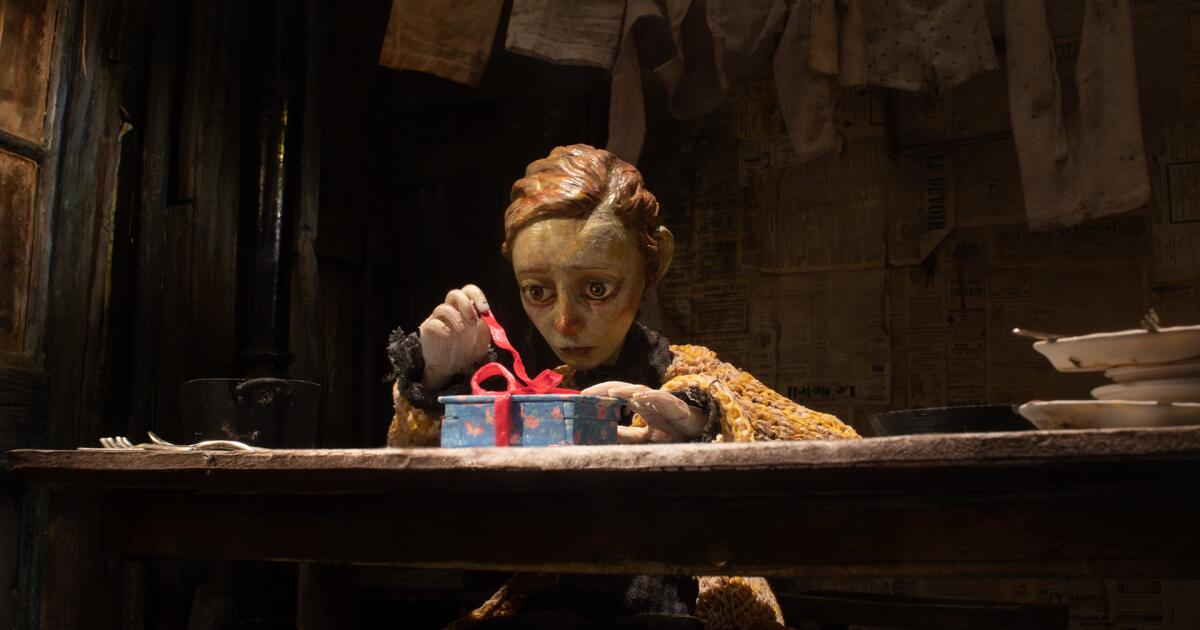
The spindly aged-doll puppetry in the stop-motion gem “The Girl Who Cried Pearls” marks a sly fable of need, greed and destiny, centered on a wealthy grandfather’s Dickensian fashioning of his poverty-stricken childhood in early 19th century Montreal. Filmmakers Chris Lavis and Maciek Szczerbowski find an enchanting balance between storybook allure and adult trickery. Maybe this one steals it?

Whichever the case, the animation that moved me the most is “Butterfly,” from Florence Miailhe, imagining the last, memory-laden swim of Jewish French-Algerian athlete Alfred Nakache, who competed in the Olympics before and after the Holocaust. In the cocooning fluidity of an ocean-borne day, rendered with thick-brushed painterliness and splashes of sound, we travel across flashes of community, injustice, achievement, love and despair. The visual, thematic constant, though, is water as a haven and a poetic life force that feeds renewal.

‘2026 Oscar Nominated Short Films’

Not rated

Advertisement

Running time: Animation program: 1 hour, 19 minutes; live-action program: 1 hour, 53 minutes; documentary program: 2 hours, 33 minutes

Playing: Opens Friday, Feb. 20 in limited release

Advertisement

Movie Reviews

8News Reel Talk: ‘The Devil Wears Prada 2’ movie review

Published

on

8News Reel Talk: ‘The Devil Wears Prada 2’ movie review

RICHMOND, Va. (WRIC) — In this episode of 8News Reel Talk, digital producer Julia Broberg is joined by anchor Deanna Allbrittin and reporter Allison Williams to talk about “The Devil Wears Prada 2.”

The hosts gave their reviews and assigned the following star ratings:

Deanna: ★★★★.5

Allison: ★★★.25

Julia: ★★

Advertisement

To watch more livestreams and digital video content, head to the WRIC+ Originals page. You can also watch full on-demand videos on your smart TV using the WRIC+ app.

Continue Reading

Entertainment

Are men OK? Actor Jena Malone genuinely hopes so on a beguiling new album

Published

on

Are men OK? Actor Jena Malone genuinely hopes so on a beguiling new album

If, god forbid, there’s a natural disaster in L.A. in the near future, Jena Malone might be one of your first responders.

“I’ve been studying Community Emergency Response Team training,” the actor-musician, 41, said, drinking coffee in the living room of her home overlooking pomegranate trees and a canyon in northeast L.A. “Whether it’s fire management or building a neighborhood tool shed, it’s less important for me to hit career milestones now than to transform how I live on this planet. Let’s build something where we’re all taking care of each other’s needs through mutual aid.”

Those are galvanizing priorities from Malone, who’s led generationally beloved films like the sci-fi noir “Donnie Darko,” played the axe-chucking Johanna Mason in two “Hunger Games” tentpoles and recently co-starred in the lesbian bodybuilding revenge flick “Love Lies Bleeding.” For almost as long, she’s also made experimental folk and electronic records that toy with avant-garde noise and quietly poignant songwriting.

This is a wild time in L.A. for anyone concerned about the city and its culture industries, and Malone is deeply invested in both. Just before the release of her new Netflix series, the Duffer Brothers-produced “The Boroughs,” she’s released her first album in nearly a decade. “Flowers For Men” is an effects-shredded, future-primitive record, written after the birth of her son upended her obligations — and expectations — toward the men in her life and the world they’ll inherit.

“It changed everything,” Malone said, about raising a son. “I grew up learning to thrive and mask in masculine spaces. Grind culture is a masculine toxicity that I inherited and indoctrinated myself in. But parenthood offers you this opportunity to burn your entire life down in sacrifice to finding out what’s real. I had no idea what it was to be a man. All of my ideas burned down and not much was being raised back up.”

Advertisement

For millennial film fans, Malone’s been a consistently compelling, trust-anything-she’s-in actor since her child-star turn in 1997’s “Contact.” Few embody a tortured, beguiling Americana quite like her.

“The Boroughs” — a high-profile follow-up to “Stranger Things” from the masters of unreality, created by Jeffrey Addiss and Will Matthews — has a stacked cast that includes Alfred Molina, Geena Davis and Bill Pullman, set amid a bucolic retirement community under supernatural threat. A ragtag group of Duffer Brothers misfits teaming up to fight off eldritch horror might be the last safe bet in television.

Yet that’s also how Malone feels about the current climate of Hollywood — a once-stable neighborhood fending off malign forces. Institutional consolidation and retreat, spiraling costs, technological upheaval — they all add to a creeping sense that an era is over, and worse is coming.

“Film is in such a delicate transition. I think that where music was 20 years ago, film is now,” she said. “It’s like being on an elevator where every floor is on fire. A lot of the things that I loved about it no longer exist, even if what I love about it is still wildly potent. My stress levels go down and my creativity goes up when I’m building a world that does not rely on the film industry, even though it’s my main love.”

That feeling called her back to music on “Flowers For Men,” arriving nine years after her last LP. The ego-shattering experience of giving birth in 2016 and raising a son prompted reflections about what men’s inner lives were really like, and she wanted to write about them.

Advertisement

“I was raised by two moms, and I had this strange aspiration to become the dad,” Malone said, laughing. “I was the breadwinner of my family then. But being a parent was all brand-new to me. I kept seeing my father in him, my grandfather, these older relationships with men. It was asking me to look at him with curious, childlike eyes.”

“Flowers For Men” was written from a sincere curiosity about mens’ strictures, bad influences and better aspirations. To inhabit someone else’s life, she had to sound different, too.

“Film is in such a delicate transition. I think that where music was 20 years ago, film is now,” Malone said. “It’s like being on an elevator where every floor is on fire. A lot of the things that I loved about it no longer exist, even if what I love about it is still wildly potent.

(Evan Mulling/For The Times)

Advertisement

The most prominent instrument on the album is its layers of vocal treatments. Malone has a lovely natural voice — intimately whispered, with hints of ‘70s country rock. But here she douses it in pitch-shifted digital acid, like a late 2000s R&B record dropped in the pool at the Joshua Tree Inn.

It’s an uncanny combo, but its lends modern melancholy to “Barstow,” which has the narrative structure of a Townes Van Zandt banger but is corroded with bleary effects. “Create In Your Name” has a Billie Eilish-worthy late-night murk, with lyrics so devotional they almost sound consumptive. “Disaster Zones” is all blown-out ambience, and the LP closes on a showstopping cover of John Prine’s classic “Angel From Montgomery.”

“I just love that a man wrote a song where the first line is ‘I’m an old woman,’” Malone said. “As a female songwriter, it gives me so much permission. Now all the doors are open. If I was to give flowers to all of the different men that have touched or changed things that deserve celebration, John Prine would be one of them.”

That idea — celebrating men for the good they’re capable of — felt transgressive enough today that it cohered the album for her. But it also came with questions about how romantic partnership fit into her life. Settling into motherhood, she read up on relationship anarchy — which she sees as not abiding by tiers of connection. She bought books on ethical nonmonogamy (“Sex at Dawn” was a big one) to learn how other lives were not just possible, but maybe even more fulfilling.

(Perhaps this was not a stretch from an actor who played the wild child Lydia Bennet in “Pride and Prejudice.”)

Advertisement

“I had been under this societal understanding that hierarchical love, placing one partner above everything else, was the ultimate romantic expression. I could name hundreds of movies that brought that up,” she said. “But while I’m learning to take care of this child, I’m realizing that self-love is one of the most important parts of this equation. I need to have expression, some work in life that felt like another love. And then my family, and how important friends were. And all of a sudden there’s no world where I would just have one love, not even just romantic love.”

Actor and musician Jena Malone in Los Angeles, CA on May 5, 2026.

“I had been under this societal understanding that hierarchical love, placing one partner above everything else, was the ultimate romantic expression. I could name hundreds of movies that brought that up,” Malone said. “But while I’m learning to take care of this child, I’m realizing that self-love is one of the most important parts of this equation. I need to have expression, some work in life that felt like another love.

(Evan Mulling/For The Times)

“Flowers For Men” is, in her way, a bargain with that contradiction — to love men deeply, but never put them above all else, even as she got engaged to her partner, actor Jack Buckley, earlier this year.

She’s still sorting out how to present this album live. She said she’s a fan of the Dead City Punx model of renegade shows in forgotten corners of L.A. Maybe as the city seems to fall apart, she’ll find a leafy park or the back of a dingy bar that’s the right home for these strange, lonely yet hopeful songs.

Advertisement

“I want someone to walk into the bathroom and be like, ‘Whoa, why is there a woman singing to me?’” Malone said. “I like the idea that art makes you a little uncomfortable and you don’t have the previously held expectations to know how to hold it.”

Continue Reading

Movie Reviews

“Billie Eilish – Hit Me Hard and Soft: The Tour” Movie Review – Spotlight Report

Published

on

“Billie Eilish – Hit Me Hard and Soft: The Tour” Movie Review – Spotlight Report

Billie Eilish fans prepare yourself,  the much talked about secret project has finally arrived on the big screens!

Billie Eilish has always been about intimacy over artifice, but her latest concert film takes that to a visceral new level. Co-directed by Eilish and James Cameron, Billie Eilish – Hit Me Hard and Soft: The Tour (Live in 3D) manages to bridge the gap between a massive stadium show and the quiet grit of life backstage.

The film starts 18 minutes out from the show and builds the tension until audiences are literally folded into a box with her. Being taken under the stage, passing fans who have no idea she’s inches away, sets a tone of total immersion. What makes this film different is the balance between the spectacle and the behind-the-scenes reality. We see the creative shorthand between Billie and James Cameron as they chase what she calls the “best kind of sensory overload”.

Advertisement

The film is very much fan focussed, with the sound mix being so specific that you can hear individual fans singing along in sync with the visuals.

There are so many standout moments, the handheld camera work during “Bad Guy” that gives a dizzying POV of the band, and the chilling minute of silence Billie requests from the crowd to record a vocal loop.

The film captures her unique stage presence. Influenced by rap culture, Billie refuses to have anyone else on stage, unlike many female artists that use back up dancers. Billie can hold the entire stadium in awe by herself which is incredible to witness, until Finneas joins her for a beautiful, emotional piano set.

Between the high-tech visuals and the “Puppy Room” (where she keeps rescue dogs for staff to decompress), the film feels incredibly personal. While the film doesn’t give us any new insights into Billie, Billie Eilish – Hit Me Hard and Soft: The Tour (Live in 3D) is an enjoyable experience that elevates the tradition concert film.

Advertisement
Continue Reading
Advertisement

Trending
