West
Obama calls Los Angeles homelessness an ‘atrocity,’ criticizes ‘losing’ political strategy

NEWYou can now listen to Fox News articles!
Former President Barack Obama criticized the homelessness crisis in Los Angeles, calling it an “atrocity” given the billions of dollars elected officials have thrown at the problem over the years.
Obama was speaking with YouTuber Brian Tyler Cohen when he touched on criticism local residents and business owners have voiced for years.
“I think it is morally — ethically speaking — it is an atrocity that in a country this wealthy, we have people just on the streets, and we should insist on policies that recognize their full humanity — people who are houseless — and be able to provide them with the help and resources that they need,” Obama said.
DAVID MARCUS: I’VE SEEN ENOUGH HUMAN SUFFERING IN HOMELESS ENCAMPMENTS TO KNOW TRUMP’S NEW POLICY IS RIGHT
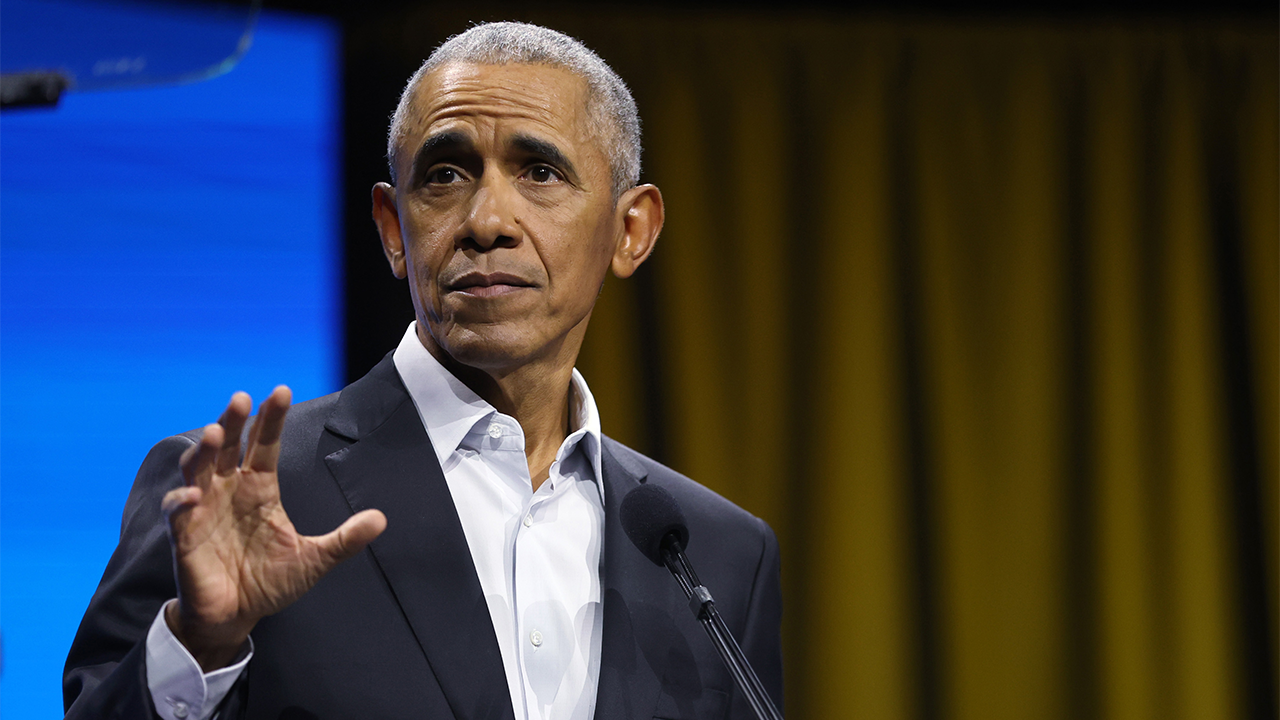
Former President Barack Obama called the homelessness crisis in Los Angeles County an “atrocity” during a podcast appearance. (Getty Images)
“We should recognize that the average person doesn’t want to have to navigate around a tent city in the middle of downtown,” he added. “That’s a losing political strategy.”
Obama noted that building support for programs and resources to assist those living on the streets needs to come with some level of accountability for those being offered the help.
“We’re not going to be able to generate support for it if we simply say, ‘You know what, it’s not their fault and so they should be able to do whatever they want,’ because that’s a losing political strategy,” he said.
FORMER OBAMA OFFICIAL FREAKS OUT AT CALIFORNIA DEMOCRAT OVER HER RECORD AMID HOUSING CRISIS DEBATE
A person walks amid large trash piles at a sprawling homeless encampment near East 14th Street in downtown Los Angeles on Sept. 25, 2025. (Allen J. Schaben/Los Angeles Times via Getty Images)
“That doesn’t mean that we care less about those folks,” he added. “It means if we really care about them, then we got to try to figure out how do we gain majority support and be practical in terms of what we can get through at this moment in time and build on those victories,” he added.
Fox News Digital has reached out to Los Angeles Mayor Karen Bass.
California has spent billions to combat homelessness. In his State of the State address last month, California Gov. Gavin Newsom touted a 9% statewide drop in homelessness.
In January, he announced new investments to create more shelters and services.
A homeless encampment in Koreatown on Sept. 12, 2025, in Los Angeles. (Carlin Stiehl/Los Angeles Times via Getty Images)
“No one in this country should be without a place to call home. In California, we’re proving there is a solution,” Newsom said in January. “The strategies we’ve put in place are working, and they’re turning this crisis around — but we’re not done. We won’t stop until everyone has a safe, stable place to call home.”
Newsom spokesperson Tara Gallegos told Fox News Digital that the governor agrees with Obama and was working to create a model to combat the problem that should be replicated nationwide.
“That’s why Governor Newsom is the first governor in California history to make addressing homelessness a statewide priority,” she said. “He is turning around a crisis that was decades in the making by building supports and systems of care to help people exit homelessness for good.”
“That’s also why, for the first time in decades, California saw a 9% decrease in unsheltered homelessness in 2025,” she added. “California is a creating a model that should be replicated nationwide — building more housing, reforming mental health systems, removing encampments, and creating stronger support and accountability.”
Read the full article from Here



The San Francisco Giants are headed even farther south today as they begin a weekend road series against the Miami Marlins.
Taking the mound for the Giants will be noted bigot Landen Roupp. Roupp enters today’s game with a 4.24 ERA, 2.96 FIP, with 82 strikeouts to 32 walks in 74.1 innings pitched. His last start was in Friday night’s 5-1 loss to the Chicago Cubs, in which Roupp clearly cared more about proselytizing than he did about winning, allowing four runs on four hits with five strikeouts and two walks in four and two thirds innings.
As of the time this is being written on Thursday, the Marlins have not announced a starting pitcher for today’s game and I am off today (Happy Juneteenth!). But you can head on down to the comments for the most up to date information.
Who: San Francisco Giants vs. Miami Marlins
Where: loanDepot park, Miami, Florida
Regional broadcast: NBC Sports Bay Area
Radio: KNBR 680 AM/104.5 FM, KSFN 1510 AM

Denver police arrested a 35-year-old man on suspicion of first-degree murder in a fatal shooting near East Colfax Avenue and North Dahlia Street.
Joseph York was arrested Thursday after detectives identified him as a suspect through interviews and surveillance video, the Denver Police Department said in a news release Friday.
Detectives believe York was arguing with the victim, 25-year-old Elijah Barr, before the shooting in the early hours of June 7, the Denver Police Department said in a news release Friday. The intersection is between the city’s South Park Hill and Hale neighborhoods.
Barr was found with multiple gunshot wounds and was pronounced dead at the hospital.
York is being held without bail in the Downtown Detention Center and is set to appear in Denver County Court on Saturday, jail records show.
Sign up to get crime news sent straight to your inbox each day.
Seattle, WA
Seattle fans pack waterfront hours early as USA defeats Australia, advances in World Cup

SEATTLE — Soccer fans descended on Seattle’s waterfront well before kickoff Friday, staking out their spots early to watch a highly anticipated World Cup matchup at Seattle Stadium between the United States and Australia. That patience paid off as Team USA won the match and now advances to the knockout round.
The atmosphere at Pier 62 was electric from the start, with fans lining up for prime viewing positions, whether down on the water’s edge or taking in the sweeping scene from the waterfront overlook above.
“I mean, look at all these people that are here hours beforehand to celebrate this incredible game,” said Paul Hanson, who was rooting for Team USA. “The hairs are going up on the arm.”
The energy was a draw in itself.
“The energy is amazing, everyone’s in a great mood, it’s just a lot of fun to be down here,” Maggie McNeil said.
Not everyone in the crowd was wearing red, white, and blue.
Lizzie Manning hails from Melbourne, Australia, and is now living in the Pacific Northwest.
Manning told KOMO News she hasn’t been back home in nearly a decade, but taking in the U.S.A-Australia match with the waterfront crowd gave her a taste of it.
“Whenever I see another Australian I’m like, ‘Aussie Aussie Aussie, oy oy oy,’” she said. “I feel so close to home. I need a meat pie, life’s good.”
“I’ve met so many people who are visiting from other countries,” Seattle resident Maddie Chaplain said. “I sat next to a couple yesterday who was eating dumplings for the first time from Argentina, that was so awesome.”
With Team USA advancing, fans like Aaron Olson say they’ll be back for more.
“USA’s gonna win it,” Olson said. “I will come down here every game. This is spectacular.”
The World Cup watch parties continue on Pier 62 throughout the tournament. They are free and open to the public with online registration, but capacity is limited.
-
 Lifestyle32 minutes ago
James Burrows, director of classic shows ‘Cheers’ and ‘Friends,’ dies at 85
-

 Technology39 minutes ago
Nothing cancels this year’s CMF phone due to RAM prices
-

 World47 minutes ago
Two-train crash leaves at least 1 dead, 89 injured as emergency crews rush to chaotic scene
-

 Politics49 minutes ago
Double endorsement drama: Trump backs second candidate in red state’s GOP gubernatorial runoff
-

 Health55 minutes ago
Measles-infected traveler may have exposed passengers at LAX and nearby hotel, health officials warn
-

 Sports1 hour ago
World Cup Red Cards: 2026 Has More Red Cards Than Each Of Last 2 World Cups
-

 Technology1 hour ago
China’s brain chip breakthrough raises big questions
-
 Business1 hour ago
Ranch lovers can soon travel with a TSA-friendly kit of the popular American dressing

