Business
Super Bowl spots spark fight over whether we’re ready for ads from our chatbots

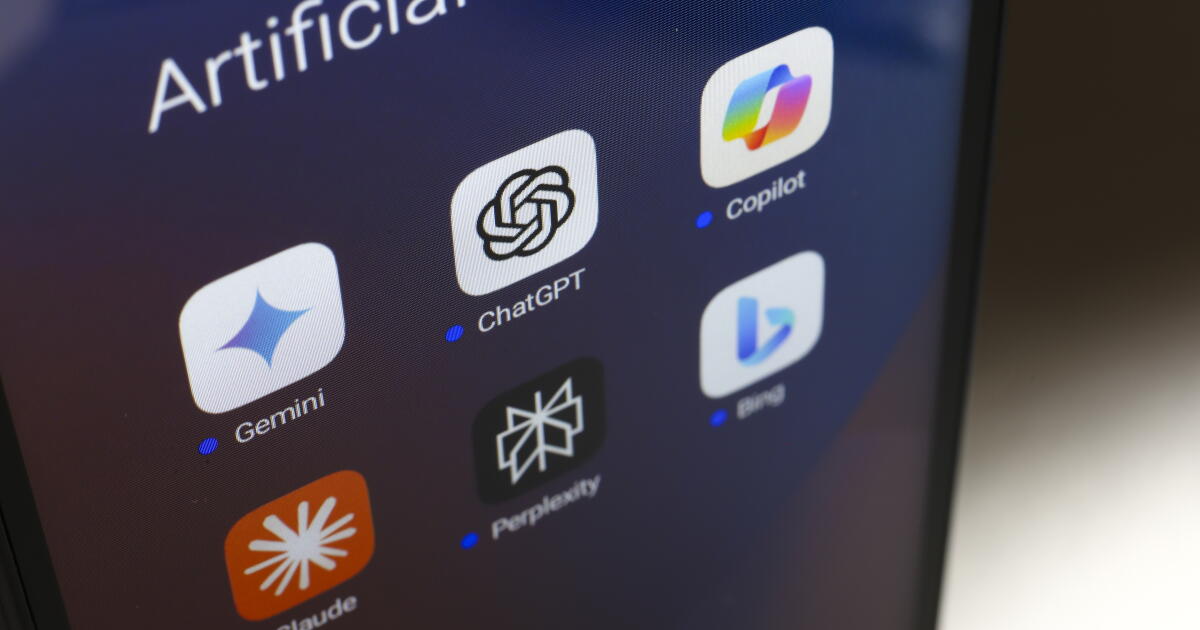
The chatbot wars entered the Super Bowl this year.
At Super Bowl LX, a ChatGPT competitor paid millions of dollars for commercials mocking the leading artificial intelligence chatbot’s plans to put advertisements in its chats.
One of the ads, titled “Betrayal,” showed a man seeking help to communicate better with his mother. His therapist, representing a sponsored bot, offers advice on mending the relationship, then suddenly suggests a mature dating site to connect with “roaring cougars.”
The ads from Anthropic, which has a chatbot named Claude, ends with the tagline: “Ads are coming to AI. But not to Claude.”
AI companies are spending hundreds of billions of dollars and need to generate more revenue to keep spending. Though much of the money comes from subscriptions from companies and other heavy users, companies serving regular consumers will probably need to increasingly rely on ads and other methods to monetize mass market users.
The Super Bowl Sunday ads launched a debate about what a future would look like in which the bots many people talk to all day start pitching products.
OpenAI, which has more than 800 million users, generated around $20 billion in revenue in 2025, according to its chief executive, Sam Altman. That still isn’t enough to cover what it has borrowed and plans to spend.
Last month, OpenAI said it will be testing ads for its free-tier users and its low-cost ChatGPT Go subscribers in the U.S.
“Subscriptions cover the committed users,” said former Google executive Justin Inman, who is the founder of Emberos, a startup that researches brand visibility in AI. “But they have a ton of free users as well.”
Ads have just started rolling out on ChatGPT, and the company has shared examples of what they look like in a chat.
One example showed a static link to purchase hot sauce at the bottom of the answer, labeled ‘sponsored’. Another was more conversational. After answering a user query about Santa Fe, the chatbox provided a link to a desert cottage in the locality.
OpenAI underlined that the ads won’t influence ChatGPT’s answers and will be separate and clearly labeled.
Altman responded to the Anthropic commercial on X, calling it funny but “dishonest.”
“We would obviously never run ads in the way Anthropic depicts them,” he said. “We are not stupid and we know our users would reject that.”
He suggested Anthropic was being elitist.
“Anthropic serves an expensive product to rich people,” he said, while OpenAI feels “strongly that we need to bring AI to billions of people who can’t pay for subscriptions.”
Anthropic was founded in 2021 by former OpenAI employees. Though the two companies have been long-term rivals, the Super Bowl ad was one of the first times the scuffle was so public.
While ChatGPT targeted everyday users, Anthropic has focused on selling chatbot services to business customers. The company has witnessed explosive growth, clocking a reported $9 billion in revenue in 2025, and is projected to reach $26 billion this year.
Demis Hassabis, the CEO of Google DeepMind, which operates Gemini, said in a recent interview that he was surprised by OpenAI’s decision to monetize the chatbot through ads this early. Pushing products mid-conversation inside a chatbot could hurt users’ trust in AI as a helpful assistant, he said.
Though Google’s Gemini chatbot doesn’t push ads, last year the company introduced ads in the AI-generated summaries users see atop Google search results. The company also began testing ads in “AI Mode,” a conversation feature on the Google homepage, where sponsored cards appear below the AI-generated search results.
Elon Musk’s Grok, the AI that is integrated into the platform X, also told advertisers last year that it would start testing ads inside chatbot responses as a way to boost revenue and pay for the expensive chips powering AI.
More U.S. shoppers are already turning to AI chatbots, and a Deloitte survey found that trust in generative AI has been steadily increasing. Younger shoppers are using chatbots for comparison shopping, finding deals, summarizing product reviews, and generating shopping lists.
Even without bribing the bots to provide direct advertising, brands are already trying to find ways to get into the good books of AI search results. An entire cottage industry of startups and consultants has emerged to help retailers and brands ensure their products appear in AI search results, a field called Generative Engine Optimization.
The market for traditional search engine optimization was $20 billion to $25 billion, but the potential for AI-driven commerce is much larger, said Amay Aggarwal, a co-founder of Anglera. His company helped Los Angeles-based e-bike and outdoor goods retailer Retrospec adapt its product catalog so that AI chatbots such as ChatGPT and Gemini could accurately recommend the right bikes for specific conditions.
Even as advertising evolves to embrace AI, many of the top AI companies saw value in old-school Super Bowl television ads. In the era of fragmented internet culture, the Super Bowl remains one of the last major shared American television viewing events that draws more than 100 million viewers. AI companies paid up to $10 million for a 30-second spot.
Super Bowl LX was overrun with advertisements from many AI majors, including OpenAI, which promoted its coding platform Codex, and Google’s Gemini, which spotlighted its photo-generation capabilities.
Despite being the “AI Super Bowl,” none of the major AI companies — OpenAI, Google, Anthropic — made the top 20 brands that performed well in generative AI search and conversation during Super Bowl week.
“Being an AI brand doesn’t automatically translate into being remembered by AI,” said Inman of Emberos, whose company produced The AI Influence Index, which tracked the top seven Super Bowl advertisers and how they were showing up in AI queries.
The seven brands that dominated chatbot searches were XFINITY, Bud Light, Squarespace, Ramp, Budweiser, Volkswagen and Dove.
“As ads move into chatbots, the real competition won’t be for attention — it’ll be for how clearly your message survives retelling by AI,” Inman said.

Earlier this year, a widely circulated 15-second AI-generated video of Brad Pitt fighting Tom Cruise on a rooftop sparked outrage across Hollywood. One screenwriter called the cinematic clip “terrifying.” The Motion Picture Assn. demanded the company behind the artificial intelligence tool — Chinese tech giant ByteDance — halt its “infringing activity.”
Despite the uproar, the former majority owner of TikTok has quietly continued to court filmmakers, independent artists and executives who are eager to adopt the AI video generation model called Seedance.
Seedance was launched in the U.S. this spring at a Santa Monica event hosted by a group linked to the Chinese government.
ByteDance began hiring for 100 open roles, signed multiple independent filmmakers and artists and held private conversations about financing AI films. The company threw a lavish caviar party at Cannes and in May hosted panels promoting its cinematic tool at Amazon’s AI on the Lot event in Culver City.
“Like any new technology, Hollywood ultimately has no choice but to react to market realities. And that reality is that the new crop of AI-empowered Hollywood creatives see Seedance as having the most powerful video generator in the market right now,” said Peter Csathy of Creative Media, an entertainment and AI business advisory firm.
Joel Kuwahara, the animation producer on early seasons of “The Simpsons,” echoed Hollywood’s quiet embrace.
“Within the industry, I know that a lot of studios haven’t approved Seedance, but yet with a wink and a nod, they’re allowing Seedance to be used. … It’s kind of like a ‘don’t ask, don’t tell’ kind of a thing,’” Kuwahara told The Times.
ByteDance declined to comment on its U.S. expansion.
The race to build the dominant AI video model has created a fierce rivalry, pitting U.S. companies against the fast-closing Chinese competitors. On the American side, there are Google Veo and startups such as Runway and Luma. OpenAI’s Sora has discontinued its video tool.
The Chinese challengers Seedance, Kling and Alibaba’s HappyHorse have rapidly closed the gap on cinematic realism and have upstaged their American rivals by undercutting them on cost.
According to Artificial Analysis, a company that tracks cost and performances of different AI models, China’s Seedance is currently the most cost-effective and high-quality option compared with U.S. competitors. Seedance costs $9 per minute for video with audio generation, significantly lower than the $24 per minute required by Google’s Veo model.
That makes it an attractive tool for independent filmmakers like Rupert Wainwright, who recently met with Seedance executives at AI on the Lot.
He wants to use the the tool to help make his feature-length film called “Sebastian,” about a Christian saint set in 3rd century Rome. The hybrid AI film will be shot partly on location in Europe and partly generated with artificial intelligence.
“It’s the equivalent to when streaming a movie over the internet onto your TV finally became possible,” Wainwright said.
Kavan Cardoza.
(Kayla Bartkowski/Los Angeles Times)

A scene from “The Chronicles of Bone.”
(Kayla Bartkowski/Los Angeles Times)
In May, Steven Schneider, the producer of “Paranormal Activity,” famous for its handheld grainy footage-style filmmaking, announced “Terrarium,” his first hybrid AI horror production. The film’s director, Jason Zada, said it will be entirely generated using Seedance’s model.
Zada’s filmmaking workflow involves writing, casting, prompting and editing all simultaneously, allowing him to rewrite scripts based on “dailies” generated by AI that day.
He estimates that generating 15 seconds of high-definition video costs only $5.
“We could go from a very detailed outline, very detailed characters and have it be a bit more fluid, because we could regen[erate] as much as we want,” Zada said.
Zada plans to shoot the movie first on a soundstage with real actors and will decide later which parts work better traditionally and what should be done synthetically. He’s a member of the Directors Guild of America and said he will be employing union actors for his hybrid AI film.
Seedance also has continued building ties by offering indie creators, AI-native studios and filmmakers free monthly credits and access to unreleased features. These “tastemakers” beta test its models, offer feedback on what works, and use it for their personal filmmaking projects — which creates corporate brand awareness.
Kavan Cardoza is one such breakout filmmaker. His AI fantasy series, “The Chronicle of Bones,” which uses Seedance, features half a dozen distinct storylines and an ensemble of characters. New episodes, each not more than 30 minutes, are released on YouTube once a month. The solo filmmaker averages 3 million views per episode and has cultivated a YouTube audience of 500,000.
Most filmmakers are tool agnostic, but lately Cardoza has become completely dependent on Seedance, he said, because it solves a persistent problem: maintaining character consistency between shots.

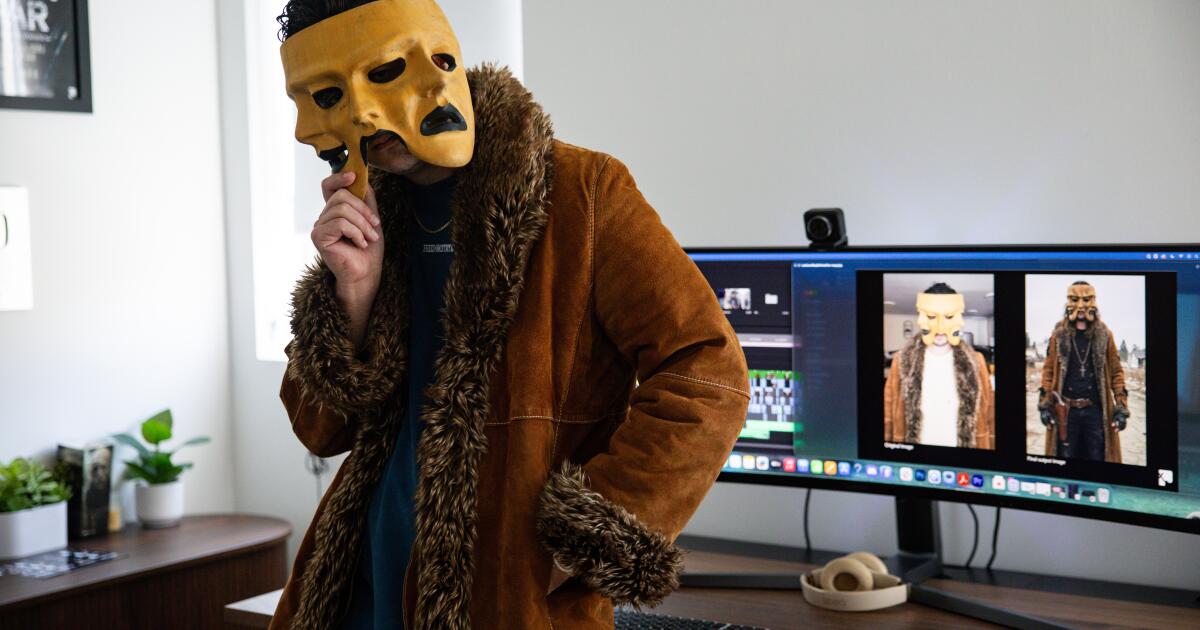
Kavan Cardoza unmasked.
(Kayla Bartkowski/Los Angeles Times)
To create one of his characters, “the last lost boy,” Cardoza took self-portraits wearing a three-faced mask and a tattered brown jacket. He used those reference images for the AI character and transforms them into a stylized person, with a personality, backstory and visual details. He fed those images back to Seedance to get consistent characters — repeating the process for each member of the cast.
“I can’t go get Brad Pitt because he costs like $5, 10, 20 million to be in my film,” Cardoza said. “I can probably get a synthetic actor that will act just as good as Brad Pitt in the future. That’s crazy to me.”
Cardoza has copyrighted his script and characters, and aims to eventually attract major studio interest to turn his intellectual property into a film which comes with a built-in fan base.
Such plans are likely to face resistance from the performers union SAG-AFTRA, which has decried the use of synthetic actors such as Tilly Norwood.
“The rise of Seedance comes down to [its] focus on pleasing filmmakers and making things that look filmic,” said Stephan Vladimir Bugaj, senior vice president of JioStar, a joint venture between Disney and India’s Reliance Industries.
ByteDance introduced timeline-based prompting so filmmakers can actually pick specific moments and tweak them, and improved the understanding of camera direction, physics, lighting and fluidity of action. All of this, Bugaj said, “unlocked a kind of spectacle filmmaking that the other models are not delivering quite as well.”
The company’s tool has been in such high demand, Zada said, that Seedance has been quoting some major Hollywood studios $2 million for unrestricted special access.
While acknowledging Seedance’s popularity and its U.S. expansion, Amit Jain, chief executive of Luma, said its ceiling in Hollywood is severely limited. Traditional studios might adopt Chinese models for some preproduction tasks such as concepting, but the geopolitical and intellectual property risks for commercial generations are too prohibitive.
“Can you imagine Disney using the ByteDance model for the next ‘Snow White’? No way,” Jain said. “This is not even a technical argument, really. That’s the reality.”
Luma has been making inroads into Hollywood selling its software but has separately funded a production service company to teach filmmakers to make hybrid AI films using its tools.
Despite conservative production budgets, AI spending by media companies is projected to grow from $2.6 billion to $12.5 billion from 2024 to 2029, according to a State of Generative AI Media report.

Kavan Cardoza flips through pages of his fine-art photography book.
(Kayla Bartkowski/Los Angeles Times)
Bugaj warned that the quality and competitive price of Chinese models should be a “wake-up call” for American players fighting for market share.
“We’re not loyal,” said Zada, the filmmaker. “Whatever is the best, we’re going to use it.”

Nearly a year after the expiration of a $7,500 federal tax incentive for new electric vehicles, California is stepping in to try to motivate buyers to go electric.
Gov. Gavin Newsom allocated $135 million in his new state budget to provide incentives for new and used EVs. Participating automakers will match the funds.
California leads the nation in EV adoption, though the market has taken a hit under the Trump administration.
The state budget — a more than $350-billion spending plan — went into effect Wednesday. The EV incentives will take effect in the coming weeks as the California Air Resources Board irons out agreements with dealerships.
Here’s what you need to know.
What are the incentives worth?
Senate Bill 168 tasked the California Air Resources Board with setting incentive amounts for new and used electric vehicles sold in California.
Eligible buyers will receive $3,500 off for new EVs and $1,750 off for used ones. Unlike the federal tax credits that expired in September, these incentives offer an instant discount and don’t require buyers to apply for credit later.
State funds will cover half of the incentive amount, and auto manufacturers will cover the other half.
The rebates will mean that most eligible buyers will effectively get between 4% and 7% of their money back.
For used EVs, “this incentive helps what’s already a good deal become an even better deal,” said auto analyst Brian Moody. “I think that’s the perfect use of these kinds of dollars.”
What are the rules and exceptions?
The new incentives can’t be used on all electric vehicles — they apply only to new EVs with a manufacturer’s suggested retail price of $50,000 or less, and used EVs with a sale price of $25,000 or less.
The $50,000 maximum rules out many options on the market, but legislation outlining the incentive program makes a special exception for California-based companies. Buyers purchasing a new or used EV from a company with headquarters in California can claim the discount regardless of the vehicle price.
That’s good news for Lucid, with headquarters in Newark, Calif., and for Irvine-based Rivian. Neither company currently offers new vehicles for less than $50,000. Rivian said it plans to launch a $44,990 SUV in 2027.
Who is eligible?
California’s new EV discounts are available only to first-time EV buyers, according to the legislation.
SB 168 says the buyer’s eligibility will be “confirmed by a buyer attestation” that they have not previously owned a zero-emission vehicle.
The new EV incentive is less than half of the federal incentive that expired nine months ago. Whereas the federal incentive may have been enough to spark interest in a range of buyers, Moody said the lesser amount will probably appeal mainly to people who already have their eye on an EV.
“I think you have to already be considering it, or in the market,” Moody said. “I think that the amount is just right for that.”
What are California’s clean car goals?
The incentives are intended to help California reach its electric vehicle and air quality goals as those targets have been under fire from President Trump.
Shortly after taking office, Trump signed an executive order that revoked California’s authority to set its own EV regulations, which included a goal of having 100% of new vehicle sales in the state be zero-emission by 2035.
California sued the administration in response. The state also has goals, including some that have been in place since 2012, that set declining limits on smog-causing pollutants and required automakers to sell increasing percentages of electric and hybrid vehicles through 2025.
In March, the administration filed a new lawsuit again trying to block California’s ability to set stricter-than-federal emissions standards for cars.
Early this year, California announced that more than 2.5 million zero-emission vehicles had been sold in the state since 2010, surpassing a target to put 1.5 million zero-emission vehicles on the road by 2025.
Business
Want an AI-proof job? New research says you may be safer at companies embracing the technology

While AI is often cited as one of the reasons for mass layoffs, particularly in the tech sector, for fast-growing companies it also seems to be creating new jobs in many companies, according to a study published Tuesday from financial services company Ramp and employment database Revelio Labs.
“Our early result is that it looks like firms are starting to look for more entry-level hires, likely people who are more AI native,” said Ara Kharazian, the lead economist at Ramp, a financial services company that found a rise in early-career hiring by companies in the period they started spending heavily on AI.
The study tracked AI spending and the workforce records of nearly 22,000 U.S. companies between January 2021 and February 2026.
It found that firms that spent more on AI ended up increasing their workforce headcount by an average of 10% over the two years after rolling out the technology. Companies that made the largest AI investment expanded entry-level job hiring by 12%.
“If you are a job seeker, or you are graduating from college, and you’re choosing between two different firms that are otherwise similar, I would choose the one that’s using AI,” Kharazian said. “Our paper shows that that firm is going to grow faster.”
The early and intense AI adopters spent more than $100 per month per employee on AI and had their employees using advanced AI, such as coding subscriptions, as opposed to simple ChatGPT subscriptions.
The low-intensity, casual AI adopters didn’t see any hiring gains and reduced headcount.
The Ramp study showed a positive effect on employment from AI because it focused on firms adopting AI, many of them fast-growing, venture-backed companies hiring AI-native junior employees.
It reached a different conclusion than a November 2025 Stanford University study, which examined payroll data across the entire labor market and found that employment among young software developers had declined by nearly 20% from its late-2022 peak.
The two findings can both be true, Kharazian said, because the Stanford study was broader and didn’t focus just on the firms that use AI.
“While there may be overall weak hiring for young people, what we found is that hiring is actually strong at the firms that use AI, and the firms that use AI intensely,” he said.
In another recent study on the impact of AI on jobs, the California AI-unemployment tracker examined the state across industries, education levels and region and highlighted some worrying trends.
It seemed to disprove the understanding that AI has been hurting mostly younger employees and those in entry-level jobs.
It found that unemployment insurance claims among college-educated workers in high-AI-exposed jobs, such as customer service and software development, increased after ChatGPT’s release in 2022 and remained elevated through May 2026.
Unemployment insurance claims among master’s and PhD holders in highly AI-exposed occupations have also risen, moving from a baseline average of 13,000 claims per month in November 2022 to between 16,000 and 22,000 claims per month since mid-2023, the study found.
The study also categorized unemployment claims by age and found that a significant portion of claims were from those aged 36 to 65, signaling that AI’s effect doesn’t only affect early-career jobs.
It also found a higher rate of insurance claims in the San Francisco Bay Area compared with the rest of California, and that job loss claims were concentrated in the technology sector.
In 2026, tech companies have let go of more than 160,000 workers, according to trueup.io, a website tracking industry layoffs.
Many companies have said AI was one of the main reasons for layoffs. Meta, Oracle, Microsoft and other big tech companies have laid off tens of thousands of employees, while simultaneously investing billions in AI data centers.
Ramp’s findings that heavy AI adoption can lead to increased hiring suggests that some of the companies announcing large layoffs may be guilty of blaming regular cost cutting on AI, a practice dubbed “AI washing.”
“When you hear CEOs talk about layoffs and they attribute it to AI, I would be skeptical,” Kharazian said.
-

 Missouri6 minutes ago
Tracking sunnier, milder conditions returning to Mid-Missouri
-

 Montana9 minutes ago
1 dead in vehicle vs. motorcycle crash in Bozeman
-

 Nebraska14 minutes ago
Nebraska True Freshman Running Back Jamal Rule Arrives at the Right Time
-

 Nevada21 minutes ago
These Nevada state parks might be the state’s best-kept secret
-
 New Hampshire24 minutes ago
Concord celebrates 250 years of American Independence – Concord Monitor
-

 New Jersey30 minutes ago
More NJ Power Outages After 2nd Storm As More Severe Storms, Flood Threat Looms
-
 New Mexico36 minutes ago
N.M. search and rescue teams face fewer missions despite increase in calls
-

 North Carolina39 minutes ago
Police: Man shot dead, juvenile injured in Fayetteville neighborhood

