Politics
Fraud fallout forces Democratic Gov Tim Walz to abandon Minnesota re-election bid


NEWYou can now listen to Fox News articles!
Gov. Tim Walz of Minnesota announced on Monday that he’s dropping his bid for an unprecedented third term as governor amid stinging criticism of the unsuccessful 2024 Democratic vice presidential nominee’s handling of his state’s massive welfare assistance fraud scandal.
“As I reflected on this moment with my family and my team over the holidays, I came to the conclusion that I can’t give a political campaign my all,” Walz wrote in a statement. “Every minute I spend defending my own political interests would be a minute I can’t spend defending the people of Minnesota against the criminals who prey on our generosity and the cynics who prey on our differences.”
“So I’ve decided to step out of this race and let others worry about the election while I focus on the work in front of me for the next year,” the governor added in his statement and in front of cameras a couple of hours later. The governor didn’t take any questions but said on Tuesday he would return to “take all your questions.”
And pointing to his efforts to deal with the growing fraud scandal, Walz charged, “The political gamesmanship we’re seeing from Republicans is only making that fight harder to win.”
GOP LAWMAKER UNVEILS WALZ ACT AFTER BILLIONS LOST IN MINNESOTA FRAUD SCANDAL
Minnesota Gov. Tim Walz, at a news conference at the Minnesota State Capitol on Monday, Jan. 5, 2026, in St. Paul, Minn., announces he’s dropping his 2026 re-election bid. (Kerem Yücel/Minnesota Public Radio via AP)
Walz launched his bid for a third four-year term as Minnesota governor in September, but in recent weeks has been facing a barrage of incoming political fire from President Donald Trump and Republicans, and some Democrats, over the large-scale theft in a state that has long prided itself on good governance.
More than 90 people — most from Minnesota’s large Somali community — have been charged since 2022 in what has been described as the nation’s largest COVID-era scheme. How much money has been stolen through alleged money laundering operations involving fraudulent meal and housing programs, daycare centers, and Medicaid services is still being tabulated. But the U.S. attorney in Minnesota said the scope of the fraud could exceed $1 billion and rise to as high as $9 billion.
MEDIA ‘COMPLICITY’ BLAMED AS FEDS SAY MINNESOTA FRAUD CRISIS COULD REACH $9B: ‘SHOWN THEIR TRUE COLORS’
Minnesota Gov. Tim Walz speaks at a press conference. (Christopher Mark Juhn/Anadolu via Getty Images)
Prosecutors said that some of the dozens that have already pleaded guilty in the case used the money to buy luxury cars, real estate, jewelry and international vacations, with some of the funds also sent overseas and potentially into the hands of Islamic terrorists.
“This is on my watch, I am accountable for this and, more importantly, I am the one that will fix it,” Walz told reporters last month, as he took responsibility for the scandal.
The governor took actions to stop some of the suspected fraudulent payments, and ordered an outside audit of Medicaid billing in the state.
But Trump repeatedly blasted Walz as “incompetent” and, during Thanksgiving, used a slur for developmentally disabled people to describe the governor.
The sun shines on the Minnesota State Capitol. (Steve Karnowski/Associated Press)
The scandal, which grabbed plenty of national attention over the past two months, went viral the past few weeks following the release of a video by 23-year-old YouTube content creator Nick Shirley, who alleged widespread fraud at Somali-run daycare centers. Days later, the Trump administration froze federal child-care funding to Minnesota.
Reactions quickly began to pour in following the Walz announcement.
“Good riddance,” Republican House Majority Whip Tom Emmer, who represents Minnesota’s 6th Congressional District, said in a statement.
Republican Governors Association Communications Director Courtney Alexander charged in a statement that “Walz’s failed leadership is emblematic of Minnesota Democrats’ agenda and whoever Democrats choose to replace Walz with at the top of the ticket will need to defend years of mismanagement and misplaced priorities.”
Minnesota Republican state Rep. Kristin Robbins, a candidate for governor, released a statement saying, “Tim Walz and his staggering fraud could not outrun our investigations and the momentum we have in this race.”
“He knows he will lose in November, and would rather give up than take responsibility. Anyone Walz handpicks to run for governor will own the fraud and failures of this administration. Our campaign is building the coalition necessary to stop the fraud, protect our kids, and make Minnesota prosper. As Governor, I will dismantle the years of fraud Democrats allowed and ensure our tax dollars work for Minnesotans.”
Minnesota House Speaker Lisa Demuth, another leading Republican gubernatorial candidate, took to social media to argue, “If Democrats think they can sweep Minnesota’s fraud scandal away by swapping out Tim Walz, they are wrong.”
“We need transformational change across state government that only comes with a Republican governor. I will deliver that no matter who the Democrats decide to run,” Demuth emphasized.
Joe Teirab, a former federal prosecutor who worked on the Feeding our Future fraud case that was a key part of the unfolding fraud scandal, told Fox News Digital that Walz “allowed fraudsters to steal billions from taxpayers, and did nothing.”
“The only fraud scheme Walz has chosen to end is his political career,” Teirab said.
But Democratic Governors Association (DGA) chair Gov. Andy Beshear of Kentucky said in a statement, “No matter who decides to run or how much national Republicans want to spend, the DGA remains very confident Minnesotans will elect another strong Democratic governor this November.”
And Besehar praised Walz, a former DGA chair, as “a true leader who has delivered results that will make life better for Minnesota workers and families for years to come.”
Democratic National Committee chair Ken Martin, a former longtime state party chair in Minnesota, said the decision by Walz “is entirely consistent with who Tim is. Tim has always believed that leadership isn’t about preserving your own power — it’s about using it to make a difference for as many people as possible.”
“In the months ahead, Tim will continue doing what he’s done throughout his career: standing up to Donald Trump, defending Minnesota’s values, and fighting for working people,” Martin predicted.
Walz met Sunday with Democratic Sen. Amy Klobuchar of Minnesota to discuss his decision to drop his re-election bid, a source familiar confirmed to Fox News’ Alexis McAdams.
Word of their meeting comes amid speculation that Klobuchar, a former Hennepin County attorney who’s been elected and re-elected four times to the U.S. Senate, may now run to succeed Walz.
Walz said he was “absolutely confident” that Democrats would “hold this seat come November.”
And the governor touted that if he had continued to seek re-election, “I have every confidence that, if I gave it my all, we would win that race.”
In the nation’s capital, the Republican chairman of the House Committee on Oversight and Government Reform, which is investigating Minnesota’s fraud scandal, took aim at Walz.
“Though Tim Walz is not running for governor again, he cannot run from accountability,” Rep. James Comer of Kentucky charged in a statement. “The House Oversight Committee demands that he appear for a public hearing on February 10 to expose this fraud and begin the process of accountability. The American people deserve answers, and they deserve them now.”
The statement was echoed by the White House, with spokeswoman Abigail Jackson saying,”Tim should know, that dropping out of the race won’t shield him from the consequences of his actions.”
But Walz, firing back, claimed that “Donald Trump and his allies – in Washington, in St. Paul, and online – want to make our state a colder, meaner place. They want to poison our people against each other by attacking our neighbors. And, ultimately, they want to take away much of what makes Minnesota the best place in America to raise a family.”
“They’ve already begun by taking our tax dollars that were meant to help families afford child care. And they have no intention of stopping there,” the governor argued.
The 61-year-old Walz was raised in rural Nebraska and enlisted in the Army National Guard in 1981, soon after graduating from high school.
Walz returned to Nebraska to attend Chadron State College, where he graduated in 1989 with a degree in social science education.
He taught English and American History in China for one year through a program at Harvard University before being hired in 1990 as a high school teacher and football and basketball coach in Nebraska. Six years later, he moved to Mankato, Minnesota, to teach geography at Mankato West High.
Walz was deployed to Italy to support Operation Enduring Freedom in 2003 before retiring two years later from the National Guard.
He was elected to the House in 2006 and re-elected five times, representing Minnesota’s 1st Congressional District, a mostly rural district covering the southern part of the state that includes a number of midsize cities. During his last two years on Capitol Hill, he served as ranking member of the House Veterans Affairs Committee.
Walz won election as governor in 2018 and re-election four years later.
Former Vice President Kamala Harris and Minnesota Gov. Tim Walz walk out on stage together during a campaign event on Aug. 6, 2024, in Philadelphia, Pennsylvania. (Andrew Harnik/Getty Images)
But Walz was unknown to many Americans when then-Vice President Kamala Harris chose the Minnesota governor as her running mate in the summer of 2024, soon after she replaced then-President Joe Biden as the Democrats’ presidential nominee.
Walz, during his three months as running mate, visually and vocally embraced the traditional role of political attack dog that has long been associated with vice presidential nominees.
But Harris and Walz fell short, losing the November 2024 election to Trump and now-Vice President JD Vance, as the Democratic Party ticket was swept in all seven crucial battleground states.
CLICK HERE TO DOWNLOAD THE FOX NEWS APP
Pundits considered Walz a possible contender for the Democratic Party’s 2028 presidential nomination.
But Walz said in multiple interviews last summer that he had no interest in seeking the presidency.
And the ongoing fraud scandal and his decision to end his gubernatorial re-election bid seems to put an end to Walz’ recent tenure in national politics.



new video loaded: Erika Kirk’s Message for Women at Turning Point USA

By Vivian Yee, Christina Shaman, Lauren Pruitt, James Surdam and Melanie Bencosme
June 18, 2026

NEWYou can now listen to Fox News articles!
FIRST ON FOX: Americans are nearly evenly split between favoring Iranian regime change and a negotiated U.S. settlement with Iran, according to a new survey.
Some 39% of respondents favor a negotiated settlement where Iran’s current government remains in place, with verifiable limits on its nuclear and missile programs, according to the findings of the Reagan Institute Summer Survey, while 36% favor replacing Iran’s current government with one more favorable to the U.S.
Another 16% favor a weakened regime where the current government stays in place but is significantly diminished militarily and economically, and 8% responded that they don’t know.
The findings underscore the political challenge facing President Donald Trump as his administration pursues a newly signed memorandum of understanding with Iran. While the agreement seeks to curb Iran’s nuclear ambitions through negotiations, Americans remain divided over the ultimate objective of U.S. policy toward the Islamic Republic.
Americans are nearly evenly split between favoring Iranian regime change and a negotiated U.S. settlement with Iran, according to a new survey. (Mandel NGAN / AFP via Getty Images)
AMERICANS AGREE WITH TRUMP THAT IRAN POSES THREAT TO UNITED STATES: POLL
Republicans who responded to the survey favored replacing Iran’s government by a 2-to-1 margin over a diplomatic deal.
Republicans were far more likely than Democrats to favor a more aggressive outcome in Iran. Half of Republican respondents said they would prefer to see Iran’s current government replaced with one more favorable to the United States, compared to 25% who said they would favor a negotiated settlement that leaves the regime in place in exchange for verifiable limits on its nuclear and missile programs.
The findings were nearly identical among self-identified MAGA Republicans, 51% of whom favored regime change while 25% backed a negotiated settlement.
SHARP PARTISAN DIVIDE EMERGES OVER IRAN STRIKE, TRUMP’S STRATEGY: POLLS
Democrats, meanwhile, largely favored diplomacy. A majority, 52%, said they would prefer a negotiated settlement with Iran’s current government, while 25% favored regime change. Another 14% favored leaving the regime in place but significantly weakened militarily and economically.
The Reagan Institute Summer Survey was conducted May 26 through June 3 among 1,555 respondents nationwide and carries a margin of error of plus or minus 2.5 percentage points. The survey used a mixed-mode methodology that included live telephone interviews, an online panel and text-to-web responses.
Smoke rises over Tehran following an explosion amid ongoing U.S. and Israeli military strikes on Iranian targets on March 2, 2026. (Majid Saeedi/Getty Images)
The findings underscore the political challenge facing President Donald Trump as his administration pursues a newly signed memorandum of understanding with Iran. (Hamid FOROUTAN / ISNA / AFP via Getty Images)
Republicans were far more likely than Democrats to favor a more aggressive outcome in Iran. (Pool via WANA/Reuters)
To better reflect the U.S. population, the results were weighted using demographic benchmarks from the U.S. Census Bureau’s 2023 American Community Survey, including age, gender, race, region and education levels. The poll also included an oversample of 331 MAGA Republicans under age 30, a group with a margin of error of plus or minus 5 percentage points.
The Reagan Institute is a Washington-based policy organization that advocates the Reagan foreign-policy tradition of “peace through strength” and sustained American leadership abroad.
The findings come as Trump has defended a newly signed memorandum of understanding with Iran as a way to reduce tensions and create a pathway toward a broader agreement addressing Tehran’s nuclear program.
The memorandum establishes a 60-day negotiating period during which the United States and Iran will attempt to reach a more comprehensive deal. The agreement also includes provisions aimed at restoring commercial shipping through the Strait of Hormuz and provides limited sanctions waivers tied to continued negotiations. Several of the most contentious issues, including the long-term future of Iran’s nuclear program, are expected to be addressed in subsequent talks.
Trump has described the arrangement as a means of avoiding a wider conflict while pursuing what he called a “great settlement” with Tehran. He has also argued that the agreement could help stabilize energy markets by reopening the Strait of Hormuz, a critical global shipping route, while creating an opportunity to negotiate additional restrictions on Iran’s nuclear activities.
CLICK HERE TO DOWNLOAD THE FOX NEWS APP
The president added that he agreed to a settlement to avoid “economic catastrophe.”
“I didn’t want to see economic catastrophe. If you kept this going, that could have happened,” he told reporters at the G7 Summit in France.
WASHINGTON — The White House pushed back Thursday against growing bipartisan criticism of a negotiated settlement to the war with Iran, arguing its concessions to the Islamic Republic were contingent on its conduct and essential to securing peace.
The administration’s defensive posture came as details of the framework agreement, known as a memorandum of understanding, were finally shared with the public, revealing a raft of compromises with Tehran long opposed by Republicans.
Vice President JD Vance, who helped negotiate the deal, told reporters Thursday that the deal was structured to reward Iran for good behavior. But the text of the agreement suggests otherwise.
The Trump administration agreed to release billions of dollars in Iranian assets that were frozen and restricted by the United States “upon the implementation” of the memorandum — before any further actions are taken or additional negotiations begin. The president will issue sanctions waivers on Iranian oil, allowing Tehran to resume trading its most valuable export and breaking with decades of policy. And to facilitate that trade, boosting Tehran’s revenues, Trump agreed to immediately end a U.S. naval blockade of Iranian ports.
Still more concessions were offered to the Iranians, including a commitment by the U.S. administration to establish a fund of “at least $300 billion for the reconstruction and economic development of the Islamic Republic” — in effect providing reparations for the war Trump started.
“All required licenses, waivers and permissions needed for the relevant financial transactions will be granted by the United States of America,” the memorandum reads.
Taken together, the document reads as a stunning reversal of U.S. policy toward Iran after decades of concern across administrations in Washington — including throughout Trump’s two terms — that the Islamic Republic represents the nation’s greatest security threats as the world’s largest state sponsor of terrorism.
Criticism from Republican senators, in particular, has been sharp and swift.
Sen. Roger Wicker (R-Miss.), chairman of the Senate Armed Services Committee, said the $300-billion fund “would make Iran’s payoff under President Obama’s 2015 deal look like a pittance by comparison.” And Sen. Ted Cruz (R-Texas) accused the Trump administration of giving Iran money it would use to kill Americans.
“History demonstrates that giving billions of dollars to theocratic lunatics who want to murder us is an exceptionally bad idea, and I think, unfortunately, the president is receiving some really bad advice on this deal,” Cruz said. “I don’t want to see us send a penny to the ayatollah. And I hope that we don’t.”
The Obama-era deal, known as the Joint Comprehensive Plan of Action, included structured sanctions relief for Iran in exchange for concrete and verifiable steps by Tehran to dismantle much of its nuclear program — a framework that Republicans broadly criticized at the time.
By contrast, Trump’s agreement commits the United States to pursuing economic relief for Iran while providing no clarity about the future of Iran’s nuclear program — the very issue Trump cited as the rationale for launching the war.
The memorandum includes a pledge by Iran to never purchase or construct nuclear weapons — a vow the Islamic Republic has made multiple times before, including by signing the Nuclear Non-Proliferation Treaty, in a religious edict issued by the late supreme leader and in the Obama-era nuclear accord.
Vice President JD Vance speaks to reporters at the White House on June 18, 2026.
(Manuel Balce Ceneta / Associated Press)
Detailed negotiations over Iran’s nuclear program — including whether Tehran could continue domestic uranium enrichment, at what level, and under what monitoring regime — were left for another day.
For more than a decade, the U.S. intelligence community has assessed that Iran sought a threshold nuclear capability, securing the strategic advantages of a nuclear power without incurring the costs of openly pursuing a bomb.
The agreement does include a commitment by Iran to do its “best” to bring commercial shipping traffic through the Strait of Hormuz, a vital international waterway, back to prewar levels. But critics of the president said he had to make deep, historic concessions just to secure a status quo ante upended by the war he started. And in the document, Tehran agreed to refrain from imposing a toll on ships transiting the strait for only a 60-day period.
“Unless you were homeschooled by a day drinker, no one’s confident that Iran is going to do anything,” Sen. John Kennedy, a Republican from Louisiana, told reporters this week.
Sen. Bill Cassidy, Kennedy’s Republican counterpart from Louisiana, called the deal “the worst foreign policy blunder in decades” that would have President Reagan “rolling over in his grave.”
“Iran’s nuclear ambitions were not curbed, and they have learned that threatening the Strait of Hormuz works and will undoubtedly leverage it in the future. Now, Iran gets to build brand-new infrastructure under this deal,” Cassidy said.
“Before the war, the strait was open, Iran was being crushed by sanctions, and 13 service members were still alive,” he added. “Now, 13 Americans are dead, families have paid billions at the pump, sanctions will be lifted, and the bombing has stopped.”
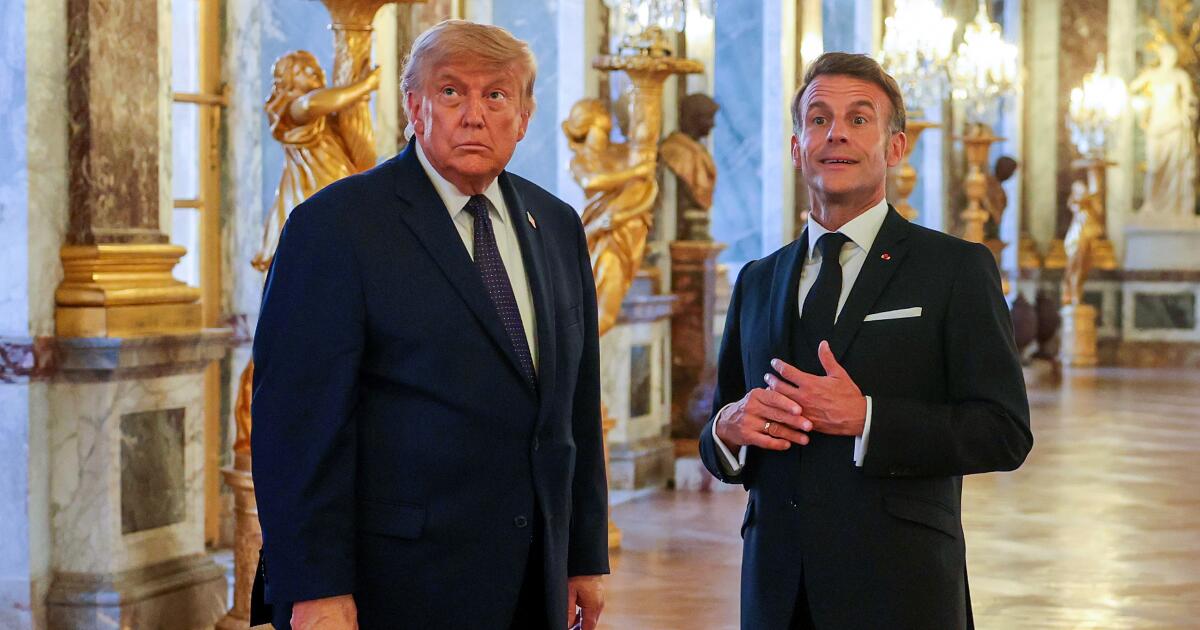
Despite mounting criticism, Trump put his signature to the memorandum on Wednesday night while attending a dinner with the French president in Versailles, a palace infamous for hosting a treaty signing that disgraced Germany at the end of the First World War.
He defended the agreement while in Europe and suggested further concessions might be forthcoming, including recognition of Iran’s claimed right to enrich uranium and a new willingness to tolerate its continued ballistic missile development — another program that Trump had vowed to eliminate as a central war aim.
“He took America to war — killing 13 soldiers, thousands of Iranian civilians and costing taxpayers $60 billion — to get rid of Iran’s missile program. And now that he’s lost the war, he pretends like it’s no big deal,” said Sen. Chris Murphy, a Democrat from Connecticut.
“Just unforgivable,” he added. “What a charlatan.”
-

 New York1 hour ago
Video: Knicks Fans Celebrate With Ticker-Tape Parade
-

 Los Angeles, Ca1 hour ago
Armed, dangerous CHP pursuit suspect tied to double homicide in Pomona
-

 Detroit, MI1 hour ago
First responders honored after rescuing 12 people from capsized sailboats near Belle Isle
-

 San Francisco, CA2 hours ago
Oakland man faces hate crime charges for Castro District attack
-

 Dallas, TX2 hours ago
At least 4 injured after vehicle drives into Dallas crowd, driver arrested
-

 Miami, FL2 hours ago
Miami Central students prepare for life changing trip to Zimbabwe amid funding challenges
-

 Boston, MA2 hours ago
Giannis to Boston is a possibility. Should the Knicks be worried?
-

 Denver, CO2 hours ago
Denver Public Schools’ decline in enrollment continues to reshape district

