Lifestyle
Seven books to help you work through the climate anxiety you developed in 2025


With the holiday travel season ramping up, a good book is a must-have for airport delays or to give as the perfect gift.
Journalists from Bloomberg Green picked seven climate and environmental books they loved despite their weighty content. A few were positively uplifting. Here are our recommendations.
Fiction
“What We Can Know” by Ian McEwan
It’s 2119, decades after the Derangement (cascading climate catastrophes), the Inundation (a global tsunami triggered by a Russian nuclear bomb) and artificial intelligence-launched wars have halved the world’s population. The U.S. is no more and the U.K. is an impoverished archipelago of tiny islands where scholar Tom Metcalfe embarks on an obsessive quest to find the only copy of a renowned 21st century poem that was never published.
The famous author of the ode to now-vanished English landscapes recited it once at a dinner party in 2014 as a gift to his wife, but its words remain lost to time. Metcalfe believes access to the previously hidden digital lives of the poet and his circle will lead him to the manuscript. He knows where to start his search: Thanks to Nigeria — the 22nd century’s superpower — the historical internet has been decrypted and archived, including every personal email, text, photo and video.
The truth, though, lies elsewhere. It’s a richly told tale of our deranged present — and where it may lead without course correction. — Todd Woody
“Greenwood” by Michael Christie
This likewise dystopian novel begins in 2038 with Jacinda Greenwood, a dendrologist turned tour guide for the ultra-wealthy, working in one of the world’s last remaining forests. But the novel zig-zags back to 1934 and the beginnings of a timber empire that divided her family for generations.
For more than a century, the Greenwoods’ lives and fates were entwined with the trees they fought to exploit or protect. The novel explores themes of ancestral sin and atonement against the backdrop of the forests, which stand as silent witnesses to human crimes enacted on a global scale. — Danielle Bochove
“Barkskins” by Annie Proulx
Another multigenerational saga, spanning more than three centuries and 700 pages, this 2016 novel by a Pulitzer Prize-winning author tracks the deforestation of the New World over 300 years, beginning in the 17th century.
Following the descendants of two immigrants to what will become modern-day Quebec, the story takes the reader on a global voyage, crisscrossing North America, visiting the Amsterdam coffee houses that served as hubs for the Dutch mercantile empire and following new trade routes from China to New Zealand. Along the way, it chronicles the exploitation of the forests, the impact on Indigenous communities and the lasting legacy of colonialism.
With a vast cast of characters, the novel is at times unwieldy. But the staggering descriptions of Old World forests and the incredible human effort required to destroy them linger long after the saga concludes. —Danielle Bochove
Nonfiction
“The Joyful Environmentalist: How to Practise Without Preaching” by Isabel Losada
It is hard for a committed environmentalist to feel cheerful these days. But Isabel Losada’s book encourages readers to undertake a seemingly impossible mission: finding delight in navigating the absurd situations that committed environmentalists inevitably face, rather than succumbing to frustration.
Those delights can be as simple as looking up eco-friendly homemade shampoo formulas on Instagram or crushing a bucket of berries for seed collection to help restore native plants.
The book itself is an enjoyable read. With vivid details and a dose of British humor, Losada relays her failed attempt to have lunch at a Whole Foods store without using its disposable plastic cutlery. (The solution? Bring your own metal fork.) To be sure, some advice in her book isn’t realistic for everyone. But there are plenty of practical tips, such as deleting old and unwanted emails to help reduce the energy usage of data centers that store them. This book is an important reminder that you can protect the environment joyfully.
— Coco Liu
“Breakneck: China’s Quest to Engineer the Future” by Dan Wang
China’s President Xi Jinping is a trained engineer, and so are many members of the country’s top leadership. Dan Wang writes about how that training shows up in the country’s relentless push to build, build and build. That includes a clean tech industry that leads the world in almost every conceivable category, though Wang explores other domains as well.
Born in China, Wang grew up in Canada and studied in the U.S. before going back to live in his native country from 2017 to 2023. That background helps his analysis land with more gravity in 2025, as the U.S. and China face off in a battle of fossil fuels versus clean tech. — Akshat Rathi
“Entangled Life: How Fungi Make Our Worlds, Change Our Minds and Shape Our Futures” by Merlin Sheldrake
A JP Morgan banker might seem an unlikely character in a book about fungi. But R. Gordon Wasson, who popularized the main compound found in “magic mushrooms” with a 1957 article in Life magazine, is only one of the delightful surprises in Merlin Sheldrake’s offbeat book. The author’s dedication to telling the tale of fungi includes literally getting his hands dirty, unearthing complex underground fungal networks, and engaging in self-experimentation by participating in a scientific study of the effects of LSD on the brain. The result is a book that reveals the complexity and interdependency of life on Earth, and the role we play in it.
“We humans became as clever as we are, so the argument goes, because we were entangled within a demanding flurry of interaction,” Sheldrake writes. Fungi, a lifeform that depends on its interrelatedness with everything else, might have more in common with us than we realize. — Olivia Rudgard
“Toms River: A Story of Science and Salvation” by Dan Fagin
When chemical manufacturer Ciba arrived in Toms River, N.J., in 1952, the company’s new plant seemed like the economic engine the sleepy coastal community dependent on fishing and tourism had always needed. But the plant soon began quietly dumping millions of gallons of chemical-laced waste into the town’s eponymous river and surrounding woods. That started a legacy of toxic pollution that left families asking whether the waste was the cause of unusually high rates of childhood cancer in the area.
This Pulitzer Prize-winning masterpiece of environmental journalism reads like a thriller, albeit with devastating real-world fallout. It also shows how companies can reinvent themselves: I was startled to learn that Ciba, later known as Ciba-Geigy, merged with another company in 1996 to become the pharmaceutical company Novartis. At a time when there’s been a push to relocate manufacturing from abroad back to the U.S., this is a worthy examination of the hidden costs that can accompany industrial growth. — Emma Court
Bochove, Woody, Liu, Court, Rudgard and Rathi write for Bloomberg.


Can you say no to a friend’s wedding?
Getty Images/Getty images
hide caption
toggle caption
Getty Images/Getty images
Are we spending too much on other people’s weddings?
Going to a friend’s weddings can be so fun and meaningful… but it can also really hurt your wallet. A survey by LendingTree found that 31% of people who had been to a wedding in the past five years had accrued debt to attend. So what’s driving up the cost of weddings for guests? And what makes it so hard to say no to these expenses?
Brittany breaks it down with Allyson Rees, senior analyst at trend forecasting firm WGSN, and Annie Joy Williams, assistant editor at The Atlantic.
This episode was produced by Liam McBain, with additional support from Corey Antonio Rose. It was edited by Neena Pathak. Our Supervising Producer is Cher Vincent. Our Executive Producer is Barton Girdwood. Our VP of Programming is Yolanda Sangweni.
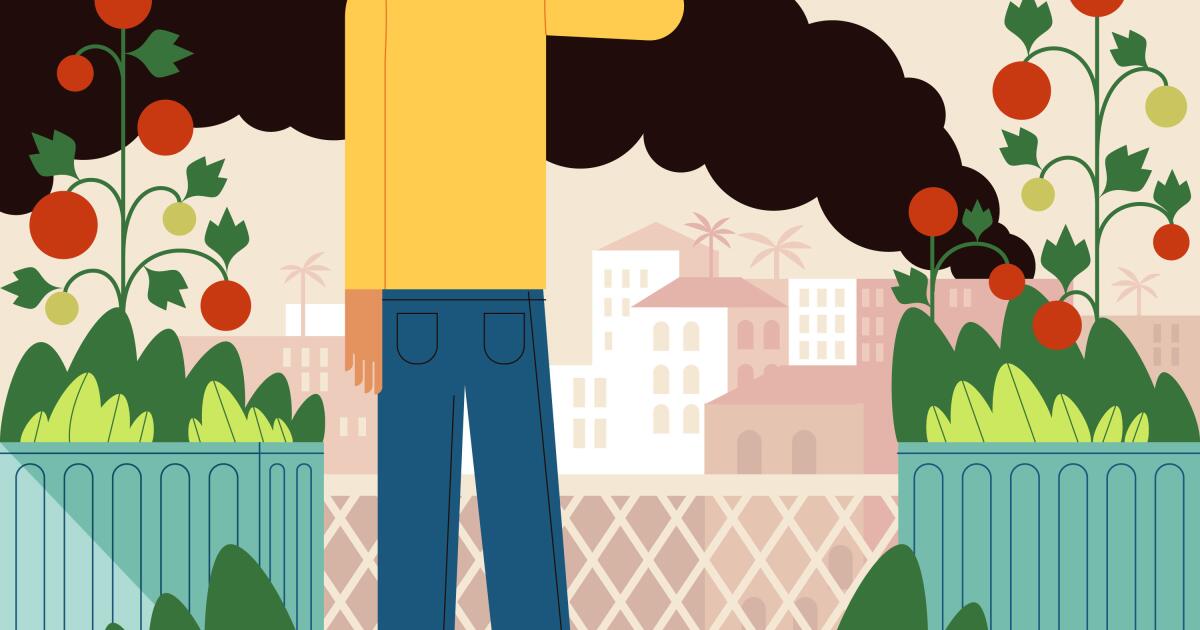
After the eight-day-long fire in a 500,000-square-foot Boyle Heights warehouse, eastern Los Angeles residents are contending with putrid smells, soot and potentially hazardous airborne chemicals after heavy plumes of smoke spread throughout the city. But those who grow food in nearby neighborhoods may also be wondering: How will the fires affect the plants and produce in my garden?
The Boyle Heights warehouse, owned by Lineage — a global temperature-controlled storage facility operator — housed 85 million pounds of frozen food and other products. In the days since the fire, local emergency visits for smoke inhalation and throat pain spiked while agencies still scramble to measure the amount of PM 2.5 — harmful fine particles — and heavy metals, like lead and arsenic, in the air.
According to researchers, any toxic airborne chemicals would likely stem from the charred foam insulation, metal exterior, burned solar panels and any lithium batteries that might have been present inside the warehouse.
After a fire, heavy metal particles can spread through ash and smoke over gardens and inhibit growth, said Olukayode Jegede, an agricultural toxicologist and assistant professor at UC Davis. Since the warehouse fire is so recent and cleanup has just begun, Jegede said the precise impact on gardens can’t be measured until comprehensive soil tests are conducted in the area.
While the L.A. city government hasn’t announced plans for soil testing, the Contaminant Level Evaluation and Analysis for Neighborhoods project at USC is offering free contaminant testing for Boyle Heights and East L.A. residents. Residents can collect soil samples and deliver them to Boyle Heights City Hall and other locations for an evaluation of lead, arsenic, chromium and mercury levels.
The good news is produce, plants and roots can still be preserved. According to Jegede, many of the soil tests conducted last year in the Altadena area after the Eaton fire showed that gardens and poultry were not as contaminated as one might expect.
“Quite a number of the soils we tested [in Altadena] were not really contaminated,” Jegede said. “We weren’t seeing many soils with concerning elevated levels of metal, so gardeners should not be too alarmed when these things happen.”
Nevertheless, there are several measures that gardeners can take to keep themselves, their children, plants and produce safe from potentially harmful contaminants stemming from the fire. Researchers, gardening experts and horticulturists offered some guidance on the handling, recultivation and cleanup that can keep you and your garden in good health.
How do I remove ash and contaminants from my garden?
Altadena horticulturist Leigh Adams said Boyle Heights plants and produce already live in a difficult environment, surrounded by industrial warehouses that spread contaminants daily.
“That area has been used industrially for 100 years, and the soil is impacted by many, many, many things,” Adams said. “Low-income neighborhoods and gardens usually don’t have a lot of resistance against dominant manufacturing.”
This means that the contamination of gardens in eastern L.A. won’t be as catastrophic as compared with those in Altadena, a more suburban environment, Adams said. But fallen ash still poses major health risks if ingested or inhaled.
An advisory from University of California Agricultural and Natural Resources last year recommended suiting up in an N95/KN95 mask, long sleeves, pants, close-toed shoes and gloves before attempting to deal with ash in the garden to limit exposure to potentially toxic contaminants. The advisory added that individuals should make sure all of this gear is cleaned thoroughly before bringing it back inside.
Once in the proper gear, Adams recommends removing the top two inches of topsoil from gardens, where the highest concentration of contaminants will settle after a fire. Using a plastic bag to collect the soil and disposing of it in the garbage — not green yard waste bins — will help to reduce the spread of airborne chemicals.
Gardeners with raised beds are advised to remove approximately six inches of soil, because excess ash can raise the pH level and prevent nutrients from soaking into the soil bed.
After this, watering the garden gently but plentifully will help to promote soil health and get rid of most of the ash present on plant leaves and stems. Adams said replacing the top two inches of soil with store-bought mulch or straw will help to contain any remaining ash and prevent it from spreading any further.
Experts say to avoid using leaf blowers if ash is present in the garden because they can send particles airborne. Doing so will increase the likelihood of heavy metal particles, which can carry lung irritants and carcinogens, being spread and inhaled.
A Boyle Heights resident keep a watchful eye on the fire at the 5,000-square-foot commercial building, which stores 85 million pounds of frozen food.
(Genaro Molina / Los Angeles Times)
Is it safe for me to eat produce from my garden?
Several studies, including one from the UC Cooperative Extension of Sonoma County, have shown that consuming produce in a fire-affected area poses minimal health risks.
Jegede said most root vegetables like potatoes and carrots, along with any fruit that has an outer layer, can be washed to remove potential contaminants, even if they were covered in ash. Peeling the outer layer of your produce can also help to reduce potential risks, he said.
Lettuce and other leafy foods with multiple layers pose a higher risk of contamination, but with a vigorous wash and peeling the outer layers, even the greens can be saved. The County of Los Angeles Department of Public Health recommends soaking leafy produce and fuzzy fruits like peaches in a 10% white vinegar and 90% water mixture.
Jegede said if the leaves or fruit are too delicate to wash or ash is still visible, it would be best to dispose of the produce.
How can I tell if my soil is contaminated?
After ridding your garden of visible ash, you might wonder how to tell if your plants will still thrive in the soil.
At-home soil tests that measure for alkaline, fertility and pH levels are widely available and can be purchased for $15 to $100 (for more detailed results) online. But Jegede said these tests can’t tell the full story of soil health.
Comprehensive soil testing is “something you can’t do properly at home,” Jegede said. “In labs, we are testing for metals like lithium and zinc, stuff that an at-home test will not show … If it comes to the point that you’re worried about your soil, I would just send it out to a lab.”
Wallace Laboratories in El Segundo, Babcock Laboratories in Riverside, Waypoint Analytical in Anaheim and other labs offer more detailed soil tests that measure heavy metal particles in addition to other fertility factors. Prices at Wallace Laboratories can range from $115 to $295 for a complete compost test.
The soil below two inches should be unharmed, Adams said, so long as new compost is set and plants are watered plentifully, which will promote natural biological cycles.
“What you’re doing is capping the soil, so that moisture stays in there, and instead of being dirt, it’s a living system called soil,” Adams said. “The more carbon we can get into our soil, the better.”
What can I do to help my soil recover?
For the last 12 years, Adams has been working with Metabolic Studio, a Los Angeles-based art and research hub focused on environmentalism, on methods for bioremediation, the practice of using additional fungi, plants and compost to decontaminate ash and break down contaminants.
Adams said straw, mushrooms, corn, rye and sunflowers are great bioremediators that can help to repair damage to soils. She said certain samples she’s worked on with Metabolic Studio have gone from testing at high heavy metal levels to nearly contaminant-free.
But for a more immediate fix, wash your produce, water your plants and have a little patience during ash cleanups. Your garden should look better in no time, Adams and Jegede said.

Inde Navarrette and Michael Johnston in Obsession.
Focus Features
hide caption
toggle caption
Focus Features
Two big horror films, Obsession and Backrooms, just smashed all box office expectations. So much of their success has been driven by Gen Z, which is now the biggest moviegoing demographic. But what makes a movie a Gen Z movie? Today we’re bringing you an episode of NPR’s It’s Been a Minute. Host Brittany Luse talks about this trend with Sam Adams and Reanna Cruz.
If you want to hear more about these movies, check out these episodes:
In ‘Obsession,’ love hurts. It really, really, really hurts.
‘Backrooms’ brings YouTube horror to the big screen
Zendaya brings ‘The Drama,’ we bring the spoilers
Connect with Pop Culture Happy Hour:
Letterboxd / Facebook
Our weekly newsletter
Support Pop Culture Happy Hour+
-

 Tennessee7 minutes ago
In-N-Out’s fifth Tennessee location is opening soon. Here’s how many stores are planned
-

 Texas9 minutes ago
Triple-digit heat returns to North Texas before weekend storms bring relief
-

 Utah15 minutes ago
Planned 60-foot long Liberty Arch in Utah sparks patriotism, but also concerns
-

 Vermont22 minutes ago
Vermont offers money to replace diesel vehicles with electric
-

 Virginia24 minutes ago
Virginia reports 10 cases of cyclosporiasis
-

 Washington30 minutes ago
Washington law says to alert the public when doctors are accused of misconduct. It can take months
-

 Wisconsin37 minutes ago
Former Wisconsin judge to be sentenced after conviction in obstructing arrest of Mexican immigrant
-

 West Virginia39 minutes ago
West Virginia town’s entire police force fired after ex-sergeant claims evidence room was broken into

