West
Colorado school district in the hot seat for allegedly factoring in race for disciplinary procedures


NEWYou can now listen to Fox News articles!
FIRST ON FOX: A conservative, Trump-aligned legal group filed a civil rights complaint alleging that a school district in Colorado is using race as a major factor when determining disciplinary procedures and has retaliated against administrators who attempt to push back.
America First Legal (AFL), founded by top Trump advisor Stephen Miller, filed a civil rights complaint asking the Department of Education and the Department of Justice to investigate Cherry Creek School District, alleging it is in violation of Title VI of the Civil Rights Act of 1964. In its complaint, AFL cites a specific instance in which a Black student and an Asian student commit nearly identical behavior, but only the Asian student was disciplined.
AFL also obtained undercover recordings of discussions between administrators that allegedly show them admitting that the district’s DEI chief has been interfering with disciplinary procedures on the basis of race. When an administrator tried to step in and call out this allegedly racist activity, the official was retaliated against, according to AFL.
“If a public school district can openly run discipline and employment systems through a racial filter, then the rule of law means nothing,” said Nick Barry, senior counsel at America First Legal. “This is discrimination, plain and simple. It is the soft bigotry of low expectations and should not be tolerated. The Department must intervene and restore equal treatment for students, educators, and families.”
JUSTICE DEPARTMENT SUES PUBLIC SCHOOL DISTRICT OVER ALLEGEDLY DISCRIMINATORY POLICIES
A Cherry Creek School District bus (John Leyba/The Denver Post via Getty Images)
Fox News Digital reached out to the district for comment, but it declined to comment on the matter, telling Fox News Digital it could not say anything because the district had “no knowledge of” AFL’s civil rights complaint despite Fox News Digital transmitting a copy of the complaint to the district. AFL’s complaint was filed electronically with the federal government.
In late 2023, according to the complaint, the district’s Campus Middle School disciplined and suspended three female students after a video of them off campus over Thanksgiving break using variations of the N-word while under the influence of alcohol was submitted to the district. Two students, one White and one Hispanic, were allegedly depicted in the video using the racially charged language, while the third Asian female did not appear in the video and only recorded the encounter.
Meanwhile, a fourth Black female student at the middle school allegedly asked the Asian female student who recorded the encounter to send her the video, which the Black student then allegedly passed along to her sister, a Black student in the district’s high school, who, AFL said, subsequently posted the video on social media and tagged the White, Hispanic and Asian students’ social media accounts. The Black female student who passed the video to her Black sister also passed it to her mother, who then shared the video with the Rocky Mountain NAACP, according to the complaint.
Despite nearly identical behavior from the Asian female student and the Black female students in the district, only the Asian student was disciplined, AFL alleged. She got the same punishment as the two female students pictured in the video using inappropriate language, which included months of expulsion hearings that eventually culminated in her suspension from school, according to AFL.
“[The Black students involved] disseminated the video to a much broader audience than [the Asian student involved],” AFL’s complaint states. “Despite both [Black female students involved] engaging in materially identical conduct as [the Asian female student involved], the District did not impose any discipline. … After [the Black female students’] identical infractions came to light, former Campus Assistant Principal Dan Hanson instructed personnel not to address the matter in electronic communications due to concerns about public records requests and adverse publicity.”
LEAKED LESSONS FROM FIRST-YEAR UNIVERSITY OF ILLINOIS EDUCATION COURSE SHOW EXTREME LEFT BIAS: ‘JUST SO WRONG’
According to AFL’s complaint, one of the non-disciplined Black female students continued to exhibit behavioral issues, and undercover recordings it obtained involving discussions between district administrators show Campus Middle School officials admitting the district’s Equity Department interferes with the equal application of disciplinary policies.
Protesters in Michigan rally against President Donald Trump’s anti-DEI policies, denouncing federal rollbacks on diversity, equity and inclusion programs. (Getty Images/Dominic Gwinn)
“[T]heir first instinct is implicit bias. So if, for example, [Redacted] is not responding appropriately to [the Black female student’s] concerns, it’s because [Redacted] has implicit bias towards a Black young lady, and that she does not know how to navigate the cultural identity of a Black young lady and that [Black female student involved] is talking to her like [she] talks to anybody,” Campus Middle School Principal Lissa Staal can allegedly be heard saying during a meeting with school leaders.
“This is just how [the Black female student involved] communicates. And that is culturally appropriate for [the Black female student involved] to communicate that way because that’s what is culturally appropriate,” Staal continued. “And that’s what is happening is that the Whiteness that is present in our building is looking at that in a punitive way … that we are attributing negative connotations to what is essentially, exactly, we’re calling her disrespectful or disruptive or defiant when she is just communicating in a culturally appropriate way.”
According to AFL’s complaint, school personnel said they had “no ability to enforce anything” against the Black female student who was continuing to act out because they would “lose every time,” since their “hands were tied” by the district’s DEI department.
The district also allegedly retaliated against former Dean of Students Pat Hogarty when he voiced disagreement with the district’s DEI priorities, according to AFL’s complaint.
CLICK HERE TO DOWNLOAD THE FOX NEWS APP
“In January 2024, Mr. Hogarty took part in the Courageous Conversations training. When faced with the topics of ‘What does it mean to be White?’ ‘What experiences define Whiteness?’ and ‘How do you identify?’ Mr. Hogarty stated that ‘he identifies as an American, that he loves his country, and that he believes it is the greatest country ever founded,’” AFL’s complaint states.
“Shortly after the training, Principal Staal informed Mr. Hogarty that the Equity Department’s Executive Director, Mr. Garcia y Ortiz, took issue with Mr. Hogarty’s failure to ‘acknowledge what people of color go through’ and refusal to ‘admit that America is systemically racist.’ Mr. Hogarty later learned that Garcia y Ortiz had referred to Mr.Hogarty’s comments in the training as having ‘racist undertones.’ Approximately a month later, Mr. Hogarty was informed that his position had been eliminated due to ‘budgetary reasons.’”
Due to the Cherry Creek School District receiving federal funds, it is subject to discrimination guidelines under Title VI of the Civil Rights Act. AFL has requested that the Education and Justice departments investigate the matter further and implement any necessary remedial action or referrals to enforce federal civil rights law.
Read the full article from Here



New Mexico
Feds allowed millions of fentanyl pills to ‘walk’ on New Mexico streets: DEA Whistleblower


Summer is in full swing, and across the country, the songs of birds and the cheeps of baby chicks are filling the air. While birdwatching season is happening just about everywhere right now, the Pacific Northwest offers something truly special: the chance to see puffins along the Oregon Coast. If you’re wondering when, where and how to see puffins in Oregon, you’re in the right place.
Few wildlife sightings feel as magical as spotting a Tufted Puffin (Fratercula cirrhata) in the wild. These beloved seabirds return to the Oregon Coast each year during their breeding season, drawing birdwatchers, photographers and nature lovers hoping for a glimpse of their bright orange beaks, expressive faces and unmistakable charm. For many visitors, seeing puffins in their natural habitat is a heartwarming coastal experience that captures the spirit of the Pacific Northwest.
Because puffins are seasonal migratory birds that nest in specific coastal areas, timing and location are key. With a bit of planning—and a little luck—you can witness one of Oregon’s most iconic wildlife moments along its rugged coastline. Here are the best places to see puffins on the Oregon Coast.
What Are the Best Places to See Puffins in Oregon?
If you’re wondering where you can you see these cute creatures, there are three spots that are worth going to and are hailed as the best places to see puffins in Oregon.
Haystack Rock, Cannon Beach
Haystack Rock is a popular place where puffins nest in Oregon.Getty Images Big5 Studio
Few wildlife encounters feel as effortless as spotting puffins right from shore, and Haystack Rock at Cannon Beach is one of the rare places where that’s possible.
This towering sea stack isn’t just an Oregon landmark, it’s also a seasonal nesting site for Tufted Puffins, who return here each year to raise their young on the rocky ledges. From the beach, visitors can often catch glimpses of puffins flying to and from the rock or resting along its cliffs, especially during the warmer months when activity peaks.
Because it requires no boat or hike to access, Cannon Beach remains one of the most rewarding and beginner-friendly places to experience puffins in the wild.
Face Rock State Scenic Viewpoint (Bandon)

Image via Getty Images/Moelyn Photos
For a quieter, more immersive coastal experience, Face Rock in Bandon offers a different kind of puffin viewing.
Here, the focus shifts from crowds to coastline where Tufted Puffins and other seabirds nest along offshore rocks just beyond the shoreline. The setting is calmer than Cannon Beach, making it ideal for visitors who want to slow down and scan the horizon for wildlife activity.
Every Saturday and Sunday from now until July 26, Face Rock Wildlife Interpreters will host on-site sessions at Face Rock Wayside from 9 am to 11 am, where guests will get to look out for puffins nesting on Face Rock with the wildlife interpreters’ help. Whether you go puffin-peeping on your own or with a group, be sure to bring binoculars!
Three Arch Rocks National Wildlife Refuge

Image via Getty Images/Bob Stefko
If looking for something a little closer to Portland, Three Arch Rocks is home to the largest breeding colony of Tufted Puffins in Oregon. A trip to Three Arch Rocks National Wildlife Refuge is sure to be a treat for any lovers of the Pacific Northwest’s coastal wildlife.
Not only is it one of the top places in Oregon to spot nesting puffins over the summer, but it is also the only pupping site on the North Oregon coast for the federally-threatened Steller sea lion, one of two sea lion species native to Oregon. Incidentally, the Steller sea lion’s pupping season, which runs from mid-May to mid-July, coincides with the first half of the Tufted Puffin’s nesting season, so right now is the perfect time of year for a visit!
When Do Puffins Arrive on the Oregon Coast?
For a large part of the year, Tufted Puffins live far out at sea across the North Pacific Ocean (in fact, they can be found as far eastward as Japan). However, from right now through August, Tufted Puffins are making their way back to coastal islands along the Oregon coastline to create their nests and raise their young until they are strong enough to join them out at sea. Therefore, if you want to catch a glimpse of them, now’s the perfect time.
What’s the Best Time of Day to See Puffins in Oregon?
These birds don’t follow a predictable shoreline schedule, which is part of what makes spotting them such a rewarding experience. So when’s the best time to see puffins in Oregon? Throughout the day during the breeding season, they move between offshore feeding areas and nesting sites on rocky cliffs and sea stacks. However, early morning and late afternoon often offer the most consistent viewing opportunities, when bird activity around colonies tends to increase and lighting conditions make movement easier to spot from shore.
For visitors hoping to increase their chances, choosing calm, clear days can make distant movement easier to detect against the waves.
What Do Puffins Eat and Why Do They Come to Oregon?
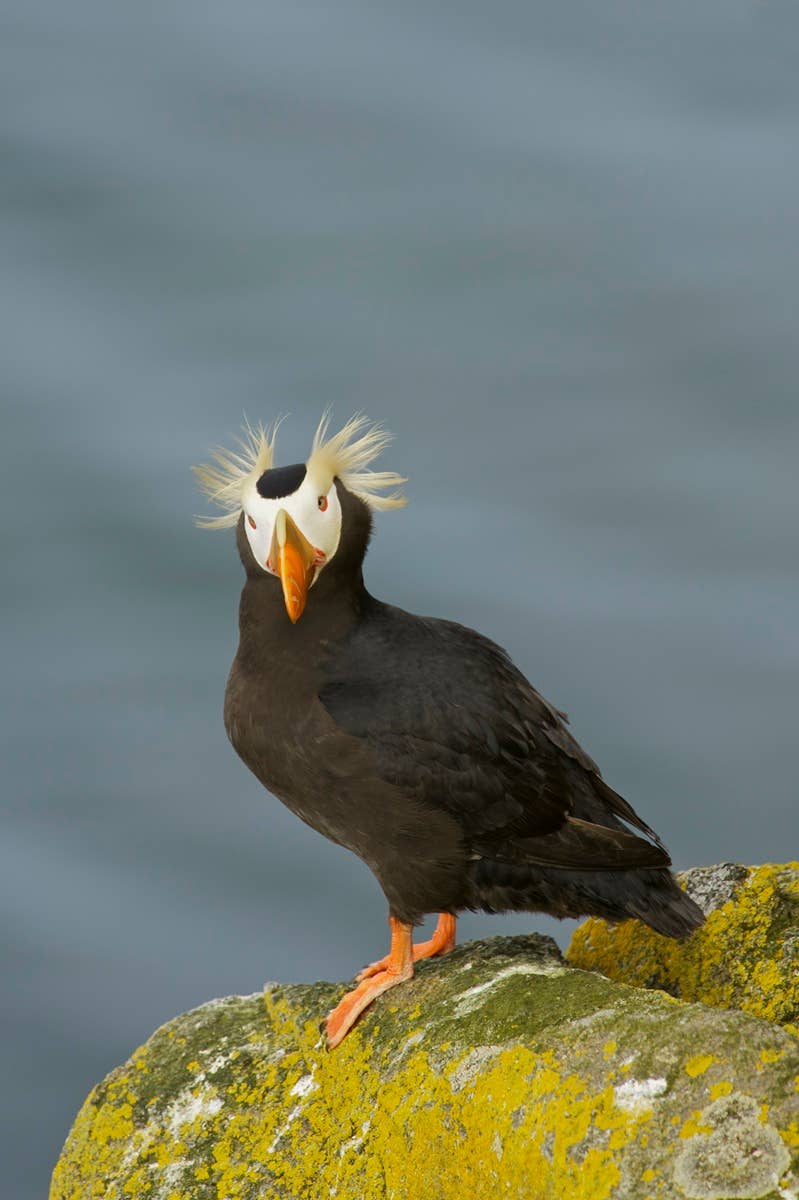
Tufted Puffins return to the Oregon Coast each summer.Getty Images Enrique Aguirre Aves
The presence of puffins along the Oregon Coast is closely tied to the health of the surrounding ocean ecosystem.
Oregon’s offshore waters provide an especially productive feeding environment thanks to cold currents that bring nutrients to the surface, supporting large fish populations. After all, Tufted Puffins rely on small schooling fish such as sand lance, anchovies and herring, which they catch by diving underwater and carry multiple fish back to feed both themselves and their chicks during the nesting season.
Combined with nearby rocky islands that offer protected nesting sites, the region creates an ideal seasonal habitat for breeding puffins and is what brings them back each year. It’s also why Oregon remains one of the most important puffin-viewing regions on the West Coast.
Tips for Spotting Puffins in Oregon
At one point, the Tufted Puffin’s distribution in North America stretched from northern California to British Columbia and the Aleutian Islands of Alaska. However, starting in the 1990s, the North American Tufted Puffin population plummeted in numbers, and now only a few thousand visit the Pacific Northwest every summer, including only a little over 500 puffins in Oregon. If you want the best odds at spotting these rare birds in Oregon, there are a few things you should keep in mind.
Puffins are easiest to spot when you know what to look for—and where to focus your attention. Bring binoculars and scan rocky cliffs and offshore waters, especially during calm mornings or late evenings when the sea is quieter. Watch for quick, low flights over the water or brief pops of movement near the surface as they dive for fish. Patience pays off, since puffins often appear suddenly and disappear just as quickly.
Why Puffin Sightings in Oregon is Special
Puffin sightings along the Oregon Coast are special because they’re both seasonal and fleeting. These seabirds spend most of their lives far offshore, only returning briefly to coastal nesting areas. That short window makes each sighting feel rare, especially when you catch them diving, flying, or gathering near rocky shorelines. Their bright beaks and energetic behavior make even a quick glimpse feel memorable.
Sources:
Utah
‘Now’s our time’: Utah Jazz fans rejoice as Darryn Peterson gives them something they’ve been missing

The rookie guard is already dreaming of a championship in Utah.
(Rick Egan | The Salt Lake Tribune) Jazz fans celebrate as the Utah Jazz pick Darryn Peterson in the 2026 NBA Draft during a watch party at The Shops at South Town in Sandy, on Tuesday, June 23, 2026.
-

 New Hampshire3 minutes ago
Masked men with baseball bats terrorize 12-year-old during NH home invasion
-

 North Carolina8 minutes ago
Henri Veesaar’s North Carolina exit proves to be costly beyond belief
-

 New Jersey8 minutes ago
8 Somerset County Cops Named In ‘Major Discipline’ Report Released By NJAG Office
-

 New Mexico15 minutes ago
Feds allowed millions of fentanyl pills to ‘walk’ on New Mexico streets: DEA Whistleblower
-

 North Dakota23 minutes ago
Finding a hero: Efforts to identify North Dakota soldier Irvin C. Ellingson’s remains took years
-

 Ohio30 minutes ago
Is Ohio at the Great American State Fair? Latest as some states opt out
-

 Oklahoma33 minutes ago
Woman hospitalized after house fire in northeast Oklahoma City
-
Oregon38 minutes ago
Puffins return to the Oregon Coast: where and when to see them


