Business
They graduated from Stanford. Due to AI, they can’t find a job

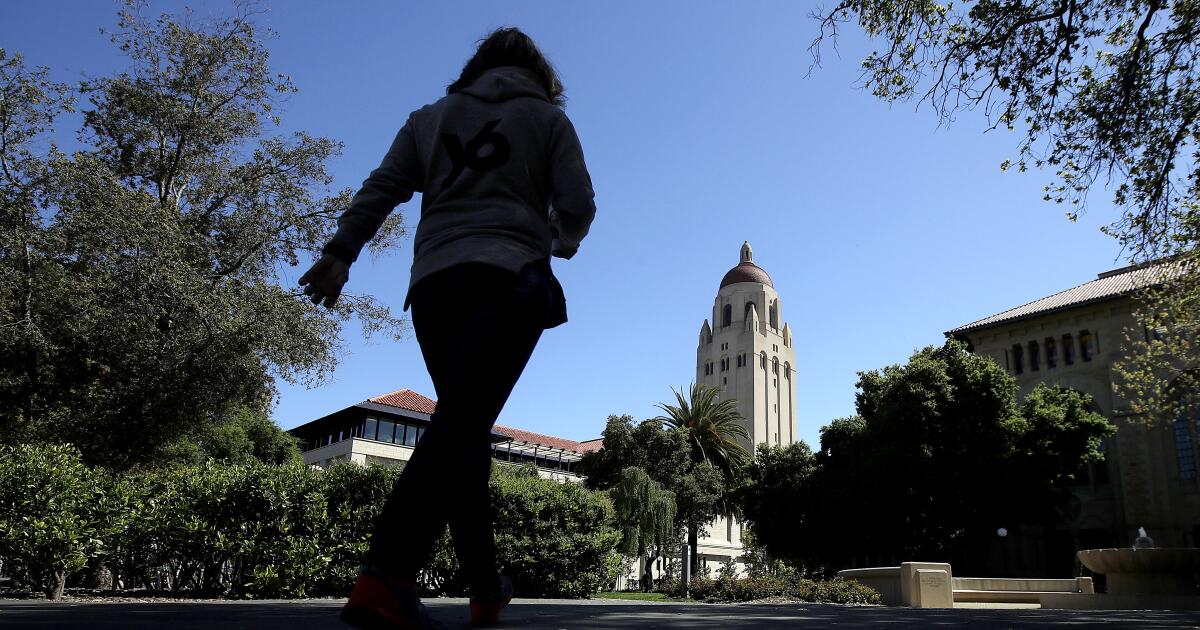
A Stanford software engineering degree used to be a golden ticket. Artificial intelligence has devalued it to bronze, recent graduates say.
The elite students are shocked by the lack of job offers as they finish studies at what is often ranked as the top university in America.
When they were freshmen, ChatGPT hadn’t yet been released upon the world. Today, AI can code better than most humans.
Top tech companies just don’t need as many fresh graduates.
“Stanford computer science graduates are struggling to find entry-level jobs” with the most prominent tech brands, said Jan Liphardt, associate professor of bioengineering at Stanford University. “I think that’s crazy.”
While the rapidly advancing coding capabilities of generative AI have made experienced engineers more productive, they have also hobbled the job prospects of early-career software engineers.
Stanford students describe a suddenly skewed job market, where just a small slice of graduates — those considered “cracked engineers” who already have thick resumes building products and doing research — are getting the few good jobs, leaving everyone else to fight for scraps.
“There’s definitely a very dreary mood on campus,” said a recent computer science graduate who asked not to be named so they could speak freely. “People [who are] job hunting are very stressed out, and it’s very hard for them to actually secure jobs.”
The shake-up is being felt across California colleges, including UC Berkeley, USC and others. The job search has been even tougher for those with less prestigious degrees.
Eylul Akgul graduated last year with a degree in computer science from Loyola Marymount University. She wasn’t getting offers, so she went home to Turkey and got some experience at a startup. In May, she returned to the U.S., and still, she was “ghosted” by hundreds of employers.
“The industry for programmers is getting very oversaturated,” Akgul said.
The engineers’ most significant competitor is getting stronger by the day. When ChatGPT launched in 2022, it could only code for 30 seconds at a time. Today’s AI agents can code for hours, and do basic programming faster with fewer mistakes.
Data suggests that even though AI startups like OpenAI and Anthropic are hiring many people, it is not offsetting the decline in hiring elsewhere. Employment for specific groups, such as early-career software developers between the ages of 22 and 25 has declined by nearly 20% from its peak in late 2022, according to a Stanford study.
It wasn’t just software engineers, but also customer service and accounting jobs that were highly exposed to competition from AI. The Stanford study estimated that entry-level hiring for AI-exposed jobs declined 13% relative to less-exposed jobs such as nursing.
In the Los Angeles region, another study estimated that close to 200,000 jobs are exposed. Around 40% of tasks done by call center workers, editors and personal finance experts could be automated and done by AI, according to an AI Exposure Index curated by resume builder MyPerfectResume.
Many tech startups and titans have not been shy about broadcasting that they are cutting back on hiring plans as AI allows them to do more programming with fewer people.
Anthropic Chief Executive Dario Amodei said that 70% to 90% of the code for some products at his company is written by his company’s AI, called Claude. In May, he predicted that AI’s capabilities will increase until close to 50% of all entry-level white-collar jobs might be wiped out in five years.
A common sentiment from hiring managers is that where they previously needed ten engineers, they now only need “two skilled engineers and one of these LLM-based agents,” which can be just as productive, said Nenad Medvidović, a computer science professor at the University of Southern California.
“We don’t need the junior developers anymore,” said Amr Awadallah, CEO of Vectara, a Palo Alto-based AI startup. “The AI now can code better than the average junior developer that comes out of the best schools out there.”
To be sure, AI is still a long way from causing the extinction of software engineers. As AI handles structured, repetitive tasks, human engineers’ jobs are shifting toward oversight.
Today’s AIs are powerful but “jagged,” meaning they can excel at certain math problems yet still fail basic logic tests and aren’t consistent. One study found that AI tools made experienced developers 19% slower at work, as they spent more time reviewing code and fixing errors.
Students should focus on learning how to manage and check the work of AI as well as getting experience working with it, said John David N. Dionisio, a computer science professor at LMU.
Stanford students say they are arriving at the job market and finding a split in the road; capable AI engineers can find jobs, but basic, old-school computer science jobs are disappearing.
As they hit this surprise speed bump, some students are lowering their standards and joining companies they wouldn’t have considered before. Some are creating their own startups. A large group of frustrated grads are deciding to continue their studies to beef up their resumes and add more skills needed to compete with AI.
“If you look at the enrollment numbers in the past two years, they’ve skyrocketed for people wanting to do a fifth-year master’s,” the Stanford graduate said. “It’s a whole other year, a whole other cycle to do recruiting. I would say, half of my friends are still on campus doing their fifth-year master’s.”
After four months of searching, LMU graduate Akgul finally landed a technical lead job at a software consultancy in Los Angeles. At her new job, she uses AI coding tools, but she feels like she has to do the work of three developers.
Universities and students will have to rethink their curricula and majors to ensure that their four years of study prepare them for a world with AI.
“That’s been a dramatic reversal from three years ago, when all of my undergraduate mentees found great jobs at the companies around us,” Stanford’s Liphardt said. “That has changed.”

Business
Company wants to revive Primm, the gambling spot turned ghost town. Owners say: Not so fast

A once-popular gambling mecca at the California-Nevada border that faded into obscurity could get a second life.
A Las Vegas-based truck-stop company is reportedly hoping to revive Primm to its former glory. But the would-be comeback faces a hurdle: striking a deal with the landowners, the Primm family.
In an interview with the Las Vegas Review-Journal, LV Petroleum Chief Executive Kris Roach shared his plans for the state-line ghost town.
“We would like to operate everything at the exit, the hotels, the casinos, the truck stop, the stores, pretty much from farm to table,” Roach told the Review-Journal. “We would like to revive the whole exit.”
But Cory Clemetson, president of Primm and grandson of founder Ernie Primm, said in a statement shared with The Times: “Recent reports suggesting that an agreement with any specific potential partner may be imminent are overstated and premature.”
LV Petroleum is an active operator of convenience stores and travel centers with more than 80 locations across the United States, according to its LinkedIn page.
In May, Affinity Gaming, which currently operates several businesses on behalf of the Primm family, announced a plan to close most properties it had been leasing by July 4.
Whiskey Pete’s, which along with its companion resorts at Primm drew in visitors with low prices and deals, closed in 2024. Buffalo Bill’s, which featured a 209-foot-tall roller coaster, concluded its operations in 2025.
Primm Valley Resorts, the sole operating casino in Primm, remains open until the July deadline. Other stores affected by the closure include the Primm Center, the Flying J, and the Primm Lotto Store, according to KSNV NBC Las Vegas.
Primm, an alternative to Vegas for Southern Californians that cut 45 minutes off the drive, suffered a decline in tourism after the COVID-19 pandemic and saw increased competition from tribal casinos in California.
Roach told the Las Vegas Review-Journal that he did not want to see the businesses go dark, adding that 344 employees would lose their jobs following the closure. Roach said, among his plans, would be reopening Whiskey Pete’s.
But the Primm family says a deal is far from done.
“Our family is currently considering opportunities involving multiple well-established operators that have successfully operated similar hotel-casino properties in Nevada,” Clemetson said. “We will continue to explore all viable options as we work toward the best possible solution especially for the hundreds of Primm employees and their families dealing with this difficult situation.”
Modern-day Primm began in the 1950s when Ernie Primm established a motel and coffee shop at the state-border location. In the 1970s, he and son Gary expanded operations to build Whiskey Pete’s. Once called State Line, the area was renamed Primm in 1996 after Ernie’s death.

Anthropic, the company behind the powerful artificial intelligence chatbot Claude, has filed to get ready to list its shares.
The development comes days after it raised $65 billion, valuing it at $965 billion.
The company, founded in 2021 by a breakaway faction from OpenAI, was viewed as an upstart that tailored its chatbots to the needs of businesses and developers, rather than consumers.
Late last year, the release of its agentic coding assistant propelled it ahead in the AI race, as the company’s annualized revenue skyrocketed from $9 billion at the end of 2025 to more than $47 billion in May.
“This gives us the option to go public after the SEC completes its review. The proposed initial public offering will depend on market conditions and other factors,” the company said in a statement, announcing the confidential filing on its website.
The number of shares to be offered and the price have not yet been set, the company said. Last week, Anthropic released its latest model, Claude Opus 4.8, to the public.
The upstart began gaining ground against its larger rival OpenAI late last year with the release of its Claude Opus 4.5, which became a huge hit among developers and enthusiasts who were able to merely describe an app or website or online dashboard or research problem in English, and have the coding agent complete the task. .
As adoption of Claude grew, OpenAI has been juggling numerous big bets, including the shuttered text-to-video model Sora, agentic shopping and an AI-native browser, with mounting challenges to monetize its base of 800 million users. The company has since streamlined its operations, focusing on its coding product, Codex, and continues to invest in image generation and robotics.
The announcement puts Anthropic ahead of OpenAI, which reportedly hired bankers Goldman Sachs and Morgan Stanley in the race to go public. Anthropic now eclipses its rival, which was valued at $852 billion in March.
Elon Musk’s xAI, which operates the chatbot Grok, is a part of SpaceX that is gearing up to go public next week. It will be the largest initial public offering of stock in history, and a successful listing will make Musk the first trillionaire.
The blockbuster year for Silicon Valley IPOs will test people’s appetite to invest in the promise of artificial intelligence, amid worries and warnings of an AI bubble. .
Nasdaq introduced a rule change this year, shortening the three-month waiting period for stocks to be included in the index to 15 days.
It was done to accommodate monster listings such as SpaceX. The cooling-off period allows newly listed stocks to stabilize before passive index funds pick them up, but indices said it’s a much-needed update, as companies stay private longer, are more mature and have much larger valuations than in the past.
Dario Amodei, co-founder of Anthropic, has been outspoken about the risks of artificial intelligence wiping out half of all entry-level jobs and driving unemployment up by 20%. Some in the Trump administration have criticized his views as alarmist and accused his advocacy of AI safety of being an attempt at regulatory capture to create onerous compliance barriers that would restrict AI development to a handful of large companies, locking out smaller competitors.
In March, the company sued the Pentagon after it was designated as a “supply chain risk” for refusing to allow the use of its AI model for domestic mass surveillance or fully autonomous weapons.
The White House softened its posture against Anthropic in May, after the release of its AI model Claude Mythos, which proved itself adept at finding critical software bugs. The incident prompted a U-turn in the Trump administration’s laissez-faire approach to AI regulation and led to the consideration of safety testing before broader public release.
Anthropic’s Mythos model has now become a tool of geopolitical advantage for the U.S., as governments across the globe, including the European Union, have requested access to the powerful tool to identify and patch vulnerabilities in the banking and financial system that could be exposed to hacking.
The explosive demand has increased Anthropic’s need for AI chips, causing previous outages and forcing the company to set usage limits for users. To secure access to vital hardware, the company signed agreements with Amazon, Google, Broadcom and SpaceX in April for new computing capacity.
Business
Paramount’s Delrahim slams ‘fear-mongering’ and partisan politics clouding Warner Bros. deal

Paramount Chief Executive David Ellison has been circling the globe, meeting government regulators who will ultimately decide the fate of his controversial $111-billion takeover of Warner Bros. Discovery.
Last week, Ellison spent two hours answering questions from U.S. Justice Department antitrust lawyers in a bid to secure a key government approval — one that few people believe is in doubt because of President Trump’s strong support of tech billionaire Larry Ellison and his son’s ambitions to amass more power.
Throughout his travels, David Ellison has been accompanied by a savvy wingman: Makan Delrahim.
Delrahim, Paramount’s chief legal officer, served as the nation’s top antitrust regulator in the Justice Department during Trump’s first term. The 56-year-old Iranian American, who grew up in Los Angeles, is the architect of shrewd moves that have brought Paramount within reach of its blockbuster merger that would redefine Hollywood.
Politics have permeated the process — even before Trump announced he would get involved. Opponents have been suspicious of the Ellisons, given the family’s ties to Trump and programming changes to redefine Paramount’s CBS, including last month’s departure of late-night comedian Stephen Colbert and a shakeup at “60 Minutes,” CBS’ newsmagazine.
Buying Warner Bros. Discovery would give the Ellisons control of both CBS News and CNN.
Paramount’s bid for Warner Bros. has sparked dread in Hollywood for another reason, too: Thousands of jobs already have vanished through a string of media mergers.
More than 5,000 artists and entertainment industry workers have signed an open letter, calling on California Atty. General Rob Bonta to try to block the deal on antitrust grounds.
In an interview with The Times, Delrahim responded to concerns and criticisms. This interview has been edited for length and clarity:
Where does the regulatory process stand?
We are still going through the regulatory approval process. We actually started planning for the regulatory approval filings last summer. We knew we were going to be pursuing this transaction but it took a few months longer to sign the transaction than we thought. There were some interveners [Netflix, Comcast], but we planned ahead.
Do you have a commitment from Trump or his administration that you’ll get a thumbs up?
There are no deals with the president. We have a deal with the Warner Bros. shareholders. We’ve submitted [applications] to the governments of Europe, Canada, U.K. and the U.S., and that’s where it is.
You got a head-start because you filed a regulatory approval in December — months before Paramount had a deal with Warner. Why so soon?
We were always very skeptical [the Netflix deal] would ever go through. The only way to really show the [Warner] board that our deal would get through — because it doesn’t have antitrust problems — was to move as fast as we could.
One of the benefits being a former [DOJ] enforcer and having a team of outside lawyers who are also former colleagues and enforcers was that we anticipated what the government would ask for. Those were questions that we would have asked, and so we provided those answers.
Your timeline is aggressive. Some suggest Paramount wants this deal done before the mid-term elections.
I don’t think it’s aggressive. It has nothing to do with the midterms. The midterms do not change the officials at the Justice Department or the FCC — we have that minor application there. The midterms have no effect on the European Commission or anybody else. We’ve been very transparent and proactive with members of Congress and with the state attorneys general and the federal authorities.
Are you preparing to defend a potential antitrust challenge from Atty. General Bonta?
Well, no matter what field you’re in, whether it’s antitrust or whether you’re preparing for a football game, you always prepare the best you can for the worst, and you hope it never gets there. So, we’re preparing for challenges from anybody and everybody. But I don’t think any serious antitrust enforcer who looks at the facts, the law, the economics of this transaction will see an antitrust violation.
Why are you so confident?
There’s no element of this merger that is anti-competitive. Once you look at it, it’s incredibly pro-competitive. It increases output, it increases jobs, and it lowers the cost to the consumers. If you actually try to block this deal, you’re going to harm consumers, you’re going to harm creative talent, because you’re going to harm the creative ecosystem — the vision that David [Ellison] is trying to deploy here. It’s transformative from the efficiencies that it creates.
David Ellison has promised to release 30 films a year. Was that commitment to show that this merger will not be a repeat of Walt Disney Co.’s 2019 purchase of Fox?
I’m quite familiar with that one because I was at the Justice Department and reviewed it. Disney-Fox was a transaction with a different thesis. Disney wanted to get into streaming and they wanted to get scripted series. It wasn’t about studios trying to increase output.
Our transaction, as David has described, is motivated to create more content to feed the theaters, then streaming. We have a natural economic incentive to create more content. We’ll still be in fourth place after this transaction on the streaming side — almost half the size of Netflix.
David Ellison hasn’t made any commitments on the television side or pledged pledge to keep the various TV studios intact. Why?
I don’t think there’s much of an overlap on the television studios. Look, you have incredible studios in HBO, Warner Bros. Television, certainly our own studio. We’re not paying money to limit supply. It’s the exact opposite.
There is overlap between CBS News and CNN. How are regulators looking at that issue?
We’re very proud of CBS News and hopefully CNN, post-transaction. There is very limited overlap. Why? Because CBS News only airs a few hours a week of programming whereas CNN is 24/7, and it has international reach.
Antitrust regulators are going to see that it’s going to create synergistic effects. You might be able to cross-program and more people will be exposed to the incredible programming of CBS News. They’ll benefit from each other’s independent strengths.
During the first Trump administration, you said merger conditions were problematic because it’s difficult for the government to enforce behavioral remedies. Has your thinking changed?
No, I’ve been quite consistent. If there’s an antitrust problem, you need a divestiture [selling assets]. I don’t think there’s a remedy needed in this transaction. But having said that, we’re happy to engage with regulators to discuss where they see a problem and a possible solution. We’re always wanting to engage in constructive dialogue.
Would Paramount spin off CNN?
I don’t see that. I can’t see any antitrust reason to do so. That would be a weaponization of the antitrust law, and that would not be appropriate.
Many people in Hollywood view the merger with trepidation because of the prospect of more job losses. Others see it through a political lens. How do you evaluate the politics?
Politics is part of life. It’s part of the beautiful process of democracy. Generally, we are very empathetic to the folks in Hollywood, but this transaction will actually create more and better and exciting jobs. David is an absolute lover of films; he’s a filmmaker himself. For the first time, you are getting an owner who comes from the creative side.
Let’s be honest. There’s a lot of fear-mongering, particularly from people in Washington, D.C. They are running a political campaign. Some of these people are trying to inflict harm on this transaction really because of their own antisemitic views. Regulators and law enforcement officials will see right through that.
Do regulators share others’ concerns about the merger debt — $79 billion — for the combined company?
Some regulators appropriately have asked about it. They say: ‘This is what we have heard, that you guys are not going to be around because of this debt,’ which is just silliness. David and his family are owner-operators. They’re not rented CEOs. They have over 50% ownership. They put their money at stake and my money is on them.
-

 Los Angeles, Ca22 seconds ago
2 women killed after being struck by BMW in Orange County intersection
-

 Detroit, MI18 minutes ago
After 12 years in downtown Detroit, Wright & Company calls it quits
-

 San Francisco, CA30 minutes ago
San Francisco voters to decide on dueling measures on Top Executive Pay Tax changes
-

 Dallas, TX32 minutes ago
Dallas Cowboys’ Path To NFC East Crown Gets Easier After June 1 NFL Trade Frenzy
-

 Miami, FL38 minutes ago
Developers pay off $115M in Miami construction loans as condos near sellout
-

 Boston, MA45 minutes ago
Updating Red Sox’s Playoff Chances: Numbers Never Lie | NESN
-

 Denver, CO48 minutes ago
Denver City Council approves $15.5 million tax break for Rossonian Hotel development
-

 Seattle, WA53 minutes ago
Melinda French Gates is done ‘cheering on Seattle from the sidelines’ — she’s buying into the bet to bring the Sonics back | Fortune

