News
Afghan CIA fighters, like National Guard attack suspect, face stark reality in U.S.


Pictures of National Guard members Andrew Wolfe and Sarah Beckstrom, who were shot on Nov. 26 in Washington, D.C., are displayed next to a picture of the suspect in the shooting, Afghan national Rahmanullah Lakanwal, on the day of a news conference in Washington, D.C., on Nov. 27.
Nathan Howard/REUTERS
hide caption
toggle caption
Nathan Howard/REUTERS
They survived some of the Afghanistan War’s most grueling and treacherous missions, regularly battling the Taliban in nighttime raids and urban gun battles. But once evacuated to the U.S., many Afghan fighters who served in “Zero Units” led by the CIA found themselves spiraling into despair because of what they saw as bureaucratic neglect and abandonment by the U.S. government, a former CIA operative and a former Afghan fighter involved in the units told NPR.
Among their ranks was Rahmanullah Lakanwal, the man charged with killing one National Guard soldier and seriously injuring a second after opening fire on them in Washington, DC on Thanksgiving Eve.
The sense of betrayal and frustration cut so deep, some Afghan soldiers living in the U.S. began threatening self-harm.
“Unfortunately, four people took their lives,” said Davud, who served as a combat translator in a Zero Unit for more than a decade.

Davud, who lives now on the West Coast, agreed to be interviewed about the struggles of his fellow soldiers only if NPR identified him by his first name and concealed his identity. He said he fears for the safety of his family still living under Taliban rule in Afghanistan.
Despite their service to the U.S., many Zero Unit fighters have struggled to gain asylum or permanent residency in the U.S., according to Davud. He condemned Lakanwal’s alleged actions, but spoke of the overwhelming mental health and emotional challenges fighters face living in exile.
While fighting under CIA leadership, thousands of soldiers like Davud and Lakanwal faced some of the most harrowing battles of the 20-year Afghanistan war, often carrying out two or even three combat missions a night. Their tactics were often brutal, and groups like Human Rights Watch accused them of engaging in torture and illegal killings.
“I almost got killed by a grenade,” Davud told NPR, describing one firefight when an American CIA agent saved his life. “He grabbed me from my body armor and pulled me back.”
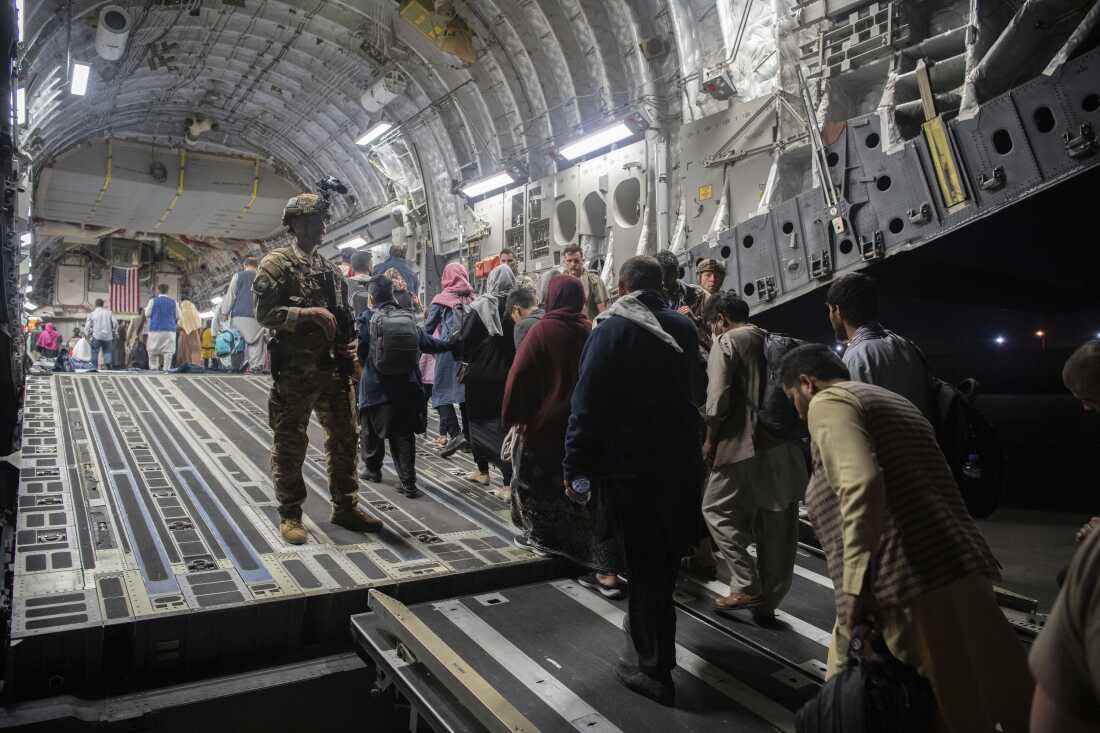
In this Aug. 22, 2021, file photo provided by the U.S. Air Force, Afghan passengers board a U.S. Air Force C-17 Globemaster III during the Afghanistan evacuation at Hamid Karzai International Airport in Kabul, Afghanistan.
MSgt. Donald R. Allen/U.S. Air Force via AP
hide caption
toggle caption
MSgt. Donald R. Allen/U.S. Air Force via AP
After being evacuated to the U.S. in 2021, when the Taliban swept into Kabul, many Zero Unit soldiers came to feel they had been abandoned by CIA officials. Despite years of service — which Davud described as “a brotherhood” — he now believes the agency failed to help his comrades navigate America’s complex immigration system.
“It’s that feeling of like you did something that nobody is appreciating,” he said. “That promise that was given to you by your employer was a fake promise.”
NPR sent detailed questions to the CIA and to the U.S. Immigration and Citizenship and Immigration Services, asking for comment. Both agencies declined to comment on the record for this story.
But many aspects of Davud’s account of growing tension and frustration among Zero Unit fighters living in the U.S. were confirmed by Geeta Bakshi, a former CIA agent who spent four years in Afghanistan.
“These guys were the tip of the spear,” Bakshi said, describing the CIA’s Afghan Zero Unit program in an interview with NPR. “They were out on the front, so that American personnel didn’t have to be. They were the ones facing the maximum danger on the battlefield.”
Bakshi now leads a refugee resettlement program, called FAMIL, that focuses on helping Zero Unit soldiers rebuild their lives inside the U.S. She says her organization grew alarmed about rising rates of self-harm among former Afghan soldiers beginning in 2023.
“Individuals from the Zero Units unfortunately suffered deaths by self-harm,” Bakshi told NPR. “We raised this issue with the Biden administration and it was one that we were very concerned about. Again, we saw a direct connection to prolonged immigration delays.”
Bakshi and Davud described struggling to help a growing number of Afghan soldiers in the U.S. who were spiraling into depression. Davud described one instance where a friend felt increasingly hopeless because his immigration status made it difficult for him to work.
“He was like, ‘I’m going to go kill myself,’ that’s how bad it was,” Davud said. “I was very worried for him, but we helped him.” That meant offering friendship, counseling, and support.
Bakshi described a separate incident where a Zero Unit fighter appeared to be unraveling because of repeated bureaucratic snafus by U.S. officials reviewing his immigration paperwork. “He was told, ‘We don’t have you in the system.’ This was a man who was in severe distress. What happened in his case is there was an error in the spelling of his name.”
That individual eventually received a Green Card, Bakshi said, adding that with proper support many Afghan soldiers are adapting well to life in America. In rare cases where Zero Unit soldiers ended their lives, the community has held memorials.
“We usually do a religious funeral for them, on their behalf, saying a prayer,” Davud said.
Lakanwal, the Zero Unit fighter accused of fatally shooting one National Guard soldier and seriously wounding another, also struggled with his immigration status. He only received asylum protection from the Trump administration in April of this year, nearly four years after coming to the U.S.
Like others who fought alongside the CIA in Afghanistan, Lakanwal appeared to be experiencing a personal crisis which began at least as early as January 2024, according to a refugee resettlement volunteer who worked with the Lakanwal family in Bellingham, Wash. Emails shared with NPR show he, too, struggled to find stable employment.

“My biggest concern was that he would harm himself,” the volunteer told NPR. “I worried he would be suicidal because he was so withdrawn.”
The volunteer spoke with NPR on condition of anonymity because they said they feared for their safety, as well as the safety of others in their volunteer community, because of possible retaliation for having worked with the Lakanwals and other Afghan refugees.
Homeland Security Secretary Kristi Noem has said that U.S. officials believe Lakanwal was “radicalized” while living in the United States, but the volunteer said they saw no signs of radicalization. Noem offered no evidence that Lakanwal was radicalized.
Davud, the Zero Unit fighter, said he didn’t know Lakanwal personally. He voiced sorrow that his community of Afghan soldiers wasn’t able to help him in time.
“We had worse cases [of emotional distress] than Lakanwal but we found solutions for them,” he said.
Lakanwal has pleaded not guilty to first degree murder and other charges. In the wake of the attack in Washington, D.C., the Trump administration has frozen all Afghan asylum cases and officials say the legal status of refugees from Afghanistan living in the U.S. is being reexamined.

People pay their respects to the fallen National Guardsman outside Farragut West Metro Station in Washington, DC, on November 28, 2025.
Andrew Thomas/NurPhoto via Reuters
hide caption
toggle caption
Andrew Thomas/NurPhoto via Reuters
CIA director John Ratcliffe suggested in a statement that Lakanwal and his fellow soldiers weren’t properly vetted “This individual — and so many others — should have never been allowed to come here,” Ratcliffe said.
FBI director Kash Patel also said the Biden administration failed to properly vet “in any way, shape or form this individual and countless others.”
That account was disputed by Davud., and Biden administration officials who said the Afghans underwent rigorous vetting.
“What they said about Mr. Lakanwal wasn’t vetted? We were all vetted,” he said, describing years of scrutiny, including polygraph tests and detailed interviews by the CIA and other federal agencies, in Afghanistan and in the United States.
“We worked with them for twenty years,” Davud said. “I was really shocked by the CIA director’s comment. I felt so betrayed.”
If you or someone you know is struggling with thoughts of suicide, you can dial or text 988 and be connected to help.


At least two structural columns buckled and failed in a 37-story office tower in Midtown Manhattan on Tuesday, prompting evacuations of nearby streets and buildings. While city officials asserted that the tower was in no danger of collapsing completely, outside engineers said further failures in the structure could not be ruled out.
A pair of columns that failed completely were part of the tower’s existing structure. A New York Times review of images and videos from inside the building has found that several floors were added atop these columns.
City officials said in a news conference on Tuesday that the building was continuing to move, while they simultaneously assured the city that the building would not suffer “total collapse.” “The way this building is constructed, it’s a steel-frame building,” John Esposito, a chief in the Fire Department in New York, said at the afternoon news conference. “So, it would not be a total collapse. It would be more of a localized collapse.” Still, he said, “that remains our concern, that it’s moved.”
Engineers said that the movement itself was cause for concern. In a properly designed steel building, they said, loads should redistribute quickly to surviving structural supports if columns failed.
Joe DiPompeo, a former president of the Structural Engineering Institute at the American Society of Civil Engineers, said that if the structure had been overloaded, he would expect any movement “to happen very quickly,” rather than gradually.
“Generally when a column buckles, it’s a sudden failure,” Mr. DiPompeo said. He said that a full collapse remained unlikely given the redundancies built into the building codes.
Engineers often refer to the most dangerous possibility as a progressive collapse, a process in which structures near the initial failure become overstressed and also fail, potentially bringing down the building if the sequence continues. While unlikely, it cannot be ruled out, Mr. DiPompeo said.
Footage recorded from inside the building shows at least two structural columns appear to have failed completely, Mr. DiPompeo said. Other nonstructural, interior walls — or at least the metal “studs” that were in place to hold them up — also appear to have deformed.
“The only way that really happens is if the floor above them dropped. It looks like the floor above could have dropped a foot or two, which is obviously not a good situation,” Mr. DiPompeo said.
The 37-story building is in the process of being converted from office space into residential units. Four new floors and a large vertical portion were added onto the existing building in recent months. The vertical portion consists of a stack of over a dozen new floors cantilevered out over the existing building below.
Engineers said that there was nothing inherently wrong with adding residential floors or the cantilevered section above the columns that failed, as long as the original structure and the modifications had properly accounted for the added weight and wind loads.
“The cantilever alone doesn’t change anything,” Mr. DiPompeo said, but it does put additional load on the columns underneath — a factor that should have been reflected in the design.
Nathan Berman, managing principal and founder of MetroLoft, the developer overseeing the conversion, said on Tuesday that “this incident is nothing more than a typical construction mishap.”
He said two columns near the northwest corner of the tower had bent under the weight of additions to the building above, most likely because those columns had not been properly reinforced, though he said an investigation would determine the cause. The rest of the columns, he said, “picked up the weight.” He estimated the affected floors above the failed columns had sagged by a maximum of four inches.
Mr. Berman said that he expected the problems to be fixed and the project to be completed with, at most, a slight delay.
On Tuesday evening, installation of temporary shoring was set to begin shortly, in order to help stabilize the 20th and 21st floors of the building.

The Justice Department sent letters warning election officials in all 50 states and the District of Columbia that they could face criminal prosecution over noncitizen voting, a spokesperson for the Justice Department confirmed Tuesday.
The letters, signed by Assistant Attorney General Harmeet Dhillon, who heads up the department’s Civil Rights Division, give states five days to explain how they will comply with federal voter eligibility laws and how they will maintain “clean voter lists.”
“The Department sent these letters to all 50 states and the District of Columbia, asking for voluntary compliance in a timely manner with their obligations under federal law to ensure only citizens vote in federal elections,” a Justice Department spokesperson said in a statement.
Noncitizen voting in federal elections is extremely rare, but Trump and his administration have falsely portrayed it as a widespread issue.
Michigan Secretary of State Jocelyn Benson, Nevada Secretary of State Francisco Aguilar and Utah Lt. Gov. Deidre Henderson are among those who said they received the letters from the Justice Department.
The letters say state election officers “could be criminally prosecuted for aiding and abetting” noncitizen voting. They further specify that any election officer who knowingly retains noncitizens on a statewide voting registration list or who facilitates noncitizens’ receiving and casting ballots could be subject to criminal liability.
“An intentional act that is aimed at diluting the votes of citizens could also constitute a violation” of federal law, the letters said.
Henderson wrote on social media that the threats constitute “truly bizarre behavior.”
“Got another love letter this morning from the DOJ sprinkled throughout with threats of criminal prosecution,” she wrote. “I’m sure I’m not the only chief election officer of a state who is being targeted for following state and federal laws by resisting DOJ’s demands for private voter data that have thus far been ruled illegal by at least a dozen courts.”
The letters are the latest move in the Justice Department’s campaign to assert more federal control over state elections.
While some states have complied with the administration’s demands that they hand over voter roll data, the Justice Department has sued 30 states and Washington, D.C., for resisting. So far, 11 different federal courts have dismissed the Justice Department’s efforts to seize voter rolls.

Lionel Messi #10 of Argentina celebrates scoring his team’s second goal during their World Cup match against Egypt in Atlanta on Tuesday.
Elsa/Getty Images
hide caption
toggle caption
Elsa/Getty Images
They looked beaten. And out. Argentina, the defending World Cup champion and No. 1-ranked team, was down 2-0 late against Egypt.

Then, in a span of 13 remarkable minutes, Argentina scored not once, not twice, but three times, capping a comeback for the ages and leaving Egypt stunned and shellshocked.
For much of the game in Atlanta, Egypt was in control, hobbling Argentina early. The Egyptian attack began almost immediately with a stunning header goal delivered by Yasser Ibrahim in the 15th minute. After that, Egypt’s defense closed ranks, making it practically impossible for Argentina to equalize.
It was downhill from there for the Argentines: team captain Lionel Messi failed to convert a penalty kick, and in the 67th minute, Egypt got a second goal from Mostafa Ziko (after an earlier Egyptian goal had been disallowed after a video review). It looked like Argentina was finished. On the brink of elimination.
But no one told the Argentine players that.
In the 79th minute, Lionel Messi began doing his thing. He fired a cross near the Egyptian goal, and Cristian Romero headed it in. Messi was not done. Four minutes later, he powered a shot past the Egyptian keeper. It was his eighth goal of this tournament, the most of any player. The score was 2-2.
Then, in stoppage time, yet another Argentina header and another goal, this time from Enzo Fernandez.
“This is the World Cup for you,” said Messi after the game. “It wasn’t easy to come back from two goals down. But as I always say, this group never gives up. We always try to fight until the end.”

French referee François Letexier speaks with Egypt forward Mohamed Salah during the World Cup Round of 16 match between Argentina and Egypt in Atlanta.
Roberto Schmidt/AFP via Getty Images
hide caption
toggle caption
Roberto Schmidt/AFP via Getty Images
Afterward, Egypt coach Hossam Hassan complained about the French referee and the officiating. “I am not convinced. I am not convinced with this outcome. I’m not convinced with the way things unfolded during this match,” said Hassan in a post-match news conference. “We have been treated unfairly today. We have suffered injustice.”
“We would have deserved to earn this win, but we are leaving with honor, with pride, regardless of this defeat,” said Hossan.
African soccer teams have been the stars of this World Cup. Morocco has yet to lose a game. Cape Verde qualified for the first time in its history and stymied Spain, Uruguay and Saudi Arabia. Argentina barely beat them in a nail-biter of a match.
For Egypt, getting this far in the tournament is historic in itself: it’s the first time the team has made it this far. For Argentina, it was a terrifying yet relieving victory: several players, including Messi himself, cried after the game.
Next, they move to the quarterfinals and will play the winner of today’s Switzerland-Colombia match.
-

 Pennsylvania2 minutes ago
Pennsylvania state trooper to be laid to rest after being fatally struck in Schuylkill County
-

 Rhode Island9 minutes ago
Man critically hurt in Providence stabbing
-

 South-Carolina12 minutes ago
Federal court revives NAACP lawsuit challenging SC education law limiting how schools can teach race
-

 South Dakota17 minutes ago
As travel costs rise, many families find summer adventures closer to home
-

 Tennessee24 minutes ago
In-N-Out’s fifth Tennessee location is opening soon. Here’s how many stores are planned
-

 Texas27 minutes ago
Triple-digit heat returns to North Texas before weekend storms bring relief
-

 Utah32 minutes ago
Planned 60-foot long Liberty Arch in Utah sparks patriotism, but also concerns
-

 Vermont39 minutes ago
Vermont offers money to replace diesel vehicles with electric

