News
Black bear populations are bouncing back. Here’s how these Texas towns are coping


Ken Clouse and his wife Pam look at a still image taken from a game camera on their porch. The couple says in the last two years, they’ve regularly seen black bears in their neighborhood south of Alpine, Texas.
Carlos Morales/NPR
hide caption
toggle caption
Carlos Morales/NPR
ALPINE, Texas — In one of the most remote corners of Texas, Matt Hewitt is unlocking the door to a giant steel trap he’s hoping will catch a black bear.
“It’s completely empty,” Hewitt says, as he reaches for a bucket with bait – days-old glazed donuts and frozen cantaloupe.
Hewitt, a researcher at the Borderlands Research Institute, affiliated with Sul Ross State University, leads a group that captures and collars black bears to try and get an idea of just how many are roaming the mountains and desert stretches of Far West Texas. And although it’s too soon to say exactly how many bears there are, Hewitt believes “there’s more than people realize.”
Historically, black bears were once the biggest predator to travel the region in large numbers, but overhunting and habitat loss led to their decline over several decades.
But in recent years, the number of black bears in West Texas have been on the rise: sightings in the state have jumped from nearly 80 in 2020 to at least 130 so far this year, according to state data. And in other states, researchers believe black bear populations are growing too.

Inside an eight-foot steel trap, researcher Matt Hewitt has sprinkled stale doughnuts and chunks of cantaloupe. Hewitt hopes the bait’s enough to lure and trap a black bear.
Carlos Morales/NPR
hide caption
toggle caption
Carlos Morales/NPR
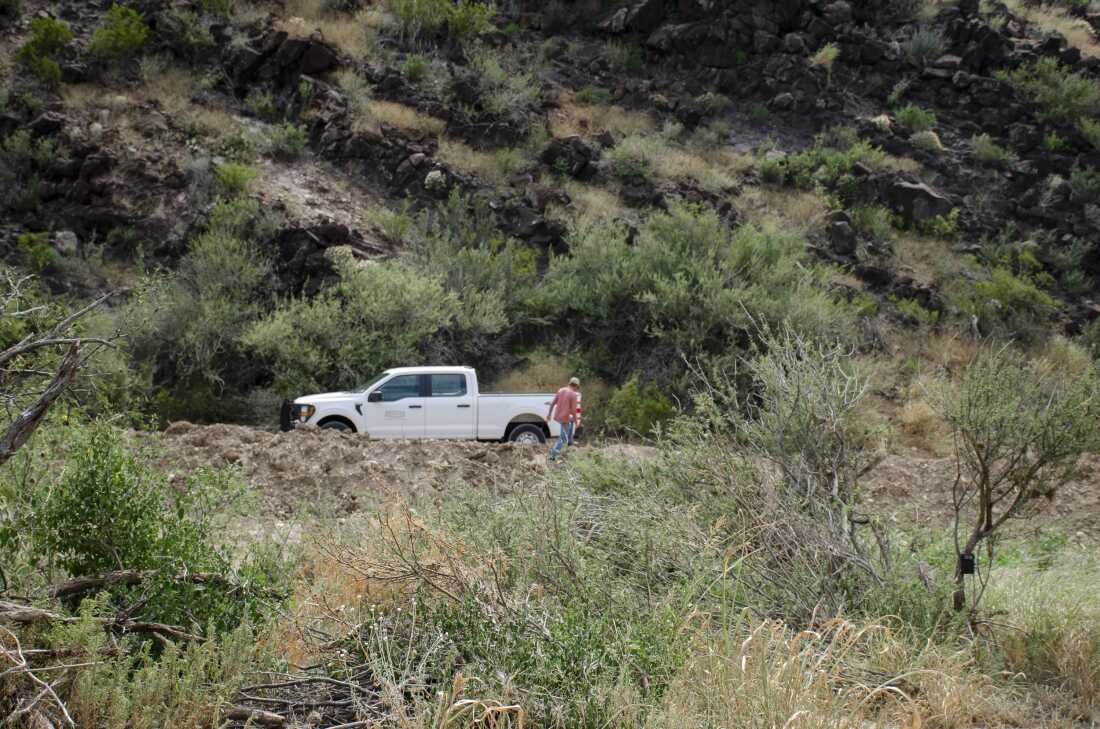
Matt Hewitt, a researcher with Borderlands Research Institute, heads for his truck after securing a snare, which he hopes will snag tufts of bear hair.
Carlos Morales/NPR
hide caption
toggle caption
Carlos Morales/NPR
But in West Texas, for all the celebration of the bears’ return to the wilderness, there are challenges and concerns as bears have ventured into neighborhoods, gotten into yards and posed a threat to livestock and pets.
“I don’t mind the bears coming back, we don’t want them wiped out, that’s for sure,” said Pam Clouse, who lives in Alpine, an area that’s seen a number of bear encounters in recent years. “You know, they were almost extinct.”
Clouse and her husband, Ken, both grew up in West Texas, and consider themselves wildlife enthusiasts. During drought years, the couple would sprinkle buckets full of corn on their yard and keep troughs of water on their property for wandering wildlife like deer and javelina.
Recently, they removed the food and water at the suggestion of state officials, and have even electrified their fence, too — all in effort of keeping the bears away.
But the bears are still coming, they say. “These bears are pretty large,” said Pam Clouse, as she pulled up an image of a bear from a trail camera at their house. “They’re probably about 4, 500 pounds if I had to guess.”

A still image taken from a trail camera Pam and Ken Clouse have on their porch in Alpine, Texas.
hide caption
toggle caption
The Clouses feel like more can be done to ease residents’ concerns over bears wandering onto their property. “I’m not promoting a hunting season for the black bears,” said Ken Clouse. “But there’s got to be some type of control.”
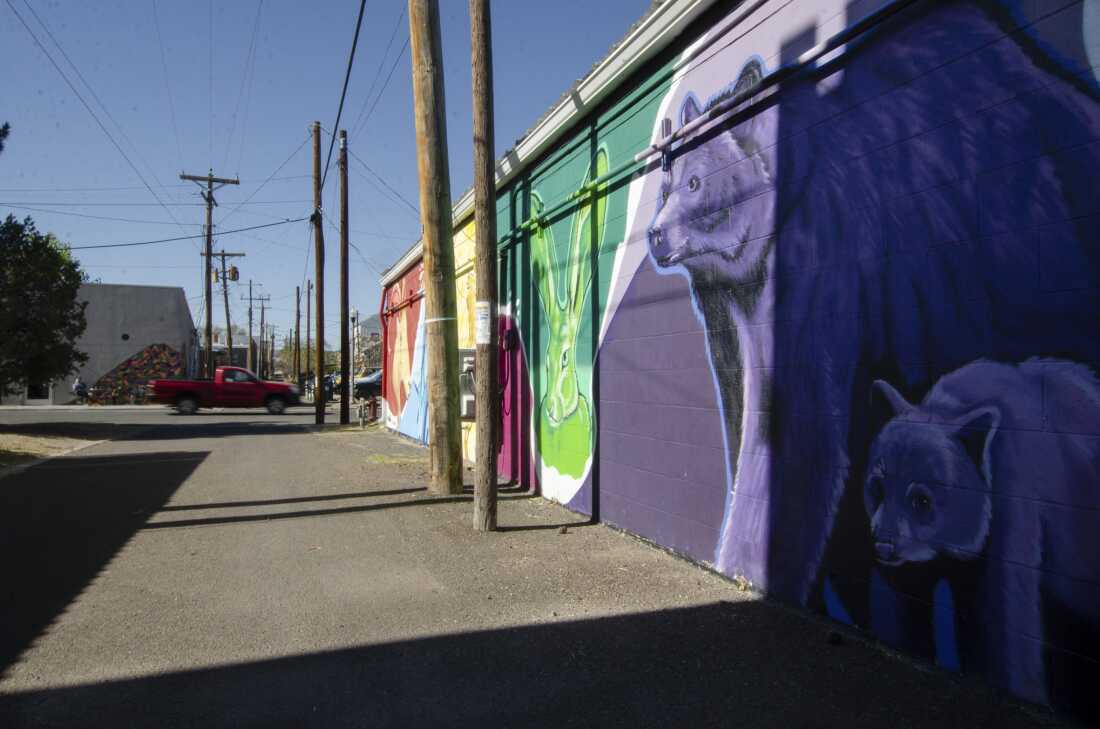
A mural in downtown Alpine, Texas highlights the wildlife that call the Trans-Pecos region of West Texas home – including the black bear.
Carlos Morales/NPR
hide caption
toggle caption
Carlos Morales/NPR
Learning to live with bears
In states like Montana and Colorado, residents have adapted to living with bears by installing bear-resistant dumpsters and trash bins and, in some cases, installing alarm systems or sprinklers — things to try and startle bears.
But of all the measures, wildlife biologists stress removing food and anything that might attract a hungry bear.
During the late summer and fall months, as black bears prepare to den, they’re looking to eat as much as possible, and they’ll go through great lengths to consume the 20,000 daily calories they’re after.
“They have a great sense of smell, much better than our own,” said Raymond Skiles, former wildlife biologist at Big Bend National Park in West Texas. “So, number one, they can smell food when you and I would never have a clue.”
Skiles was at Big Bend National Park when black bears made their return there in the late 1980s. He said it took time and work at the park, but they were able to adapt to the return of bears there. The park brought in dumpsters that were hard for bears to get into, educated visitors about the animal, and put into place rules that ensured food wasn’t being left out.
Today, Skiles said, those measures have gone a long way in reducing the possibility of bear-human conflict in the Chisos Mountains, one of the most popular corners of the park. Now, Skiles wonders if the same can happen in cities and towns across West Texas.

Krysta Demere sits in the offices for Texas Parks and Wildlife Department in Alpine. Part of her job as a wildlife biologist is getting people ready to live with black bears and educate them in hopes of reducing bear-human conflict.
Carlos Morales/NPR
hide caption
toggle caption
Carlos Morales/NPR
From the national park, an expansive stretch of desert land roughly the size of Rhode Island, the bears are now pushing north. Wildlife conservationists here say it’s likely because the land has reached what they call “carrying capacity.”
“And when you’re over carrying capacity, there’s not [enough] resources on the natural landscape for those animals,” explained Krysta Demere, a wildlife biologist with the Texas Parks and Wildlife Department. “So, then they begin to move out and search for new food sources.”
Part of Demere’s job is to help people across West Texas get ready to live with bears, something they haven’t experienced in well over 80 years.
“And that’s a long time,” said Demere. “That means there’s not a generation alive today that’s had to live with [the] black bear before.”
But the next generation in Alpine and the ones after that will likely grow up knowing this place, once again, as bear country.


At least two structural columns buckled and failed in a 37-story office tower in Midtown Manhattan on Tuesday, prompting evacuations of nearby streets and buildings. While city officials asserted that the tower was in no danger of collapsing completely, outside engineers said further failures in the structure could not be ruled out.
A pair of columns that failed completely were part of the tower’s existing structure. A New York Times review of images and videos from inside the building has found that several floors were added atop these columns.
City officials said in a news conference on Tuesday that the building was continuing to move, while they simultaneously assured the city that the building would not suffer “total collapse.” “The way this building is constructed, it’s a steel-frame building,” John Esposito, a chief in the Fire Department in New York, said at the afternoon news conference. “So, it would not be a total collapse. It would be more of a localized collapse.” Still, he said, “that remains our concern, that it’s moved.”
Engineers said that the movement itself was cause for concern. In a properly designed steel building, they said, loads should redistribute quickly to surviving structural supports if columns failed.
Joe DiPompeo, a former president of the Structural Engineering Institute at the American Society of Civil Engineers, said that if the structure had been overloaded, he would expect any movement “to happen very quickly,” rather than gradually.
“Generally when a column buckles, it’s a sudden failure,” Mr. DiPompeo said. He said that a full collapse remained unlikely given the redundancies built into the building codes.
Engineers often refer to the most dangerous possibility as a progressive collapse, a process in which structures near the initial failure become overstressed and also fail, potentially bringing down the building if the sequence continues. While unlikely, it cannot be ruled out, Mr. DiPompeo said.
Footage recorded from inside the building shows at least two structural columns appear to have failed completely, Mr. DiPompeo said. Other nonstructural, interior walls — or at least the metal “studs” that were in place to hold them up — also appear to have deformed.
“The only way that really happens is if the floor above them dropped. It looks like the floor above could have dropped a foot or two, which is obviously not a good situation,” Mr. DiPompeo said.
The 37-story building is in the process of being converted from office space into residential units. Four new floors and a large vertical portion were added onto the existing building in recent months. The vertical portion consists of a stack of over a dozen new floors cantilevered out over the existing building below.
Engineers said that there was nothing inherently wrong with adding residential floors or the cantilevered section above the columns that failed, as long as the original structure and the modifications had properly accounted for the added weight and wind loads.
“The cantilever alone doesn’t change anything,” Mr. DiPompeo said, but it does put additional load on the columns underneath — a factor that should have been reflected in the design.
Nathan Berman, managing principal and founder of MetroLoft, the developer overseeing the conversion, said on Tuesday that “this incident is nothing more than a typical construction mishap.”
He said two columns near the northwest corner of the tower had bent under the weight of additions to the building above, most likely because those columns had not been properly reinforced, though he said an investigation would determine the cause. The rest of the columns, he said, “picked up the weight.” He estimated the affected floors above the failed columns had sagged by a maximum of four inches.
Mr. Berman said that he expected the problems to be fixed and the project to be completed with, at most, a slight delay.
On Tuesday evening, installation of temporary shoring was set to begin shortly, in order to help stabilize the 20th and 21st floors of the building.

The Justice Department sent letters warning election officials in all 50 states and the District of Columbia that they could face criminal prosecution over noncitizen voting, a spokesperson for the Justice Department confirmed Tuesday.
The letters, signed by Assistant Attorney General Harmeet Dhillon, who heads up the department’s Civil Rights Division, give states five days to explain how they will comply with federal voter eligibility laws and how they will maintain “clean voter lists.”
“The Department sent these letters to all 50 states and the District of Columbia, asking for voluntary compliance in a timely manner with their obligations under federal law to ensure only citizens vote in federal elections,” a Justice Department spokesperson said in a statement.
Noncitizen voting in federal elections is extremely rare, but Trump and his administration have falsely portrayed it as a widespread issue.
Michigan Secretary of State Jocelyn Benson, Nevada Secretary of State Francisco Aguilar and Utah Lt. Gov. Deidre Henderson are among those who said they received the letters from the Justice Department.
The letters say state election officers “could be criminally prosecuted for aiding and abetting” noncitizen voting. They further specify that any election officer who knowingly retains noncitizens on a statewide voting registration list or who facilitates noncitizens’ receiving and casting ballots could be subject to criminal liability.
“An intentional act that is aimed at diluting the votes of citizens could also constitute a violation” of federal law, the letters said.
Henderson wrote on social media that the threats constitute “truly bizarre behavior.”
“Got another love letter this morning from the DOJ sprinkled throughout with threats of criminal prosecution,” she wrote. “I’m sure I’m not the only chief election officer of a state who is being targeted for following state and federal laws by resisting DOJ’s demands for private voter data that have thus far been ruled illegal by at least a dozen courts.”
The letters are the latest move in the Justice Department’s campaign to assert more federal control over state elections.
While some states have complied with the administration’s demands that they hand over voter roll data, the Justice Department has sued 30 states and Washington, D.C., for resisting. So far, 11 different federal courts have dismissed the Justice Department’s efforts to seize voter rolls.

Lionel Messi #10 of Argentina celebrates scoring his team’s second goal during their World Cup match against Egypt in Atlanta on Tuesday.
Elsa/Getty Images
hide caption
toggle caption
Elsa/Getty Images
They looked beaten. And out. Argentina, the defending World Cup champion and No. 1-ranked team, was down 2-0 late against Egypt.

Then, in a span of 13 remarkable minutes, Argentina scored not once, not twice, but three times, capping a comeback for the ages and leaving Egypt stunned and shellshocked.
For much of the game in Atlanta, Egypt was in control, hobbling Argentina early. The Egyptian attack began almost immediately with a stunning header goal delivered by Yasser Ibrahim in the 15th minute. After that, Egypt’s defense closed ranks, making it practically impossible for Argentina to equalize.
It was downhill from there for the Argentines: team captain Lionel Messi failed to convert a penalty kick, and in the 67th minute, Egypt got a second goal from Mostafa Ziko (after an earlier Egyptian goal had been disallowed after a video review). It looked like Argentina was finished. On the brink of elimination.
But no one told the Argentine players that.
In the 79th minute, Lionel Messi began doing his thing. He fired a cross near the Egyptian goal, and Cristian Romero headed it in. Messi was not done. Four minutes later, he powered a shot past the Egyptian keeper. It was his eighth goal of this tournament, the most of any player. The score was 2-2.
Then, in stoppage time, yet another Argentina header and another goal, this time from Enzo Fernandez.
“This is the World Cup for you,” said Messi after the game. “It wasn’t easy to come back from two goals down. But as I always say, this group never gives up. We always try to fight until the end.”

French referee François Letexier speaks with Egypt forward Mohamed Salah during the World Cup Round of 16 match between Argentina and Egypt in Atlanta.
Roberto Schmidt/AFP via Getty Images
hide caption
toggle caption
Roberto Schmidt/AFP via Getty Images
Afterward, Egypt coach Hossam Hassan complained about the French referee and the officiating. “I am not convinced. I am not convinced with this outcome. I’m not convinced with the way things unfolded during this match,” said Hassan in a post-match news conference. “We have been treated unfairly today. We have suffered injustice.”
“We would have deserved to earn this win, but we are leaving with honor, with pride, regardless of this defeat,” said Hossan.
African soccer teams have been the stars of this World Cup. Morocco has yet to lose a game. Cape Verde qualified for the first time in its history and stymied Spain, Uruguay and Saudi Arabia. Argentina barely beat them in a nail-biter of a match.
For Egypt, getting this far in the tournament is historic in itself: it’s the first time the team has made it this far. For Argentina, it was a terrifying yet relieving victory: several players, including Messi himself, cried after the game.
Next, they move to the quarterfinals and will play the winner of today’s Switzerland-Colombia match.
-

 New Jersey56 seconds ago
Police conclude investigation at Walmart in Cherry Hill, officials say
-

 New Mexico6 minutes ago
Monsoon high shifts slightly west but rain is still possible Wednesday in New Mexico
-

 North Carolina13 minutes ago
North Carolina Republican operative shaping the state’s early voting plans is reassigned
-

 North Dakota16 minutes ago
West Fargo Attorney Chosen for North Dakota Ethics Commission Position
-

 Ohio21 minutes ago
Jeff’s Donuts opens first Ohio location, open 24 hours
-

 Oklahoma28 minutes ago
5 Things To Know: Oklahoma County inmate death, deadly OKC hit-and-run
-

 Oregon31 minutes ago
Oregon to ask court to delay Paramount deal for 60 days while it reviews records
-

 Pennsylvania36 minutes ago
Pennsylvania state trooper to be laid to rest after being fatally struck in Schuylkill County

