A funny thing about this year’s best films: Half of them are adaptations. As a movie lover who’s always hunting for new talent, new ideas and new stimuli, I used to view that as creative inertia. But 2025 has changed my mind.
Now I see artists drawing inspiration from the past to show that Hollywood should trust the sturdy bones that have kept it running for over a century: good yarns, bold casting, films that don’t feel made by focus groups or doomsaying bean-counters (or, God help us, AI), but by blood and sweat.
Our picks for this year’s best in arts and entertainment.
Advertisement
From original tales to radical reworkings of classics both high-falutin’ and raucously lowbrow, these 10 filmmakers all know that the most vital part of the storytelling business has stayed exactly the same. They have to wow an audience. And they did.
1. ‘Sinners’
Michael B. Jordan as twins Smoke and Stack in the movie “Sinners.”
(Warner Bros. Pictures)
A period-piece-vampire-musical mashup could have been discordant, but writer-director Ryan Coogler confidently makes all three genres harmonize. In “Sinners,” Coogler double-casts his longtime collaborator Michael B. Jordan as twin bootleggers Smoke and Stack, then pits them against a pack of banjo-picking bloodsuckers helmed by a roguish Jack O’Connell. We’re expecting a big, bloody brouhaha and we get it. Underneath the playful carnage, however, the question at stake is: Why suffer the daily indignities of the Jim Crow-era South when you could outlive — and eat — your oppressors? “Sinners” is the most exciting film of 2025, both for what it is and for what it proves: that fresh blockbusters still exist and people are eager to gobble them up.
(“Sinners” is available on multiple platforms.)
Advertisement
2. ‘Hedda’
Tessa Thompson in the movie “Hedda.”
(Prime Video)
The stage’s iconic mean girl glides from 1890s Norway to 1950s England in this vibrant and venomous adaptation of Henrik Ibsen’s “Hedda Gabler.” Tessa Thompson stars as the restless housewife who needs to secure her milquetoast husband (Tom Bateman) a promotion and has a nasty habit of playing with guns. Keeping pace with her manipulative anti-heroine, writer-director Nia DaCosta (“Candyman”) makes a few calculated moves of her own, including gender-swapping Hedda’s ex into a curvaceous career woman (a haughty Nina Hoss) whose drab and geeky new girlfriend (Imogen Poots) irritates their hostess’ insecurities. As a capper, “Hedda” stages its brutal showdown at an all-night vodka-and-cocaine-fueled mansion shebang with a live jazz band, a lake for skinny-dippers and a hedge maze where former lovers are tempted to canoodle. The original play is over a century old, but every scene feels screamingly alive.
(“Hedda” is available on Prime Video.)
3. ‘Eddington’
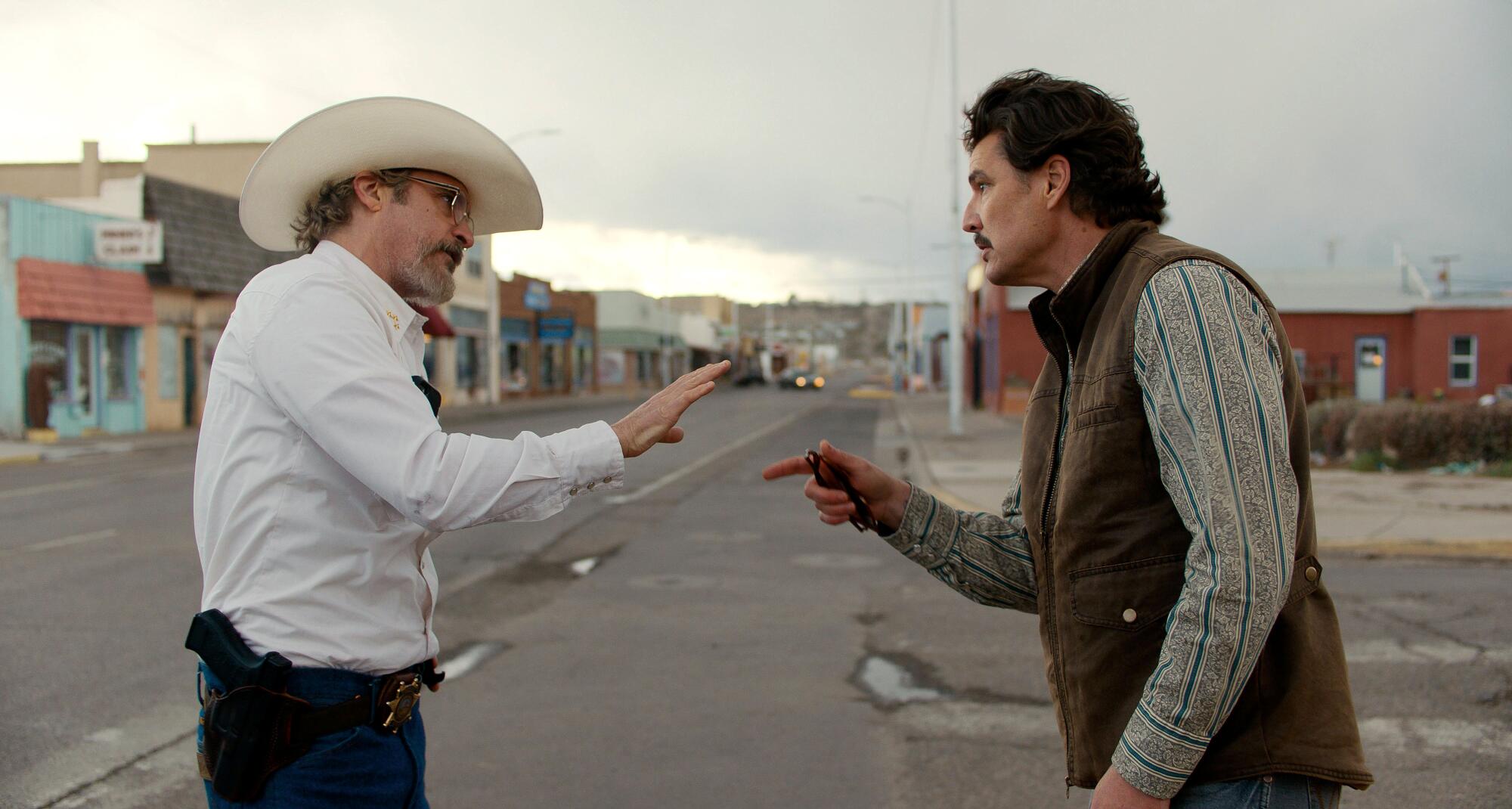
Joaquin Phoenix, left, and Pedro Pascal in “Eddington.”
(A24)
Advertisement
No film was more polarizing than Ari Aster’s COVID-set satire about a mask-hating sheriff (Joaquin Phoenix), a sanctimonious mayor (Pedro Pascal) and the high-tech cabal that benefits when these two modern cowboys come to blows. “Eddington” immortalizes the bleak humor and lingo of May 2020 (think murder hornets, Antifa and toilet paper hoarders). More stingingly, it captures the mental delirium of a small town — make that an entire planet — that hasn’t yet realized that there’s a second sickness seeping in through their smartphones. Everyone’s got a device in their hand pretty much all the time, aiming their cameras at each other like pistols in a Wild West standoff. Yet no character grasps what’s really going on. (I have a theory, but when I explain the larger conspiracy, I sound cuckoo too.) This is the movie that will explain pandemic brain to future generations. With distance, I’m pretty sure the haters will come around.
(“Eddington” is available on multiple platforms.)
4. ‘One Battle After Another’
Leonardo DiCaprio in the movie “One Battle After Another.”
(Warner Bros. Pictures)
Advertisement
Every shot in Paul Thomas Anderson’s invigorating nail-biter is a banger: sentinels skateboarding over rooftops, caged kids playing catch with a crumpled foil blanket, Teyana Taylor’s militant Perfidia Beverly Hills blasting an automatic rifle while nine months pregnant. It’s the rare film that instantly imprints itself on the viewer. On my second watch, I was shocked by how much of “One Battle After Another” already felt tattooed on my brain, down to the shudder I got from Sean Penn’s loathsome Col. Lockjaw licking his comb to tidy his bangs. Riffing from Thomas Pynchon’s “Vineland,” the central drama follows flunky anarchist Bob (Leonardo DiCaprio) fumblingly attempting to rescue his daughter (Chase Infiniti) from Lockjaw’s clutches. But he’s not much help to her, and as the title implies, this is merely one skirmish in humanity’s sprawling struggle for freedom that has, and will, drag on forever. Anderson’s knack for ensemble work stretches back as far as “Boogie Nights,” yet here, even his unnamed characters have crucial roles to play. His world-building has never before felt this holistic and inspirational.
(“One Battle After Another” is now playing in theaters.)
5. ‘Kiss of the Spider Woman’
Jennifer Lopez and Tonatiuh in the movie “Kiss of the Spider Woman.”
(Roadside Attractions)
The backstory behind this stunner couldn’t be more baroque: Director Bill Condon (“Dreamgirls”) boldly revamped a Broadway musical of an Oscar-winning drama (itself taken from an experimental novel) about two inmates in an Argentinean cell who mentally escape into the movies. Each incarnation has doubled down on the sensorial overload of what came before. If you know “Kiss of the Spider Woman’s” lineage, you’ll be impressed by how Condon ups the fantasy and stokes the revolutionary glamour with more Technicolor dance showcases for Jennifer Lopez’. (She’s doing her best Cyd Charisse, which turns out to be darned good.) If this is your first taste of the tale, give yourself over to the prickly but tender relationship between prisoners Luis and Valentin, played by feisty new talent Tonatiuh and a red-blooded Diego Luna. This is go-for-broke filmmaking with a wallop. As Luis says of his own version of “Kiss of the Spider Woman” playing in his head, “Call it kitsch, call it camp — I don’t care, I love it.”
Advertisement
(“Kiss of the Spider Woman” is available on multiple platforms.)
6. ‘A Useful Ghost’
A scene from the movie “A Useful Ghost.”
(TIFF)
Thai director Ratchapoom Boonbunchachoke’s Cannes Grand Prix winner opens with a haunted vacuum cleaner. From there, it gets even more surprising. Ghosts have infested a wealthy widow’s factory and are possessing appliances, seducing her son and cozying up to the prime minister for favors. Some of these people have died by accident, some by corporate neglect or worse. This droll spook show bleeds into romance and politics and, to our shock, becomes genuinely emotional. (It helps to remember that the military killed over 80 Bangkok protestors in 2010.) But why vacuum cleaners, you ask? The conceit is more than a sticky idea. Ordinary people can get crushed but the anger they leave behind lingers like fine dust.
(“A Useful Ghost” opens Jan. 16, 2026, in theaters.)
Advertisement
7. ‘The Roses’
Olivia Colman and Benedict Cumberbatch in the movie “The Roses.”
(Jaap Buitendijk / Searchlight Pictures)
Technically, “The Roses” is rooted in the 1980s hit novel and subsequent blockbuster “The War of the Roses,” which starred Michael Douglas and Kathleen Turner as an estranged couple who attack each other with lawyers, poison and chandeliers. In spirit, however, this redo is pure 1930s screwball comedy. Leads Benedict Cumberbatch and Olivia Colman are skilled verbal ninjas who hurl razor-sharp insults at each other’s egos, and although their characters’ divorce happens in California, director Jay Roach lets the actors keep their snippy British accents. The script by two-time Oscar nominee Tony McNamara (“The Favourite,” “Poor Things”) adds a cruel twist to the original: This time around, the marrieds truly do try their damnedest to love and support each other. And still, their walls come tumbling down.
(“The Roses” is available on multiple platforms.)
8. ‘In Whose Name?’
Ye and Elon Musk in the documentary “In Whose Name?”
(AMSI Entertainment)
Advertisement
Nico Ballesteros was a high schooler with an iPhone when he entered Kanye West’s orbit in 2018. Over the next six years, the Orange County kid shot over 3,000 hours of footage as Ye (as the artist legally became known in 2021) jetted from Paris to Uganda, Calabasas to the White House, meeting everyone from Kenny G to Elon Musk on a quest to fulfill his creative and spiritual goals while incinerating his personal life and public reputation. Ye gave the documentarian full access with no editorial oversight, besides one moment in which he tells the camera that he wants the film to be about mental health. This riveting tragedy definitely is. We see an egomaniac whose fear of being beholden to anything motivates him to go off his meds, a billionaire provocateur who believes he can afford the consequences of his bigotry and, above all, a deeply flawed man who nukes his entire world to insist he’s right.
(“In Whose Name?” is available on multiple platforms.)
9. ‘Sirāt’
An image from the movie “Sirāt,” directed by Oliver Laxe.
(Festival de Cannes)
Advertisement
The techno soundtrack of Oliver Laxe’s desolate road thriller has rattled my house for months. Lately, I’ve spent just as much time contemplating the movie’s silence — those hushed stretches in which this caravan of bohemians speeds across the Moroccan desert looking like the only free people left on Earth. A father, Luis (“Pan’s Labyrinth’s” Sergi López), and his 12-year-old son team up with this band of tattooed burnouts in the hope of finding the boy’s runaway sister. Before long, Luis is just hoping to make it to safety, assuming anywhere safe still exists. Static on the radio warns that World War III might be underway. These outsiders click off the news and crank up the music. The paradox of “Sirāt” is that I’m dying to talk about it more but I’ve got to keep my mouth shut until people experience its dramatic twists for themselves.
(“Sirāt” returns to theaters on Feb. 6, 2026.)
10. ‘The Naked Gun’
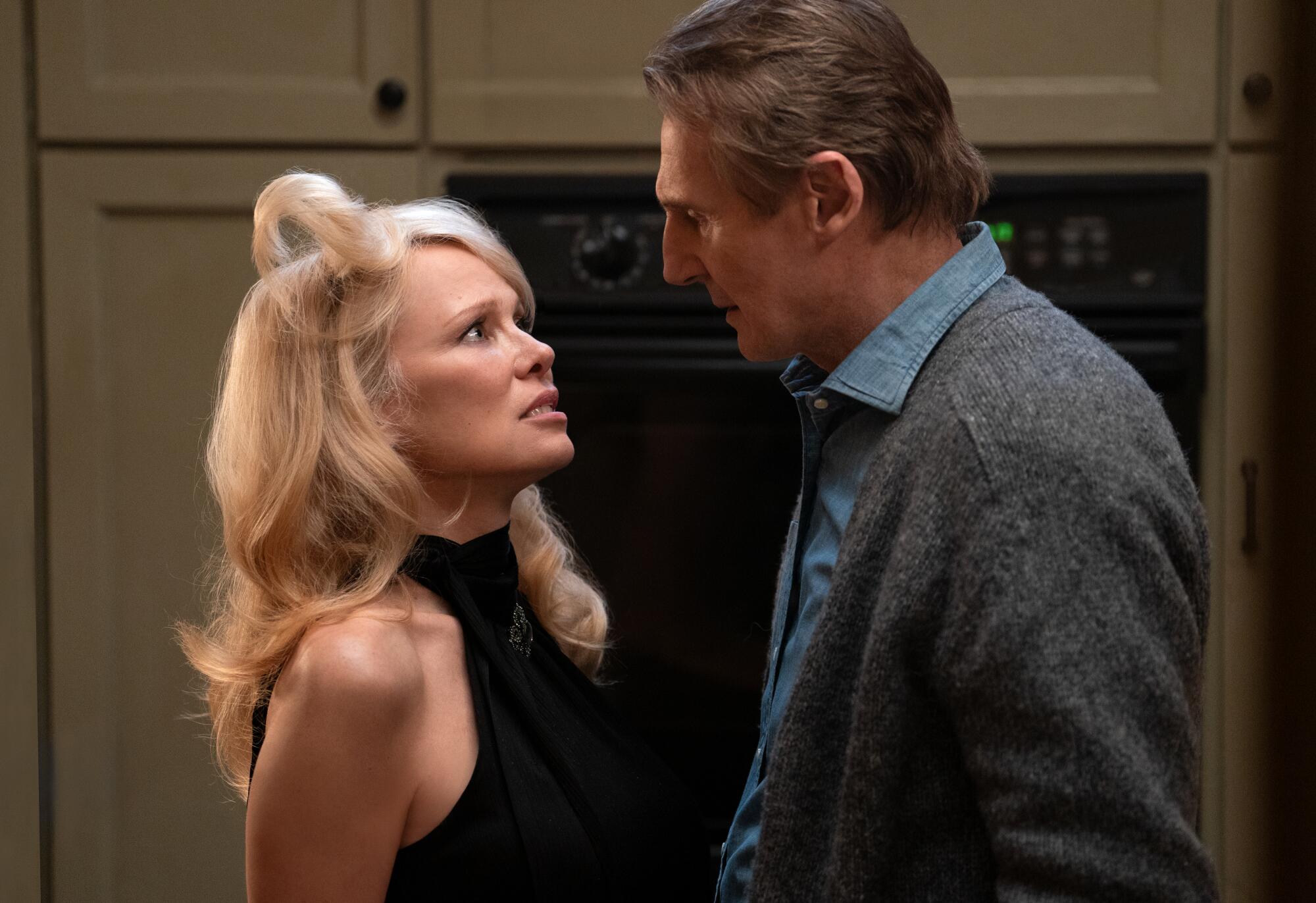
Pamela Anderson and Liam Neeson in the movie “The Naked Gun.”
(Frank Masi / Paramount Pictures)
Liam Neeson needed this pummeling pun-fest. So did everyone else in 2025. Director Akiva Schaffer’s continuation of the “Police Squad!” franchise let the 73-year-old “Taken” star poke fun at his own bruising gravitas. Playing the son of Leslie Nielsen’s Lt. Frank Drebin, Neeson kept us in hysterics with a stupid-brilliant barrage of surreal wordplay and daffy slapstick. The casting was as odd — and perfect — as rumors that he and his co-star Pamela Anderson started dating on set. This fourth sequel didn’t try to outsmart the classic Zucker, Abrahams and Zucker template. It simply told the same old story: Cop meets babe, cop and babe canoodle with a magical snowman, cop drops his trousers on live TV, this time minus the blimp. Goodyear? No, the worst — which made Neeson our hero.
Advertisement
(“The Naked Gun” is available on multiple platforms.)
Since I’m all jazzed-up about great movies, here are 10 honorable mentions very much worth a watch.
“The Ballad of Wallis Island” A kooky millionaire strong-arms his favorite mid-aughts folk duo into playing a reunion show on his Welsh island. Sounds cutesy, but it’s the movie I recommended most — to everyone from my mailman to my mother. They all loved it. Join the fan club.
“Bunny” This East Village indie by debut director Ben Jacobson is a scummy gem. A gigolo’s birthday goes very wrong. But all the characters racing up and down the stairs of his uber-New York walk-up hovel are a howl.
“If I Had Legs I’d Kick You” Rose Byrne excels equally at comedy and drama. This audit of a breakdown smashes both together and cranks the tension up to eleven. Playing a high-stress working mom of an ill child, her try-hard heroine leans in so harrowingly far, she goes kamikaze.
Advertisement
“Lurker” Today’s celebrity might be viral on Instagram and unknown everywhere else. Alex Russell’s stomach-churning psychodrama stars Archie Madekwe as an L.A.-based singer on the brink of genuine fame and Théodore Pellerin as the hanger-on who endures — and exploits — the fledgling star’s power moves and hazy boundaries.
“Magic Farm” Filmmaker Amalia Ulman’s rascally farce stars Chloë Sevigny and Alex Wolff as clickbait journalists who fly to Argentina to shoot a viral video about a singer in a bunny costume and wind up looking twice as ridiculous.
Keke Palmer, left, and SZA in the movie “One of Them Days.”
(Anne Marie Fox / Sony Pictures)
“One of Them Days” Keke Palmer and SZA play broke Baldwin Hills roommates who have nine hours to make rent. I’d happily watch their stoner hijinks in real time.
Advertisement
“The Perfect Neighbor” Pieced together primarily from police body-camera footage, Geeta Gandbhir’s documentary unfurls in a Florida cul-de-sac where a community — adults, kids and cops — agrees that one woman is an entitled pill. The problem is she thinks they’re the problem. And she has a gun.
“Sisu: Road to Revenge” If Buster Keaton were alive, he’d hail this grisly, mostly mute Finnish action flick as a worthy successor to “The General.” It even boasts a thrilling sequence on a train, although director Jalmari Helander also brazenly poaches from “Die Hard” and “Mad Max: Fury Road.”
“Train Dreams” Trees fall in the woods and a 20th-century logger (Joel Edgerton) plays an unheard, unthanked but beautiful role in the building of America.
“Wake Up Dead Man: A Knives Out Mystery” Detective Benoit Blanc (Daniel Craig) teams up with a soul-searching priest (Josh O’Connor) to solve a perplexing church stabbing. From deft plot twists to provocative Catholic theology, Rian Johnson’s crowd-pleasing murder mystery is marvelously executed.
Rhea Seehorn was nervous about whether “Pluribus” would be recognized by Emmy voters Wednesday when nominations were announced. So she was jubilant when she and the surreal sci-series on Apple TV scored 18 nominations, the most for a first-year drama.
“I’m just so grateful,” the actor said in a phone interview. “People were like, ‘Why were you nervous?’ Honestly, you never actually know. I’m just so thrilled for the show, my co-stars, the production design, the editing, the writing, the music, the sound. I haven’t moved from my couch since they first announced everything because I’m still trying to call everybody on the show.”
Seehorn received a nomination for lead actress in a drama series for her portrayal of cynical Carol Sturka, a fantasy romance author who finds herself in a mystifying situation after a virus seems to have wiped out most of Earth’s population. The series was created by Vince Gilligan, who created the acclaimed series “Breaking Bad” and co-created its spinoff “Better Call Saul,” which also featured Seehorn.
The actor compared her experience of being nominated for “Pluribus” to “Better Call Saul,” which earned her two supporting actress nominations: “ ‘Better Call Saul’ was such a family that supported and cheered each other on, and I’m so grateful I have that environment again. People could not be happier for each other, and we get to celebrate the show together.”
She added, “The only part that feels different is that it’s my first nomination as a lead. It’s the process of Vince writing this for me and seeing the mountain which he wanted me to climb and going through that process. The whole thing has been its own journey, so ending up with awards and nominations, and being so well received by critics and fans is not lost on me.”
Advertisement
The series has been applauded for its mix of drama, comedy and strangeness in its portrait of a woman coming to terms to what seems like an impossible dilemma.
“I love the storytelling, how much Vince and I would drill down on making this as authentic as we could in terms of an everyman who has to deal with an insane situation,” Seehorn said. “Most of us are just not heroic or leaping off the couch to go save the world. And Carol is dealing with immense grief and confusion in an utter dystopian crisis. I love the humor and the drama that comes out of us being as realistic as we can with her amidst an unrealistic event.”
Fans of “Pluribus” have been relentlessly curious since the finale in December about when the second season will launch.
“I don’t know anything about that,” Seehorn said. “I don’t have to keep secrets because I’m not great at keeping them, and I know nothing. I don’t know what I’m doing with an atom bomb in the driveway. I can’t wait to find out. The writers want to have the same quality and reward the intelligence of the fans and never phone a single thing in. So their process is their process.”
In a roundabout way, the fact that I don’t have a strong attachment to The Wizard of Oz as a film (my late mother loved it, so that memory is deeply rooted in me, but the movie itself never did much for me) contributed directly to how amusing I found Gail Daughtry and the Celebrity Sex Pass to be. This comedy spoofs the plot of the classic fantasy movie, though the jokes are largely about Hollywood. The humor is big and broad, with some of the jokes really landing. Others? Not so much. Still, more than enough do to warrant a recommendation.
Gail Daughtry and the Celebrity Sex Pass gets a lot of mileage out of sending up show business, even if the observations, while funny, are not particularly new. Besides the deluge of jokes, there’s also a lot of likably broad characters to spend time with, especially our lead. They make the 90 minutes and change spent together with them go down very easy.
Sony Pictures Classics
For Gail Daughtry (Zoey Deutch), her life as a small town hairdresser is perfect. Engaged to her high school sweetheart Tom (Michael Cassidy), she’s the picture of happiness, at least until a trip to a celebrity book signing. There, Tom meets and ends up sleeping with his “celebrity pass,” a term Gail wasn’t even really previously aware of. Feeling betrayed, Gail impulsively joins her co-worker and friend Otto (Miles Gutierrez-Riley) on a trip to Los Angeles. There, a psychic convinces her that the can save her marriage by sleeping with her own celebrity pass: Jon Hamm (Jon Hamm).
Journeying through Tinseltown in a manner that recalls Dorothy’s adventure in Oz, Gail and Otto won’t have to find Hamm alone. Joining forces with talent agency assistant Caleb (Ben Wang), down on his luck paparazzo Vincent (Ken Marino), and actor John Slattery (John Slattery). As they search for Hamm, some for their own purposes, they meet other celebrities, while also being hunted by a group of Italian assassins after a case of mistaken identity. Eventually, they come across Hamm, and the moment of truth is at hand.
Sony Pictures Classics
Zoey Deutch dives headfirst into a broad comedy like this, absolutely relishing the opportunity to get silly again. She’s able to make Gail a babe in the woods but also someone you laugh with, not at. It’s a wildly enjoyable turn. Deutch started out in comedies and was always a talented comedic actress, so it’s a pleasure to watch her back at it. Miles Gutierrez-Riley and Ben Wang get some very funny moments, while Ken Marino is a reliable comic presence. Jon Hamm and John Slattery are delighted to be sending up themselves, with amusing results. Supporting players here, in addition to Michael Cassidy, also include Kerri Kenney, Richard Kind, Thomas Lennon, Joe Lo Truglio, Fred Melamed, and more, plus some cameos.
Advertisement
Filmmaker David Wain, again co-writing with Ken Marino, continues to make it look easy. Few can make a silly comedy like Marino and Wain, especially as they pack their flicks with extra bits that only subsequent viewings reveal. Is Gail Daughtry and the Celebrity Sex Pass on the same level as Wet Hot American Summer or They Came Together? No, not quite. At the same time, is this, scattershot approach and all, funnier than most other 2026 releases? You bet. Marino and Wain have a hit rate that allows some of the jokes to miss, as you only have seconds to wait before the next one, which probably will hit.
Gail Daughtry and the Celebrity Sex Pass is very amusing, and occasionally hilarious, even if not as many jokes land as you might expect. Zoey Deutch is great in the lead role, David Wain is in his comfort zone, and the laughs come hot and heavy. If you’re a Wain fan, this new movie should be a must see.
Right now in Los Angeles it’s Wes Week, with multiple tributes to the career of filmmaker Wes Anderson, known for his fastidious visual style, melancholy longing and nerd-chic aesthetic.
On Monday night there was a sold-out 30th anniversary screening of Anderson’s debut feature, “Bottle Rocket,” at the Academy Museum with the filmmaker making a rare in-person L.A. appearance. He sat for a warmly endearing Q&A with actor Luke Wilson and director James L. Brooks, an early champion who executive-produced.
Then on Friday, Saturday and Sunday, the Hollywood Bowl will have three nights celebrating the music of Anderson’s films, hosted by the director’s 10-time fixture, Bill Murray. Among those scheduled to perform are Beck, Jenny Lewis, Karen O, Rufus Wainwright and Devo, among many more. Other surprise guests may appear as well, performing songs familiar from Anderson’s music-stuffed movies.
“I was surprised how many things we did have to leave out,” Anderson, 57, tells The Times in a recent interview conducted via voice notes (his personal preference) recorded from Paris, where he has long lived. “There’s so much music over all these movies because I’ve been doing them for so long. We could do a whole other round of this, but let’s see how it goes on this first one.”
Because of his unique use of music, combining left-field vintage pop songs with classical pieces and original scores by favored composers Alexandre Desplat and Devo’s Mark Mothersbaugh, there have been frequent requests over the years for live performances, but Anderson and his longtime music supervisor Randall Poster have always declined — up until now and this ambitious three-night event at the Bowl.
Advertisement
“From the moment that he said yes we’ve been on the phone talking about his vision and how to execute it,” says Johanna Rees, vice president of programming and creative partnerships at the L.A. Phil, during a recent call from San Diego. “It’s about exploring and celebrating so many styles of music. It’s been such a fun adventure.”
Kara Hayward and Jared Gilman in Wes Anderson’s 2012 movie “Moonrise Kingdom.”
(Focus Features)
This will be more than a typical evening at the Bowl, with dedicated Anderson-branded merchandise and uniformed bicycle riders dispensing candy. “The plan is you walk into the Hollywood Bowl and you are immersed in the world of Wes Anderson,” Rees says.
Advertisement
Criterion, which has long put out high-end home video editions of Anderson’s work and recently issued a 20-disc box set, will also have a special presence at the Bowl. Alongside the popular Criterion Mobile Closet making another stop in L.A., there will also be a lounge, a listening booth and a screening room showing Anderson’s movies as well as ones curated by him, including “Yojimbo,” “Amarcord” and “Belle de Jour.”
“Wes is an amazing community-builder as a human being,” said Peter Becker, president of Criterion, in a video call from the Il Cinema Ritrovato Festival in Bologna, Italy. “If you look at his films and the people he’s been working with consistently, we’re not the only ones who’ve been part of the greater Wes Anderson family for the last 25-plus years. How could we not be a part of this?”
From left, Jason Schwartzman, Adrien Brody and Owen Wilson in the movie “The Darjeeling Limited.”
(Fox Searchlight Pictures)
Music supervisor Poster met Anderson in 1996 at L.A.’s Original Farmers Market shortly after “Bottle Rocket” was finished and immediately began to assist in pulling together the soundtrack release. Though the CD at the time could not include some of the key songs from the movie, these Bowl events will finally offer a flexi-disc of the Rolling Stones’ “2000 Man” as well as a limited-edition yellow vinyl 12-inch record with two songs by the band Love.
Advertisement
The two have worked together on all of Anderson’s films since, with a process that is constantly developing.
“Sometimes we’ve been talking about it even before the film takes shape,” says Poster on a recent phone call from New York. “We get to that point where I feel informed to a certain degree, that we’ve identified an element or two, whether it’s a composer, a specific song, a specific band that allows us to sort of start weaving it together. Sometimes we have more details, and sometimes we’re in a little bit more of a process of discovery.”
As impeccably detailed as his movies can be, Anderson acknowledges that his method can still be a bit vague. “I really couldn’t tell you what it’s all about, where it came from or why,” he says. “It’s just totally instinctive.”
One of the most indelible moments in Anderson’s repertoire is Gwyneth Paltrow’s slow-motion exit from a bus in “The Royal Tenenbaums” to the sounds of Nico’s 1967 recording of the song “These Days,” perfectly capturing a tender, delicate rush of emotions.
“That music was part of the inspiration for the entire movie,” Anderson recalls. “There’s a Ravel string quartet in F Major and this song — those two things together, for whatever reason, suggested something to me that slowly became the whole movie. With Gwyneth Paltrow coming off of the bus, we played the music on the set. It was all a bit choreographed to that.”
Advertisement
“Everybody wanted to do ‘These Days,’ ” says Poster of the artists lined up for this weekend’s shows. “But Jackson Brown wrote ‘These Days’ and Jackson Brown is going to perform ‘These Days.’ Nobody could really argue with that one.” (The rest of the song choices and performers are being kept under wraps.)
Ben Stiller, left, Gwyneth Paltrow and Gene Hackman in the 2001 movie “The Royal Tenenbaums.”
(James Hamilton / Touchstone Pictures)
In choosing music for the movies, inspiration can strike from just about anywhere, as with the Johnny Duncan and the Blue Grass Boys’ recording of “Last Train From San Fernando,” memorable from the opening credits of 2023’s “Asteroid City.”
“I knew that song because my daughter used to listen to it,” says Anderson. “She had a CD of western swing from the ’50s and ’40s that she was listening to again and again. So I stole it from her.”
Advertisement
Poster mentions Anderson’s affinity for woodwinds and novelty instruments along with his tremendous sense of rhythm, which is why the music often has a strong percussive feel, from Gene Krupa’s “Drum Boogie” in last year’s “The Phoenician Scheme” to Japanese taiko drums and the work of composer Peter Jarvis.
“I would say that I think the biggest change is that Wes has taught himself how to read music,” says Poster. “He just really gets into the score’s DNA and really has a great insight into how to arrange thematic pieces that I think help make the movies more wholesome, just being a whole thing.”
Poster playfully refers to Anderson as “The Maestro” and remains struck by how fresh the music cues feel in the context of the films.
“When those clips come on — ‘Here Comes My Baby,’ ‘A Quick One, While He’s Away,’ ‘These Days,’ ‘Needle in the Hay,’ ‘Ooh La La’ — I mean, countless, countless, I always get a kick out of it.”
All of which should add up to a special alchemy at the Bowl.
Advertisement
“They won’t happen again,” says Rees of the three nights curated by Anderson. “Not knowing what he’s going to do in the future, but certainly this is a special event, a one-of-a-kind weekend. It won’t be happening like this again.”
For Anderson, putting together the Hollywood Bowl shows has been a reminder of how far his work has evolved.
“When we made ‘Bottle Rocket,’ I didn’t intend to have an original score at all,” he remembers. “We had some Ennio Morricone music. We put Bob Dylan’s ‘Pat Garrett and Billy the Kid’ in the movie originally — and that’s a score from somebody else’s movie. At a certain point everything sort of changed, and Mark Mothersbaugh came and saw the movie and he liked everything we had in there. And so he brought his own voice in, but from the point of view of somebody who was very sympathetic to what was already in place, and that led to more movies together.”
Showing a bit of his own trademark wistfulness, he adds, “It is quite an amazing thing to have Mark and Devo coming up on the stage to do this music that reflects back on all these years — this whole gathering.”















 Sony Pictures Classics
 Sony Pictures Classics