Science
This rural hospital closed, putting lives at risk. Is it the start of a ‘tidal wave’?

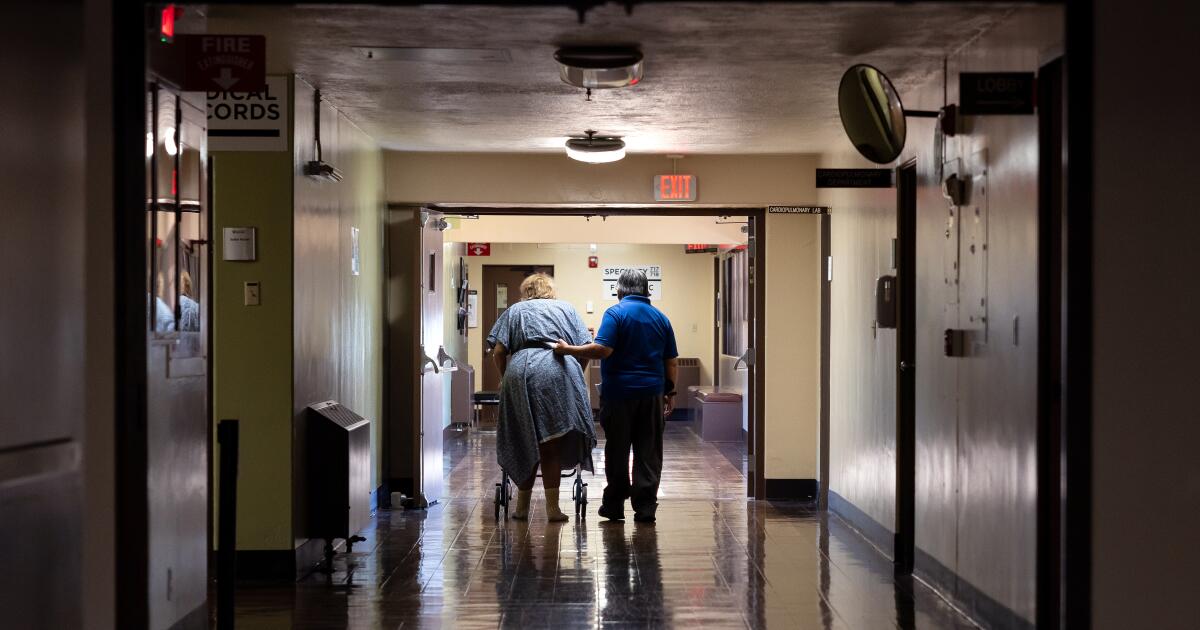
WILLOWS — As hospital staff carted away medical equipment from abandoned patient rooms, Theresa McNabb, 74, roused herself and painstakingly applied make-up for the first time in weeks, finishing with a mauve lipstick that made her eyes pop.
“I feel a little anxiety,” McNabb said. She was still taking multiple intravenous antibiotics for the massive infection that had almost killed her, was unsteady on her feet and was unsure how she was going to manage shopping and cooking food for herself once she returned to her apartment after six weeks in the hospital.
But she couldn’t stay at Glenn Medical Center. It was closing.
The hospital — which for more than seven decades has treated residents of its small farm town about 75 miles north of Sacramento, along with countless victims of car crashes on nearby Interstate 5 and a surprising number of crop-duster pilots wounded in accidents — shut its doors on Oct. 21.
McNabb was the last patient.
Registered nurse Ronald Loewen, 74, checks on one of the last few patients. Loewen, a resident of Glenn County and a former Mennonite school teacher, said the hospital closing is “a piece of our history gone.”
Nurses and other hospital workers gathered at her room to ceremonially push her wheelchair outside and into the doors of a medical transport van. Then they stood on the lawn, looking bereft.
They had all just lost their jobs. Their town had just lost one of its largest employers. And the residents — many of whom are poor— had lost their access to emergency medical care. What would happen to all of them now? Would local residents’ health grow worse? Would some of them die preventable deaths?
These are questions that elected officials and policymakers may soon be confronting in rural communities across California and the nation. Cuts to Medicaid funding and the Affordable Care Act are likely rolling down from Washington, D.C., and hitting small hospitals already teetering at the brink of financial collapse. Even before these cuts hit, a 2022 study found that half of the hospitals in California were operating in the red. Already this fall: Palo Verde Hospital in Blythe filed for bankruptcy and Southern Inyo Hospital in Lone Pine sought emergency funds.
But things could get far worse: A June analysis released by four Democrats in the U.S. Senate found that many more hospitals in California could be at risk of closure in the face of federal healthcare cuts.
“It’s like the beginning of a tidal wave,” said Peggy Wheeler, vice president of policy of the California Hospital Assn. “I’m concerned we will lose a number of rural hospitals, and then the whole system may be at risk.”
1

2

1. Medical assistant Kylee Lutz, 26, right, hugs activities coordinator Rita Robledo on closing day. Lutz, who will continue to work in the clinic that remains open, said through tears, “It’s not going to be the same without you ladies.” 2. Rose Mary Wampler, 88, sees physician assistant Chris Pilaczynski at the clinic. Wampler, who lives alone across the street from Glenn Medical Center, said, “Old people can’t drive far away. I’m all by myself, I would just dial 9-1-1.”
Glenn Medical’s financing did not collapse because of the new federal cuts. Rather, the hospital was done in by a federal decision this year to strip the hospital’s “critical access” designation, which enabled it to receive increased federal reimbursement. The hospital, the only one in Glenn County, is just 32 miles from the nearest neighboring hospital under a route mapped by federal officials — less than the 35 miles required under the law. Though that distance hasn’t changed, the federal government has now decided to enforce its rules.

Local elected officials and hospital administrators fought for months to convince the federal government to grant them an exception. Now, with the doors closed, policy experts and residents of Willows said they are terrified by the potential consequences.
“People are going to die,” predicted Glenn County Supervisor Monica Rossman. She said she feared that older people in her community without access to transportation will put off seeking care until it is too late, while people of all ages facing emergency situations won’t be able to get help in time.

Kellie Amaru, a licensed vocational nurse who has worked at Glenn Medical Center for four years, reacts after watching a co-worker leave after working their final shift at the hospital.
But even for people who don’t face a life-or-death consequence, the hospital’s closure is still a body blow, said Willows Vice Mayor Rick Thomas. He and others predicted many people will put off routine medical care, worsening their health. And then there’s the economic health of the town.
Willows, which sits just east of I-5 in the center of the Sacramento Valley, has a proud history stretching back nearly 150 years in a farm region that now grows rice, almonds and walnuts. About 6,000 people live in the town, which has an economic development webpage featuring images of a tractor, a duck and a pair of hunters standing in the tall grass.
“We’ve lost 150 jobs already from the hospital [closing],” Thomas said. “I’m very worried about what it means. A hospital is good for new business. And it’s been hard enough to attract new business to the town.”
Dismantling ‘a legacy of rural healthcare’
From the day it started taking patients on Nov. 21,1950, Glenn General Hospital (as it was then called) was celebrated not just for its role in bringing medical care to the little farm town, but also for its role in helping Willows grow and prosper.
“It was quite state-of-the-art back in 1950,” said Lauren Still, the hospital’s chief administrative officer.
When the hospital’s first baby was born a few days later — little Glenda May Nieheus clocked in at a robust 8 pounds, 11 ounces — the arrival was celebrated on the front page of the Willows Daily Journal.
But as a small hospital in a small town, the institution struggled almost immediately. Within a few years, according to a 1957 story in the local newspaper, the hospital was already grappling with the problem of nurses leaving in droves for higher-paying positions elsewhere. A story the following year revealed that hospital administrators were forcing a maintenance worker to step in as an ambulance driver on weekends — without the requisite chauffeur’s license — to save money.
In a sign of how small the town is, that driver was Still’s boyfriend’s grandfather.
1

2

3

1. A customer walks into Willows Hardware store. 2. Cheerleaders perform during Willows High School’s Homecoming JV football game against Durham at Willows High School. 3. The press box at Willows High School’s football field is decorated with previous Northern Section CIF Championship wins.
Still, the institution endured, its grassy campus and low-slung wings perched proudly on the east end of town. Generations of the town’s babies were born there. As they grew up, they went into the emergency room for X-rays, stitches and treatment for fevers and infections. Their parents and grandparents convalesced there and sometimes died there, cared for by nurses who were part of the community.
“They saved my brother’s life. They saved my dad’s life,” said Keith Long, 34, who works at Red 88, an Asian fusion restaurant in downtown Willows that is a popular lunch spot for hospital staff.
Glenn Medical’s finances, however, often faltered. Experts in healthcare economics say rural hospitals like Glenn Medical generally have fewer patients than suburban and urban communities, and those patients tend to be older and sicker, meaning they are more expensive to treat. What’s more, a higher share of those patients are low-income and enrolled in Medi-Cal and Medicare, which generally has lower reimbursement rates than private insurance. Smaller hospitals also cannot take advantage of economies of scale the way bigger institutions can, nor can they bring the same muscle to negotiations for higher rates with private insurance companies.
For more than two decades across California, rural hospitals have been running out of money and closing their doors.

T-Ann Pearce, who has worked at Glenn Medical Center for six years, sits in the medical surgical unit during one of her last shifts with only a few remaining patients left to care.
In 2000, Glenn Medical went bankrupt, but was saved when it was awarded the “critical access” designation by the federal government that allowed it to receive higher reimbursement rates, Still said.
But by late 2017, the hospital was in trouble again.
A private for-profit company, American Advanced Management, swooped in to rescue Glenn Medical and a nearby hospital in Colusa County, buying them and keeping them open. The Modesto-based company specializes in buying distressed rural hospitals and now operates 14 hospitals in California, Utah and Texas.
The hospital set about building back its staff and improving its reputation for patient care in the community, which had been tarnished in part by the 2013 death of a young mother and her unborn baby.
“We’ve been on an upswing,” Still said, noting that indicators of quality of care and patient satisfaction have risen dramatically in recent years.
Then came the letter from the federal Centers for Medicare & Medicaid Services. On April 23, the federal agency wrote Glenn Medical’s management company with bad news: A recent review had found that Glenn Medical was “in noncompliance” with “distance requirements.” In plain English, federal officials had looked at a map and determined that Glenn Medical was not 35 miles from the nearest hospital by so-called main roads as required by law — it was just 32. Nor was it 15 miles by secondary roads. The hospital was going to lose its critical access designation. The hit to the hospital’s budget would be about 40% of its $28 million in net revenue. It could not survive that cut.

At first, hospital officials said they weren’t too worried.
“We thought, there’s no way they’re going to close down hospitals” over a few miles of road, Still, the hospital’s chief executive, said.
Especially, Still said, because it appeared there were numerous California hospitals in the same pickle. A 2013 federal inspector general’s report found that a majority of the 1,300 critical access hospitals in the country do not meet the distance requirement. That includes dozens in California.
Still and other hospital officials flew to Washington to make their case, sure that when they explained that one of the so-called main roads that connects Glenn Medical to its nearest hospital wasn’t actually one at all, and often flooded in the winter, the problem would be solved. The route everyone actually used, she said, was 35.7 miles.
“No roads have changed. No facilities have moved,” administrators wrote to federal officials. “And yet this CMS decision now threatens to dismantle a legacy of rural health care stability.”
Without it, the administrator wrote, “lives will be lost for certain.”
But, Still said, their protestations fell on deaf ears.
In August came the final blow: Glenn Medical would lose its critical access funding by April 2026.
The news set off a panic not just in Glenn County but at hospitals around the state.
1

2

1. A bicyclist passes by Glenn Medical Center. First opened to patients on November 21, 1950, the center was called Glenn General Hospital then. 2. A member of the staff signs a farewell board on closing day at Glenn Medical Center on October 21, 2025.
At least three other hospitals got letters from the Centers for Medicare & Medicaid saying their status was under review, Wheeler said: Bear Valley Community Hospital in Big Bear Lake, George L. Mee Memorial in Monterey County and Santa Ynez Valley Cottage Hospital in Solvang. The hospitals in Monterey and Big Bear Lake provided data demonstrating they met the requirements for the critical access status.
Cottage Hospital, however, did not, despite showing that access in and out of the area where the hospital is located was sometimes blocked by wildfires or rockslides.
Cottage Hospital officials did not respond to questions about what that might mean for their facility.
Asked about these situations, officials at the Centers for Medicare & Medicaid said the law does not give the agency flexibility to consider factors such as weather, for example, in designating a critical assess hospital. They added the hospital must demonstrate there is no driving route that would make it ineligible based on driving distances included in the statute.
Jeff Griffiths, a county supervisor in Inyo County who is also the president of the California Assn. of Counties, said he has been following the grim hospital financing news around the state with mounting worry.
The hospital in his county, Southern Inyo, came close to running out of money earlier this year, he said, and with more federal cuts looming, “I don’t know how you can expect these hospitals to survive.”
“It’s terrifying for our area,” Griffiths said, noting that Inyo County, which sits on the eastern side of the Sierra, has no easy access to any medical care on the other side of the giant mountain peaks.
‘This is the final call’
In Willows, once word got out that the hospital would lose its funding, nurses began looking for new jobs.
By late summer, so many people had left that administrators realized they had no choice but to shutter the emergency room, which closed Sept. 30.

Helena Griffith, 62, one of the last patients, waves goodbye as patient transport Jolene Guerra pushes her wheelchair down the hallway on October 20, 2025.
Through it all, McNabb, the 74-year-old patient receiving intravenous antibiotics, remained in her bed, getting to know the nurses who buzzed around her.
She became aware that when they weren’t caring for her, many of them were trying to figure out what they would do with their lives once they lost their jobs.
On the hospital’s last day, nurse Amanda Shelton gifted McNabb a new sweater to wear home.
When McNabb gushed over the sweetness of the gesture, Shelton teared up. “It’s not every day that it will be the last patient I’ll ever have,” she told her.
As McNabb continued to gather her things, Shelton retreated to the hospital’s recreation room, where patients used to gather for games or conversation.
With all the patients save McNabb gone, Shelton and some other hospital staff took up a game of dominoes, the trash talk of the game peppered with bittersweet remembrances of their time working in the creaky old building.

Registered nurse Ronald Loewen, 74, looks out the window on closing day at Glenn Medical Center on October 21, 2025. Loewen, who grew up and attended school in Willows, had four children delivered at Glenn Medical, two of them survived, and took care of former classmates at this hospital, says the hospital closing is, “a piece of our history gone.”
Shelton said she is not sure what is next for her. She loved Glenn Medical, she said, because of its community feel. Many people came for long stays or were frequent patients, and the staff was able to get to know them — and to feel like they were healing them.
“You got to know people. You got to know their family, or if they didn’t have any family,” you knew that too, she said. She added that in many hospitals, being a nurse can feel like being an extension of a computer. But at Glenn Medical, she said, “you actually got to look in someone’s eyes.”
The building itself was in dire shape, she noted. Nothing was up to modern code. It didn’t have central air conditioning, and it was heated by an old-fashioned boiler. “I mean, I have never even heard of a boiler room” before coming to work there, she said.
And yet within the walls, she said, “It’s community.”
Bradley Ford, the emergency room manager, said he felt the same way and was determined to pay tribute to all the people who had made it so.
At 7 p.m. on the emergency room’s last night of service, Ford picked up his microphone and beamed his voice out to the hospital and to all the ambulances, fire trucks and others tuned to the signal.
He had practiced his speech enough times that he thought he could get through it without crying — although during his rehearsals he had never yet managed it.
“This is the final call,” Ford said. “‘After 76 years of dedicated service, the doors are closing. Service is ending. On behalf of all the physicians, nurses and staff who have walked these halls, it is with heavy hearts that we mark the end of this chapter.”
Nurses and other staff members recorded a video of Ford making his announcement, and passed it among themselves, tearing up every time they listened to it.
In an interview after the hospital had closed, Ford said he was one of the lucky ones: He had found a new job.
It was close enough to his home in Willows that he could commute — although Ford said he wasn’t sure how long he would remain in his beloved little town without access to emergency medical care there.

Rose Mary Wampler, 88, waits to have blood drawn at the lab beside a cordoning off, signaling the closure of the hospital side of Glenn Medical Center, on October 22, 2025. Wampler lives alone across the street from the hospital.
Rose Mary Wampler, 88, has lived in Willows since 1954 and now resides in a little house across the street from the hospital. Her three children were born at Glenn Medical, and Wampler herself was a patient there for two months last year when she was stricken with pneumonia and internal bleeding. She said she was fearful of the idea of driving more than 30 miles for healthcare elsewhere.
She looked out her window on a recent afternoon at the now-shuttered hospital.
“It looks like somebody just shut off the whole city, there’s nowhere to go get help,” she said.

Glenn Medical Center patient Richard Putnam, 86, closes the window in his hospital room. A month shy of it’s 75th year, the hospital closed on Oct 21, 2025.
(Christina House/Los Angeles Times)
Times photographer Christina House contributed to this report.


The first five months of 2026 in Southern California have been the smoggiest — with the highest number of unhealtful air days — in more than a decade, according to statewide air monitoring.
So far this year, the South Coast air basin, which includes Los Angeles, Orange, Riverside and San Bernardino counties, has seen 39 days when the concentration of lung-irritating ozone (commonly known as smog) exceeded the federal standard, according to preliminary state air quality data.
That’s even worse than the infamously hot and hazy 2017, when Greater Los Angeles had 36 unhealthful air days by June 4 and ultimately saw 145.
Many of the roughly 18 million people who live in the air basin have been subjected to unhealthful levels of ozone, a highly corrosive gas that triggers asthma attacks and a wide range of respiratory illnesses. This has taken many by surprise since successive days of smog more commonly happen in summer, when heat waves and intense sunlight convert man-made pollution into ozone.
“If we have this many violations by this time, this could be a really awful year for air quality,” said Adrian Martinez, director of Earthjustice’s Right to Zero campaign, an initiative calling for the transition away from fossil fuels. “We’re already the worst place in the country for summertime smog pollution. So it could be one of the worst years in one of the worst places in the country.”
The pollution has been especially severe in valleys. On April 18, an air monitor in Reseda in the San Fernando Valley measured the second highest spike in hourly ozone levels in the last decade.
Greater Los Angeles has seen more high-smog days so far in 2026 than any other year in the past decade.
(Courtesy of South Coast Air Quality Management District)
The South Coast Air Quality Management District says the high ozone levels are due to early heat waves. Officials said they were not aware of any increase in the pollutants — most of them from different kinds of exhaust — that lead to ozone formation.
Local temperatures have been well above normal, climbing into the mid-80s and high 90s between January and April, breaking several daily high temperature records, according to the National Weather Service.
March in particular was the warmest on record in California. Riverside had an unprecedented 13 days of temperatures above 90 degrees, the weather service said.
“It was really that heat wave — conditions we typically see in July or August, we saw them in March,” said Sarah Rees, deputy executive officer of the air district. “That put us ahead of the curve in terms of how much ozone we got.”
Air district officials urged residents to monitor pollution levels on the agency’s website and mobile app, and spend only limited time outdoors when smog levels are high.
“People generally know when there’s a wildfire, because you see the smoke and smell it,” said Scott Epstein, the air district’s manager of planning and rules. “Then, it’s like, I’ve got to take precautions. Ozone, you can’t really tell.”
Southern California has been particularly susceptible to smog formation because of its millions of gas-powered cars releasing tons of tailpipe emissions each day. The region’s sunshine acts as a catalyst for smog formation. Then the mountains trap this pollution over densely populated communities.
For nearly half a century, state and local air regulators have made rules designed to alleviate this pollution, enacting the nation’s first tailpipe emission standards in 1966 and requiring catalytic converters in 1975.
Smog-forming pollution has been dramatically reduced over the last two decades, but the region still does not meet federal air quality standards for ozone.
At an air district meeting Friday in Diamond Bar, the governing board held a moment of silence for William Burke, a former longtime chair. During his tenure, the agency enacted nearly 270 rules that are credited with reducing smog-forming pollution by hundreds of tons per day. Burke, who also founded the Los Angeles Marathon, died in May at 87.
“Those are just emission reductions,” air district Chair Michael Cacciotti said at the Friday meeting. “But what it doesn’t tell you is how many kids, families, seniors were prevented from going to the hospital from an asthma attack, didn’t get cancer or other respiratory problems.”
Several residents from the Inland Empire, which suffers some of the worst smog pollution, expressed their appreciation for the air district’s efforts. But they also stressed the need for more progress.
“I’m old enough to remember growing up in the ‘70s and ‘80s … and not being able to see the mountains for weeks and months at a time,” said Erik Morden, one of several residents who spoke at the meeting.” I know things have improved, and I want to thank all of you for all the hard work that you’re doing. But there’s a lot of invisible stuff that you don’t see, that’s still out there — a lot of particulates in the ozone and chemicals that are causing a lot of problems.”
Martinez, the Earthjustice attorney, said the abnormally early outbreak of smog should be a wake-up call to government regulators that there’s work to be done, including offering more incentives to help residents and businesses transition to zero-emission appliances.
“We shouldn’t over-complicate it. We’ve got a lot of heat, we’ve got a lot of pollution,” Martinez said. “Our contention is, this agency can’t control the weather. But the one thing it can control is the pollution.”

Federal agricultural inspectors detected a case of New World screwworm larvae — maggots that burrow into the flesh of living animals and sometimes humans — on a 3-week-old calf in south Texas, near the U.S.-Mexico border. Officials anticipated the arrival of screwworm in the United States and say they’re prepared to contain it.
New World screwworm, also known as Cochliomyia hominivorax, is starkly different from the average maggot that feeds on decaying organic matter such as garbage, rotting food or dead animals, said Tom Talbot, veterinarian and member of the California Cattlemen’s Assn.
That’s because a screwworm larva “attacks living flesh,” Talbot said.
On Thursday, the U.S. Department of Agriculture confirmed the detection of New World screwworm in the umbilical area of a bovine in Zavala County, Texas, more than 60 miles from the northern Mexico border.
As of Friday morning, there have been no additional cases of infected animals reported.
Screwworm is endemic in South America and parts of the Caribbean, according to the Centers for Disease Control and Prevention. However, the parasitic fly has been steadily moving north from Central America to Mexico since 2023.
The USDA says it has actively monitored the fly’s movement. Last month, the USDA was aware of more than 200 active screwworm infestation cases in the border states of Nuevo León and Tamaulipas, according to Mexico’s Secretary of Agriculture and Rural Development dashboard. There are currently more than 2,000 active cases throughout Mexico.
It was believed that the New World screwworm would enter the U.S. in 2025, “however, thanks to the hard work across the entire Trump administration and our industry, state, and local partners, we were able to buy time for this moment,” said Dudley Hoskins, undersecretary for Marketing and Regulatory Programs for the USDA, in a statement.
The potential economic impact of New World screwworm on the cattle industry due to import restrictions, reduced productivity and animal loss is substantial, said Sally DeNotta, director of the University of Florida’s Equine Performance Laboratory.
Last year, 175 key agricultural organizations signed a letter urging additional federal funding for screwworm-control measures, emphasizing USDA estimates that a New World screwworm outbreak in the U.S. could cost producers $4.3 billion annually and cause economic losses of more than $10.6 billion across the southern United States.
“While the fly does not survive at temperatures at or below freezing, infected animals could carry the parasite northward and spread infection during the summer months, and the temperate climate of Southern California could certainly support year-round New World screwworm populations,” DeNotta said.
Talbot said from the federal to the local level, everyone in the ranching community has been talking about the arrival of screwworm and how to combat it.
“My expectation is that there will be a minimal number of cases of [New World screwworm] in California,” he said.
That’s because there are several stations on the border in Southern California, he said, that are collecting data, monitoring for any incidents of the parasitic fly and trapping them.
Talbot says he’s confident that the proactive measures on behalf of the federal government will mitigate the screwworm’s reach and therefore not impact the beef supply locally or nationally.
How screwworm infection spreads
Female screwworm flies are attracted to the smell of wounds — that can be as small as a tick bite — and body openings such as the nose, eyes, ears and mouth where they can lay eggs, according to the CDC.
A female screwworm fly can lay 200 to 300 eggs at a time and may lay up to 3,000 eggs during her 10 to 30-day lifespan.
When the eggs hatch into maggots, the maggots eat live tissue, causing a worsening, often painful and foul-smelling wound, according to the CDC.
Screwworm has hit the United States before
There was a screwworm outbreak in the southwestern region of the United States in 1965 that prompted Mexican and U.S. livestock producers to sign a declaration to establish a joint program for the eradication of the screwworm from the states on either side of the Mexico-U.S. border, according to the National Agricultural Library.
By 1966, the United States had eradicated screwworms, but livestock remained vulnerable to reinfestation from screwworms migrating from Mexico.
Eradication was possible through the sterile insect technique, which uses gamma radiation to irradiate screwworm pupae and create sterile male flies.
The U.S. Department of Agriculture’s Animal and Plant Health Inspection Service maintains a screwworm pupae sterilization facility in North America and is currently building a new center in southern Texas.
When produced and released in large numbers, sterile male flies mate with wild female flies, which then lay unfertilized eggs, according to the USDA.
“Since female screwworm flies normally mate only once, the population progressively reduces and is, ultimately, eradicated,” according to USDA officials.
Last year, the Trump administration cut thousands of grants and programs from the U.S. Agency for International Development, which includes U.S.-funded animal disease monitoring projects operated by the United Nations Food and Agriculture Organization, Argi-Pulse Communications reported. Among the slashed programs were some dedicated to monitoring and containing New World screwworm in Central America.
Today, screwworm infestations aren’t a regular occurrence in the U.S., but cases have occurred in travelers returning from areas where the flies are present, according to the CDC.
Can infected animals be treated?
Infected wounds are cleaned and debrided to remove any screwworm larvae, after which the animal is treated with an approved insecticide, DeNotta said.
Last month, the U.S. Food and Drug Administration issued an emergency use authorization for several insecticides known to be effective against screwworm.
There are approved systemic and topical options for a variety of species, including cattle, horses, small ruminants, cats and dogs, DeNotta said.
“Multiple days of treatment are often required, and antibiotics and analgesics may also be administered to treat secondary infection and control pain,” she said.
If left untreated, the tissue destruction caused by flesh-eating larvae can be extensive and severe, often resulting in debilitation and eventual death of the host, DeNotta said.
“Animals that survive may suffer weight loss, poor growth and reduced productivity as a result of pain and discomfort,” she said.
Screwworm can infect humans
Human infection is rare, DeNotta said, but it can happen.
Humans are at risk of being infected by screwworms if they travel to an area where the flies are present, such as South America and the Caribbean, according to the CDC.
CDC officials said your risk of screwworm infection increases when you:
- Spend a lot of time outdoors during the day, especially if sleeping or unable to keep the flies at bay.
- Have any open wounds. A small break in the skin, including from a scratch, insect bite or recent surgery, may attract screwworm flies.
- Have a medical condition that causes bleeding or open sores, such as from skin or sinus cancer, or from treatments that can create breaks in the skin.
- Live, work or spend an extended amount of time with or near, livestock or other warm-blooded animals in areas where screwworm flies are present.
The symptoms humans experience when infected by screwworm
The following are symptoms of screwworm according to the CDC:
- Feeling maggots move or seeing maggots within a skin wound, sore or body opening.
- Painful skin wounds or sores that worsen within a few days.
- Foul-smelling odor from the site of the infestation.
- Bleeding from open sores.
Bacteria can also infect wounds where screwworm maggots are present and may cause an infection that can lead to symptoms like fever or chills.
To treat a screwworm infection, DeNotta said, people undergo the same combination of wound debridement and insecticides used in animals.

California researchers are leading a nationwide effort to find out why some Asian American communities have high rates of certain cancers.
It comes as health experts see rising rates of lung cancer among Asian American women who have never smoked and increasing rates of early-onset breast cancer.
“Asian Americans are actually the first racial and ethnic group for whom cancer is the leading cause of death,” said Scarlett Gomez, a cancer epidemiologist at UC San Francisco and a lead on the project.
UCSF joins researchers from UC Irvine, UC Davis, Cedars-Sinai and Temple University in launching a $12.5 million National Cancer Institute-funded study called the ASPIRE Cohort, that will follow 20,000 Asian Americans over time. Researchers say it’s the first large-scale longitudinal cancer study focused on Asian Americans.
Lung cancer incidence has declined across much of the United States as smoking rates have fallen. However, researchers have observed a slight increase among Asian Americans, despite relatively low smoking rates, particularly among women. More than half of Asian American women diagnosed with lung cancer are nonsmokers, they say.
Many existing studies of lung cancer risk among nonsmokers have been conducted in Asia, where exposure patterns can differ significantly from those in the United States, said Iona Cheng, a molecular epidemiologist at UCSF and also a lead on the project.
Researchers know that outdoor air pollution, secondhand smoke and cooking oil fumes can contribute to lung cancer risk. But it’s not clear if these explain disease patterns among Asian Americans in the United States.
Rising rates of breast cancer among Asian American women are also driving the push.
“Early onset breast cancer” — diagnosed before age 50 — “is going up the fastest among Asian Americans,” Gomez said. Recent data show rates among Asian Americans, Native Hawaiians and Pacific Islanders are approaching those of non-Hispanic white women, she said. Cancer experts don’t know why.
One of the central goals of the ASPIRE study is to move beyond treating Asian Americans as a single category. The term can include people with roots in dozens of countries from Sri Lanka to China’s border with Russia to Pacific islands, with completely different exposure patterns and cuisines.
“When we separate and look at all the distinct Asian ethnicities, we see a wide variation,” Cheng said.
Filipino women have a higher incidence of thyroid cancer, and stomach cancer has been more common among some Korean and Japanese people. Combining all Asian Americans into one category can make those differences impossible to detect.
The study also seeks to address longstanding gaps in representation. Although Asian Americans make up nearly 8% of the U.S. population, they have historically received little research funding.
Existing cancer studies have also often included too few Asian Americans to draw meaningful conclusions about specific ethnic groups, researchers said. Salma Shariff-Marco, a social and behavioral scientist at UCSF and also a lead on the projects, aid that has made it hard to show the need for more targeted research. The ASPIRE cohort, she said, is designed to show the variation by including a broader range of ethnic groups and more contemporary exposures than previous work.
-

 Movie Reviews11 minutes ago
Film review #5: The Life and Times of Allen Ginsberg
-

 World14 minutes ago
Soccer-Iran World Cup Players Granted Visas to Enter the US, Says White House Official
-
 Lifestyle58 minutes ago
Summer TV season has arrived — here’s what you shouldn’t miss
-

 Technology1 hour ago
JMGO’s N3 Ultimate projector is the new portable 4K champ
-

 World1 hour ago
Pro-US conservative faces leftist in Peru’s high-stakes presidential runoff
-

 Politics1 hour ago
GOP firebrand lashes out at reporter over Massie allegation: ‘F— you, first of all!’
-

 Health1 hour ago
Scientists unveil ‘living bandage’ that could dramatically speed wound healing
-

 Sports1 hour ago
Golden Knights beat Hurricanes in double OT Game 3, one of the wildest Stanley Cup Final games of all-time

