Midwest
JONATHAN TURLEY: Why blue states’ new anti-ICE laws are unconstitutional virtue signaling

NEWYou can now listen to Fox News articles!
Illinois has now joined California and Connecticut in barring federal immigration agents from conducting “civil arrests” of illegal aliens in or around state courthouses. The sanctuary law appears largely performative since it also appears unconstitutional. It is difficult to see how a state can bar the exercise of federal jurisdiction, at least after the Civil War.
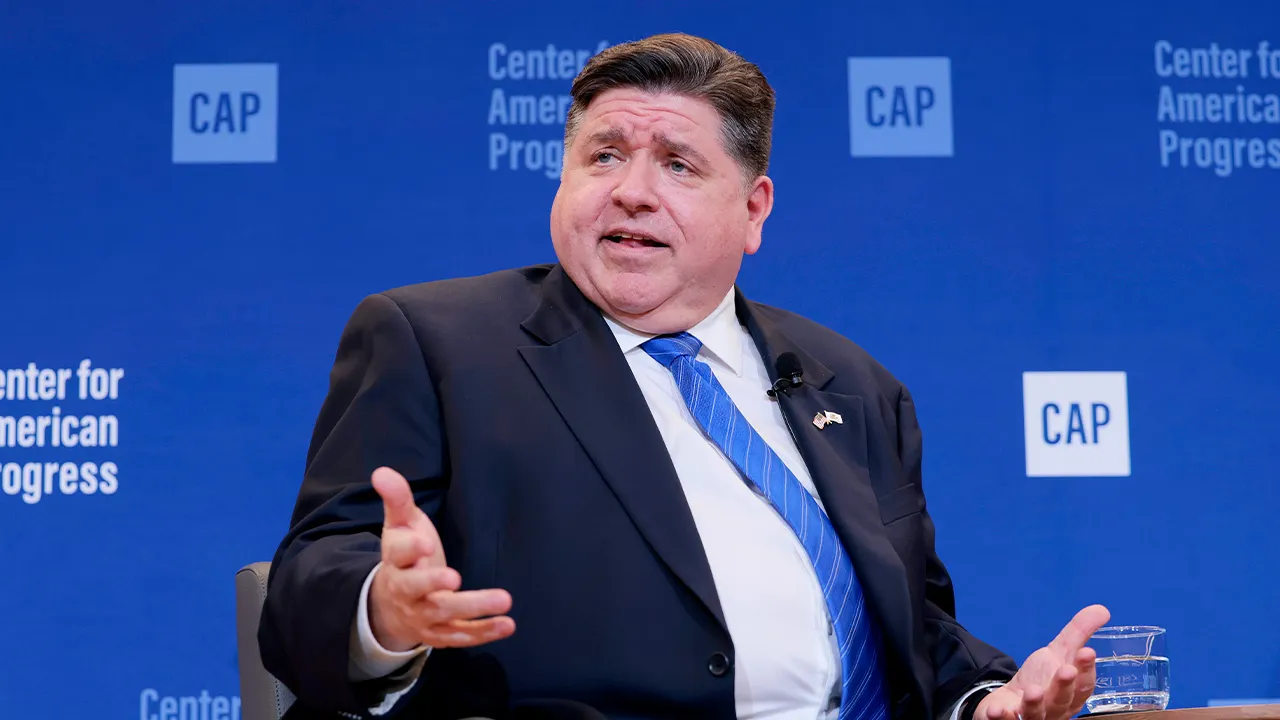
Gov. JB Pritzker has been ratcheting up the rhetoric against ICE and the Trump administration for months, including analogies to the Nazis and claims that democracy is dying. The new law, however, crosses the constitutional Rubicon by not only limiting the operation of Immigration and Customs Enforcement (ICE) but also establishing a 1,000-foot “buffer zone” outside of buildings.
Illinois State Police made several arrests at the Broadview ICE facility on Friday. (Fox News/Getty Images)
The law makes courthouses equivalent to churches, where suspects can claim sanctuary not only when they cross the threshold but also within 1,000 feet, unless, of course, ICE ignores the law.
Recently, the chief judge in Cook County issued an order with the same prohibition. A few other judges in other states have issued similar orders.
ILLINOIS LAWMAKERS PASS BILL BANNING ICE IMMIGRATION ARRESTS NEAR COURTHOUSES
The authority for the orders is highly dubious.
The federal government can cite laws mandating the arrest of certain individuals for immigration violations, including mandatory detention of certain aliens who are removable due to criminal convictions or terrorist activities and detention and removal of aliens with final orders of removal.
President Donald Trump and Illinois Gov. JB Pritzker traded sharp words as Trump floated deploying National Guard troops to Chicago and Pritzker vowed to fight the move in court. (Chip Somodevilla/Getty Images; Kamil Krzaczynski/AFP via Getty Images)
The most immediate problem for Illinois is the supremacy clause of the U,S. Constitution, which states: “This Constitution, and the Laws of the United States which shall be made in Pursuance thereof[]… shall be the supreme Law of the Land[]… any Thing in the Constitution or Laws of any State to the Contrary notwithstanding.”
BLUE CITY JUDGE CITES ‘FEAR OR OBSTRUCTION’ IN BLOCKING ICE COURTHOUSE ARRESTS DURING COURT PROCEEDINGS
The second problem is the Supreme Court, which has repeatedly rejected such state authority to dictate federal enforcement or policies. In the 1952 c ase Harisiades v. Shaughnessy, the high court found that the federal government has the “exclusive” control over “any policy toward aliens.”
Ironically, as I have previously pointed out, these blue states will face an unusual authority cited against them: Barack Obama. It was President Obama who went to the Supreme Court to strike down state laws that interfered with federal immigration enforcement (even in assisting that enforcement). In the 2012 case Arizona v. United States, Obama largely prevailed, as the Supreme Court affirmed that “[t]he Government of the United States has broad, undoubted power over the subject of immigration and the status of aliens.”
This recognized authority goes back to the 19th century. The court ruled in the 1893 case Fong Yue Ting v. United States that “Congress [has] the right, as it may see fit, to expel aliens of a particular class, or to permit them to remain,” and “has undoubtedly the right… to take all proper means to carry out the system which it provides.”
JUDGE ALLOWS ICE TO CONTINUE COURTHOUSE ARRESTS IN NEW YORK CITY FOLLOWING LEGAL CHALLENGE
The Illinois law also creates the ability to sue federal authorities for false imprisonment under state law and it creates a 1,000-foot circle around any state court, creating safe zones for illegal immigrants.
Presumably, if you rent an apartment within one of those zones, you would be able to create effective immunity by simply signing a lease. As long as you stay within the specified public areas, you would be protected from civil arrest. With Illinois and other states pushing apps tracking ICE operations, a suspect could step outside onto a sidewalk or public space to claim protection from any civil arrest. It is unclear whether landlords will raise their rents in light of the new immunity amenity.
Keep in mind, if this were constitutional, the state could add to the list of sensitive places from city services to clinics. The result would be a mosaic of safety zones that would be maddening for federal authorities. Notably, blue states have attempted the same tactic to circumvent Second Amendment rights.
LONG-HELD SCOTUS PRECEDENTS COULD UNDERCUT PORTLAND, CHICAGO NATIONAL GUARD LAWSUITS
The legal infirmities behind these laws are irrelevant for politicians seeking to virtue signal. However, it will come at a real cost for individuals who mistakenly rely on these assurances and assume that they are protected within safe zones.
CLICK HERE FOR MORE FOX NEWS OPINION
Many states during the desegregation period challenged federal authority in the fight against civil rights. They also failed.
Of course, the greatest irony is that the two figures who will be cited against this move are the two favorite sons of Illinois who became presidents: Lincoln and Obama. Both reinforced the supremacy of federal jurisdiction.
Indeed, the bill was passed just a couple days before the anniversary of Lincoln’s election as the 16th president of the United States. He then faced states that claimed that they could take the ultimate step of removing themselves from federal authority and jurisdiction.
CLICK HERE TO DOWNLOAD THE FOX NEWS APP
Illinois now claims the right to dictate where federal authority can be exercised and makes federal authorities liable for violating specified state safe zones.
Good luck with that.
CLICK HERE TO READ MORE FROM JONATHAN TURLEY
Read the full article from Here



Employees at a south Minneapolis child care center said they are increasingly concerned about drug use and safety issues, as a homeless encampment grows nearby under the Cedar Avenue and Highway 55 overpass.
Staff at Baby’s Space child care, which has served the neighborhood for more than 25 years, said things have gotten especially bad over the past month.
Yolanda Reyes is an administrative assistant at Baby’s Space, which is just blocks away from the encampment.
“The encampment was moving and then the cops would clear it out, and they’d wait a few hours and they were right back,” said Reyes.
Staff said a fence installed to discourage people from gathering at the encampment has been ineffective. A WCCO camera captured an opening in the fence that allowed people to continue gathering on the sidewalk.
Drug use has become more visible and has moved right outside the child care center’s front door, Reyes said.
“Open use, just freely using their drugs. I had to go out the front door and say, ‘Hey, this is a child care center,’” she said.
The concerns have affected daily activities at the facility. Debbie Lund, executive director for Baby’s Space, said staff worry about what children could encounter while playing outside. She said Minneapolis police now stand watch by their playground.
“It’s hard for us to play outside because we’re not sure what the kids are going to be exposed to,” said Lund.
The concerns have drawn the attention of city leaders. On Tuesday, Minneapolis City Council Member Jason Chavez sent an email to city officials, including Mayor Jacob Frey and Public Safety Commissioner Todd Barnette, requesting immediate support for unhoused residents in the area.
A city spokesperson said the fencing is temporary to allow time for a better long-term solution, in collaboration with the county, Metro Transit, and the Minnesota Department of Transportation, who all have facilities in the area.
In the meantime, the city said they are working to help people move from unsheltered homelessness into stable housing.
Reyes and Lund emphasized that they sympathize with people living in the encampment who are struggling with addiction.
“It’s so hard because our hearts go out to everybody, and yet we really need to keep our children safe,” said Lund.

July 13, 1931 – June 22, 2026
 Karl E. Muszar, Jr., 94, Indianapolis, was called to his heavenly home June 22, 2026. He was born July 13, 1931, in Indianapolis to Karl E. Muszar, Sr. and Golda Lucille (Martin) Jones.
Karl was a 1949 graduate of Howe High School. He then enlisted in the U.S. Air Force where he served until 1955. Following his military service, he attended Purdue University and in 1958 earned a B.S. in Metallurgical Engineering. Karl worked for Allison Aircraft until 1975 at which time he started his own consulting business, Metallurgical Engineering of Indiana, Inc. Karl enjoyed photography and hiking in the mountains of Colorado. He served as a board member of Heritage Christian School from1971 to 2001.
In addition to his parents, Karl was preceded in death by his beloved wife, Barbara J. (Foulk) Muszar; sister, Boni Kennelly, and stepbrother, Wesley Jones.
Survivors include his daughter, Michelle (Mark) Anderson; son, Jeffrey Muszar; granddaughter, Brittany (Alex) Winfield; great-grandchildren, Krystiyan Hall, Czarina Green, Mikhail, and Odessa Winfield; and many nieces and nephews.
Family and friends will gather at 10 a.m. Saturday, June 27, 2026, at Colonial Hills Baptist Church, of which he was an active member, and where the funeral service will begin at noon.
Burial will follow in Union Chapel Cemetery. In memory of Karl, contributions may be directed to Colonial Hills Baptist Church-Missions, 8140 Union Chapel Road, Indianapolis, IN 46240. Envelopes will be available at the church.
Bussell Family Funerals is privileged to assist the family in arrangements. Condolences: bussellfamilyfunerals.com.
-

 Milwaukee, WI3 minutes ago
Bucks draft Burries, Ament after Giannis trade: 'We're building'
-

 Atlanta, GA10 minutes ago
Sports with Sam: Hawks draft Kingston Flemmings & Zuby Ejiofor
-

 Minneapolis, MN13 minutes ago
Concerns grow over south Minneapolis homeless encampment near child care center
-

 Indianapolis, IN18 minutes ago
Karl E. Muszar Jr.
-

 Pittsburg, PA25 minutes ago
Prince of Pittsburgh: Cole Young delivers go-ahead homer in 3-2 Mariners win
-

 Augusta, GA28 minutes ago
Augusta-based E-Z-GO could be sold, Textron announces
-

 Washington, D.C33 minutes ago
Kronenwetter mom in D.C. to remember son, victims of internet crimes
-

 Cleveland, OH40 minutes ago
Cleveland Cavaliers Trade out of No. 29 Overall in 2026 NBA Draft

