Milwaukee, WI
Thousands in Milwaukee join ‘No Kings’ rally to make voices heard


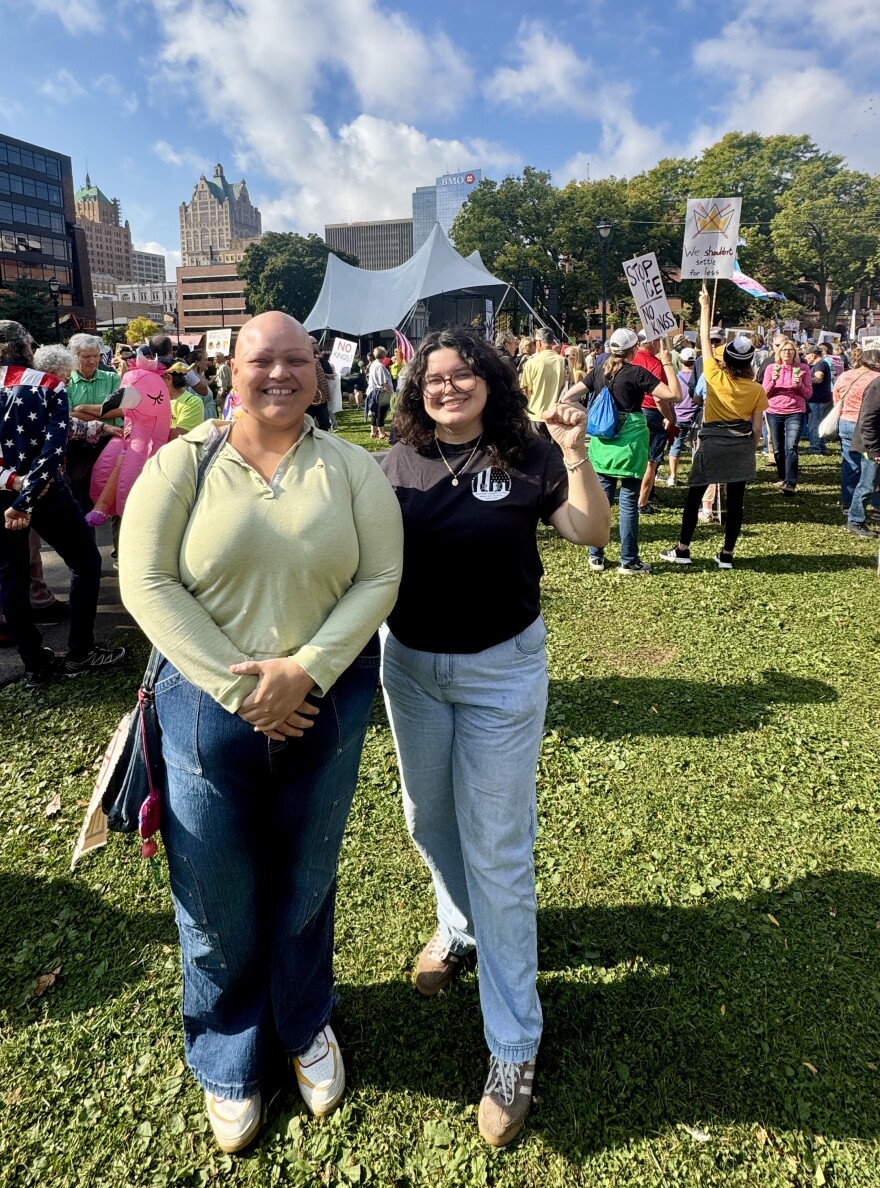
Saturday, Oct. 18 was the second No Kings rally of the year, protesting President Trump and his policies. An estimated seven million people participated in over 2,500 rallies across the globe. In Milwaukee, thousands packed Milwaukee’s Cathedral Square Park, including Tequila Matthew.
“We should not have to worry about walking down our streets as U.S. citizens,” Matthew says. “You should not have to be scared to take your kids to school. You should not be scared to go to church. That’s not what this country was built on.”
Local organizers estimated more than 15,000 people came out in Milwaukee. The crowd included families, veterans, people supporting abortion access, LGBTQ+ rights and immigrant safety.
“We are more powerful in numbers,” says Milwaukee’s Daisey Velazquez. “What the government is doing currently is not OK. I’m a child of immigrants. And stuff that’s happening right now with our immigration is not OK.”
Velazquez is an MPS teacher who has family in Chicago. On the block where her family lives, there have been ICE and DHS raids. While Velazquez says her family members weren’t stopped, the legalized racial profiling has been horrific.
Considering how urgent the danger is for her family, she was skeptical about the No Kings rally before coming out.
“Sometimes a protest just feels like empty words and being very honest,” she says. “However, I do think that it lets the country see, the government see that their actions are not going unnoticed. Seeing their state sanctioned violence is not going unnoticed. Like we’re here and we’re standing up for what we believe in because they are hurting people directly.”
Organizers of the Milwaukee event started the day with an Org Fair, or a chance for people to get familiar with organizations doing work in the area that opposes Trump and his policies. It also invited local leaders to speak at the event.
“I think it’s important to make sure that we’re resisting at every opportunity,” says Angela Lang, executive director of BLOC, Black Leaders Organizing for Communities. “And folks are eager to come together to show that display of power. And so I was really excited to ask to be here today.”
In her speech, Lang urged people to think nationally and act locally, and consider how some of these issues like surveillance or police militarization are already affecting people in Milwaukee.
“I joke around and say everyone has a role in the movement, whether you’re my therapist or you’re the yoga instructor helping us all breathe through it,” says Lang. “So I really always want to see protests like this inspire folks to take more action, whether it’s facial recognition technology or it’s the city budget and how we’re allocating and investing in our communities. All of this is a way for us to get involved.”

President Trump denied claims of being a king but later posted multiple AI-generated videos mocking the event. Meanwhile, the No Kings organizers have a public virtual event scheduled for Tuesday, Oct. 21 night.



MILWAUKEE – The death toll from two earthquakes in Venezuela has topped 1,400 with an estimated 69,000 people still missing.
Earthquakes in Venezuela
The backstory:
The initial earthquakes registered at 7.2 and 7.5 on the Richter scale, and there have been more than 400 aftershocks since then. Meanwhile, neighbors in Milwaukee are doing their part to provide relief for families affected.
FREE DOWNLOAD: Get breaking news alerts in the FOX LOCAL Mobile app for iOS or Android
Milwaukee relief effort
Local perspective:
Organizers told FOX6 News the generosity was nonstop since doors opened Saturday morning, all to collect basic needs for those impacted by the tragedy in Venezuela.
On Historic Mitchell Street, all hands were on deck as neighbors dropped bags filled with clothes, emergency care items and toiletries. People boxed up the items to send off to families in Venezuela.
“Wipes, Pampers that we have, so many things that we have collected,” said organizer Ana Gilmond. “There is no infrastructure there, so people are struggling.”
Gilmond helped organize the disaster relief collection site at Voces de la Frontera’s headquarters Saturday.
SIGN UP TODAY: Get daily headlines, breaking news emails from FOX6 News
“We all feel devastated, and we thought, ‘We have to get together in order to to help,’” she said. “We might be far, but our heart is there right now.”
Gilmond said she is thinking of families and her friend who died after her building collapsed during the back-to-back earthquakes. It’s a labor of love that has brought dozens of donations to the site from folks like Alex Wenzel and her mother, Deb Smith.
“Just saw images of people being pulled out of the rubble and leaving little dogs,” said Wenzel. “If there’s something you can do, why not do it?”
Group collects donations for Venezuela earthquake relief at Voces de la Frontera headquarters in Milwaukee
“Out of the hopelessness, I know that when we take action in this collective way, we’re all helping each other,” Smith said.
It’s a simple gesture they hope will make a difference. As organizers work to pack up and load donations overseas, Gilmond has a message:
“Fuerza, be strong – we’re here for you,” she said.
Upcoming relief drive
What you can do:
This earthquake relief drive will continue at Blessed Sacrament Catholic Church at 41st and Oklahoma. It takes place from 9 a.m. to 3 p.m. starting Monday and continuing through Friday, July 3.
Desired items include non-perishable foods and cases of water, temporary household needs like new batteries and blankets, and hygiene products like toilet paper and toothpaste.
The Source: Information in this story is from FOX6 News interviews and FOX Television Stations coverage of the earthquakes.

Penelope the corpse flower is in bloom at Milwaukee’s Mitchell Park Domes.
Penelope, which last bloomed in 2024, will be open and stinking for the next 24-48 hours. This rare and very large flower only booms every couple of years; when it does, it emits a powerful – and disgusting – odor.
“Typically they only bloom once every six to eight years, ” said Amanda Garchow, horticulturist at the Domes. “Penelope’s a little different in our case; this is her second bloom in two years, so it’s extra exciting for us because it’s a rare event that’s she’s blooming so soon.”
The ephemeral nature of this plant and its experience has gathered somewhat of a cult following, according to Bryan Connolly, botanist and associate professor of biology at Eastern Connecticut State University, who once had someone visit his greenhouse with a corpse flower tattoo on his leg.
Below, with some help from Connolly and Garchow, we answer questions about this fascinating plant.
What exactly is a corpse flower?
The corpse flower, also known as a Amorphophallus titanum to scientists and “titan arum” to fans of David Attenborough’s “The Private Life of Plants,” is a flowering plant native to rainforests on the Indonesian island of Sumatra. It is known for its putrid smell, often compared to the scent of rotting flesh, and for only blooming for 24-48 hours every couple years.
Why does it take so long to bloom?
It needs to accumulate enough nutrients. The corpse plant starts as a seed or, if it’s already bloomed, an underground tuber-like corm (think potato). Both produce a really large leaf, which can be up to 15 feet tall.
“There’s no stem when it’s not flowering, and so it has a petiole, which is part of the leaf that looks kind of like a stem, but it’s not a stem,” Connolly explained. “They can get very large, like bigger than your thigh around.”
The leaf generates sugar – food for the plant – and stores it in the underground corm.
After a year, the leaf dies, and the tuber rests for four months. Then it produces a new leaf and repeats the cycle until the tuber becomes large enough. This takes about seven to 10 years for a new seed and three to four years for a corm that’s bloomed before.
The corm of a corpse flower is the largest of any flowering plant. According to Connolly, the biggest one has been up to 200 pounds, but they’re typically more like 60 pounds.
Why the rotting meat smell?
To attract pollinators. After years of tuber growing, the tuber eventually produces a spike, formally known as a spadix, of flowers wrapped in a specialized leaf called a spathe. Female and male flowers grow in a ring at the bottom of the spadix. This stage is called an inflorescence, which is a group of flowers.
The corpse flower is the world’s largest unbranched inflorescence or group of flowers.
Eventually, as the spathe opens, the spadix heats up to about 99 degrees F and the flowers begin to emit pulses of powerful odor to attract insects, like carrion beetles or fruit flies, that typically eat or lay their eggs on rotten meat. These insects pollinate the flowers at the base of the plant.
Are there benefits to being pollinated by insects like fruit flies and carrion beetles instead of more common pollinators like bees?
Not really.
According Connolly, it may be related to the plant’s native environment. Corpse plants can be miles apart in a rainforest, and since they bloom infrequently they can only be pollinated and reproduce every few years. Because of that, it could be advantageous to seek pollinators that are willing to travel long distances between plants.
What makes it smell so bad?
Chemists have isolated identified over 40 compounds that make up the odor released by the plant. Some of the chemicals include two that smell like garlic (dimethyl trisulfide and disulfide), one that smells like sulfur (methanethiol), one that smells like citrus (limonene), one that smells like feces (idole), and one that smells like urine (phenylalanin).
Why should I care?
There is inherent intrigue to a smelly plant named Penelope. But also, corpse flowers are an endangered species due to loss of habitat, climate change and encroachment from invasive species. Garchow said that it’s estimated there are only 800 left in the wild.
Additionally, these plants are difficult to conserve via seed preservation because their seeds aren’t viable after drying.
Therefore, they must be conserved in living collections in gardens, research labs or greenhouses and conservatories like the Domes.
Since they can’t self-pollinate, despite having both male and female flowers, they must be pollinated by another plant. Different research labs and greenhouses often rely on sending stored pollen to each other to keep these plant lines going.
“I’m really thankful that we have this giant, smelly, weird plant that, you know, kind of brings botany to the public,” said Connolly with a smile. “And just the conservation of plants and of the species in general.”
The Domes will have extended hours on Saturday and Sunday to accommodate visitors who want to see the corpse flower in bloom, though the smell will mostly fade by Sunday. Stop by to see Penelope, support important conservation work and acquire a unique, albeit smelly, experience.
The Dome, 524 S. Layton Blvd., will host extending hours for this event, from 8 a.m. to 4 p.m. both days. Admission is $10 for adults ($9 for residents), $6.50 for ages 3-12 and free for children younger than 2. Due to road construction and the closure of the 27th Street bridge, the Milwaukee Domes Alliance suggests using GPS to plot a route. Directions and more information, including specific discounts, are available at www.MilwaukeeDomes.org.
Reach Donnisa Edmonds at DEdmonds@usatodayco.com.

Garrett Mitchell celebrates with third base coach Matt Erickson after hitting a two-run home run against the Chicago Cubs. (Photo by John Fisher/Getty Images)
MILWAUKEE – Garrett Mitchell and William Contreras homered, Jacob Misiorowski delivered another winning performance, and the Milwaukee Brewers beat the rival Cubs 6-2 at American Family Field on Friday night.
Jacob Misiorowski
By the numbers:
Misiorowski (9-3) struck out eight over six innings and 105.5 mph, tied for the third-fastest since pitch tracking began in 2008. He allowed one earned run – a Seiya Suzuki home run in the fifth – on two hits but walked four. His earned run average for the season now sits at 1.45.
FREE DOWNLOAD: Get breaking news alerts in the FOX LOCAL Mobile app for iOS or Android
Home runs at AmFam
By the numbers:
Milwaukee trailed 1-0 when Misiorowski threw his final pitch of the night, but Mitchell belted a two-run home run in the bottom of the sixth to put Miz in position for the win. David Hamilton made it 3-1 with a triple that scored Cooper Pratt later in the sixth.
Contreras added insurance with a two-run home run of his own in the seventh. Suzuki drove in Pete Crow-Armstrong with a sacrifice fly in the eighth to close the gap for Chicago, but Christian Yelich doubled home Pratt in the bottom half.
Abner Uribe pitched a scoreless seventh for his eleventh hold of the season, Aaron Ashby gave up the sac fly to Suzuki in the eighth and Trevor Megill walked one but worked a scoreless ninth.
Former Milwaukee pitcher Colin Rea pitched five innings in the start for Chicago, but Ethan Roberts was credited with both the loss and a blown save.
Brewers manager Pat Murphy, who had surgery Thursday for a ruptured disk in his back, guided his club from a safe spot near the dugout.
Saturday’s game
What’s next:
LHP David Peterson (3-6, 6.09 ERA) makes his Cubs debut after being acquired Thursday from the New York Mets for minor league third baseman Cole Mathis. LHP Kyle Harrison (8-1, 2.50) starts for the Brewers.
The Source: Information in this story is from Brewers.com. The Associated Press contributed.
-

 Minnesota4 minutes ago
Anti-ICE organizers shift focus to defend democracy from Trump assault
-
Mississippi7 minutes ago
A new law could create a list of immigrants illegally living in Mississippi. Advocates are alarmed
-

 Missouri12 minutes ago
Missouri parent groups organize with school funding concerns
-
Montana19 minutes ago
Montana Lottery Powerball, Lotto America results for June 27, 2026
-

 Nebraska21 minutes ago
Five-Star Forward Dawson Battie Returning to Nebraska for Official Visit
-

 Nevada27 minutes ago
Nevada National Security Site Museum hosts Cold War history presentation
-

 New Hampshire34 minutes ago
Nashua resident charged over chats seeking access to children
-

 New Jersey37 minutes ago
3 missing teens located after vanishing from New Jersey train station

