San Diego, CA
Morning Report: A Trans Republican School Board Member


In August, a Republican school board member of Escondido Union High School District had an announcement for the public.
“I was elected to this board in November 2014 as Bill Durney and re-elected in 2018 and 2022. This year I have come out as a transgender woman, and I have changed my name to Carol Durney,” she continued.
Conservative contempt for trans people is nothing new, but how would Republicans react to one of their own coming out as trans?
At that first meeting, not well.
People referred to her as an “abomination” and called on her to resign. But at a board meeting this Tuesday, the tone changed. Far more people showed up to support Durney than castigate her.
Our Jakob McWhinney has an in-depth and moving profile of Durney and how her transition has (and hasn’t) shaped her politics.
Read the full story here.
County Health and Human Services Chief Out in November
Another high-level official is preparing to depart county government.
Kim Giardina, who has led the county’s massive Health and Human Services Agency for the past year, announced that her last day at the county will be Nov. 6.
Giardina wrote that she plans to “explore other options,” in an email obtained by Voice. The decision came with a “mix of emotions,” she wrote.
This is a turbulent time for the county. It’s facing federal cuts that will impact services and has already endured other major departures. The county’s top attorney abruptly retired in July and its behavioral health director caught even insiders off guard with his resignation. The county official who oversees Medicaid and food stamp programs that will be hit hard by federal cuts is also set to retire in December.
“Change can be hard, but it is expected in a large organization, and the county is committed to a smooth transition,” county spokesperson Tammy Glenn wrote.
North County Report: Shaffer’s Court Appearance
Reporter Tigist Layne takes us inside the courthouse for Encinitas Councilmember Luke Shaffer’s arraignment for hit-and-run charges.
Dozens of supporters showed up for Shaffer.
“They offered each other condolences, hugs and words of encouragement. I heard people say things like, ‘I can’t believe this is happening,’ and ‘It will all be over soon.’ One person said it felt like they were mourning,” Layne writes.
Read the full North County Report here.
About Those Robots at City Council
The City Clerk’s Office confirmed on Wednesday that AI bots have not breached Council’s online comments after a series of strange audios made their way to meetings this week.
City Clerk Diana Fuentes said in a statement that the city’s system, ZoomGov, does not allow it.
“It appears that an individual chose to play a pre-recorded audio clip once they were recognized to speak,” she said. “We are monitoring this matter and will continue to ensure public participation in City Council meetings is conducted in line with our established rules of order.”
An Insane Bond Deal Exposed
Back in 2012, Voice of San Diego published one of its all-time bangers.
Poway Unified School District had borrowed $105 million for construction projects. Former reporter Will Carless discovered that the district would be on the hook to pay back roughly $1 billion — almost ten times more than it had borrowed!
The story led to national media attention, lots of pissed off residents and a new state law that capped debt-to-principal ratios on government borrowing.
This story is part of our 20th anniversary series on Voice’s impact. Read it here.
In Other News
- The San Diego city council voted Tuesday to settle for nearly $900,000 for a police response involving excessive force. The payout is the result of an incident last year, where officers shot beanbag rounds at a man and released K-9 units on him, after he had surrendered. (KPBS)
- A residential care facility in Mira Mesa is facing elder abuse charges. California’s Attorney General’s Office brought the charges forward earlier this week, alleging that residents suffered from bedsores and malnourishment because the facility was understaffed. (NBC 7)
- Potholes are one of the greatest obstacles San Diegans face on a daily basis. The City of San Diego is trying to do something about it, recently adding four new trucks to a fleet dedicated to smoothing city streets. We’ll see if this “gets it done.” (CBS 8)
The Morning Report was written by Will Huntsberry, Lisa Halverstadt and Tessa Balc. It was edited by Andrea Sanchez-Villafaña.



CORONADO, Calif. (KGTV) – Everyone from NASCAR officials to the drivers to those who serve on Naval Base Coronado is beaming with excitement, waiting to kick the tires and light the fires this race weekend for NASCAR San Diego Weekend.
“Fans can expect one incredible time. History is being made this weekend,” Matt Humphrey, Sr. Director of Track Communications for NASCAR, said.
The racing track is up at Naval Base Coronado.
“It’s been amazing from seeing the bones of the track going up to driving the track, going to work in the morning. It’s incredible,” Seaman Naylei Fausto of the U.S. Navy said,
And now it’s time to race.
The NASCAR San Diego weekend is officially underway, with the first event held at an active military base.
“They’re going to be able to see a lot of what NASCAR is about with all the different fan displays, the kids’ zone, all the different activations from our partners around, but most importantly, they’re going to see the United States Navy showcased in the best form possible,” Humphrey said.
One of those sailors, Seaman Fausto, who is a lifelong NASCAR fan, never thought she’d see her station transformed into a NASCAR track, let alone any base.
“Joining the Navy, I thought I was going to be out taking pictures and doing Navy-related things, and now I get to work with NASCAR, which is just amazing and it’s fulfilling my inner child,” Fausto said.
Those behind the wheel say that, in their experience, there’s nothing like this event.
“It’s definitely a once-in-a-lifetime opportunity. I think we’ve had some opportunities. We did the street course in Chicago for the last couple of years,” Cody Ware, NASCAR Driver, said. “But to show up here, getting the opportunity to race on an active military base just for the US Navy and NASCAR to be able to work together to put the show on is really incredible.”
There will be a Truck Series race starting at 4 p.m. on Thursday. On Saturday, that’s when the NASCAR O’Reilly Auto Parts race will be happening. That begins at 2 p.m. This is the second tier of NASCAR races where drivers hone their skills, looking to get into the top level of the NASCAR circuit. Sunday is the main race with the NASCAR Cup Series happening at 1 p.m.
While it’s incredible to host NASCAR at the naval base, NASCAR officials hope people plan ahead to avoid the painful process of getting to the track.
“But if you do not have that government-issued photo ID or passport, you’ll be turned away. So very important that you bring that. But then bring your patients, come early,” Humphrey said. “If you think it’s going to take a half hour to get here, add an extra 30 to 40 to even 60 minutes on top of that; just to give yourself enough time to get over the bridge to make sure you get through the gates, get through security.”
Humphrey added that NASCAR is working together with local, state and federal agencies to make sure traffic is moving smoothly, and everyone is getting into the race and having fun.

San Diego County will be the center of NASCAR nation this weekend, with fans flocking to Naval Base Coronado for three days of events.
This is the first-ever Cup race held in San Diego County and the NASCAR community is also presenting it as its way of celebrating the 250th anniversary of the U.S. Navy.
Tickets are completely sold out, but locals can still get in on the fun at various event and activities taking place across the region.
Here’s what to know about this one-of-a-kind weekend in San Diego. Full coverage of NASCAR San Diego Weekend can be found at sandiegouniontribune.com/tag/nascar.
What is NASCAR San Diego Weekend?
The three-day event begins with Friday’s Craftsman Truck Series race, continues with an O’Reilly Auto Parts series race on Saturday and wraps Sunday with the Anduril 250.
Grandstands with a capacity for 40,000 fans have been erected, with another 10,000 spectators expected to occupy standing areas around the grounds.
Here’s a turn-by-turn look at Naval Base Coronado’s race circuit
When is it taking place?
Parking lots, which are on base, open each day at 7 a.m. and gates open at 9 a.m.
The Craftsman Truck Series takes place Friday at 4 p.m. The O’Reilly Auto Parts series race blasts off at 2 p.m. Saturday. The main event, NASCAR Cup Series Race, happens Sunday at 1 p.m.
A race-by-race look at NASCAR’s San Diego Weekend
Each day will also feature entertainment, driver Q&As and other activities.
Where is it?
Naval Base Coronado will host the weekend’s activities. All fans in attendance must carry a valid government-issued photo ID at all times.
Going to this weekend’s NASCAR races in Coronado? Here’s what you need to know
All event parking will be located on Naval Base Coronado. There is no event parking available within the city of Coronado.
Who is racing?
Shane Van Gisbergen, Tyler Reddick, Mike McDowell, Chase Elliott and Ty Gibbs are just a few of the names to expect this weekend. A full lineup can be found at nascarsandiego.com/nascar-san-diego-mission-lineup.
These 13 Cup racers could all win Sunday’s Anduril 250 in Coronado
How to watch on TV:
Craftsman Trucks Series race: 4 p.m. Friday on Fox Sports 1
O’Reilly Auto Parts Series race: 2 p.m. Saturday on The CW
NASCAR Cup race: Sunday at 1 p.m. on Prime Video
Local events:
San Diegans have a range of options for getting in on the fun of NASCAR weekend in Coronado, including meet and greets with drivers, watch parties and fan zones.
Your guide to fan events during NASCAR San Diego Weekend
More coverage:

CORONADO, Calif. (FOX 5/KUSI) — Final preparations are underway for NASCAR’s historic race weekend at Naval Base Coronado, where stock cars will compete on an active military installation for the first time in the sport’s history.
Crews, race teams, military personnel, first responders and event staff spent Thursday putting the finishing touches on the temporary road course as thousands of fans prepare to descend on the base for the inaugural event.
“The countdown is on,” as organizers work to transform portions of the installation into a race venue unlike any NASCAR has hosted before.
“It’s a very proud moment for NASCAR and myself and my company for being part of it,” said Jordan Litchko, a NASCAR production partner with ignition production. “It’s the America 250, so what a year to celebrate and be here on the naval base.”
Officials say the event marks the first time a NASCAR national series race has been held on a military base, bringing one of America’s most recognizable motorsports directly onto a working military installation.
Unlike traditional oval tracks, competitors will tackle a temporary road course built specifically for the event.
“It’s a road course race, which adds way more excitement, so it’s going to be ultra challenging,” Litchko said.
Thursday’s preparations included long lines of team members, vendors, staff and emergency personnel picking up credentials and completing security and base access requirements ahead of race weekend.
Meanwhile, drivers and crews got their first close look at the unique layout, which winds through portions of the base and presents a challenge far different from a conventional speedway.
With large crowds expected throughout the weekend, organizers are encouraging fans to plan ahead and allow extra travel time. Traffic delays are anticipated around Naval Base Coronado and nearby access points as spectators arrive for the event.
After months of planning and construction, the wait is nearly over.
On Friday, engines will roar to life aboard Naval Base Coronado, marking a milestone moment for NASCAR and creating a new chapter in the sport’s history. By the weekend’s end, fans will witness a race unlike any ever held before — stock cars competing on a military base in the heart of San Diego.
-
 Entertainment7 minutes ago
At the Fonda, Jane Remover’s violent yearning heralds a new kind of stardom
-
 Lifestyle10 minutes ago
Beer, with a twist? SoCal dads find solidarity through an unexpected activity
-
 Politics15 minutes ago
Billionaire tax proposal faces hurdles as it moves closer to November ballot
-
 Science22 minutes ago
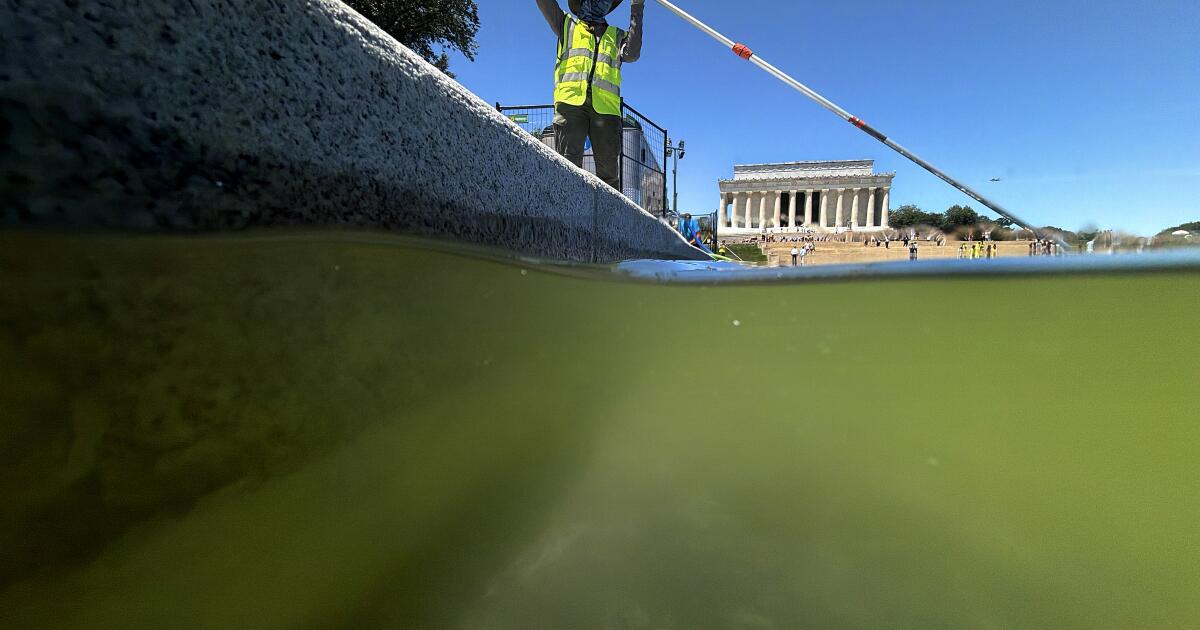
Here’s why the Lincoln Memorial Reflecting Pool went green so fast
-
 Sports25 minutes ago
Shohei Ohtani out of Dodgers’ lineup vs. Orioles for birth of his second child
-

 World37 minutes ago
Lebanese influencer organises World Cup event amid Israel’s attack on Leban
-
 News60 minutes ago
Air Force One, gifted to Trump from Qatar, arrives at Joint Base Andrews
-

 New York2 hours ago
Video: Fans Show Up to the Parade in Their Best Knicks-Themed Attire

