Ohio
Ohio GOP infighting stalls marijuana legislation

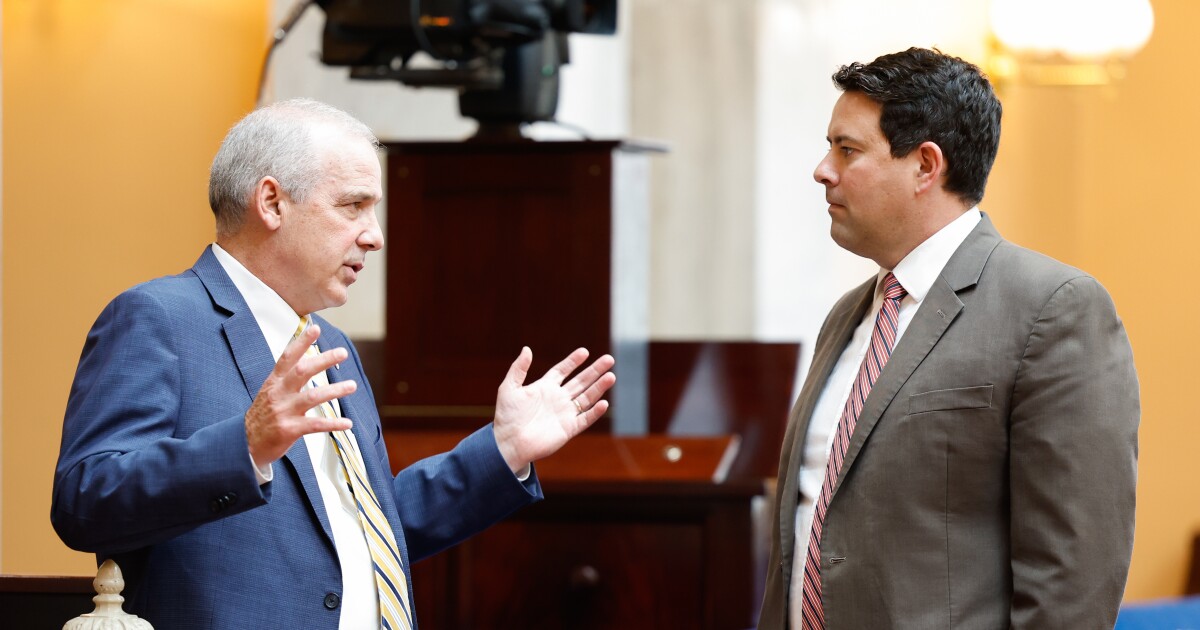
COLUMBUS, Ohio — Ohio House and Senate Republicans had finally agreed on a bill changing the state’s recreational marijuana policy, but hours before the vote was supposed to take place, it was pulled from the schedule.
Voters spoke loud and clear in November of 2023, with 57% of Ohioans voting yes on Issue 2: legalizing recreational marijuana.
“I voted for it,” state Rep. Jamie Callender (R-Concord), the House’s resident cannabis expert.
Callender has been smoking marijuana for decades and has been trying to reduce stigma around the product for just as long.
If you are 21 years old, you can smoke, vape, and ingest marijuana. Individually, you can grow six plants, but you can grow up to 12 plants per household if you live with others.
But since then, other Republican leaders have been trying to change the law.
For the past several months, the House and Senate chambers have been trying to compromise on their separate bills.
I have been covering marijuana policy extensively for years, including a series answering viewer questions about cannabis.
Ohio GOP plans to pass marijuana restrictions by end of June
In short, the Senate’s proposal decreases THC content, reduces home growing from 12 plants to 6, imposes more criminal penalties and takes away tax money from local municipalities that have dispensaries. The House’s latest version had none of those.
Click here for Senate version and here for House version changes.
“The Senate had proposed taking that tax away, and the House has fought really hard to keep that in…” Callender said. “We finally had that negotiated so it would stay in.”
Recently, Callender told me an agreement was reached on following most of the House’s new version, which mainly focused on preventing children from accessing the drug. The bill was set to hit the House floor Wednesday.
But in a turn of events, Republican infighting is preventing the bill from being passed.
“Apparently, the Senate changed their mind,” Callender said.
In a shock to House Speaker Matt Huffman (R-Lima), the Senate pulled out of the compromise.
“I’m pretty disappointed — we’re not going to have it on the floor today,” Huffman said. “To my surprise, there was a whole new set of issues, additional issues, which were raised Monday night by the Senate regarding what we were trying to do.”
It was a Senate push for 16 changes, ones that Huffman didn’t get to even see until the day before the vote was set to take place.
“They wanted to make a mandatory jail sentence for passing a joint between friends,” Callender said, referencing a provision on “sharing.”
The main holdup is the tax money, he added.
The law gives the 10% tax revenue from each marijuana sale to four different venues: 36% to the social equity fund, to help people disproportionately impacted by marijuana-related laws; 36% to host cities — ones that have dispensaries; 25% to the state’s mental health and addiction services department; and 3% to the state’s cannabis control department.
Instead, the Senate wants all the revenue from the tax to be sent to the state’s General Revenue Fund, meaning lawmakers can choose to allocate that money toward whatever they want.
The House, as Callender had mentioned, has a major sticking point with making sure that at least the local municipalities get at least some percentage of the tax revenue.
“What changed in the past 72 hours to pull the Senate out of the marijuana deal?” I asked Senate President Rob McColley (R-Napoleon)
“Well, I wouldn’t say anything has changed; I think the conversations have gone pretty well on it,” McColley responded. “I think, maybe, there was a misunderstanding as to where we might have been on the bill as both chambers.”
The president wants to follow his version of the legislation.
“Our priorities are in the bill that we already passed,” he said.
The teams will work together to actually come to an agreement as soon as possible, he continued.
“I would like to get something done by the end of June; I think [Huffman] would like to get something done by the end of June,” McColley added. “We’ll see if we can get something done in the next week.”
Huffman said he’s “not very optimistic” about that.
“I just told my caucus: ‘We’re not going to just say, “OK,” because we’re so anxious to pass the marijuana bill,’ which I’d like to get it done, but we’re not going to give up house priorities to do that,” the speaker said.
Several hours later, Huffman responded to additional cannabis questions.
“I thought we were on a path, this time last week, to pass it [this week],” the speaker said. “That was the kind of clear indication we had.”
However, when I pointed out to Huffman how McColley denied their agreement, he switched gears.
“There was no agreement to pull out of,” he said.
I asked why he would put a bill on the floor if there wasn’t an agreement.
“We were hoping that there would be, anticipating there would be, sounded like we might have, but it’s not correct to say that there was an agreement that anybody pulled out of,” he said.
However, his cousin and the resident marijuana expert in the opposite chamber, state Sen. Steve Huffman (R-Tipp City), said there was. The senator had been the main negotiating party for that chamber.
“We were in an agreement,” S. Huffman said.
He continued that policy staff and McColley brought “ongoing concerns” to him, but he believes they could be easily fixed. An additional reason why it was pulled is due to drafting issues with the bill language, he added.
“I believe that things are still being worked out, and I have the utmost confidence that we will resolve this by next Wednesday,” the senator said.
Callender isn’t so sure about that.
“Do you believe that the Senate will be going against the will of the voters with all of their requests?” I asked him.
“Yes,” he said.
Callender said that this reminds him of the last General Assembly, when M. Huffman and former Speaker Jason Stephens (R-Kitts Hill) were squabbling constantly about everything, but especially marijuana.
Stephens and Callender prevented then-Senate President Huffman’s legislation from passing. Back in 2023-24, Huffman proposed a bill very similar to the Senate’s current version.
It appears that Huffman, with the House GOP, has shifted away from a more restrictive view to a position similar to the one Stephens held in the past.
Follow WEWS statehouse reporter Morgan Trau on Twitter and Facebook.





Real estate transfers in Licking County, Ohio, range from $85,000 to $865,000
The following are property transfers recorded in Licking County from June 1-5, 2026.
First name indicates the seller; second name represents the buyer
Buckeye Lake
- 502 Providence Lane; Cohagen, Christopher C and Lori A; Adams, Jeffrey L and Boyce-Adams, Jo Anna; 6/1/2026; $511,000
- 131 Cranberry Lane; Smart, Amy and Kidwell, Kevin K; Sew and Minor, Christian; 6/1/2026; $262,000
Etna Township
- 116 Cameron Drive SW; Ray, Erica L; Darjee, Sanjay and Laxmi and Dil; 6/2/2026; $412,000
- 119 Kraner St. SW; Adkins, Zane and Amy; Culbertson, Brenton Howard; 6/1/2026; $368,500
- 160 Dusky Willow Drive; Willow Reserve LLC; Martin, Alaina K; 6/2/2026; $290,940
Granville
- 119 Derwyn Del Way; Lifer, David C and Julia H; Martin, Michael and Lisa; 6/1/2026; $865,000
- 39 Victoria Drive; Acton, Wendy S and Paul J; Cannon, Matthew Evan and Zywica, Natalie Nicole; 6/2/2026; $835,000
Granville Township
- 49 Alberry Drive; Halliday, Lucas and Breayne; Howe, Jason and Kathryn; 6/2/2026; $570,000
Harrison Township
- 102 Whirlaway Loop; Rice, Dawn (Trustee); Bope, Maria and Shane; 6/2/2026; $420,000
Heath
- 1306 Kacey Court; Fischer Homes Columbus II LLC; Owens, Blake Andrew and Taylor Marie; 6/2/2026; $437,779
- 805 Fieldson Drive; Flowers, Ingrit; Harder, Noah C; 6/2/2026; $250,000
Hebron
- 802 Cumberland Meadows Circle; Lines, Marlene S; Gerhart, Jamie A and Ralph W Jr; 6/2/2026; $232,000
Johnstown
- 101 Bigelow Drive; McGovern, Matthew S and Jennifer L; Sanford, Jessica; 6/2/2026; $442,500
Liberty Township
- 5844 Nichols Lane Road NW; La Jeunesse, Garth E and Debra; Nesselroad, William Heath and Annie; 6/1/2026; $629,000
- 7211 Northridge Road NW; Devault, Robert E Jr and Joann; Esbenshade, Travis M and Lowe, Shelby M; 6/1/2026; $495,000
Newark
- 2110 Overlook Way; D.R. Horton-Indiana LLC; Tarsha, Michele A; 6/1/2026; $433,335
- 1162 Taylor Ave.; Heath Fluid LLC; Anglada, Gabriel P and Salina T; 6/1/2026; $200,000
- 32 Postal Ave. W.; Palmisano, Phil; Moore, Dominic Michael and Miksich, Paige Elizabeth; 6/1/2026; $198,900
- 75 Gay St.; Velez, Marcos A; Camell, Campbell; 6/1/2026; $155,000
- 655 Evans St.; TNL; McRada Properties LLC; 6/1/2026; $145,000
- 63 Wallace St.; FDA Peachtree LLC; Burns, Amber L; 6/2/2026; $86,500
- 404 10th St.; Synergy Group Properties LLC; Busy Boys Restoration LLC; 6/2/2026; $85,000
Reynoldsburg
- 8447 Rodebaugh Road; Collins, Carol J; Thorpe, Kimberley Lynn and Henry, Steven; 6/2/2026; $340,000

COLUMBUS, Ohio (AP) — Ohio’s law requiring children under 16 to get parental consent to use social media apps must be restored, a divided panel of the Sixth Circuit Court of Appeals ruled Thursday.
The decision comes as a blow to NetChoice, which has won court victories against identical digital identification laws in other states, including Arkansas, Louisiana and Georgia. The trade group representing TikTok, Snapchat, Meta and other major tech companies said the Ohio decision went against “clear national consensus” and that it intended to keep fighting.
“An unconstitutional law protects no one, and we remain focused on ensuring the First Amendment rights of Ohioans are protected,” said Paul Taske, director of the NetChoice Litigation Center.
Netchoice brought suit against Ohio’s law in 2024, arguing that it was overly broad, vague and represented an unconstitutional impediment to free speech.
The Cincinnati-based Sixth Circuit’s panel disagreed. In a 2-1 decision, it found that the law was not unconstitutional and sent it back to a lower court to have a block on the law’s enforcement vacated.
“At bottom, the Act imposes a parental consent requirement,” Judge Eric Clay wrote in the lead opinion. “That requirement constitutes a marginal burden that precisely targets the multi-faceted problem that Ohio has identified: Children’s unsupervised assent to terms and conditions for use of platforms that take advantage of and harm them.”
Judge Alice Batchelder concurred, writing that “a statute is not vague just because it has a wide berth.”
Known as the Social Media Parental Notification Act, the Ohio law was part of an $86.1 billion state budget bill that Republican Ohio Gov. Mike DeWine signed into law in July 2023.
The administration pushed the measure as a way to protect children’s mental health, with then-Lt. Gov. Jon Husted, now a U.S. senator, saying at the time that social media was “intentionally addictive” and harmful to kids.
The law requires companies to get parental permission for social media and gaming apps and to provide their privacy guidelines so families know what content would be censored or moderated on their child’s profile.
Republican Ohio Attorney General Andy Wilson called Thursday’s ruling “a win for Ohio families.”
“The court agreed that parents –- not social media companies –- should get a say in what kids see online,” he said in a statement. “We have an obligation to keep our children safe, and today, the most dangerous place for our kids is the internet. This decision gives parents the tools to be involved and provide oversight.”

Piketon, Ohio (WSAZ) – Folks in southern Ohio are waking up to power outages and road closures.
Route 32 in Pike County is down to one westbound and one eastbound lane due to debris on the roadway.
Drivers are also dealing with tree limbs on roadways.
The Athens County 911 dispatcher told WSAZ that it’s not believed a tornado touched down, but there is storm damage.
The dispatcher said storm damage from flooding and trees being knocked down has affected US 50.
Power outages are being reported in Athens, Pike, Vinton, Scioto and Meigs Counties and even as far south as Boyd County, Ky.
If you’re in a tornado warning area, you’re urged to get to the lower part of your home.
Keep checking the WSAZ app for the latest.
Copyright 2026 WSAZ. All rights reserved.
-

 Detroit, MI6 minutes ago
Top 10 ‘Hour Detroit’ Covers, As Voted By Readers
-

 San Francisco, CA18 minutes ago
Injured SFPD officer released from hospital after line-of-duty shooting
-

 Dallas, TX21 minutes ago
25,000 free Dallas teen passes available June 29 for museums, zoo and more
-

 Miami, FL26 minutes ago
3 wildfires burn over 20,000 acres in Miami-Dade ahead of long-awaited rain
-

 Boston, MA33 minutes ago
Boston is opening outdoor drinking areas during the World Cup. Here’s how it works.
-

 Denver, CO36 minutes ago
Claimed by Christ, Free in Him: Archbishop Golka Celebrates First Juneteenth Mass in Denver
-

 Seattle, WA41 minutes ago
‘Seattle News Weekly’: FIFA World Cup 2026 at Seattle Stadium
-

 San Diego, CA48 minutes ago
It’s NASCAR weekend in Coronado. Here’s what San Diegans need to know.

