Lifestyle
Murals Have Moved Indoors


When Megan Debin purchased her Long Beach, Calif., house in 2020, she found her backyard dreary with its cinder-block walls. Dr. Debin, an art history professor and content creator, was smitten with a light blue crab motif she had come across on Instagram. She asked its artist, Tracy Allen, a muralist in Long Beach, to paint the crab on one of her yard’s walls.
One mural turned into five — all different designs, predominantly blue — and now Dr. Debin, 45, sees her yard differently. “It’s so bright and playful, and it lifts your mood,” she said, adding that the murals inspired her to create an outdoor space where she could entertain among the yard’s orange trees.
Home murals were once relegated to children’s bedrooms, where they often tied into a theme. Today, they’ve grown up and taken over walls, indoors and out.
Technically speaking, a mural is a large work of art executed right on a wall. And while modern murals are typically associated with streetscapes and Insta-worthy backdrops, they’re one of the most primitive forms of artistic storytelling. In Dordogne, France, for example, the Lascaux cave paintings of about 15,000 to 17,000 years ago depicted horses, bison and other animals. And in Patagonia, Argentina, the “Cueva de las Manos” (“Cave of Hands”) is a composite of stenciled human hands that dates back at least 9,000 years.
“I think as humans we have this built-in tendency to share things with other people and do that in a visual way,” said Hailey Widrig, an art historian and founder of Art Partners Advisory in Paris, which advises collectors and appraises art works. “Murals really evolved out of that.”
The sprawling wall paintings have ebbed and flowed out of popularity through the centuries, from religious works in the Renaissance (like the “Last Supper”) to political statements by Diego Rivera in the 1930s and Banksy’s start in the 1990s. In the 2010s, destinations like Richmond, Va., which has hosted the RVA Street Art Festival since 2012, and Wynwood Walls in Miami began welcoming murals to add vibrancy and become attractions.
The rise of murals on social media has inspired homeowners to bring them indoors. “Platforms like Instagram have reframed murals as contemporary visual statements by transforming them from niche to aspirational through sheer exposure,” said Elena DeStefano, an interior designer in Philadelphia. “In response, designers began integrating them as immersive, site-specific works that introduce a unique narrative and spatial complexity into the home.”
That individualized touch is what makes Ms. DeStefano so inclined to incorporate murals in homes. “I think they work in literally any room with walls,” she said. “They are a true representation of the person that lives in that home because there’s no mural that is ever going to be the same.”
Ms. DeStefano is also a proponent of digital mural wall coverings by companies like Phillip Jeffries. She recently worked with a couple who wanted birds in their mural, and the company blended their designs and tweaked the scale of the birds to make a customized mural.
There are considerations to take into account before painting a mural. Diana Hathaway, an interior designer in the San Francisco Bay Area, suggested pulling in colors from the surrounding design to make the space cohesive. “It doesn’t have to be too literal, but it should echo something you already have going on,” Ms. Hathaway said.
Many see hand-painted murals as an alternative to wallpaper, which can be fussy to install — and not as unique. Some muralists paint designs reminiscent of wallpaper, like Kate White who lives in Garrison, N.Y. She specializes in retro hues and geometric patterns, such as a terrazzo-inspired bathroom mural or pink and yellow blocks in an entry hallway.
Even an often-overlooked area, like a stairwell, is not immune to a muralist’s palette. Kreh Mellick, an artist in Asheville, N.C., recently painted one in a family member’s home in Virginia. Ms. Mellick took the stairwell from plain to whimsical, adorned with stars and a dress-clad sun ascending over flowers and a blueberry patch.
In some cases, homeowners empower muralists to think beyond just painting the walls. Christina Kwan, a muralist in Atlanta, installed an oceanic mural-painting hybrid in a client’s dining room. “When I work on canvases, they’re so contained,” she said. “Then when I work on murals, they’re so expansive, but I want them to have the intimacy that a canvas does.” Additionally, if the homeowners ever move, they can bring the canvas with them, too.
Even in the modern era, murals tell stories. Rachel Kerns, a muralist in Sacramento with a flair for boho-chic florals, painted a dining room ceiling in Pasadena, Calif., last year. Among leaves and golden flowers set against a red backdrop, Ms. Kerns painted silhouettes of the homeowner’s children on the edge of the mural.
“We incorporated the silhouettes in a way that was kind of abstract and not too on the nose or cheesy,” Ms. Kerns said. “I just thought it was so special that it was above the table that they’re going to dine at for years.”



A tarp covers the facade of the John F. Kennedy Memorial Center for the Performing Arts in Washington, DC, on June 13, 2026. Workers removed President Donald Trump’s name from the facade of the building.
Alex Wroblewski/AFP via Getty Images
hide caption
toggle caption
Alex Wroblewski/AFP via Getty Images
WASHINGTON – Workers have taken down President Donald Trump’s name from the Kennedy Center, hours after a court-ordered Friday deadline to remove it from the building, and less than six months after it was first affixed to the iconic performing arts venue. The removal of the more than a dozen bronze letters followed a judge’s ruling that the Center could not be renamed without Congressional approval.

In a court filing, Kennedy Center Executive Director and Chief Operating Officer Charles Matthew Floca confirmed that President Trump’s name has been removed from the building façade, despite what Floca said were weather-related delays. References to Trump on the center’s website are also gone.
Just a month into his second term, Trump ousted the Kennedy Center’s president, board chair and board members, then replaced them with a group of trustees that soon named Trump as chairman. Soon after, the president’s name was added to the building, so that it became, “The Donald J. Trump and the John F. Kennedy Memorial Center for the Performing Arts.”
The administration had on Friday asked a higher court to stay the ruling as it argued that Trump’s name on the building had helped attract donors and was crucial to raising funds for the Kennedy Center’s renovation.
“Without the name, “Trump” on the Building, our fundraising will not only come to a halt,” the administration wrote in a court filing, “but any and all monies raised or committed would be obligated to be returned, refunded or terminated.”

An appeals court denied that request Friday night. Workers erected scaffolding on Friday around the section of the building where Trump’s name had been added in December 2025. Then, in a pre-dawn operation, the laborers draped the scaffolding in tarpaulin, before removing the giant metallic letters. The Kennedy Center had asked a judge to briefly extend the deadline for this removal —because of Friday night thunderstorms forecast for Washington D.C.
Finally, with the scaffolding up, and tarpaulin covering their efforts, workers began to remove Trump’s name. Hundreds of people braved the rain and thunderstorms overnight to document the take-down. Some heckled those involved for hiding the removal using tarpaulin – with shouts of “Cover up!” and “Cowards!”
Among the onlookers watching proceedings was Krystal Brewer, 40, who works for a social justice advocacy group. She said removing Trump’s name was a way to enforce accountability, maintain government checks and balances, and reclaim a piece of Washington from a president who she said has tried to impose his stamp on the nation’s capital. “It’s about just not being able to do something just because you think you’re the most powerful person and you can defy the courts,” Brewer said.

Protestors wave a U.S. and signs as workers prepare to remove President Donald Trump’s name from the John F. Kennedy Center for the Performing Arts in Washington, Saturday, June 13, 2026.
Cliff Owen/AP
hide caption
toggle caption
Cliff Owen/AP
Trump has recently overseen the controversial demolition of the White House’s East Wing in favor of a giant ballroom, and ordered large banners of his face to hang from several federal buildings during his second term. “I wanted to see us get a part of our city back,” said Brewer. “With all the things that he’s trying to destroy and corrupt and taint and alter, it’s nice to see a piece of it being restored.”
Also among those gathered on the Center’s plaza Friday was Rep. Joyce Beatty of Ohio, who initiated the lawsuit to remove Trump’s name from the building. She wrote on social media that she had stood outside to watch, writing “No more stalling. It’s time for Trump to obey the law.”

Watching the tarps go up a little before 2 a.m., Saturday, another onlooker, 60-year-old nurse Mary Foltz, said it was a metaphor for the Trump administration.
“I think there’s a lack of transparency — and that’s just the epitome of it,” Foltz said. “This is a meme.”

There’s a sense of quiet mystery in tarot. That’s why during my reading last week, it was more peculiar than disruptive when a dancer hopped on a table to lay at a 90-degree angle and jet her feet in the air.
Despite said activity, the tone was contemplative, and moments later, as I was being asked to describe the colors and mood of a Ten of Swords card, I was tapped on the shoulder. After a gesture to follow, I was handed a lantern.
The way I swayed the light would now dictate the performer’s movements. We may not have been dancing, but it was close. Melancholic and intimate, the performer (Haylee Nichele) silently guided me to become comfortable in my discomfort, to sit with the evening’s themes of longing, loss, confusion and impending grief.
Sam Alper’s Bill, foreground, and Haylee Nichele’s Constance in Koryn Wicks’ “You Must Be Here for the Reading,” an immersive tarot show.
(Daniel Kleen)
“You Must Be Here for the Reading,” running through June 20 at North Hollywood’s After Hours Theatre, is part theatrical and dance performance, part tarot reading and part cocktail hour. It’s also personal, led by two actors who encourage the attendees to open up, to complete poems and to generally tune into their vulnerability.
The 60-minute show, partly scripted and partly improvised, comes from the mind of Koryn Wicks. Trained in dance and choreography, Wicks’ day job is in themed entertainment while her personal projects explore the immersive space. They’re theatrical works that experiment with audience interaction. “You Must Be Here for the Reading” is no different.
The setup: Collectively, our group of eight has arrived at a tarot reading, only the famed reader we are there to work with, Constance, performed by Nichele on the night I saw, never arrives for her assigned role. We know her fate, but her partner, Sam Alper’s Bill, who nervously attempts to carry on with the performance in her absence, does not.
From there, “You Must be Here for the Reading” becomes a show heavy on audience participation. There are scripted, story-specific beats, but the cards pulled — and the tales they tell — is, of course, randomized.

Sam Alper as Bill, an unsuspecting tarot card reader in Koryn Wicks’ “You Must Be Here for the Reading.”
(Daniel Kleen)
“I knew that I wanted the audience to be the primary drivers of the tarot reading,” Wicks says. “I knew that I wanted the host to not be a tarot reader and there to be some sort of event that made it so the audience would have to take the reins and read the tarot.”
In turn, “You Must Be Here for the Reading” works for both those who are novices to the space as well as those who are more experienced. During the pre-show, guests can explore tarot books and uncover slips of paper hidden in them that prompt us to answer questions or complete poems — the latter will figure into the performance. A worksheet given to us asks us to interpret some core tenets, as well as to enter the reading with a question we would like to explore.
The show then focuses on how each attendee’s desires, concerns or lived experiences shape the perception of the reading.
“What’s drawn me to tarot is the way it’s built on symbolism and the way that symbolism is embedded in the collective unconscious,” Wicks says. “I think it’s really fascinating that we have this artifact that has this ability to give us insight into a lot of shared experiences. When I’ve read different books about tarot, or had my cards read by different people, there is an openness to interpenetration.
“The assignment I gave myself for this piece,” Wicks continues, “was to create an experience in which you had a group of people coming together and going through the process of defining the symbolism and meaning of the cards in real time.”
And yet the show also pulls from Wicks’ background in dance. While Constance never shows for the reading, her presence is still felt, often hovering or circling around the table with movements designed to interpret the tone of the reading. She’s a ghostly presence, the gracefulness heightening the somber emotions of the night. Though she and Bill never interact directly, much of the dance seeks to explore their unseen bond. At times, Constance may call on various audience members to act as a dance partner.
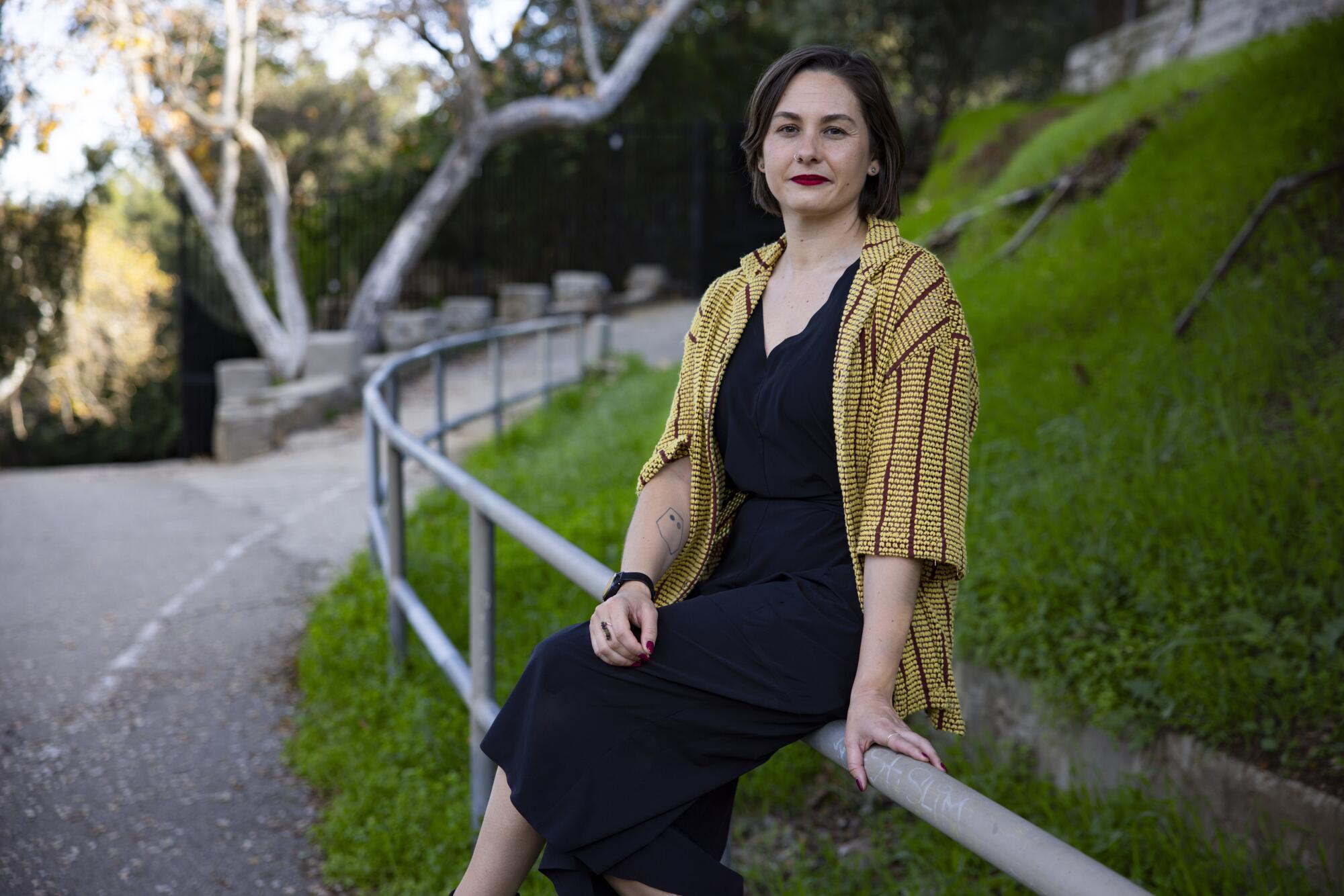
Koryn Wicks, creator of “You Must Be Here for the Reading,” an immersive tarot performance in which audiences are tasked with deciphering their own cards while a melancholic story unfolds around them.
(Kayla Bartkowski / Los Angeles Times)
“I really believe that one of the most beautiful things art does for us is remind us that we are not alone,” Wicks says.
Immersive art allows for a sense of participation, which Wicks hopes will increase one’s appreciation of dance.
“Dance is an embodied art form,” Wicks says. “There is science that shows that some of the enjoyment from watching dance comes from imagining yourself moving. In North America, a lot of people haven’t had an experience or education with dance, especially not concert dance. Then we ask them to sit in a dark auditorium in a small chair and not move to enjoy it. I found through my research, both practical and academic, there is something to inviting audiences to participate in dance that allows them to derive meaning from it.”
‘You Must Be Here for the Reading’
While there isn’t enough time in the show for everyone to have a one-on-one experience with the dancer, watching an audience and cast member attempt to get in sync with each other underlines the night’s themes of connecting. Ultimately, that’s the space where the show resides. “You Must Be Here for the Reading” uses tarot as a means to bring some structure to our often disconnected lives.
“It stands in contradiction to our current historical moment,” Wicks says of the show. “It’s very anti-AI. It’s asking people to sit with books and to find little seeds and not necessarily pursue solutions or puzzles. It’s asking us to connect, sometimes with strangers.”
I kept my question that I brought to the reading secret, but I found the show provided a hopeful answer. Not because the cards offered a solution. Instead, they provided a community.

Sunday Puzzle
NPR
hide caption
toggle caption
NPR

On-air challenge
Every answer is the six-letter name of a world capital, in which I’ve changed the first and last letters. You name the capitals.
Ex. VASSAL –> NASSAU (capital of the Bahamas)
1. CONDOR
2. ROSCOE
3. PUBLIC
4. SAVANT
5. ZANILY
6. DRAG UP
7. ETHENE
8. TARSAL
9. TUSCAN
10. NONACT
11. I AGREE
12. [7 letters:] CALLING
Last week’s challenge
Rearrange the letters of NECESSARY MISPRINT to spell a familiar phrase.
Answer: Sic semper tyrannis.
Winner:
Judy Alexander of South Burlington, Vermont.
This week’s challenge
This week’s challenge comes from listener Michael Pickard. Name something in 10 letters that’s found in a kitchen. Drop its sixth letter to name something on a keyboard. Then drop the new word’s fifth letter to name something no one wants to get. What words are these?
If you know the answer to the challenge, submit it here by Thursday, June 18 at 3 p.m. ET. Listeners whose answers are selected win a chance to play the on-air puzzle. Important: include a phone number where we can reach you.
-

 Maryland4 minutes ago
Maryland Lottery Pick 3, Pick 4 results for June 14, 2026
-

 Michigan7 minutes ago
NWS confirms two EF0 tornadoes touched down in West Michigan Thursday night
-

 Massachusetts12 minutes ago
Pursuit in Middleborough ends with people in custody, police say
-

 Minnesota19 minutes ago
Idaho, Minnesota universities stonewall public records requests for controversial course syllabi | The College Fix
-

 Mississippi22 minutes ago
Mississippi Lottery Cash 3, Cash 4 results for June 14, 2026
-
Missouri27 minutes ago
Missouri Lottery Pick 3, Pick 4 winning numbers for June 14, 2026
-
Montana34 minutes ago
Montana Lottery Big Sky Bonus, Millionaire for Life results for June 14, 2026
-

 Nevada37 minutes ago
Nevada Gaming Control Board asks state court to hold Kalshi in contempt – CDC Gaming

