Science
Antelope Valley residents say they are fed up with rampant dumping, official inaction


Eric Eller likes to ride his dirt bikes through the canyons, dry riverbeds and rocky outcroppings of the Antelope Valley in the high desert north of Los Angeles.
Eller’s an off-the-grid kind of guy with a “Mad Max” vibe — living in a house on a remote plot of land next to a jury-rigged trailer where he tinkers with the remnants and pieces of gutted automobiles, motorcycles and other mechanical debris.
But Eller’s isolation was obliterated last June when dozens of big dump trucks began snaking up the dirt road behind his house and discarding their loads into the nearby dry river canyon. The caravan of waste-haulers continued in the days that followed, often arriving after sundown or in the dark hours before dawn.
Two months later, the convoys abruptly stopped. But not before the makeshift dump’s surface had been camouflaged with dirt and mulch — much of which has since blown away, revealing a 30-foot-deep noxious stew of chopped-up concrete, plastic tampon applicators, faded plastic children’s toys, toothbrushes, syringes, empty caulking tubes, two-by-fours, faded books, weathered Styrofoam pipe insulation, plastic bucket tops and more.
EL MIRAGE, CA – APRIL 18: A truck leaves the Circle Green mulch dump site near El Mirage on Friday, April 18, 2025. (Myung J. Chun / Los Angeles Times)
Across the Antelope Valley, waste trucks are hauling garbage in from the Greater Los Angeles area and Central Valley towns such as Bakersfield, and then dumping it at makeshift sites. Letters, bills and envelopes visible at several of these waste sites in April showed addresses in Pacoima, Los Angeles and Van Nuys, among other cities.
“Illegal dumping has been a problem in the Antelope Valley for decades,” said Chuck Bostwick, a senior field deputy for Los Angeles County Supervisor Kathryn Barger, who represents much of the area. “But it’s gotten worse in the last two or three years, markedly worse.”
In some cases, such as the site behind Eller’s home, the waste sites are flat-out unauthorized. No landowner has given permission to dump at the site, and the waste consists of construction, household and medical debris.
But in others cases, the waste-haulers have the landowners’ permission to dump — but are disposing waste that should be going to landfills equipped to handle household and industrial waste, lawsuits claim.
In one lawsuit filed in U.S. District Court in Los Angeles, residents claim that major residential waste-hauling companies including Athens Services, California Waste Services and Universal Waste Systems are dumping hazardous substances without authorization.
The suit claims these companies are disguising the construction and demolition debris as “green waste by unlawfully covering this waste with highly flammable wood chips and other organic waste.”
Eric Casper, the president of California Waste Services, said in an email that his company has “never engaged in dumping waste of any kind, at any time, in the Antelope Valley — legal or illegal. Nor anywhere else.”

A sneaker among the trash dumped at Adobe Mountain near Lancaster, CA. Locals say this was a canyon before it was filled in to hold trash. Photographed on Friday, April 18, 2025.
Athens Services also denied any illegal dumping, saying in a statement that California’s organics recycling law “encourages sending compostable material to third parties such as farmers and other property owners for beneficial use. This is the material that Athens Services produces and distributes.”
Universal Waste Systems and other companies named in the suit didn’t respond to requests for comment, nor have they filed responses to the federal suit.
Residents say there are more than 100 dump sites scattered throughout the valley — from Lake Los Angeles to the Antelope Valley California Poppy Reserve and north to Mojave — that they contend are unauthorized.
Some of these sites cover hundreds of acres and extend dozens of feet deep. And residents worry that what they can see — from the roads or their homes — is just the tip of a malodorous and malignant iceberg, and that there are probably dozens more they haven’t yet identified.
They complain they are plagued by the toxic, sour and rotten-egg like smells emanating from the discarded trash that cooks in the hot sun and then wafts across their properties.
They also note that the flammable mulch and other materials in the dump, combined with a broiling desert sun, makes for an acute fire risk.
Between 2020 and 2024, the Los Angeles County Fire Department responded to 42 mulch or trash-related fires in the Antelope Valley, ranging from a quarter-acre to 22 acres, ultimately costing taxpayers roughly $1.6 million to extinguish, according to Los Angeles County documents.
Ashley Mroz, who lives in the Antelope Valley community of Neenach, said a mulch-covered dump site spontaneously combusted near her home last summer.
“It had been smoldering for days and days,” said Mroz, one of the plaintiffs in the federal court suit. “We could not even go outside. The smell was so horrific.”

Trash dumped at Adobe Mountain near Lancaster, CA. Locals say this was a canyon before it was filled in to hold trash. Photographed on Friday, April 18, 2025.
And the scourge has spread beyond the dump sites: Shredded plastic debris can be seen hanging from roadside Joshua trees and creosote bushes. While a midday view across the arid landscape reveals a sea of glimmering, reflective glass shards, like the tips of cresting waves over a vast, brown ocean.
According to Antelope Valley residents and the federal suit, property owners in some cases have given permission — and received payments for — waste to be dumped on their land. Not only do these sites pose a nuisance to the neighbors who live adjacent to or near them, in some cases the material being dumped includes industrial and household waste that can leach into the groundwater.
In its statement, Athens pointed out that property owners sometimes give permission to accept material from multiple waste companies.
“To the extent there are any instances of noncompliant material, we are confident the evidence will demonstrate that it came from another source,” Athens said.
Encounter in Adelanto
On a blustery day in April in the high desert town of Adelanto, local residents watched as two dump trucks offloaded their waste into a San Bernardino county-certified organic waste dump site that is surrounded by eight- to 10-foot high berms of mulch-like waste laced with shredded plastic, insulated wires and chopped-up, plastic children’s toys.
Through a break in the berm, the residents could see that the ground around the recently dumped haul glittered in the sunlight with broken glass, while stalks of what appeared to be insulated wires and rigid plastic stood sentry across the 138-acre expanse.
Two men sitting in a silver GMC pickup truck who were watching the disposal drove over to the gawking residents.
When the residents asked who they were and what the trucks were dumping, the men declined to answer and referred questions to the owner of the property, which The Times later determined to be Kevin Sutton, the owner of a company called Circle Green Inc. Sutton didn’t respond to requests for comment.
As neighbors and a Times reporter and photographer drove away from the site, the silver pickup followed for several miles, tailgating and swerving erratically. The truck turned around only when the small caravan came across a handful of heavily armed California Fish and Game law enforcement agents parked alongside the road.
“It’s the Wild West out here,” said Kristina Brown, a Lancaster property owner who is a party to the federal suit.
A convenient dumping ground
The Antelope Valley’s proximity to Los Angeles and its vast stretches of wild desert make it a prime target for unauthorized dumping.
Sitting at roughly 3,000 feet above sea level, and surrounded by the Tehachapi, Sierra Pelona and San Gabriel mountains, the valley is also divided by jurisdiction — with Los Angeles, Kern and San Bernardino counties all claiming some territory.
“For decades, our illegal dumping was small-time stuff,” said Bostwick, Supervisor Barger’s field deputy. “It was somebody who had a sofa they couldn’t be bothered to take to the dump or they didn’t want to pay, so they dumped it out in the desert. There was commercial dumping then, but it was small time as well.”
But then the state’s waste laws changed, he said.
Starting in 1989, California began requiring municipalities to divert 50% of their waste away from landfill and toward more sustainable waste management solutions, such as recycling and compost. And as Bostwick noted, the vast open spaces of the Antelope Valley beckoned.
In 2022, lawmakers implemented Senate Bill 1383, which initially mandated the diversion of 50% of all food and organic waste away from landfills, but increased to 75% on Jan. 1, 2025. Another 2020 law closed a loophole that had allowed waste companies to dump green waste in landfill, but not have it counted against them. As a result, the need for dumping grounds increased again.
Cities, counties and towns that fail to meet the diversion rates risk fines of up to $10,000 a day.
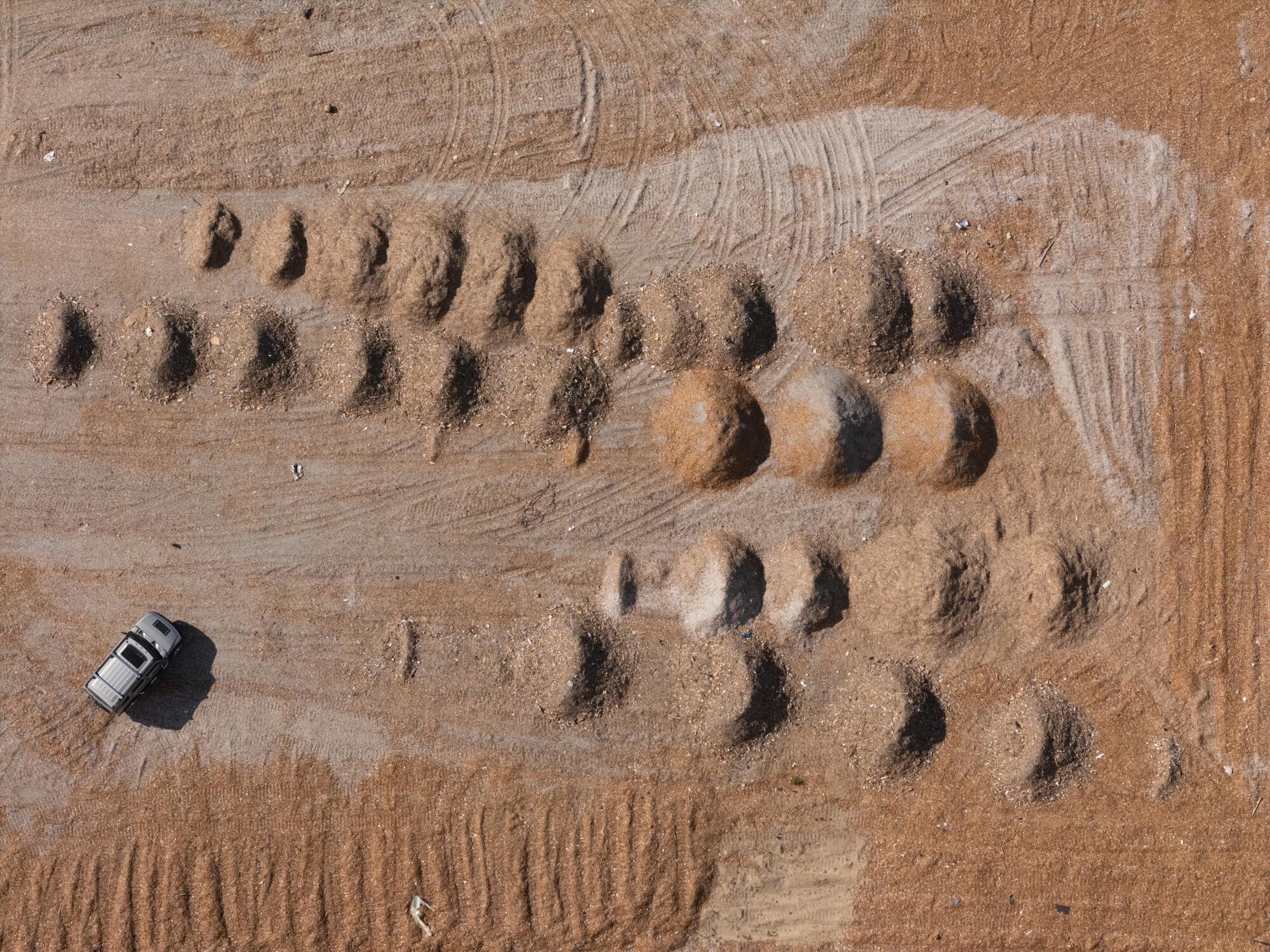
Mounds of dumped loads at this location south of E. Avenue M in Lake Los Angeles. The mounds contain mulch, trash and construction debris. The site was found by a resident who followed a truck onto the dirt roads. Photographed on Friday, April 18, 2025.
Residents, lawmakers and experts say while the spirit of these laws is noble, in many areas of the state, the infrastructure to handle the diverted waste is lacking — especially in Southern California, where there is not nearly enough farmland or water to handle the increased volumes of green waste leaving the region’s cities and suburbs.
As a result, waste companies and haulers — trying to keep costs down and maintain city contracts — are tempted to dump the waste wherever they can, while local governments are reluctant to crack down on violations, Bostwick said.
State regulations have made “disposal much more expensive and hard to deal with, and so that’s increased the financial incentives for companies or individuals to just dump illegally,” he said.
There’s also very little enforcement.
According to Los Angeles County data, while taxpayers spent roughly $1.3 million between 2017 and 2018 to mitigate illegal waste disposal in the region, that number jumped nearly fourfold in 2022-2023, when taxpayers had to foot $4.46 million to mitigate the problem.
At the same time, the number of cases filed with the Environmental Crimes Division of the district attorney’s office decreased from 15 in 2019 to three in 2023.
In February, CalRecycle, the state’s waste agency, finalized emergency orders they say should empower local law enforcement agencies to stop the illegal disposal. Previous regulations only allowed for action against the owner of land where the disposal was occurring. The new orders allow enforcement officials to target parties that are dumping the materials and the facilities that provided the material.
The orders came after officials from the state agency came to visit the area in October 2024 — prodded by Brown, Mroz and other local residents, many of whom have spent years calling state and local officials about the problem.
Enforcement of these orders, however, is the responsibility of the county, said Lance Klug, a spokesman for the state waste agency.
“Local enforcement agencies can best speak to their enforcement actions to date, and any anticipated next steps, now that emergency regulations are in effect,” he said.
The Los Angeles County Board of Supervisors adopted a measure last year requiring mulch suppliers to take back any contaminated or illegal waste dumped on private land. The measure, which was sponsored by Barger, also directed county agencies to require “stringent record keeping for all land application operations regarding the origin of all incoming loads and testing results from all mulch suppliers.”
County officials couldn’t immediately provide numbers recently when asked how many enforcement actions had been taken.
“There’s literally no enforcement,” said Brown, who worries that the situation is only going to get worse.
Last month, Eller was riding his dirt bike when he stumbled upon a 60-acre expanse of freshly dumped construction debris, medical waste and compost on a plot of land miles away from any major road.
The tire marks from dump trucks hadn’t yet been blown away by the incessant gales of the high desert. No fences or berms were erected to contain the site, making it impossible to see from the road or along the horizon.
He said it feels like they are living in a real-life game of whack-a-mole: As soon as he and his neighbors identify and report one site, the haulers move onto another.
And they say they feel abandoned by regulators, who they say are doing nothing to stop it.
“It feels like we’re screaming into the wind,” Brown said.


new video loaded: NASA Announces Artemis III Crew
transcript
transcript
NASA Announces Artemis III Crew
NASA announced the crew of Artemis III mission, which will fly to low-Earth orbit to test rendezvous and docking maneuvers with one or two lunar landers.
-
“I am excited to welcome you as the next crew in the Artemis journey to successfully return to the moon — this time to stay.” “I’m honored by the role that I’ve been given. I’m also very humbled by the task in front of us. But first and foremost, I’m grateful.” “So with that, the Artemis II crew, comrade, hands you the baton. You got the controls.” “As you know, we had a significant anomaly at our Launch Complex 36A on May 28. We’ve redoubled our efforts and are moving forward.”
By Alisa Shodiyev Kaff
June 9, 2026
Science
Santa Monica Mountains’ last steelhead trout survived the Palisades fire — and even had babies

Scientists feared the Santa Monica Mountains’ last remaining steelhead trout were dead, smothered by debris flows unleashed by the Palisades fire.
But the endangered fish surprised them: A team of biologists recently spotted 30 of the rare trout — and 21 babies — in Topanga Creek.
“There was a lot of happy dancing in the creek,” said Rosi Dagit, principal conservation biologist for the Resource Conservation District of the Santa Monica Mountains, which works with public and private landowners to conserve natural resources.
That’s because the steelhead here are endangered, at both the state and federal levels. Once, they swam in most streams of the Santa Monicas, but their numbers plummeted amid overfishing and coastal development. Increasingly frequent wildfire has further stressed their habitat. Topanga Creek, a biodiversity hot spot, is home to their last known population in the mountains that stretch from the Hollywood Hills to Point Mugu in Ventura County.
The trout that were spotted, including this one, are part of a distinct Southern California population that’s listed as endangered at the state and federal levels.
(RCDSMM Stream Team)
The California Department of Fish and Wildlife spearheaded a complex mission to rescue trout threatened by the Palisades fire that sparked in January 2025.
Time was of the essence. The fire hadn’t yet been fully contained. But rain was on the way, which would sweep massive amounts of sediment from the denuded hillsides into the water. Fish are often killed this way.
Crews stunned the fish with electricity, scooped them up in buckets, trucked them to a hatchery and ultimately moved them to Arroyo Hondo Creek in Santa Barbara County.
Within days, Topanga Creek was choked with mud. Some assumed the fish left behind were goners.
But in March, the conservation district’s team found four. The following month, when water conditions were clearer, they saw more.
“These fish continue to amaze me,” said Kyle Evans, environmental program manager for the state Department of Fish and Wildlife, who had seen the damage to the creek. “I had seen populations get wiped out in similar situations. So when I heard, I was thrilled.”
Evans surmises the fish that survived were in an area of the creek where less charred material and sediment were swept in.
“These fish likely hunkered down, were hiding under some rocks or places to try to get away from the main concentration of flow,” he said. “And luckily they weren’t buried.”
The ones that were spotted were fairly small, around 6 to 14 inches. Rainbow trout and steelhead trout are the same species, but with different lifestyles. If the fish remain in freshwater, they’ll be considered rainbows. However, they can migrate to the ocean and become steelhead, where they typically grow larger before returning to their natal waters to spawn.
Topanga Creek hasn’t fully recovered from the damage it sustained, but scientists say it’s looking better. Surveys last year were “so depressing,” Dagit said, with very few animals, and stretches that were essentially transformed into flat roads from all the sediment buildup. Some of the riparian canopy burned right down to the creek.
Then came 32 inches of rain over the last nine months, scouring out and moving sediment, creating deeper pools. Dagit said they recently found newt egg masses for the first time in years, as well as a few adult newts and many frogs. Plants that provide cover are starting to recover.
She provided photos comparing certain pools last year and this year, some dramatically transformed. In September 2025, the Shrine Pool could have been an overgrown hiking trail. This April, it was filled with shallow water.

The Shrine Pool in September 2025, left, and the same location in April 2026, right, with RCDSMM’s Isaac Yelchin donning a wetsuit.
(RCDSMM Stream Team)
Topanga Creek is home to another endangered fish, the small but hardy northern tidewater goby, often described as cute. Not long before the trout operation, Dagit led a rescue of hundreds of these fish too. Many were repatriated to the lagoon at the mouth of the creek in a moving ceremony last June.
There’s still the matter of what to do with the trout that were moved to Santa Barbara County last year. Evans would like to bring them home to the Santa Monicas at some point, but isn’t sure if it will happen. On one hand, they could bolster the small, genetically isolated surviving population. On the other, they might inadvertently bring in a disease or bacteria. There is some time to decide. Evans estimates the creek still needs to recover for two to three more years.
For now, the fish are functioning fine in their adopted creek. Experts worried the trauma wrought by the move would disrupt their spawning process, but they had babies that spring. This year, they spawned again.

The Pacifica Municipal Pier was shut down and taped off Thursday after city workers noticed cracks running through the landmark structure and concrete chunks falling into the ocean.
It’s just one of many coastal California structures that have recently crumbled under pressure from a rising and relentless ocean.
Officials from the small, beach city south of San Francisco said the pier was closed due to “cracking, separation, and displacement of the concrete walkway and structural elements.”
It will stay closed while structural engineers asses its safety.
Photos taken by city employees show a wide crack that runs from top to bottom and across the structure as well. Other photos show a large horizontal crack under the foundation of a small restaurant on the pier, the Chit Chat Cafe.
The cafe was also shut down.
This is not the first time the 53-year-old pier has shown signs of stress. In 2021, part of it was shut down after handrails along the edge collapsed. And in 2023, after a series of storms pummeled the Central California coast, damaging parts of the pier, the structure was partially closed for more than year.
Those same storms caused extensive damage in Aptos and Capitola, 70 miles south, where piers and waterfront infrastructure were swept away or damaged.
In 2024, a 150- to 180- foot section of the Santa Cruz wharf was ripped off by powerful waves.
At least 10 of the state’s dozens of coastal public piers were closed for part or all of 2024 due to structural damage sustained in winter storms since 2022. At least five others have longer-term upgrades planned to address structural issues.
“These things are costly to maintain,” said Zach Plopper, senior environmental director at Surfrider. “They are a part of our California coastal culture in many ways, but we’re going to need to reckon with, one, the state that they’re in, and two, the continuous and worsening threats they’re going to experience,”
He said most of the piers were constructed in the early 1900s, and they weren’t built to withstand decades of rough seas, storms and rising sea level.
“With this incoming El Niño, which is forecasted to be significant, and this marine heat wave we’re in the midst of, we’re kind of in uncharted waters as far as what this winter could bring in terms of storms and swells to the California coast, and we’re likely going to see a lot more damage,” he said. “Not just piers, but roads and other coastal infrastructure up and down the state.”
There was no storm in Pacifica earlier this week, so no single event could be blamed for the destruction.
However, a 2025 report from an outside engineering firm, GHD, found that several sections of the pier were in “poor” or “serious” condition, and they recommended closure before anticipated storms or events that could “subject the piles to high winds, swells and large waves.”
The firm found several areas of the pier where concrete was missing and rebar was exposed and corroding.
“The pier has continued to experience high winds and large waves in a harsh marine environment,” the engineers wrote in the report, noting that continuous exposure to seawater or marine spray was “detrimental” to the structure.
A 2023 city report estimated it would cost $19 million to repair.
That same year, a state law was enacted to require local governments along the California coast to plan for sea level rise in the coming decades.
Sea level has risen some 8 inches, on average, along the coast in the past 150 years, Plopper said, and researchers anticipate another foot in the next 25 years.
“We’re going to see profound shifts on our coastline, none that we have ever experienced before, and building static structures on the coast just doesn’t work all that well,” he said. “We’re going to have to make some really hard decisions.”
-

 Los Angeles, Ca12 minutes ago
Los Angeles High School locked down as police search for armed juvenile
-

 Detroit, MI30 minutes ago
‘Diarra From Detroit’ sets date for second season on Paramount+
-

 San Francisco, CA42 minutes ago
San Francisco police release video of shootout that critically wounded officer
-

 Dallas, TX45 minutes ago
3 Dallas educators among FIFA World Cup volunteers
-

 Miami, FL50 minutes ago
Miami Gardens man arrested after fleeing Florida Keys deputies at 125 mph, sheriff says
-

 Boston, MA57 minutes ago
Boston gives update on plans for 3 a.m. last call at bars, outdoor drinking areas during World Cup
-

 Denver, CO1 hour ago
One Invitation Can Change a Life: Called By Name Campaign Inspires Future Priests For a Second Year in Denver
-

 Seattle, WA1 hour ago
Survey: What’s the toughest game to start the Seahawks’ season?

