The Met Gala is always something of a performance art spectacle. The 2025 edition was no different. What was unique was that it sought to celebrate not just clothes or ideas, but an entire culture. The Met Gala stepped outside the typical focus on couture womenswear to highlight men’s tailoring and the Black dandy as a historical figure.
But what is a dandy, exactly? A dandy is, simply, someone with an all-encompassing devotion to fashion, style and tidiness. Society has called these people fussy, or in more recent times, metrosexual. But the crucial element of dandyism is its antagonism toward class, race and sexual boundaries. This is especially crucial for Black people, who have and continue to use the trappings of fashion to signal success, self-worth and pride. That pride is, at many times throughout history, a subversive act.
Advertisement
Actor and Met Gala co-chair Colman Domingo in Valentino.
(ANGELA WEISS/AFP via Getty Images)
Jeremy O. Harris in Balmain, tailored by Lionel Nichols.
(Michael Loccisano/GA/The Hollywood Reporter via Getty)
In the introduction to her book “Slaves to Fashion: Black Dandyism and the Styling of Black Diasporic Identity,” Monica L. Miller (who was a guest curator for the accompanying exhibition at the Costume Institute) says that “Black dandyism has always been practiced by those interested in much more than materialism and the latest style.” She goes on to say that dandyism is a “truly radical kind of freedom, accessible perhaps only through a constant, playful, yet studied change of clothes.” It is, as she says, both appropriation of the trappings of the upper class and a challenge to the order they’ve subjected the world to.
Advertisement
“Slaves to Fashion” is a dense book, filled with history and reference. It looks back at the novelty of slaves wearing finely tailored clothes, which it connects to the explosion of Blackness and queerness in the Harlem Renaissance. The thesis (and ultimate challenge) of the book is drawing a straight line between an enslaved Black child in elaborate clothes far beyond his station in life to a modern hip-hop celebrity like Andre 3000. To Miller, both the slave and the star are examples of Black identity and masculinity transcending the boundaries and barriers set up around them by society. Blackness itself becomes a performance, a concept invented by those who sought to turn Africans into an other. And a performance almost always requires the appropriate uniform.
Rihanna in Marc Jacobs.
(Evan Agostini/Evan Agostini/Invision/AP)
Tessa Thompson wearing Prabal Gurung.
(Dimitrios Kambouris/Getty Images for The Met Museum)
Advertisement
While the theme of this Gala might have leaned more toward men, that didn’t prevent women from finding a way to creatively connect to it, as the dandy’s role is to perform an exaggerated form of masculinity — twisted, contorted and pumped. Zendaya’s creamy white Louis Vuitton suit popped for its elegant, understated tailoring. Doechii, also rocking Vuitton, went for a more outre LV-monogrammed suit and trouser shorts with a maroon bow tie. Wide shoulder pads on Alton Mason, Doja Cat, Lupita N’yongo and Teyana Taylor recalled the broad, hyper-male suits one might see on a Sunday trip to church.
Alton Mason in custom Boss ensemble.
(Jamie McCarthy/Getty Images)
Doja Cat wearing Marc Jacobs.
(Dia Dipasupil/Getty Images)
Advertisement
Lupita Nyong’o wearing Chanel.
(Evan Agostini/Evan Agostini/Invision/AP)
Zendaya in Louis Vuitton.
(Evan Agostini/Evan Agostini/Invision/AP)
And then there were the hats. Whoopi Goldberg’s Thom Browne outfit was punctuated by a hat that wouldn’t have been out of place on a Victorian-era dandy intellectual. Singer and actor Janelle Monáe’s Thom Browne fit included a contrasting color suit, hat, monocle and cape adorned with the outline of a totally different suit splashed across it. Multiple suits, to be exact — a pinstripe and a plain navy blazer with white piping. It was a Russian nesting doll of menswear, with allusions to every tool in Browne’s prodigious toolbox of suiting. This is masculinity as posturing, as provocation and as protection. Presenting masculine symbols while tweaking them or reappropriating them is a potent subversion of the norm.
Advertisement
(Gilbert Flores/Variety via Getty Images)
Whoopi Goldberg in Thom Browne
(Dia Dipasupil/Getty Images)
Janelle Monáe wears Thom Browne.
(Evan Agostini/Evan Agostini/Invision/AP)
Advertisement
Tracee Ellis Ross wears Marc Jacobs.
(Evan Agostini/Evan Agostini/Invision/AP)
The Met Gala — a lavish, invite-only party that gathers the most famous people in the world for one night to raise money for the arts — is far from subversive. Instead, it’s a worldwide announcement about who matters most, who is affecting society most deeply, and who has the money to attend. It is inherently about the establishment. The men wearing the luxurious suits Monday were not breaking class barriers. The clothes on display were not accessible to the masses. In many cases, the outfits were bespoke, custom and never to be replicated.
But it would be too easy to dismiss the Met as some sort of “Hunger Games”-like spectacle of wealth. The idea of Black dandyism goes beyond extreme displays of status. It means that you care — about how you look, but also about yourself. In an interview with GQ about the Met, legendary designer Dapper Dan described how he became a dandy. “I’m from the poorest neighborhood in Harlem, right by the banks of the Harlem River. Everybody in my little enclave was all poor. We had rats and roaches. Goodwill was our Macy’s. Whenever I was lucky and fortunate enough to have something to wear, I went to 125th Street. Nobody went there who wasn’t dressed. At 125th Street, nobody knew I had rats, nobody knew I had roaches, and that for me was the birth of dandyism because I saw the power of transformation that could take place with your clothes.”
Brian Tyree Henry
(Dia Dipasupil/Getty Images)
Advertisement
Angela Bassett
(Dia Dipasupil/Getty Images)
Alicia Keys, left, and Swizz Beatz, both wearing Moncler.
(Kevin Mazur/MG25/Kevin Mazur/Getty Images for The)
Advertisement
Colman Domingo wearing Valentino.
(Theo Wargo/FilmMagic)
This year’s Met Gala theme allowed the spectator to think not just of the clothes, but what those clothes mean to them and to the wearer. To dress up is to project power, possibility and preeminence. A Black person dressing up for church can reclaim their place in the cultural hierarchy as much as a hip-hop star uses clothes to signal their wealth. The table sponsored by Jerry Lorenzo’s Fear of God label spotlighted Black celebrities as disparate as filmmaker Ryan Coogler and artists Amy Sherald and Lauren Halsey. Their outfits, many of them custom by the house, were as challenging and avant-garde as anything the fashion establishment has to offer. Coogler and actor Adrien Brody both wore broad-shouldered suits paired with T-shirts and more formalist cummerbunds — a house style of Fear of God. As always, Lorenzo is more than happy to muss up the expected, to push the boundaries while still respecting the core traditions of the art form.
Artist Lauren Halsey wearing Fear of God.
(Evan Agostini/Evan Agostini/Invision/AP)
Advertisement
What defines dandyism is a willingness to play by a set of rules, whatever those might be for the time and temperature of the world around it. While the celebrities in these clothes aren’t explicitly transgressive figures, their presence in this world of high status is in a sense a form of transgression. Their mere existence in a place like the Met Gala signals that there is a sliver of an opening to greatness, no matter how small it might look in the moment. There will always be that spirit of Dapper Dan at Goodwill to hold on to, and that style is not about how much the clothes cost, but what it says about the person wearing them.
Lauryn Hill wears Jude Dontoh.
(Evan Agostini/Evan Agostini/Invision/AP)
Khaby Lame wearing Boss.
(Evan Agostini/Evan Agostini/Invision/AP)
Advertisement
Myha’la Herrold, left, and Raul Lopez of LUAR.
(Savion Washington/Getty Images)
Bad Bunny wears Prada.
(Michael Loccisano/GA/The Hollywood Reporter via Getty)
Laura Harrier wearing Ecru Gap, left, and Zac Posen.
(Michael Loccisano/GA/The Hollywood Reporter via Getty)
A family and friends gather for a naming-day ceremony at a Danish seaside hotel, but an unexpected appearance by one uninvited attendee (Trine Dyrholm) ruptures the veil of bland, happy-clappy familial unity in director Mads Mengel’s gutsy, well-wrought debut feature, The Guest.
The most audacious move here may be Mengel and co-screenwriter Christian Bengtson’s choice to write something that will inevitably invite comparisons with Festen (The Celebration), arguably the most notorious Danish-language film of the last 30 years, which similarly revolved around a bougie gathering disrupted by angry revelations. But there’s a savvy 2026 vibe about the way the film refuses to create florid melodrama out of quotidian crisis, and instead observes with generosity as the characters grope awkwardly toward emotional détente and mutual forgiveness.
The Guest
The Bottom Line
When wetting the baby’s head goes too far.
Advertisement
Venue: Karlovy Vary Film Festival Cast: Simon Bennebjerg, Trine Dyrholm, Josephine Park, Peter Gantzler, Petrine Agger, Mette Klakstein Wiberg, Kristine Kujath Thorp, Buster Lund Luscher Director: Mads Mengel Screenwriter: Christian Bengtson, Mads Mengel
1 hour 40 minutes
Festen-alumnus Dyrholm, having a bit of a career moment with outstanding performances both here and in the recent The Girl With the Needle among others, leads a uniformly excellent cast in a work that deserves celebration on the festival circuit and beyond.
Dyrholm’s Vibeke is technically the first person we meet, although she’s seen only in shadow at first as she smokes and drives while her unattached seatbelt, caught outside by a closed door, clatters on the road. This is the kind of unsafe driving her son Karl (Simon Bennebjerg) so deplores, a point of contention later on in the story when he will steal her car keys in interest of her own safety and that of others.
Advertisement
But well before we get to that flashpoint, the film introduces Karl, effectively the film’s protagonist, as he arrives at the swanky resort with his wife Emilie (Mette Klakstein Wiberg) and their infant son Elliot (Buster Lund Luscher). The young family, who’ve chosen this new, secular tradition instead of a christening to welcome their child to the world, are there a day before the ceremony to meet up with core family members.
As this advance party settles down for dinner, a table that includes Karl’s sister Rikke (Josephine Park) and Emilie’s parents Frank (Peter Gantzler) and Kirsten (Petrine Agger), there’s a surprise: Vibeke is coming, courtesy of Rikke’s invitation. Karl is quietly furious and seems determined to turn her away, even when she shows up minutes later. Poor Frank and Kirsten look on confused, determinedly polite in their insistence that all family members should be welcome.
Bengtson and Mengel’s economical script carefully dripfeeds backstory as the film unfolds to explain that Karl hasn’t spoken to his mother in years, that Rikke has taken over all the daily mom management and that she’s very worn out by it. Even so, she insists Vibeke is regularly taking her medication and isn’t a problem these days, although to Karl every weird anecdote and moment of emotional intensity is an augur of impending chaos. Rikke counters that their mother is just “big, that’s her personality not her condition.”
Interestingly, that specific condition is never named throughout, although armchair diagnosticians might spot many of the signs of bipolar disorder. But the film’s emotional focus on the person and her actions rather than the label is also very contemporary, reflecting a more holistic, inclusive mindset and approach to dealing with mental health issues.
Which is all fine and dandy, until Vibeke duly does skip a dosage and starts getting manic. One of the first signs of chemical imbalance arrives during the ceremony on the beach, when Vibeke carries little Elliot much further away from the shore than anyone wants, creating a panic. From there it just gets worse as Vibeke picks up on the censorious feeling emerging from the other party guests, who had found her so charming the night before when she’d led everyone to the casino to play roulette and diverted a bunch of partying teenagers from the room next to Karl and Emilie so they could get some sleep. When the toasts at the formal dinner begin, Vibeke’s mood darkens much further, and if we’ve all learned one thing from Festen, it’s be very afraid when a Dane gets up to make a toast.
Advertisement
Cinematographer David Bauer’s nimble-footed lensing and use of natural light does indeed hark back considerably to the look of those Dogme 95 movies back in the day, as does the naturalistic editing style deployed by Louis Emil Ramm Seeberg. But there are plenty of sins against the rules of cinematic chastity that marked that movement, such as the ample space made for Lasse Aagaard’s affecting, low-key score that amps up the anxiety as Vibeke starts to spiral.
That said, Mengel keeps things simple in sonic terms when it really counts, letting the musicality of Dyrholm’s deep, sonorous voice ring out on its own in the big monologue scenes. She is, as ever, utterly mesmerizing but the performance is made even more powerful by the muted, expressive reactions of the rest of the cast as they look on, frozen like deer in the headlights of the car crash of pseudo-christening. Moments of levity puncture the gloom, but the final feeling is one of numbed sorrow and pity for all these kind, fallible people, just trying to do their best.
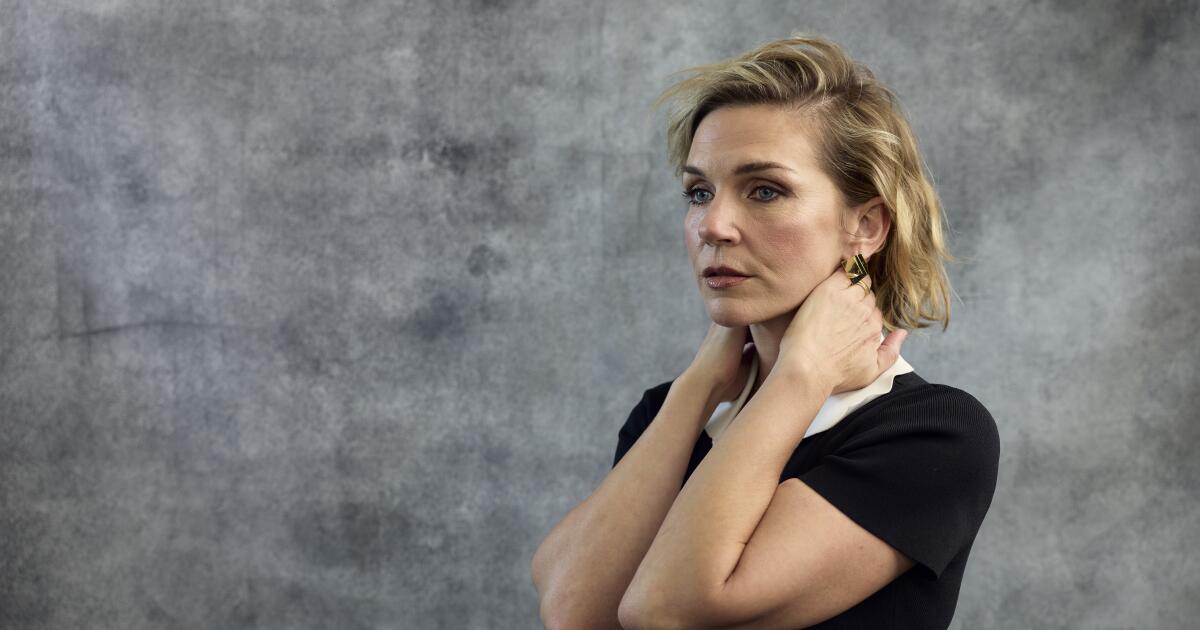
Rhea Seehorn was nervous about whether “Pluribus” would be recognized by Emmy voters Wednesday when nominations were announced. So she was jubilant when she and the surreal sci-series on Apple TV scored 18 nominations, the most for a first-year drama.
“I’m just so grateful,” the actor said in a phone interview. “People were like, ‘Why were you nervous?’ Honestly, you never actually know. I’m just so thrilled for the show, my co-stars, the production design, the editing, the writing, the music, the sound. I haven’t moved from my couch since they first announced everything because I’m still trying to call everybody on the show.”
Seehorn received a nomination for lead actress in a drama series for her portrayal of cynical Carol Sturka, a fantasy romance author who finds herself in a mystifying situation after a virus seems to have wiped out most of Earth’s population. The series was created by Vince Gilligan, who created the acclaimed series “Breaking Bad” and co-created its spinoff “Better Call Saul,” which also featured Seehorn.
The actor compared her experience of being nominated for “Pluribus” to “Better Call Saul,” which earned her two supporting actress nominations: “ ‘Better Call Saul’ was such a family that supported and cheered each other on, and I’m so grateful I have that environment again. People could not be happier for each other, and we get to celebrate the show together.”
She added, “The only part that feels different is that it’s my first nomination as a lead. It’s the process of Vince writing this for me and seeing the mountain which he wanted me to climb and going through that process. The whole thing has been its own journey, so ending up with awards and nominations, and being so well received by critics and fans is not lost on me.”
Advertisement
The series has been applauded for its mix of drama, comedy and strangeness in its portrait of a woman coming to terms to what seems like an impossible dilemma.
“I love the storytelling, how much Vince and I would drill down on making this as authentic as we could in terms of an everyman who has to deal with an insane situation,” Seehorn said. “Most of us are just not heroic or leaping off the couch to go save the world. And Carol is dealing with immense grief and confusion in an utter dystopian crisis. I love the humor and the drama that comes out of us being as realistic as we can with her amidst an unrealistic event.”
Fans of “Pluribus” have been relentlessly curious since the finale in December about when the second season will launch.
“I don’t know anything about that,” Seehorn said. “I don’t have to keep secrets because I’m not great at keeping them, and I know nothing. I don’t know what I’m doing with an atom bomb in the driveway. I can’t wait to find out. The writers want to have the same quality and reward the intelligence of the fans and never phone a single thing in. So their process is their process.”
In a roundabout way, the fact that I don’t have a strong attachment to The Wizard of Oz as a film (my late mother loved it, so that memory is deeply rooted in me, but the movie itself never did much for me) contributed directly to how amusing I found Gail Daughtry and the Celebrity Sex Pass to be. This comedy spoofs the plot of the classic fantasy movie, though the jokes are largely about Hollywood. The humor is big and broad, with some of the jokes really landing. Others? Not so much. Still, more than enough do to warrant a recommendation.
Gail Daughtry and the Celebrity Sex Pass gets a lot of mileage out of sending up show business, even if the observations, while funny, are not particularly new. Besides the deluge of jokes, there’s also a lot of likably broad characters to spend time with, especially our lead. They make the 90 minutes and change spent together with them go down very easy.
Sony Pictures Classics
For Gail Daughtry (Zoey Deutch), her life as a small town hairdresser is perfect. Engaged to her high school sweetheart Tom (Michael Cassidy), she’s the picture of happiness, at least until a trip to a celebrity book signing. There, Tom meets and ends up sleeping with his “celebrity pass,” a term Gail wasn’t even really previously aware of. Feeling betrayed, Gail impulsively joins her co-worker and friend Otto (Miles Gutierrez-Riley) on a trip to Los Angeles. There, a psychic convinces her that the can save her marriage by sleeping with her own celebrity pass: Jon Hamm (Jon Hamm).
Journeying through Tinseltown in a manner that recalls Dorothy’s adventure in Oz, Gail and Otto won’t have to find Hamm alone. Joining forces with talent agency assistant Caleb (Ben Wang), down on his luck paparazzo Vincent (Ken Marino), and actor John Slattery (John Slattery). As they search for Hamm, some for their own purposes, they meet other celebrities, while also being hunted by a group of Italian assassins after a case of mistaken identity. Eventually, they come across Hamm, and the moment of truth is at hand.
Sony Pictures Classics
Zoey Deutch dives headfirst into a broad comedy like this, absolutely relishing the opportunity to get silly again. She’s able to make Gail a babe in the woods but also someone you laugh with, not at. It’s a wildly enjoyable turn. Deutch started out in comedies and was always a talented comedic actress, so it’s a pleasure to watch her back at it. Miles Gutierrez-Riley and Ben Wang get some very funny moments, while Ken Marino is a reliable comic presence. Jon Hamm and John Slattery are delighted to be sending up themselves, with amusing results. Supporting players here, in addition to Michael Cassidy, also include Kerri Kenney, Richard Kind, Thomas Lennon, Joe Lo Truglio, Fred Melamed, and more, plus some cameos.
Advertisement
Filmmaker David Wain, again co-writing with Ken Marino, continues to make it look easy. Few can make a silly comedy like Marino and Wain, especially as they pack their flicks with extra bits that only subsequent viewings reveal. Is Gail Daughtry and the Celebrity Sex Pass on the same level as Wet Hot American Summer or They Came Together? No, not quite. At the same time, is this, scattershot approach and all, funnier than most other 2026 releases? You bet. Marino and Wain have a hit rate that allows some of the jokes to miss, as you only have seconds to wait before the next one, which probably will hit.
Gail Daughtry and the Celebrity Sex Pass is very amusing, and occasionally hilarious, even if not as many jokes land as you might expect. Zoey Deutch is great in the lead role, David Wain is in his comfort zone, and the laughs come hot and heavy. If you’re a Wain fan, this new movie should be a must see.




 Sony Pictures Classics
 Sony Pictures Classics


