West
Colorado's 'totalitarian' transgenderism bill sparks concerns from parents

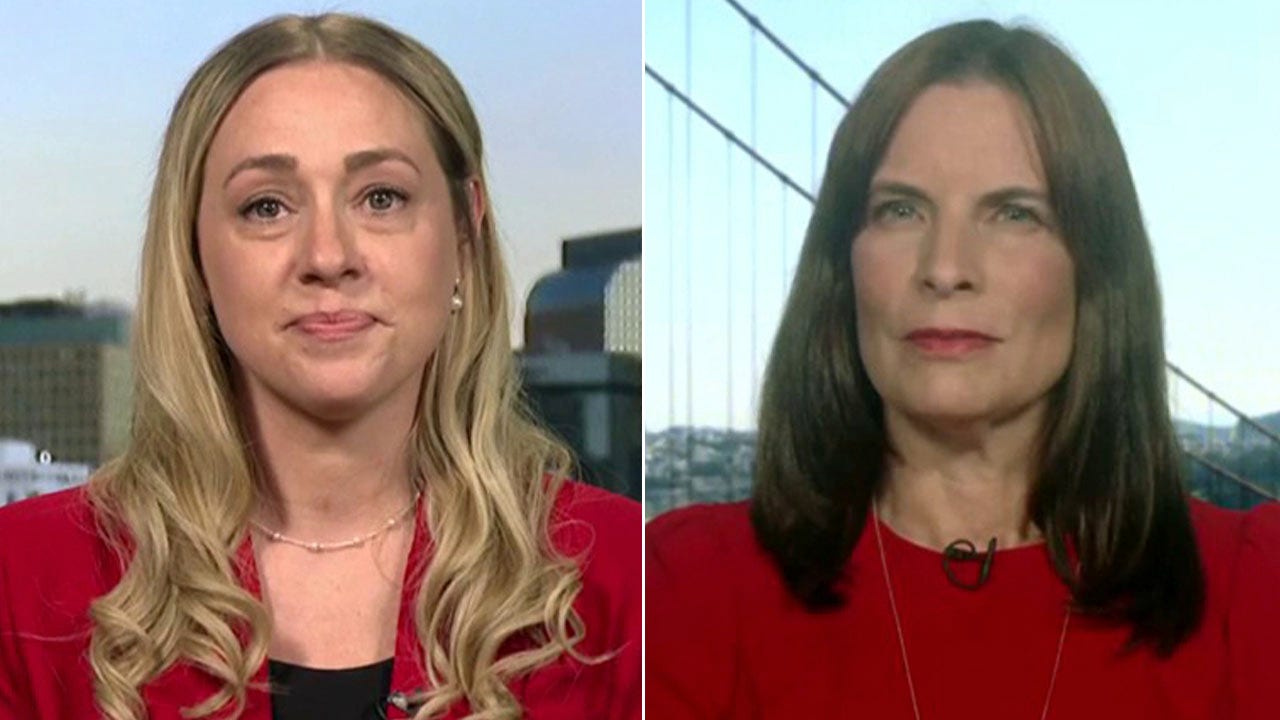
Parental rights advocates are cautioning against a “totalitarian” transgenderism bill rammed through the Colorado state House that they say could jeopardize parents’ chances in custody battles if they “misgender” or “deadname” their children.
“This is giving the authority to our state to take our children away if we don’t agree with these gender transitions, so it’s got huge ramifications for all parents, especially those in custody situations who are fighting with their ex-spouses to stop their children from being medicalized,” Erin Lee, a mom from the Centennial State, told “The Faulkner Focus” on Monday.
She added, “It opens the door for all parents to potentially have their children forcibly removed by the state if they’re not willing to affirm their child’s mental health distress.”
CONCERNED PARENTS OF TRANS KIDS COMPARED TO ‘HATE GROUPS’ BY COLORADO DEM: WOULDN’T ‘ASK THE KKK’ FOR OPINION
Erin Lee (left) and Erin Friday (right) are warning against a Colorado bill involving transgenderism and parenting. (The Faulkner Focus)
HB25-1312, which imposes state-mandated gender policies on schools and considers it “coercive control” in child custody cases when a parent does not affirm a child’s gender identity, was among a slate of Democratic-led bills pushed through earlier this month.
More specifically, the bill states that, “when making child custody decisions and determining the best interests of a child for purposes of parenting time, a court shall consider deadnaming, misgendering or threatening to publish material related to an individual’s gender-affirming health-care services as types of coercive control.”
The Colorado bill, which would create the Kelly Loving Act, named after a transgender man who was killed in the 2022 Colorado nightclub shooting by a nonbinary gunman, also prohibits Colorado courts from enforcing laws from other states that remove children from parents who allow transgender treatments for minors.
For moms like Lee and California parental rights activist Erin Friday, the issue is personal. Both Lee’s and Friday’s daughters once identified as boys, but neither mom affirmed that belief and their daughters eventually stopped identifying as transgender.
COLORADO DEMS RAM ABORTION, TRANSGENDER BILLS THROUGH ON LIMITED SUNDAY SESSION DEBATE: ‘UNPRECEDENTED’
Flags fly at half-staff over the Colorado State Capitol on March 28, 2021 in Denver, Colorado. (Michael Ciaglo)
“This bill will not only determine that parents like Erin and I are abusers — both of us had Child Protective Services come to our home when we refused to call our daughter males — but this bill also affects the press and its freedom of the press, and it will require them to use the chosen name of a child, how they choose it, and any adult,” Friday warned, adding that, if implemented, the measure poses a “massive First Amendment violation.”
Friday, a lifelong Democrat, insisted the issue should be “bipartisan,” adding that parents need to fight back in the courts, in the public domain and through “standing up” at legislative hearings.
Both moms fundamentally oppose the idea that children can be born in the wrong body. The bill now heads to the state Senate.
At a contentious hearing last month on the bill, a Colorado Democrat likened concerned parents to hate groups like “the KKK.”
Fox News’ Jamie Joseph contributed to this report.
Read the full article from Here

Washington
Touring Trump’s Washington: How the president is putting his imprint on the nation’s capital

The United States is celebrating its 250th year. And what better way to mark that anniversary than with an American summer staple — a trip to the nation’s capital.
But visitors to Washington will find that the city is undergoing tremendous change, courtesy of President Donald Trump’s takeover makeover.
Since returning to office 17 months ago, Trump has demonstrated a continuing fixation with the District of Columbia. The Republican president has slapped his image and name on buildings, torn down storied structures, altered others, started massive construction projects and deployed armed military personnel.
The traditional tourist sights remain. But with slight detours, an open mind and a critical eye, the ambitious walker can see all the ways the president has pushed to remake the capital.
On the eve of the United States’ birthday, take a trip with The Associated Press across a changing Washington.
A new study found that the National Guard in D.C. has had no effect on violent crime. News4’s Jackie Bensen unpacks it.
First stop: An indefinite National Guard deployment
We start our tour at Union Station and Metro Center, the city’s main transit hubs. Notice the Greco-Roman architecture of the former, the Brutalist design of the latter. Now see the ongoing, indefinite deployment of armed National Guard troops there and in many other parts of the city.
National Guard members from the district and several states have been in the city since August 2025, deployed under an emergency order issued by Trump in what he called a bid to fight crime. Trump has portrayed the deployment as a lifeline for the city. They will be here for most, if not all, of 2026 and are expected to number 5,000 this summer.
FILE – Members of the National Guard walking in the lobby of Union Station in Washington, May 27, 2026. (AP Photo/Matt Rourke, file)
It’s not the first time the military has deployed to the capital. Troops were in Washington throughout the Civil War, to quell riots after Martin Luther King Jr.’s 1968 assassination and, famously, hours into the Jan. 6, 2021, Capitol riot.
But in Trump’s Washington, Guardsmen at street corners and metro stations have become an increasingly normal part of the city’s scenery.
And no one knows when they will leave.
Second stop: Scars left by DOGE
Exit Union Station, take in the view of the Capitol and turn right down Pennsylvania Avenue. There sits a building now synonymous with the Department of Government Efficiency, the Trump administration’s effort to shrink the federal government.
The U.S. Agency for International Development was the first major federal agency targeted by then-DOGE leader Elon Musk in the remake of the federal government, when cost-cutting measures prompted the terminations of tens of thousands of workers. USAID spent billions on humanitarian aid worldwide and was credited with saving millions of lives over time.
By eliminating 90% of foreign aid contracts, the Trump administration effectively cut some $60 billion in funding.
After workers cleared their desks in February 2025, the USAID offices on Pennsylvania Avenue were repurposed for other government uses.
The shuttering of the agency also contributed to a massive increase in unemployment in the region where about one-fifth of the workforce lives.
Many workers still ask: When their lives were upended, what was saved?
FILE – A banner featuring an image of President Donald Trump hangs on the Department of Justice in Washington, Wednesday, May 27, 2026. (AP Photo/Matt Rourke)

Third stop: Trump’s image staring down
Walking south along any of the numbered streets leads to Constitution Avenue and the National Mall. Banners bearing Trump’s image have adorned the facades of several government buildings over the past 17 months — an uncommon practice for a sitting American president and a highly literal sign of his imprint upon the city.
At the Department of the Interior, his image has equal billing with George Washington on similar banners proclaiming “America’s First” and “America First.”
A mile away, Trump’s face glowers from the storied Department of Justice building, a physical display of Trump’s efforts to exert power over the law enforcement agency that once investigated him. It’s also a striking symbol of the erosion of the department’s tradition of independence from White House control, as the president pushes to prosecute his political adversaries.
Next up: The Reflecting Pool painted ‘American flag blue’
Westward toward the Lincoln Memorial sits the recently repainted Reflecting Pool.
The site has always been a must-see on any tourist’s checklist. But the Reflecting Pool, the scene of historic marches and protests, today also symbolizes Trump’s drive to change Washington.
Trump called the area “filthy” and had workers paint it in a color he has called “American flag blue.” A Washington-based nonprofit that tried to block the move said it undermined the somber tone of the area, which sits near the memorials to Lincoln and to the Vietnam and Korean wars.
Since the makeover, the pool has been fraught with problems, from runaway algae growth to dead ducks and a torn lining. Authorities say vandals have been responsible for some of the problems and arrests have been made. The National Park Service said the liner was intentionally cut with a sharp razor or knife.
Getty Images Getty Images Chipped paint and algae in the Lincoln Memorial Reflecting Pool after it was painted blue in Washington, DC, US, on Monday, June 22, 2026. Photographer: Aaron Schwartz/Bloomberg via Getty Images

A walk over the Memorial Bridge across the Potomac River leads directly to the proposed future site of Trump’s 20-story, gold-adorned triumphal arch. Although embroiled in a court battle, like a number of his projects, the arch has been approved by a key federal agency and survey work has begun at the site.
In a city meticulously planned and rich with the symbolism that defines the nation, new construction can unsettle the carefully crafted balance.
The arch, when built, will break up the intentionally designed symbolic sightline between Arlington House, once the home of Confederate Gen. Robert E. Lee, and the Lincoln Memorial, which symbolized the reunification of a divided nation following the Civil War.
Just ahead: The Trump-Kennedy Center
Visible from the site is the John F. Kennedy Memorial Center for the Performing Arts — known for much of this year as the Donald J. Trump and John F. Kennedy Memorial Center.
Congress named the performing arts venue as a living memorial to Kennedy in 1964, the year after he was assassinated. A law explicitly prohibits its board of trustees from making the center into a memorial to anyone else, and from putting another person’s name on the building’s exterior.
A court decision eventually stripped the center of Trump’s name, but a tarp remains there, obscuring the change.
Getty Images Getty Images A tarp covers the facade of the John F. Kennedy Memorial Center for the Performing Arts in Washington, DC, on June 14, 2026. (Photo by Alex WROBLEWSKI / AFP via Getty Images)

Trump also added his name to the U.S. Institute of Peace, part of a broader series of tributes that has been largely unprecedented for a sitting, living president.
In the middle of it all: A significantly changed White House
No tour would be complete without 1600 Pennsylvania Ave. — the White House. There, gazers can look at the construction site formerly known as the East Wing. It’s now the president’s ballroom-in-waiting as the courts and Congress battle over whether to build it.
The White House has said the $400 million cost would be paid by private donors, but public money — around $1 billion for the entire White House complex, including the ballroom — would be used for security measures. The proposed building has also expanded to a size larger than the rest of the White House. Trump argues the ballroom is necessary for security reasons, and amplified that assertion after the attack on the White House Correspondents’ Association dinner in April.

Guests attend a Rose Garden Club dinner hosted by US President Donald Trump (off frame) for American farmers at the White House in Washington, DC, on June 25, 2026. (Photo by Mandel NGAN / AFP via Getty Images)
Not viewable on the tour: the area formerly known as the Rose Garden. Planted by then-first lady Jackie Kennedy, it has been paved over into a patio.
Last stop: Black Lives Matter Plaza no more
Directly north, across Pennsylvania Avenue, is the area of town formerly known as Black Lives Matter Plaza. During Trump’s first term, a more defiant Democratic Mayor Muriel Bowser ordered the painting and naming of the area as a remembrance of the death of George Floyd at the hands of the Minneapolis police.
This combination of images shows Black Lives Matter plaza on 16th Street, NW, near the White House on March 10, 2025, top, as work was beginning to remove signage and markings, and on April 1, 2025, after the work was completed. (AP Photo)

BLM Plaza became a magnet point for years of political activism. Hundreds of protests started, ended or rallied there.
The plaza came down in March 2025 at Bowser’s direction, spurred by threats from Congress to hold the city’s funding. The decision served as an acknowledgment of a major shift in tone under Trump.
That’s the tour, folks. Please enjoy your stay.
Wyoming
Politicians mull action as details of alleged abuse, falsified records at Wyoming Boys’ School become public

by Maya Shimizu Harris, WyoFile
The photo of an Iraqi inmate strapped by U.S. military police to a restraint chair in the Abu Ghraib prison sparked “a collective cry of ‘torture,’” Sue Burrell, an attorney and author of a 2009 paper on restraints used at U.S. youth detention centers, recalled of a 2005 Newsweek magazine cover.
For Burrell, however, it stirred a more personal response. “All I could think of was that the restraint chair in the photo was almost exactly like the one we had recently seen in a juvenile detention facility in the United States,” she stated in the paper’s preface, which showed the Newsweek photo next to another of a restraint chair at a U.S. youth detention center.
A June court filing in an ongoing lawsuit alleging abuse at the Wyoming Boys’ School, a state facility for delinquent juveniles, almost mirrors the 2009 paper’s preface, showing two side-by-side images, one of a boy in a restraint chair with a white bag over his head and another of him huddled alone in the corner of a cinderblock room. Above the images is a quote attributed to one of the defendants: “[The] best part of the chair is watching the kids cry and scream like a fucking child . . . that’s what makes it worth it.”
“I had never thought I would see a photo of a child with a bag over their head, like they’re being water boarded,” said Rep. Karlee Provenza, a Laramie Democrat who has advocated for juvenile justice reform in Wyoming.
It’s unlikely the images — which sparked outrage on social media — would have come to light if it weren’t for the lawsuit. For years, lawmakers and advocates have grappled with the lack of transparency around the Wyoming Boys’ School specifically and the state’s juvenile justice system more broadly.
Citing confidentiality laws, the Wyoming Department of Family Services, which oversees the boys’ school, has declined to release information about abuse allegations at the facility. DFS treats allegations of abuse or mistreatment at the detention center as Child Protective Service cases. Child Protective Services and the boys’ school are both under the auspices of DFS, meaning the agency investigates itself without oversight or transparency.
“We can’t trust the government to investigate itself,” Provenza said. “We’ve seen how that falls short, so it might be that it needs to be a broader conversation and not just targeted at DFS.”
A legislative catch-22
Lawmakers — those responsible for crafting laws that regulate the state’s juvenile justice system — also struggle to access data that could help them see more broadly how Wyoming’s juvenile justice system works. That’s because Wyoming doesn’t have a statewide system. Instead, each county takes a different approach, making it difficult to collect uniform data showing how kids move through the system and what outcomes they experience.
For years, legislators have sought new laws to standardize data collection on Wyoming’s juvenile justice system and allow DFS to share it. They hoped the data would show how children move through the system and what their outcomes are, which could help lawmakers pinpoint what’s working and what needs to improve.
But fears of government overreach have stymied efforts to pass legislation that would increase transparency. Some lawmakers who opposed these measures have suggested studying the juvenile justice system more before passing any laws.

“My recommendation would be that the Legislature take some time to really put together a good dive into the juvenile justice system and all of its programs together to be able to make one clear, concise bill that fixes a plethora of problems,” Casper Republican Rep. Jayme Lien told her colleagues before voting against a measure to change Wyoming’s confidentiality statutes.
That idea puts the Legislature in a catch-22: to study the state’s juvenile justice system, lawmakers need data. But when the Joint Judiciary Committee tried to do a deep dive into juvenile justice in 2021, it quickly realized that access to that data would require a statute change.
Lien didn’t respond to a message from WyoFile sent Monday inquiring about whether she had looked into the topic and had interest in supporting any related legislation this upcoming session if reelected.
Political will?
Juvenile justice reform isn’t an interim priority for the Joint Judiciary Committee this year. “It doesn’t need any study,” Rep. Art Washut, the Casper Republican who chairs the House Judiciary Committee, said. “We know what it is, we know what the needs are. It’s just a political will to pass legislation.”
“It’s always been very frustrating, sort of circular arguments that we haven’t done this, so we can’t do that,” Donna Sheen, the former executive director of the Wyoming Children’s Law Center, said. “But the bottom line is that we continue to leave children in really harmful places.”
When it comes to how children are treated at juvenile facilities, Wyoming’s current regulations are “pretty minimal,” Sheen said, and don’t differentiate between facility types. “So in that respect, there are very minimal expectations or rules around how children can be treated.”
Through materials provided in discovery, including depositions — testimony given under oath — images and records, the lawsuit against the boys’ school provides a window into what a child might experience at the facility. Besides providing images, the latest response in the case also includes new allegations that boys’ school employees were encouraged to downplay the use of force against residents in incident reports.
“In light of what’s coming out from this lawsuit, it is clear that we need to make changes,” Provenza, the Laramie Democrat, said in a phone call.
What those changes might look like is unclear right now. “I think everyone is digesting what’s coming out from the lawsuit, and then trying to figure out: What are the policies that need to change within the agency? What are the guardrails that the state needs to put in place to protect kids?”
Provenza said over text that she’s “hopeful” other lawmakers “will see the need for statute changes” and will also be willing to work on juvenile justice reforms come the next legislative session.
More broadly, Provenza said she would also prioritize putting a version of past confidentiality amendment bills into statute. “Without that change in statute, we are going to have a difficult time evaluating any program effectiveness,” she said in a follow-up text message.
Governor, candidates react
Gov. Mark Gordon, who appointed DFS director Korin Schmidt, declined to comment on the specifics of the case when asked by WyoFile if he thinks Wyoming should have stronger guardrails on the use of solitary confinement and force against children in state custody and if the lawsuit’s allegations call for an independent review of the boys’ school and DFS’ oversight of the facility.
“Building upon the commitment I witnessed firsthand during my mental health town hall and visit to the Wyoming Boys School in 2023, the safety and security of the students and staff at the facility are paramount to me,” he said.
The governor said that he had been “in direct contact” with Schmidt, who “verified and assured” him that “the youth currently residing at the school are safe and receiving proper care.” He also mentioned that most of these allegations “were made roughly four years ago.” In 2022, WyoFile and the Casper Star-Tribune reported that the use of force, restraints and confined isolation had increased at the boys’ school.

Gordon will finish his final term as governor in November. There are four Republicans and a Democrat vying to replace him. WyoFile posed the same questions to these candidates.
“Wyoming needs a juvenile justice system that protects communities, holds offenders accountable, and ensures children in state custody are treated humanely, safely, and with appropriate guardrails that focus on rehabilitation,” State Superintendent of Public Instruction Megan Degenfelder, a Republican running for governor, said in a statement to WyoFile.
“I take these allegations seriously, children in state custody are the responsibility of the State of Wyoming.”
If elected, Degenfelder said she would “support an independent review” of the boys’ school, including its use-of-force policies, isolation practices, staff training, reporting and transparency for lawmakers and the public.
Republican gubernatorial candidate Brent Bien also said in a statement to WyoFile that he would support an independent review of the allegations. “These are minor children in state custody. As such, the state does have a duty to not only maintain order, but to also ensure accountability while still protecting that child.”
“Though I can not prejudge a lawsuit, as Governor, I would not ignore any allegations that involve excessive force, isolation, ‘restraint chairs,’ or any other actions that may harm children in state custody.”
Wyoming, he said, should have “clear guardrails” for juveniles in state custody. If elected, he would support legislation requiring reporting, “body/video records,” limits on isolation and restraints, trauma-informed training and regular oversight of “all juvenile facilities.” Bien said those measures should include “strong consequences” for violations.
“The recent allegations about the Wyoming Boys’ School are deeply concerning,” Sen. Eric Barlow, a Gillette Republican who served as Speaker of the House, said in a statement to WyoFile. “Every young person in the state’s care deserves to be safe and treated with dignity. Wyoming families want their kids close to home, getting help and support.”
In 2025, Barlow voted in favor of Senate File 157, “Department of family services-confidentiality amendments-2,” one of many attempts over the last couple of years to improve juvenile justice data sharing, before it died in the House Judiciary Committee.
Republican candidate Curt Blake did not respond to WyoFile by publishing time.
The state defendants in the boys’ school lawsuit have until Friday to file their reply supporting their request for summary judgement — when a court decides a matter before a case goes to trial.
This article was originally published by WyoFile and is republished here with permission. WyoFile is an independent nonprofit news organization focused on Wyoming people, places and policy.
Related
San Francisco, CA
I own a Turkish Restaurant in San Francisco. Turkey’s World Cup match here has changed my business.

This as-told-to essay is based on an interview with Aziz Aslan, 45, the owner of Turquaz, a Turkish restaurant on Mission Street in San Francisco. It has been edited for length and clarity.
I opened my Turkish restaurant, Turquaz, in San Francisco in February 2025. Typically, most of our customers are locals, and Turkish diners make up a small minority.
But Turkey’s World Cup appearance in San Francisco has brought a different type of customer through our doors.
Over the past week, we’ve had far more Turkish customers dine with us. Reservations are up, walk-in traffic has increased, and we’ve hired additional staff to keep up with demand.
Gabriela Hasbun for BI
Turkey qualifying for the World Cup changed my business
As soon as we heard that San Francisco would be one of the World Cup host cities, we were thrilled. We knew it would bring visitors to the city, and potentially new customers to our restaurant.
At that point, we didn’t yet know whether Turkey would qualify.
Gabriela Hasbun for BI
In March, Turkey secured its place in the tournament, and we later learned the team would be playing at the San Francisco Bay Area Stadium on June 20. That’s when I knew we needed to start preparing for the tournament.
Over the last few weeks, we launched targeted advertising campaigns on social media. One Instagram post was written in Turkish. In another, we told visitors that wherever they were traveling from, if they were looking for good food, they should come to us. It helped spread the word about our restaurant.
Gabriela Hasbun for BI
Most of my customers aren’t usually Turkish
I’m originally from Istanbul, although I’ve been in the Bay Area for about 10 years. Compared with places like New York and New Jersey, there aren’t as many Turkish people in this part of California.
Usually, our customers come from a wide range of backgrounds, with Turkish people making up only 5% to 10% of those who dine with us.
With our usual customers, our most popular dishes are chicken kebabs and lahmacun, a flatbread topped with minced meat, vegetables, and herbs. We’re a traditional Turkish kitchen, and our pastry section is popular as well, especially our fresh baklava.
Gabriela Hasbun for BI
In recent weeks, however, we’ve had a lot of Turkish customers, which is unusual for us. Some have come from places like New Jersey and Texas, while others have flown in from Istanbul, all to watch Turkey play.
Turkey’s World Cup match in San Francisco has changed who our customers are and what they’re ordering. Dishes like beans and braised meats aren’t as popular with our usual clientele, but we’re selling a lot more of them now because of our Turkish customers.
Gabriela Hasbun for BI
They’ve been ordering foods like white beans with pilaf, braised meat with pilaf, and salads, all of which are really traditional dishes. Turkish customers can be tough critics because they’re comparing our food to what they have back home, but I feel confident in our food, and we’ve received compliments so far.
It hasn’t really affected our stock, thankfully. We have good inventory management, and my warehouse for the wholesale food business is only a short drive away, so we can pick up products whenever we need.
We’ve hired extra staff to meet demand
To prepare for the World Cup, we’ve had to hire additional employees. On top of the 24 staff members we already had, we added three more because of increasing demand. The staff is also working longer hours than usual.
Gabriela Hasbun for BI
For Turkey’s first match, against Australia, we didn’t do anything special, other than create a football-shaped cake. We decided to host watch parties for Turkey’s second and third matches because customers kept asking for them. We set up a big screen for fans to watch together.
I think the World Cup is giving Turkish people a reason to gather, reconnect, and talk about soccer.
I hope the World Cup leaves a lasting impact
The first few months of opening a restaurant are never easy. We spent them getting things set up, perfecting our recipes, and building awareness. We’re still a relatively new restaurant, so it’s been encouraging to see this positive momentum from the World Cup.
Gabriela Hasbun for BI
The city feels busy. You can see it on the streets. There’s an energy in San Francisco right now that’s having a positive effect on businesses like ours, and I hope we can keep that going.
Of course, the World Cup is a one-time event, but we’ll do our best to serve these customers well. If we can meet their expectations, I hope they’ll come back.
And who knows? Maybe the Turkish national team will stop by for a meal before the tournament is over. I’m still holding out hope.
-

 Washington3 seconds ago
Touring Trump’s Washington: How the president is putting his imprint on the nation’s capital
-

 Wisconsin7 minutes ago
Northwest Wisconsin Highway Construction Update – Jun. 26, 2026
-

 West Virginia10 minutes ago
West Virginia AD: McAfee’s Value to School ‘Maybe Eight Figures’
-
Wyoming15 minutes ago
Politicians mull action as details of alleged abuse, falsified records at Wyoming Boys’ School become public
-

 Crypto22 minutes ago
CLARITY Act Needs 60 Votes and 7 Democrats as GOP Races the August Recess Clock
-

 Finance25 minutes ago
S&P Global improves outlook on city of Houston’s finances | Houston Public Media
-

 Fitness30 minutes ago
Can VR Fitness Replace Traditional Exercise? – TechRound
-

 Movie Reviews40 minutes ago
Movie review: Hero of folklore worse off in ‘The Death of Robin Hood’

