Lifestyle
How Lauren Sanchez Helped Design Blue Origin’s Flight Suits


What do you wear for your first trip to space?
If you are like most people, probably whatever spacesuit or astronaut outfit the company (or government agency) you are flying with provides. However, if you are Lauren Sánchez — journalist, pilot, children’s book author, philanthropist and fiancée of Jeff Bezos, the second-richest man on the planet — you have another idea. You think, “Let’s reimagine the flight suit.”
“Usually, you know, these suits are made for a man,” Ms. Sánchez said recently on a video call from the West Coast. “Then they get tailored to fit a woman.” Or not tailored: an all-female spacewalk, planned in 2019, had to be canceled because NASA did not have two spacesuits that fit two women. (Instead they sent out one woman and one man.)
But Ms. Sánchez is part of the first all-female flight since Russia sent Valentina Tereshkova on a solo flight in 1963. She will be going up on a Blue Origin flight with a pop star (Katy Perry), a journalist (Gayle King), two scientist/activists (Amanda Nguyen, Aisha Bowe) and a film producer (Kerianne Flynn). Feeling like yourself is what makes you feel powerful, she said, and you shouldn’t have to sacrifice that because space has been — well, a mostly male space. Even if you are a space tourist, rather than a full-fledged astronaut.
So five months ago, Ms. Sánchez got in touch with Fernando Garcia and Laura Kim, the co-founders of the brand Monse, who are also creative directors of Oscar de la Renta (Mr. Garcia and Ms. Kim made Ms Sánchez’s 2024 Met Gala outfit). She wanted to know if they would work with Blue Origin, Mr. Bezos’ space company.
“I was like: right away!” Mr. Garcia said over Zoom.
The result of their collaboration will be unveiled on Monday, when Ms. Sánchez and crew climb into the Blue Origin rocket in West Texas, and take off for their approximately 11-minute trip past the Kármán line and into zero gravity.
“I think the suits are elegant,” Ms. Sánchez said, “but they also bring a little spice to space.”
When Gayle King tried hers on, she said, she loved it. She thought the suits looked “professional and feminine at the same time.”
Which, when it came to space, happened to be “something we had never seen before,” she said.
The Monse Blue Origin suits, which were produced by Creative Character Engineering, look like a cross between “Star Trek” (on top) and the outfits Elvis wore in his Vegas years (on the bottom) and are made of a flame-resistant stretch neoprene, rather than the shiny polyester-looking fabric of the original, baggier, Blue Origin suits, as modeled by Mr. Bezos on a flight in 2021. (Ms. Sánchez helped design those suits as well.)
Still, “We really didn’t know where to start,” Mr. Garcia said. “There’s no precedent. All the references are men’s spacesuits.”
Because Blue Origin fliers do not go out into space, Mr. Garcia and Ms. Kim did not need to incorporate the life-support system of the classic astronaut suit, but they still had to work within technical specifications.
“Simplicity was important, and comfort, and fit,” Mr. Garcia said. “But we also wanted something that was a little dangerous, like a motocross outfit. Or a ski suit. Flattering and sexy.”
Ms. Kim added: “I, personally, would want to look very slim and fitted in my outfit.”
They batted ideas back and forth with Ms. Sánchez. “We even had a meeting on what underwear Lauren is going to wear,” Mr. Garcia said.
“Skims!” Ms. Sánchez responded.
The result is a body-con jumpsuit, with a compression layer, a slight mandarin collar, a dual-zip front that can look like it is open to the waist, a belt, and a zipper on the side of each calf, so the wearer can create a flared effect according to their own taste. “You’ll be able to zip or unzip,” Mr. Garcia said. (Ms. King said she liked the bell-bottom idea.)
The suits also feature a darker, ombre effect on the sides that works to shade the body, almost like trompe l’oeil. There are small pockets on the arms, but leg pockets were dropped because they were too bulky, Ms. Kim said. Every crew member was three-D body-scanned so the suits could be made exactly to their measurements.
“I almost put a corset in your suit, because I know you wouldn’t have been against it,” Mr. Garcia said to Ms. Sánchez.
“I probably wouldn’t have,” she said. But “we’re going to be in zero gravity. So we have to be able to move.” When Ms. Sánchez first tried the prototype on, she said, “I was stretching. I was doing a back bend. I was like, ‘OK, let’s make sure it doesn’t split up the back in space.’”
Mr. Garcia said when he saw the suit on he thought, “Damn, you look good. You’re going up in space looking hot.”
Amanda Nguyen called the suits “revolutionary.” Clothes are about identity and representation, she said, and by allowing women to look like women, the suits are a statement that “women belong in space.”
Blue Origin is not the first private space company to enlist a fashion brand for help in outfit design. Axiom Space has also been working with Prada on their Extravehicular Mobility Unit spacesuit, otherwise known as the suit that NASA’s astronauts will wear when they walk on the moon during the Artemis III mission in 2026 (prototypes were revealed last October). Similarly, Elon Musk worked with the costume designer Jose Fernandez, the man behind the ‘fits of “The Fantastic Four” and “The Avengers,” on the SpaceX suits.
As to why fashion designers were suddenly so popular with the astrophysics set, Mr. Garcia said, “if we make suits look approachable and like something anyone could wear, then space might feel a little bit less distant.” Maybe, Mr. Garcia said, when people saw the Monse Blue Origin style, they might even think they “want to buy that spacesuit to go to the gym.”
In fact, he went on, he and Ms. Kim were thinking they might “set up an office on Mars.” In both cases, he was joking. Sort of.
It turned out Mr. Garcia, Ms. Kim and Ms. Sánchez were already working on something else for Blue Origin, related to “the moon.” Blue Origin has been selected by NASA to develop the human landing system for the Artemis V mission to the Moon, but Ms. Sánchez would not say if Monse would have anything to do with that.
She was, however, excited to give space travel a new look.
“This isn’t what you would call ‘normal,’ but neither is sending six women into space,” she said. “If you want to do glam, great; if you don’t, great.” The point was everyone gets to choose.
Then she quoted something she said Katy Perry had told her: “We’re putting the ‘ass’ in astronaut,” she said.



Are women’s handbags becoming obsolete? I notice they are not as popular as they used to be. Some very powerful professional women do not use them, preferring clothing with pockets and/or brief cases. Is the age of the handbag over? — Nancy, Abyhoj, Denmark
If there is one thing that is certain in fashion, it is that everything that is out comes in again, so declaring the end of any garment or accessory is pretty much a fool’s errand. But it is also true that our relationship to fashion items changes over time, and when it comes to handbags, we are at something of a pivot point.
The data bears this out: According to a spokeswoman for Lyst, the fashion search engine, “After years of growth, demand for women’s handbags was down 5.5 percent in April 2026 compared to April 2025.”
However, she went on, using the same comparison, “searches for briefcases are up 14 percent.” As for clothes with pockets, search volume rose a whopping 542 percent between last January and April.
So what exactly is going on? I think the answer has to do with both fashion trends and power. The two are connected but also different.
Fashion first.
The supremacy of the It bag, that millennial symbol of arrival that was a flag on the arm to alert a wider world to an individual’s currency, taste and achievement, has fractured along with the wider culture. Every algorithm-driven niche now has its own bit of purse semiotics: the Trader Joe tote for the crunchy urban liberal set; the Prada Re-Edition 1995 for Carolyn Bessette Kennedy wannabes; the Row clutch for the stealth wealth set.
As luxury bag prices have risen to formerly unimaginable heights — the new, much buzzed-about Chanel Maxi Flap bag (leather, not quilted) is $8,500 — many consumers, even the very few who can afford them, have turned away in offense.
At the same time, the rise of vintage and resale markets means that onetime It bags like Balenciaga’s Le City and Mulberry’s Bayswater are once again discoverable. It can seem cooler to resurrect an old It bag than to risk looking like a fashion victim with a new one. (There’s a reason Fendi is reissuing the original versions of its famous Baguette, the bag that kick-started the whole 1990s phenomenon.)
And finally, the advent of phone technology means that more stuff can be contained in a much smaller space, and toting a mess of papers and objects may make you look old-fashioned.
Which leads me to the final reason our relationship to bags may be shifting: Generally, the more powerful the person, the less the need to carry a bag. The more powerful the person, the more likely they are to have people around them to deal with their stuff.
That means that if you are paying attention to that adage about dressing for the job you want (or the job you just got), the power move is to lose the handbag.
Though glass ceiling-breakers like Margaret Thatcher and Sanae Takaichi, the prime minister of Japan, turned their purses (or totes) into symbols of their ascension, many other powerful women have embraced the handbag-free effect. Hillary Clinton and Nancy Pelosi were not known for their bags during their time in leadership. Nor was Kamala Harris, when she was a presidential candidate. Despite the obsessive chronicling of her wardrobe, neither was Michelle Obama.
Nor, currently, is Melania Trump. For all the attention paid to her outfits in her recent documentary, there was nary a handbag onscreen. Anna Wintour, the most powerful woman in fashion, is famous for carrying only her phone.
All of which points to the conclusion that what is obsolete is not necessarily the bag, but the era of its dominance.
Your Style Questions, Answered
Every week on Open Thread, Vanessa will answer a reader’s fashion-related question, which you can send to her anytime via email or X. Questions are edited and condensed.

The idea grew as organically as the purple cauliflower at Erewhon. One day, I walked from my place in Los Feliz to the beach. I stopped at two Erewhon locations on the way to refuel. I made a reel about my journey and posted it to Instagram. My friend Fish saw it and said, “You should walk to all the Erewhons.”
I thought: I don’t have time to do that. I’m a very serious person who needs to write her novel.
But later I found myself mapping out an 89-mile hike in my Notes App, starting in Pasadena and ending in Calabasas, stopping at all 10 Erewhon locations on the way. (My route did not include the Palisades, which is closed because of the fires; nor did it include LACMA or the new Glendale locale.)
“I need to write my novel” is a thought I have a lot. I usually heed this thought and sit at the desk like a soldier, imagining the wonderful day when I’ll sell said novel — for an amount that would probably be comparable to a fraction of an Erewhon employee’s yearly salary.
Erewhon Trail map illustration by Swan Huntley.
(Erewhon Trail map illustration by Swan Huntley. )
I really wasn’t in the mood to write the novel, though. When I imagined myself pecking away at the keyboard, I felt bad. When I imagined myself walking around L.A. in my Home Depot gardening hat, I felt good. So, I put on my hat, got into an Uber headed for Pasadena, and texted my sister, “Carpe diem, bitch.” Or at least that was my intention. What I actually sent was, “Carpet diem hitch.”
Over the summer, I hiked a little bit of the Pacific Crest Trail. A few years ago, I biked the Camino in Spain. I’ve walked from Los Feliz to the beach a handful of times. I’ve traversed the length of Manhattan thrice. Before that, when I was a teenager, I used to trek from La Jolla to Del Mar while drinking beer (I carried a cooler; yes, I’m sober now) and listening to Sarah McLachlan on my Discman. I’ve always been drawn to activities that many people find tedious. Like walking forever. Or writing a novel.
Starting in the fourth century, pilgrimages were served up by the church as a way for Christians to pay penance for their sins. They were hard and dangerous and a lot of people died. Fast-forward to now: Such treks have taken on an “Eat, Pray, Love” aura. Or a “Wild “ aura. They live in the realm of self-help and of sport. They’re a way to create friction in an increasingly frictionless world. By walking from Mexico to Canada, or from Erewhon to Erewhon, I wonder whether we’re trying to get back to the part of ourselves that wants to try harder.
Or we just want to become more valuable dinner party guests.
What do you do?
I do really long walks.
I ordered a Goddess Smoothie in Pasadena, and then I repeated this tradition at every store thereafter. The smoothie costs $19, tastes like heaven, and it’s green, which my brain reads as “good for me.”
It took me a little over three hours to walk 11 miles to Silver Lake. I got a Vegan Avocado Sandwich for lunch, took an Uber home and posted a reel on Instagram about my first day on the trail. A lot of people liked it. Some of them called me a genius.
In the last 10 years, I’ve published four novels and two illustrated books for adults. I was naïve and just totally blindly happy about the publishing process in the beginning. People wanted to buy my work? Other people wanted to read it? Cool.
The first book, “We Could Be Beautiful,” did well because the publisher put real money into the marketing of it. Then that stopped happening. At a certain point, I realized that expecting too much was unwise. It was up to me to market my books myself. Which meant: social media.
They say you have to see a book cover six times before you buy the book — or consider buying it. There are a lot of book covers on Instagram. Actually, there’s a lot of everything on Instagram, and out of all the everything, is a book cover that exciting?
No.
My second reel, which depicted my journey from Silver Lake to Studio City, went a little bit viral. To date, almost 10,000 people have shared it with their friends. Why? I think the answer has something to do with a desire for levity.
If the atmosphere of the world could be depicted by an Erewhon beverage, it wouldn’t be a vibrant, cheerful one, like the bright magenta Pitaya Smoothie. It would be the dark and brooding Germ Warfare Shot. I find it perplexing that people talk about the apocalypse as if it’s happening later. It’s happening now. If we were really thinking about how climate change is affecting us, we’d be out in the streets screaming. All the time. But we’re not doing that. We’re carrying on with our usual lives. Apparently, for me, that includes walking to Erewhons.
Any long-distance trek is as much an internal journey as it is external. As I continued the trail, I started to think that maybe my endeavor was a reaction to my feeling of total powerlessness. I can’t save the polar bears. I can’t force the president to go to therapy. But I can add some levity to the brooding atmosphere.
Recently, someone commented on one of the reels, “Transplants make LA locals look bad.” This person, and many others, hear the name Erewhon and assume I’m poking fun at it. Erewhon has become a joke about L.A. — a joke that was amplified after Hailey Bieber invented her smoothie in 2022 that Erewhon dubs the “Strawberry Glaze Skin Smoothie.” I’ve never had it, but I can tell you that it looks like a sky full of strawberry clouds. According to an Erewhon employee I spoke to, this smoothie was a turning point. It aligned the brand with wealth and power. Now, Erewhon evokes the image of smooth-skinned, health-conscious Angelenos with money to burn.
The Erewhon Trail, then, inevitably becomes a conversation about privilege, my own included. Instagram hid my two favorite comments, because it was worried they’d be too rude to show, but I think they’re the funniest ones.
This is what white people do on Prozac.
This is what happens when a liberal arts teacher gets fired.
To both of these comments, I say: Yes.
I’m not on Prozac yet, but maybe after I get fired, I will be.
In order to get fired, though, I’d have to get an actual job, which might never happen.
The most intense leg of the trail was from Santa Monica to Calabasas. My friend Fish joined me. Google said it would take 27 miles. After marching through the mountains, I decided to use my own intelligence to make the route shorter. This cut out four miles, bringing the total to 23. For long stretches, Fish and I walked in the bike lane, or in the bramble by the side of the road. That’s the penalty for straying from Google. Your sidewalks disappear and your chances of getting hit by a car go way up.
My legs were noodles by the time we got to Calabasas. I crawled across the parking lot to show my viewers how weak they’d become. The employee at the door smiled at me and handed me a basket, and I thought about the pain of my legs, which no one could see, and about all the secret battles people are fighting all the time, and I wished that we cared about each other as much as Erewhon cares about us. Multiple employees were perfecting the already-perfect plateaus of bell peppers and apples in the produce section. Their thoughtfulness was the opposite of the vibe I encounter in most public restrooms, which is that the strangers who were there before me didn’t have many thoughts about my experience. As lame as the fact that an Erewhon smoothie costs $19 is that so many of us need to be paid to be nice to each other.
When I tell people about my love for Erewhon, they either say, “Duh, I know,” or something along the lines of, “That place is ridiculous, right?” This is almost always followed by the mention of a food item and some amount of money. Like, “Doesn’t a carrot cost $12,000?”
Actually, I tell them, no. Although sometimes, yes. There is a Japanese strawberry that’s famously expensive ($20), but that’s avoidable. I then explain that contrary to popular thought, there is a way to shop at Erewhon on a budget. A jar of soup, for example, costs $15.50. If you return the bottle, you get $3 back. In my opinion, the soup can be two meals, so that’s $6.25 per meal. A lot of the produce is either the same price or only a little bit more expensive than at other health food stores, and it’s in consistently better shape. The most important piece of making Erewhon more affordable, though, is becoming a member. You get 10% off, a free drink of the month and discounts on a bunch of items.
You might be wondering: How many Erewhon memberships has she personally sold?
She’s lost count.
The other reason to go to Erewhon is the environment. It’s visually appealing and the employee-to-customer ratio is notable, and the result is that you feel like you’re at a resort. And frankly, these simple things — a nice environment, high quality food — should be available to everyone.
Back to the question of whether or not Erewhon is ridiculous — yes, of course it is. If you sit at any of the locations and listen to the conversations around you, you’ll probably feel like you’re an extra in a satirical movie. At Studio City, I overheard two moms in white pants and cashmere sweaters talking about how, based on their Instagram recon, they figured out that so-and-so was sitting next to so-and-so at a benefit dinner. Another snippet I overheard in Studio City: “You gotta make music from the heart, man, and the label will feel it.”
It didn’t occur to me to ask for free merch until after I’d finished the trail. Armando at the Santa Monica location was the lucky recipient of my request. I explained my uniquely heroic feat to him, and then wondered aloud if perhaps I could get a sweatshirt, or at least a hat.
Sadly, Armando was unauthorized to give me merch, but he did offer me a gift card in a tiny envelope. I was very grateful. I assumed the card was worth $50 at least.
After we parted ways, I opened the envelope.
Ten dollars.
Enough to put a down payment on a smoothie.
My dreams now are so different from when I was younger. Back in grad school, I imagined that maybe I’d write a bestselling novel, and maybe it would be adapted for the screen, and maybe my tombstone would read: She contributed very serious literature to civilization.
What I never accounted for was, of course, the unknown. Maybe one day, over a decade after school ended, I’d get a lot of attention for making performance art about walking to grocery stores.
Huntley’s novels include “I Want You More,” “Getting Clean With Stevie Green,” “The Goddesses” and “We Could Be Beautiful.” She’s also the writer/illustrator of the darkly humorous “The Bad Mood Book” and “You’re Grounded: An Anti-Self-Help Book to Calm You the F— Down.” She lives in Los Angeles.

Illustrations copyright © Ross Collins 2026/Courtesy of Faber & Faber
Author Julian Gough was giving a talk to children one day when they gave him the best gift an author can get: an idea.
“I was telling them how you make up stories and how you invent stories,” Gough remembers. “What makes a story a story? You have to have stuff happen and then the stuff that happens has to have consequences.”
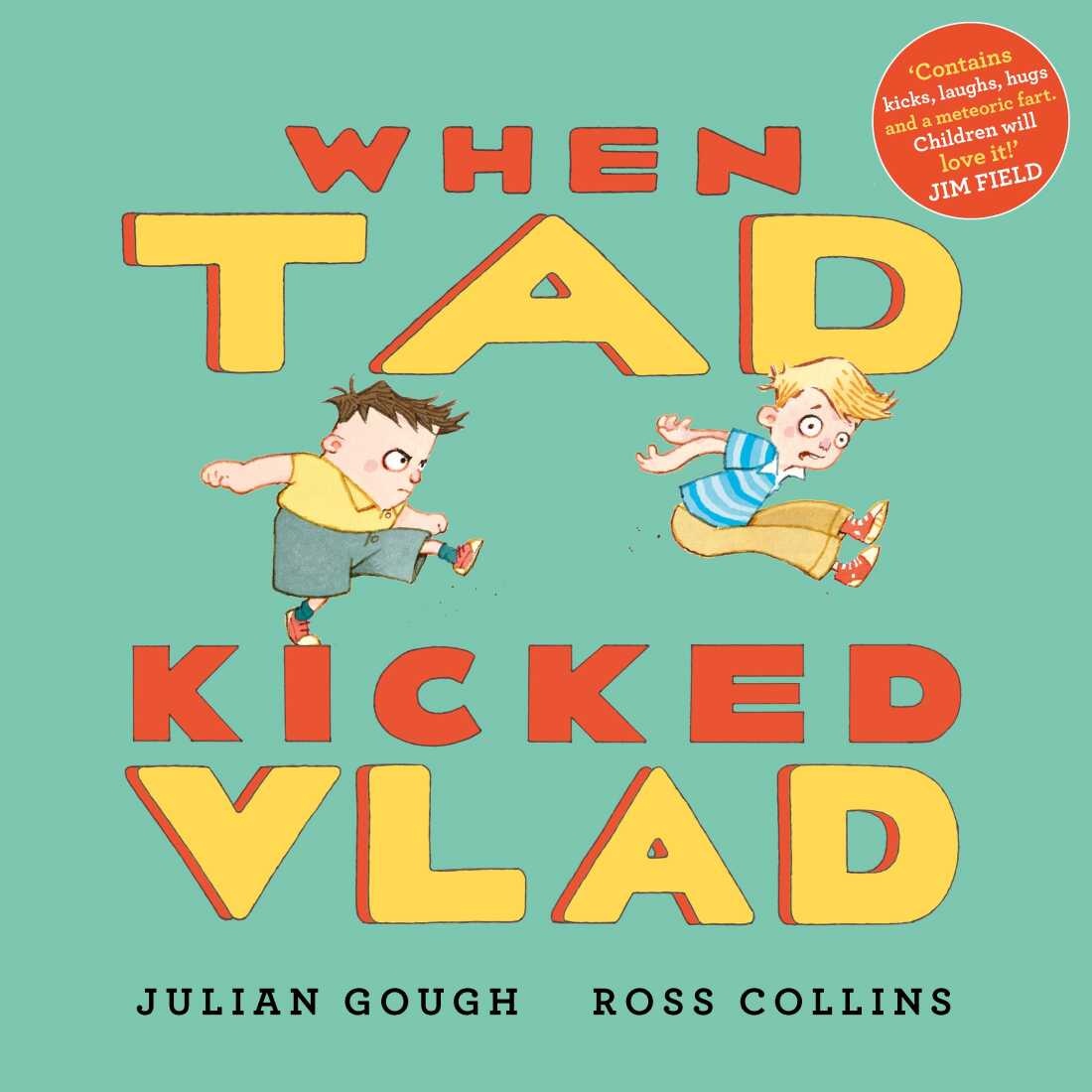
The kids came up with a story about someone who kicked someone. And then that character kicked someone else. And then, Julian Gough says, “one kid just sort of jumped up in his seat in the class and shouted, ‘The kick could go ’round the world!’ and I thought, ‘Oh my God, that’s a book!’”
When Tad Kicked Vlad begins on Tad’s birthday. Before he’s gotten to eat any of his own birthday cake, Tad’s best friend, Vlad, eats the very last slice. Tad is mad. So Tad kicks Vlad.
Vlad kicks Bill. Bill kicks his twin sister, Jill. And before you know it, Tad’s kick has kicked off a chain of kicks that travels all the way around the world, and back to Tad on his next birthday. At which point, Tad farts in Vlad’s face. And on it goes.
Ross Collins illustrated When Tad Kicked Vlad and Gough admits he didn’t give him an easy job. When Gough sends the kick off to the big city, he writes:
“It kicked everyone in the playground! Then it kicked everyone in the park! And then it kicked everyone in the stadium! Fifty-five thousand, five hundred and fifty-five people kicked each other, and the referee had to give so many red cards his arm got tired. After the game, the kick went for a hot dog.”

Illustrations copyright © Ross Collins 2026/Courtesy of Faber & Faber
Collins says as an illustrator, “you’re reading that going, ‘This could be like the best thing I’ve ever had to illustrate or the worst and it’s really hard to know what.’” His way out of drawing something complicated was to draw something even more complicated: an entire city as viewed from the sky. “I drew the path of the kick working its way around the city,” he explains, “so that a child could work their way around the city and see all those points where the kick had gone up and down and ’round buildings and into the stadium.”
When Tad Kicked Vlad is about twice as long as other picture books. Collins says this gave him a lot of space to play around. “I could also break up the tempo of the book with a lot of illustrations where it’s just complete chaos on a larger scale,” he explains. One illustration features the kick going up and down the aisle of an airplane 23 times. And also there’s a chicken.

Illustrations copyright © Ross Collins 2026/Courtesy of Faber & Faber
“The one thing that, you know, if you put it into an illustration, that means that all chaos has just broken loose is if you put a chicken in there,” says Collins. “There shouldn’t be a chicken in a plane.”
Collins first drew everything in pencil before using watercolor. And then he tackled the line work. “Normally I would use a charcoal line, but this book is too detailed for a charcoal line,” Collins says. So, he used colored pens instead. “I tried to make it as clean as I possibly could so that you could actually read the action that was going on.”
Gough says the illustrations remind him of The Adventures of Tintin, by Belgian cartoonist Hergé: clean, well-defined, but grounded in reality and funny. “I was being pretty cheeky with some of the things I was asking for,” Gough admits, laughing. “You really pulled it off.”

Illustrations copyright © Ross Collins 2026/Courtesy of Faber & Faber
-

 Missouri56 seconds ago
Missouri lawmakers fail to pass AI regulations during 2026 legislative session
-

 Montana7 minutes ago
Montana group sends direct aid to Palestinian families
-

 Nebraska13 minutes ago
Nebraska baseball earns No. 13 national seed in Lincoln Regional
-
 Nevada19 minutes ago
Nevada communities honor fallen service members on Memorial Day
-
New Hampshire25 minutes ago
Letter: Vote Brad, Laurel, Tom for NHEC – Concord Monitor
-

 New Jersey31 minutes ago
A hunger strike at an ICE facility has led to protests in New Jersey. Here’s what we know | CNN
-

 New Mexico37 minutes ago
Two men shot and killed in Roswell, police investigating
-

 North Dakota49 minutes ago
Rough Cuts: A history of Theodore Roosevelt in North Dakota

