Sports
Like it or not, the A’s have a new home, and it's a win for this scrappy city


WEST SACRAMENTO, Calif. — The arrival of a major league team to this decidedly minor league city last week was not, as they say in baseball, error free.
Players for the A’s, formerly of Oakland and eventually to be of Las Vegas, were unfamiliar with the layout of their temporary home, Sutter Health Park. There was “a lot of chaos,” manager Mark Kotsay told the Sacramento Bee, as the team tried to figure out how to navigate the much smaller footprint of a triple-A ballpark.
The Wi-Fi went down. The radio broadcast cut out numerous times. The beer line was epic. The game was paused after someone snuck a drone over the field in the seventh inning. Many die-hard Oakland fans in attendance were still roiled by a sense of betrayal at the manner in which the team departed Oakland. And then there was the score: The A’s lost to the Cubs, 18-3.
Summing it all up, the website SFist pulled no punches with its headline: “A’s first game in Sacramento was a complete debacle, and losing 18-3 was probably the least embarrassing part.”
But for boosters of the unsung city of West Sacramento — a scrappy town of 54,000 that many people, even in the wider region, don’t realize is a city — none of that mattered.
Excitement has been running high ever since team officials announced that the A’s would alight at the 14,000-seat stadium of the minor league River Cats — the triple-A affiliate of the San Francisco Giants — for three years while the A’s future home on the Las Vegas Strip is constructed.
This has been widely described in the national press as a move to the city of Sacramento, California’s capital, which is across the river from West Sacramento and in a different county. Most of the news organizations that crowded in to cover the season opener, and the players they quoted, didn’t seem to register the existence of West Sacramento.
A’s relief pitcher T.J. McFarland’s comments were typical. “It’s a nice city, the state capital,” he told the Sacramento Bee, standing in the heart of West Sacramento’s most treasured civic landmark.
West Sacramento took it all in stride. City officials are used to living in Sacramento’s shadow, and they are confident that bringing the A’s here — even if no one seems to know the team is here — will be a boon.
After all, it’s not the first time that the magic of baseball has lifted this town’s fortunes.
“I couldn’t be happier to share the limelight with our neighbors across the river,” said state Sen. Christopher Cabaldon (D-Yolo), who served two decades as West Sacramento’s mayor before being elected to the Senate last year.
Still, Martha Guerrero, the city’s mayor, made one thing clear: “We prefer West Sacramento. That is the official location.”
West Sacramento has long been the region’s scrawny stepchild of a municipality. The city of Sacramento, population 526,000, with its luminous Capitol dome, graceful tree canopy and Gold Rush-era prominence, was incorporated in 1850. Across the Sacramento River and the county line, the other major towns in Yolo County followed not too long after. Woodland dates to 1871. Winters was incorporated in 1898. And even relative newcomer Davis became an official city in 1917. Woodland was known for its stately Victorian homes; Winters for its picturesque downtown and miles of walnut orchards, velvet green against the purple Vaca Mountains; and Davis for its bustling University of California campus.
But for most of the 20th century, what is now called West Sacramento was a collection of small communities known, in many ways, as a dumping ground for people and pets the city of Sacramento didn’t want.
Back in the day, Sacramento authorities “escorted their criminals, morphine addicts and alcoholics” to the area, according to a historian quoted in the Sacramento Bee in 1984. During Prohibition, the area was known as “Sin City” because it did not embrace the era’s no-alcohol edict. During the Depression, one longtime resident told a local newspaper, it was common practice for Sacramentans to dump dogs and cats they could no longer afford to feed on the West Sacramento side of the river.
By the early 1980s, the area was known as a hub for drugs and prostitution, particularly along a strip of rundown motels that lined West Capital Avenue.
Still, local leaders always had big dreams. In the 1940s, Congress authorized construction of a deep water channel that connected the community with Suisun Bay. In the 1960s, the Port of West Sacramento (originally the Port of Sacramento) became operational, hosting big cargo ships and giving rise to a thriving industrial base.
In the 1980s, developers saw the area’s potential as an affordable bedroom community for legislative aides and other state employees working just a short drive or bike ride away in Sacramento’s downtown, on the other side of the landmark Tower Bridge. Single-family homes started going up on what had been vast acres of cropland sprouting corn, tomatoes, melons and rice.
And in 1987, voters in the area finally voted to incorporate.
The Tower Bridge spans the Sacramento River, connecting West Sacramento with the glittering downtown of its higher-profile neighbor, the city of Sacramento.
(Christina House / Los Angeles Times)
It was shortly after this that Cabaldon moved to town.
“I accidentally ended up in West Sacramento,” he said. The year was 1993, and he was starting work as a legislative staffer. A real estate agent took him to a “great neighborhood” that was “unusually affordable” and promised that exciting shops, restaurants, parks and other amenities were coming soon. Cabaldon was sold. “I didn’t realize it was the other side of the tracks, and no one wanted to go there at night,” he said.
Cabaldon grew to love his little city. He admired its gorgeous riverfront — mostly underused land, but so much potential. Still, he noticed that many of the amenities the real estate agent had promised were nowhere on the horizon. And he gathered, too, that the city had long felt like an underdog.
Instead of moving, he ran for City Council. He lost, but ran again and won in 1996. By 1998, he was mayor. Shortly thereafter, he recalled, he was approached by developers who wanted to build a minor league ballpark in the city.
“We kind of ran with it,” he said. “It really changed the notion that we were the armpit of the region.”
The park was built, and by 2001, the River Cats had moved in (originally as a farm team for the Oakland A’s before becoming the Giants’ triple-A affiliate in 2015). The ballpark, which is a stone’s throw from the Sacramento River and about a mile from the Capitol, quickly became a draw for people across the region.
Sure, the team took the name the Sacramento River Cats, but their presence in West Sacramento helped spur a whole new wave of development: affordable condos, apartments and townhomes geared toward young workers and, finally, the long-promised restaurants and big-box stores so that all these new residents had places to eat and shop without crossing the river. Parcel by parcel, the land along the city’s waterfront was transformed into entertainment venues, parks and trails.
“We’ve done so many ribbon cuttings,” said Guerrero, the mayor.
West Sacramento was on its way, even before the A’s very bad breakup with Oakland.
The Oakland Coliseum, the A’s longtime home, was widely considered one of the most run-down stadiums in the major leagues — baseball’s last dive bar, as the Guardian newspaper put it. There were, famously, feral cats roaming the complex. Dead mice where they didn’t belong. Sewage issues. Barbed wire. And so much concrete.
“It’s a giant concrete toilet bowl,” said baseball analyst Eric Byrnes, who played six seasons for the A’s. “But it’s their toilet bowl, and it’s a special toilet bowl.”
The A’s owner, John Fisher, made no secret of his desire to get out, and when he finally did, hatching a plan to move to a $1.5-billion stadium on the Las Vegas Strip, residents of Oakland — and a host of nostalgic sportswriters — erupted with fury and heartbreak.

In a 2023 photo, fans at Oakland Coliseum protest the A’s plans to relocate.
(Jed Jacobsohn / Associated Press)
“The argument could be made that the A’s departure from their run-down home for the riches of Las Vegas is a large part of what’s wrong with American professional sports today,” the New York Times said.
“The Oakland A’s were so much to so many of us, for so long, and now they are nothing at all,” wrote Ellen Cushing in the Atlantic.
At the last game in the Coliseum, desperate fans assailed the owner with loud chants of “Sell the Team.” Then they waited in line to collect dirt from the old diamond.
It is said there are two sides to every breakup. But in this divorce, it seemed almost everyone took the side of Oakland and its fans.

The A’s season opener in West Sacramento was marked by operational glitches as the team figured out how to navigate the much smaller footprint of a triple-A ballpark.
(Scott Marshall / Associated Press)
All these months later, West Sacramento officials emphasize they played no part in stealing the team from Oakland. But they also don’t hide their pride in being the A’s rebound city — even if it’s just for three years.
They spent the off-season making upgrades to the stadium, including a new clubhouse and expanded locker room facilities. They came up with a parking plan to accommodate what are expected to be bigger crowds. They added premium seating.
The dream, Guerrero said, is that the A’s short-term relationship with West Sacramento is such a success that Major League Baseball considers the region for an expansion team. And all the dreamier if they put that team in her town — and not that stepsister city across the river.
“West Sacramento has a strong fan base,” Guerrero said. “We’re a baseball city.”

Sports
Pirates star pitcher makes unfortunate history after being taken out in middle of perfect game bid

NEWYou can now listen to Fox News articles!
Jared Jones was flirting with Major League Baseball history on Wednesday night — he got it, but it was not what he originally envisioned.
The Pittsburgh Pirates pitcher retired the first 18 batters he faced, but he was taken out in the middle of his perfect game bid after six innings.
Now, the Pirates certainly have their reasons — the 24-year-old Jones hasn’t thrown more than 81 pitches in eight starts since returning May 20 after missing all of last season while undergoing ulnar collateral ligament internal brace surgery on May 21, 2025. He was yanked with 77 pitches and likely would have needed more than 100 pitches to record the 25th perfect game in MLB history.
Jared Jones of the Pittsburgh Pirates pitches during the first inning against the Atlanta Braves at PNC Park on July 8, 2026, in Pittsburgh, Pennsylvania. (Photo by Joe Sargent/Getty Images)
However, Jones left the game after getting zero run support, so when the Atlanta Braves tacked on three runs late for a 3-0 victory, Jones instead found himself in the wrong chapter of the history books.
According to Opta Stats, Jones became the first pitcher in the modern era (since 1920) to pitch at least six perfect innings and not record a win.
“It does suck. Something’s cool coming on, but I’m on what? My eighth start off of surgery? I completely understand it, and it is what it is,” Jones told reporters after the game.
Pittsburgh Pirates starting pitcher Jared Jones (17) makes his way to the field to warm up before pitching against the Atlanta Braves at PNC Park. (Charles LeClaire/Imagn Images)
JUSTIN VERLANDER ANNOUNCES HE WILL RETIRE AFTER THIS SEASON: ‘I’VE REALIZED THAT TIME HAS COME’
Jones said he didn’t entertain attempting to complete the perfect game.
“Not with the pitch count,” he said. “Not really ever expecting to go nine right now, so that was never in my head.”
Joey Bart, traded to the Braves from the Pirates on June 18, followed a double by Mike Yastrzemski with a 422-foot, two-run homer to left-center field off a slider from Dennis Santana. Drake Baldwin added an RBI single to center in the ninth for good measure.
It was the second time in less than a week that a pitcher was taken out of the game with a perfect bid through six innings — the Miami Marlins took Eury Perez out after seven innings in which he had 92 pitches. Perez, too, is in the midst of returning from injury and has surprisingly found himself right in the postseason mix.
He was pulled for Lake Bachar to start the eighth, and the Marlins allowed eight runs to the Athletics in the final two innings, but held on to win 9-8.
Jared Jones (17) of the Pittsburgh Pirates delivers a pitch during a MLB game against the Cincinnati Reds on June 27, 2026, at PNC Park in Pittsburgh, Pennsylvania. (Joe Robbins/Icon Sportswire via Getty Images)
CLICK HERE TO DOWNLOAD THE FOX NEWS APP
The Pirates are 4.0 games out of the final wild card spot, which is held by the Marlins.
The Associated Press contributed to this report.
Follow Fox News Digital’s sports coverage on X, and subscribe to the Fox News Sports Huddle newsletter.
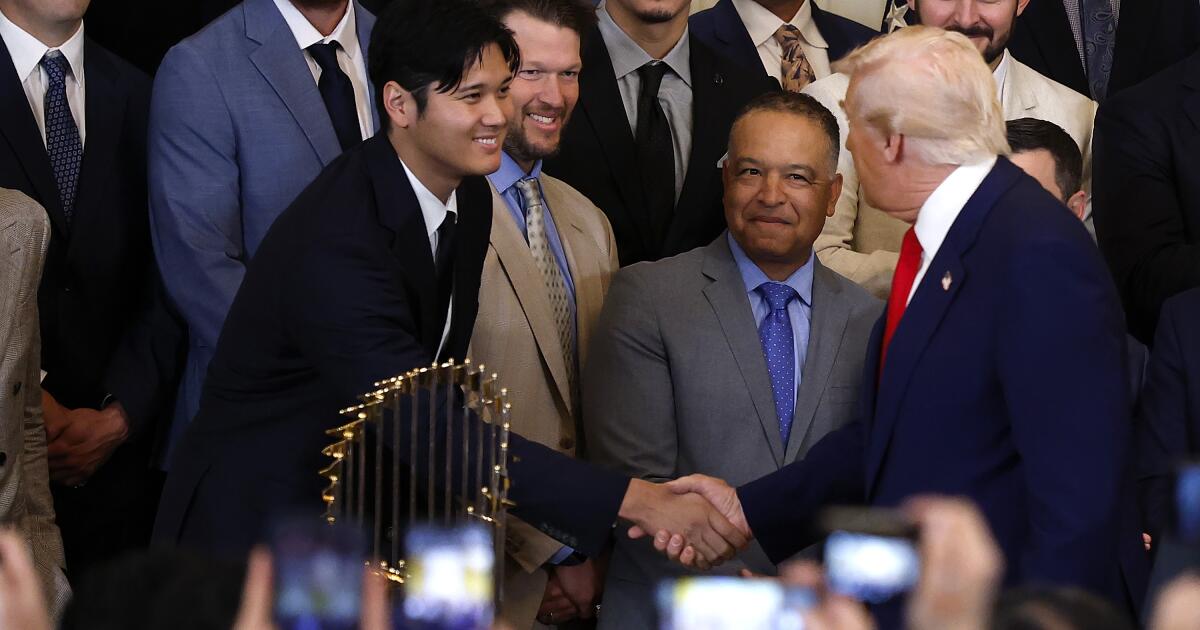
WASHINGTON — The Dodgers are scheduled to visit the White House on July 23 to celebrate their latest World Series title.
“President Trump is excited to welcome the Los Angeles Dodgers BACK to the White House to celebrate their World Series championship!,” White House spokesperson Taylor Rogers said in a statement to The Times.
The date falls on a scheduled off day in the middle of a nine-game East Coast road trip for the Dodgers. The team will play three games in Philadelphia against the Phillies July 20-22 before ending the trip with a three-game series against the New York Mets July 24 to 26.
The visit continues a tradition from the Dodgers’ two previous World Series championships. They were hosted by President Biden in 2021 and President Trump in April 2025.
After the Dodgers claimed their second consecutive World Series title with a dramatic Game 7 victory over the Toronto Blue Jays, a visit to the White House was planned, but it wasn’t until Thursday that a date was officially booked and confirmed.
Questions swirled around whether players would decline the visit this year after it did not happen during a scheduled visit to Washington in April.
Kiké Hernández said in 2018 he was unsure he would have gone had the Dodgers won the World Series the previous year. Mookie Betts said he was undecided and needed to talk it over with his family when last year’s visit was announced. After winning his first World Series with the Boston Red Sox in 2018, Betts skipped their trip to the White House the following year during Trump’s first term.
Both players, along with every returning member of the 2024 team who was with the team during its road trip, participated in the visit. The only notable absence was first baseman Freddie Freeman, who remained in Los Angeles to nurse an ankle injury.
Manager Dave Roberts, who indicated in comments to The Times in 2019 he might not go to the White House if Trump was president, also participated in last year’s ceremony.
Asked at the Dodgers’ fan festival in January about the possibility of returning to the White House, Roberts told The Times’ Bill Shaikin: “For me, I stand by: I’m a baseball manager. That’s my job.”
“I was raised — by a man who served our country for 30 years — to respect the highest office in our country,” Roberts said. “For me, it doesn’t matter who is in the office, I’m going to go to the White House. I’ve never tried to be political. … For me, I am going to continue to try to do what tradition says and not try to make political statements, because I am not a politician.”
Clayton Kershaw, who retired after last season but was on Team USA for this year’s World Baseball Classic, told The Times in the spring that he was aware Dodgers fans are split over whether the team should visit the White House again this year, but he said he is looking forward to it.
“I went when President Biden was in office. I’m going to go when President Trump is in office,” Kershaw said. “To me, it’s just about getting to go to the White House. You don’t get that opportunity every day, so I’m excited to go.”
Times deputy sports editor Ed Guzman contributed to this report.

NEWYou can now listen to Fox News articles!
All eyes were on Caitlin Clark on Wednesday night as she made her anticipated return from injury in a road matchup in Los Angeles.
But instead of a triumphant comeback, the Fever spent the entire night chasing the Sparks as Clark’s rough return fueled a 106-92 rout.
The superstar never found a groove, looking completely out of sync in her return from a back injury.
STEPHANIE WHITE GIVES CAITLIN CLARK STATUS UPDATE AHEAD OF FEVER-SPARKS, BUT HER NEXT MOVE RAISES QUESTIONS
Caitlin Clark huddles with teammates as the Indiana Fever battle the Sparks. (Photo by Katelyn Mulcahy/Getty Images) ((Photo by Katelyn Mulcahy/Getty Images))
Much of that disjointed performance falls squarely on head coach Stephanie White, who kept Clark on a ridiculously tight leash by limiting her to just 16 minutes. The stop-and-go approach could have sabotaged any chance for the phenom to establish a rhythm.
Clark finished with just 9 points, 4 rebounds and 3 assists. Her minus-16 plus-minus told the story.
The Los Angeles Sparks were severely shorthanded, taking the floor without stars Kelsey Plum and Cameron Brink.
MERCURY’S NOW-DELETED SOCIAL MEDIA POST MOCKING CAITLIN CLARK DRAWS SCRUTINY AFTER STAR’S INJURY
Yet while a depleted Sparks roster played to win, Indiana spent the night over-managing its biggest asset.
With Clark on a minutes restriction and Aliyah Boston out of the lineup, Kelsey Mitchell was forced to shoulder the entire offensive burden.
Mitchell did her part, pouring in 29 points while shooting 5-of-9 from beyond the arc.
Caitlin Clark orchestrates the Fever offense as Indiana battles the Los Angeles Sparks in primetime action. (Photo by Katelyn Mulcahy/Getty Images) ((Photo by Katelyn Mulcahy/Getty Images))
But one hot hand couldn’t stop an efficient LA squad.
The Sparks shot 45% from three-point range, going 9-of-20 from deep to cruise to the 106-92 victory.
White’s next move is to sit Clark against the Mercury on Thursday while Boston returns.
CLICK HERE TO DOWNLOAD THE FOX NEWS APP
After Wednesday’s loss to a shorthanded Sparks team, it’s fair to question whether Indiana’s cautious approach is working. The Fever dropped to 12-9.
Caitlin Clark and Dearica Hamby face off as Fever and Sparks battle at Crypto.com Arena in Los Angeles. (Photo by Tyler Ross/NBAE via Getty Images) ((Photo by Tyler Ross/NBAE via Getty Images))
Send us your thoughts: alejandro.avila@outkick.com / Follow along on X: @alejandroaveela
-

 Louisiana2 minutes ago
Parasitic stomach illness that can cause explosive diarrhea rises in Louisiana
-

 Maine9 minutes ago
Is prison in play for Graham Platner?
-

 Maryland12 minutes ago
Office building in Glen Burnie evacuated after shift in parking garage floor
-

 Michigan17 minutes ago
Menominee, Michigan man arrested on sexual assault charges involving a minor
-

 Massachusetts24 minutes ago
Healey administration vows to appeal as Trump rejects Massachusetts blizzard aid request – The Boston Globe
-

 Minnesota26 minutes ago
Minnesota Looks to Add 1,100 Child Care Slots, With Melrose Among the 11 Funded Communities
-

 Mississippi32 minutes ago
Death of Mississippi teen Nolan Wells under investigation
-

 Missouri39 minutes ago
Missouri realtors hold statewide rally to vote no on Amendments 4 & 5

