Sports
Thanks to the transfer portal, this March’s Cinderella stories are players, not teams


To find Cinderella stories at this men’s Final Four, you have to look at the name on the back of the jersey rather than the front.
For the second time in the history of the NCAA Tournament’s modern-day bracketing practices, all four top seeds advanced to the national semifinals. It will be No. 1 Florida vs. No. 1 Auburn and No. 1 Houston vs. No. 1 Duke on Saturday in the national semifinals, a perfect ending to a most chalky March Madness. Only one double-digit seed reached the Sweet 16, and all of the teams in the regional semifinals were from Power 4 conferences.
Where have you gone, Loyola Chicago and Sister Jean? Check the transfer portal.
Two of the very best players competing for a championship this weekend in San Antonio — Florida’s Walter Clayton Jr. and Auburn’s Johni Broome — might not be where they are today if not for this new world order of college sports, with unlimited, unrestricted transfers and name, image and likeness compensation.
Clayton is the former high school football star from Florida whose passion for basketball led him to New Rochelle, N.Y., a hidden gem uncovered by Rick Pitino during his time at Iona. You probably didn’t even notice Clayton scoring 15 points for the Gaels against eventual national champion UConn in the first round of the 2023 NCAA Tournament.
Now, he’s being compared to Steph Curry.
“He’s obviously a blessing to have in our program, have on our team,” Florida coach Todd Golden said. “He’s an incredible player, but outside of that, he’s a great leader. He’s been everything we could have asked him to be for this program since he got to campus two years ago.”
Broome, another Floridian, was the 471st-rated prospect in his recruiting class per 247Sports Composite rankings, not even good enough to get an offer from Florida Atlantic. To be fair, former FAU coach Dusty May put together a team good enough to reach a Final Four two years ago without Broome, so not being good enough for those Owls is no slight.
Instead, Broome landed at Morehead State and blossomed in two seasons in the Ohio Valley Conference before becoming the best player in the SEC in his third year at Auburn.
“Shoutout to Morehead State,” he said. “I think those two years of my college career have helped me become who I am.”
We’re not quite ready to declare the NCAA Tournament underdog dead. The trends are working against the mid-majors — specifically, relaxed transfer rules that turn every player in the country into a free agent every year.
For years, draconian transfer rules gave way too much power to schools and coaches. Not only did undergraduate basketball players have to sit out a season after transferring — a non-compete clause for non-employees — but schools could block athletes from going to certain schools, just because.
It was borderline shameful. Even Mark Emmert, the former NCAA president who was not exactly known for getting out in front of potential problems, knew change was needed.
“How complicated could this be?” Emmert said at the last Final Four in San Antonio in 2018. “It’s about students changing schools. And yet I’ve never seen anything that’s quite as intractable a problem as this one because you just can’t get agreement.”
Even back then, before the portal was a viable option for every player from superstar to walk-on, transfers were on the rise in college basketball, with instances increasing from 10 percent of Division I players in 2010 to about 13 percent in 2016.
The Villanova team that won the NCAA Tournament in 2018 started forward Eric Paschall, a transfer from Fordham. Surely, Rams fans were wondering what could have been as they watched Paschall score 24 points in the semifinal victory against Kansas.
Villanova, Kansas, Michigan and Sister Jean’s Loyola Chicago all started at least one transfer in the Final Four that season. There were a total of nine on those rosters, including players who were sitting out to comply with the NCAA rules of the time.
The Wolverines reached the title game with the help of Division III transfer Duncan Robinson.
According to the NCAA’s most recent reported figures, over 1,200 Division I men’s basketball players transferred after the 2022-23 season. Typically, there are about 4,200 scholarship athletes playing Division I men’s basketball.
This year’s Final Four teams have 20 scholarship transfers from other NCAA schools on their rosters, led by Auburn with seven. Florida has six, Duke has five and Houston has two, both from other Big 12 programs. Cougars star L.J. Cryer is in the Final Four for the second time after being part of Baylor’s 2021 title team as a freshman.
Florida, Auburn and Duke all have at least one starter who once played at a mid-major.
For Duke, that’s guard Sion James, a former three-star recruit from Sugar Hill, Ga. He played four seasons at Tulane before taking advantage of the extra year of eligibility all athletes received in the wake of the pandemic to become a glue guy for one of the most storied and prestigious programs in the country.
“I’d played a lot of college basketball games, but none in the tournament, and I knew that we’d have a chance to win a national championship,” James said. “And it’s cool being here, however many months later, just a few games away.”
The pendulum has swung hard toward player empowerment when it comes to transfer rules. It’s fair to say we might be in the too-much-ice-cream phase. Bouncing around the country and averaging about a school per season is probably not ideal for players with minimal pro prospects who would benefit from graduating from … somewhere.
Purdue coach Matt Painter made an interesting point earlier in the tournament about balancing the opportunity to get a degree with recognizing that for some players, college will be the last chance they have to make money playing basketball.
“I don’t think that’s a bad (thing) … like, why not?” he said.
Painter’s 2024-25 team, it should be noted, had no transfers, but former Boilermaker Mason Gillis is back in the Final Four with Duke.
Will Wade, who took the NC State head coaching job after leading 12th-seeded McNeese past Clemson in one of the few true upsets of this tournament, talked about selling his mid-major program as a place for players to develop into power-conference transfers. More and more mid-majors are recruiting that way, resigned to the fact that, yes, they are indeed farm teams for the big schools.
Maybe with a revenue sharing system coming to college sports, along with player contracts and something that replicates a salary cap for monied schools that opt into the system, the low-mid-major poaching will slow down. Probably not.
That’s not great news for the future of Cinderella in March Madness, but just last year Oakland, Yale, Grand Canyon, James Madison and Duquesne won first-round games as double-digit seeds. Then again, Morehead State made the tournament last year, two seasons after Broome left, and lost in the first round as a 14-seed to Illinois. Imagine what that team could have been with Broome.
We’re also only two years removed from FAU’s Final Four run. One of those players, Alijah Martin, is back in the Final Four with Florida. Others, from Michigan’s Vladislav Goldin to Arkansas’ Johnell Davis, came a win or two away from returns of their own.
Then there is Chaney Johnson, who played three seasons of Division II basketball at Alabama Huntsville before becoming a key reserve for Auburn.
Fans might lament the transient nature of college basketball, with mercenary players quickly coming and going, but this is Clayton’s second season at Florida. Broome has been at Auburn for three years, and it’s probably not a coincidence the Tigers only added three transfers this past offseason to a rotation with lots of multi-year veterans.
Thanks to NIL, Auburn fans have watched Broome and this core of players develop to be able to cut down the nets on the way to a Final Four.
“Man, words can’t even describe it,” Broome said after the regional final victory against Michigan State in Atlanta. “To stand on top of the ladder in front of all the Auburn fans still being there, traveling and witnessing it as well, and looking down and seeing my teammates, the whole Auburn family, it just means the world to me. To kind of be able to deliver for the Auburn family.”
And they all lived happily ever after.
(Illustration: Will Tullos / The Athletic; Photos: Andy Lyons, Alex Slitz / Getty Images)



NEWYou can now listen to Fox News articles!
With the largest World Cup field in the history of the tournament, 32 of the 48 teams will be fighting for a spot in the knockout stage.
66.6% of nations will advance out of the group stage this summer, which is a massive upgrade from 50% in past World Cups. Because of this, sportsbooks have adjusted with less favorable odds.
Prior to the start of the tournament, Spain, Argentina, Brazil, England, and Germany entered with the strongest odds to advance from the group stage, supported by recent major-tournament success and talent-rich rosters.
All five nations are heavily favored at -10000 to advance to the knockout round.
The Spaniards are the defending European Champions while the Argentinians are looking to win back-to-back titles. Germany has not made it out of the group stage in the last two World Cups, but has always been a perennial contender— having won four titles in its history. And then of course there’s Brazil, which has more titles than any country with five.
Now, after the conclusion of the first day of the World Cup, Mexico has joined the group at the top. El Tri has surged to -10000 to advance to the knockout stage after initially being just -1400. Mexico’s huge leap up the oddsboard is a direct result of its dominating 2-0 win over South Africa.
With that in mind, let’s dive into the odds for each team to advance to the knockout stage of the 2026 FIFA World Cup as of June 12.
This page may contain affiliate links to legal sports betting partners. If you sign up or place a wager, FOX Sports may be compensated. Read more about Sports Betting on FOX Sports.
Odds to Advance to Knockout Stage
Spain: -10000 (bet $10 to win $10.10 total)
Argentina: -10000 (bet $10 to win $10.10 total)
Brazil: -10000 (bet $10 to win $10.10 total)
England: -10000 (bet $10 to win $10.10 total)
Mexico: -10000 (bet $10 to win $10.10 total)
Germany: -10000 (bet $10 to win $10.10 total)
Portugal: -5000 (bet $10 to win $10.20 total)
France: -5000 (bet $10 to win $10.20 total)
Belgium:-3500 (bet $10 to win $10.29 total)
South Korea: -2500 (bet $10 to win $10.40 total)
Switzerland: -1800 (bet $10 to win $10.56 total)
Netherlands: -1400 (bet $10 to win $10.71 total)
Morocco: -1000 (bet $10 to win $11 total)
Colombia: -1000 (bet $10 to win $11 total)
Uruguay: -1000 (bet $10 to win $11 total)
Canada: -1000 (bet $10 to win $11 total)
Ecuador: -900 (bet $10 to win $11.11 total)
Norway: -900 (bet $10 to win $11.11 total)
United States: -750 (bet $10 to win $11.33 total)
The U.S. men’s national team is currently -750 to advance from Group D (Photo by Omar Vega/USSF/Getty Images).
Croatia: -500 (bet $10 to win $12 total)
Austria: -500 (bet $10 to win $12 total)
Türkiye: -500 (bet $10 to win $12 total)
Ivory Coast: -500 (bet $10 to win $12 total)
Japan: -500 (bet $10 to win $12 total)
Egypt: -340 (bet $10 to win $12.94 total)
Algeria: -310 (bet $10 to win $13.23 total)
Scotland: -310 (bet $10 to win $13.23 total)
Senegal: -230 (bet $10 to win $14.35 total)
Sweden: -230 (bet $10 to win $1435 total)
Bosnia and Herzegovina: -220 (bet $10 to win $14.55 total)
Paraguay: -205 (bet $10 to win $14.88 total)
Iran: -200 (bet $10 to win $15 total)
Czechia: -165 (bet $10 to win $16.06 total)
Ghana: -140 (bet $10 to win $17.14 total)
Australia: -110 (bet $10 to win $19.09 total)
DR Congo: +100 (bet $10 to win $20 total)
Raúl Jiménez helped propel Mexico to a 2-0 win over South Africa in the opening match of the 2026 FIFA World Cup (Photo by Yair Gonzalez/Jam Media/Getty Images).
Saudi Arabia: +105 (bet $10 to win $20.50 total)
Tunisia: +140 (bet $10 to win $24 total)
New Zealand: +150 (bet $10 to win $25 total)
Uzbekistan: +180 (bet $10 to win $28 total)
Cape Verde: +200 (bet $10 to win $30 total)
Panama: +200 (bet $10 to win $30 total)
Qatar: +275 (bet $10 to win $37.50 total)
South Africa: +320 (bet $10 to win $42 total)
Jordan +350 (bet $10 to win $45 total)
Iraq: +450 (bet $10 to win $55 total)
Haiti: +800 (bet $10 to win $90 total)
Curaçao: +1000 (bet $10 to win $110 total)
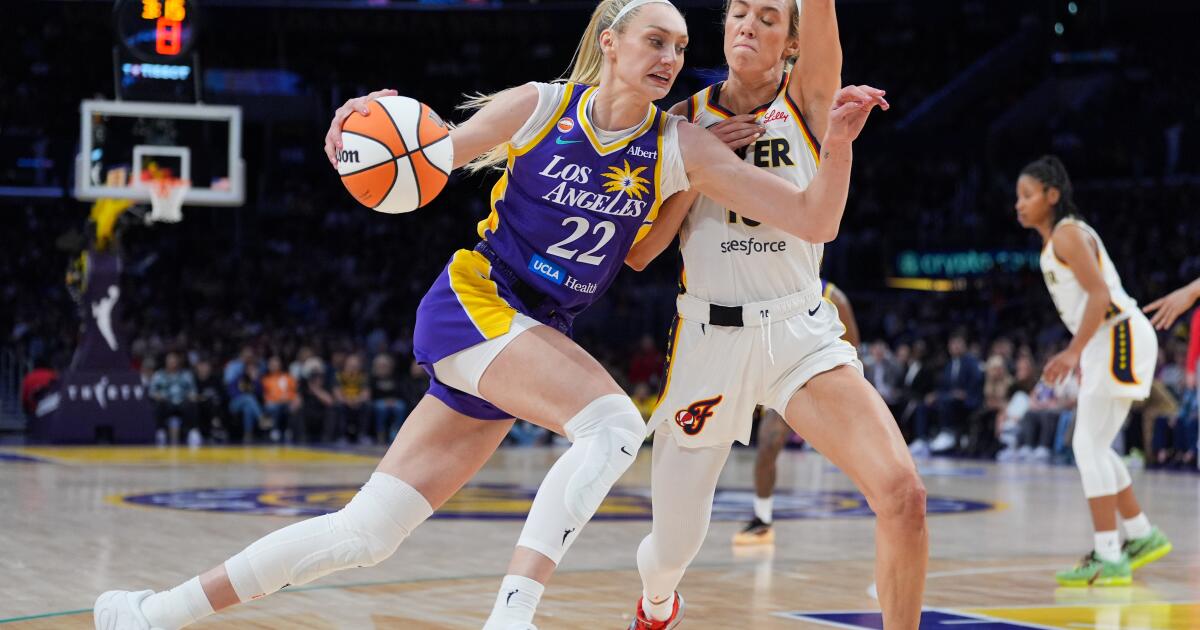
Cameron Brink said she’d appreciate some grace. She really would.
Sparks fans should give her some, because where else is she going to get it?
Certainly not from WNBA refs. Not from opponents with more to play for than ever. Certainly not from the game itself; basketball moves fast, and a bummer can become a bust in a blink.
But Brink, 24, is not on the brink of bust territory, no. Block that thought. Technically, it’s Year 3, but after a torn ACL derailed her as a rookie two summers ago, it’s practically like Year 2 for the former Stanford star. And by design, the WNBA is testing her confidence, her decision-making and her patience as she tries to reestablish herself as one of the WNBA’s best young players.
So, grace.
The recognizable 6-foot-4 forward — she’s the long-blond-haired hooper in the New Balance ads — was the No. 2 overall pick in 2024.
Now she’s her team’s No. 3 option in the post. She’s coming off the bench behind Nneka Ogwumike and Dearica Hamby for the Sparks, who are a modest 6-6 after wins this week over the expansion Portland Fire and the struggling Seattle Storm.
Against the Fire, Brink scored two points and picked up four fouls in nine minutes. Then she went to Seattle and had 15 points in 18 minutes but was pulled with more than five minutes left in the fourth quarter after getting her third, fourth and fifth fouls in 86 seconds. (WNBA players get six fouls before being disqualified.)
For the season, Brink has been called for 49 fouls in 208 minutes. A foul about every four minutes!
They’re silly fouls and they’re phantom calls. Egregious and ticky-tack. Costly and common. A real fouled-up buffet. She sets screens that get scrutinized as if by the most vigilant TSA agent. And sometimes, yes, she’s doing the accidental tripping. Other times, the officials are.
Her reputation precedes her, so everyone gets a superstar’s whistle when being defended by Brink. Opponents bake it into their game plans.
That can’t continue.
All that fouling is hindering Brink’s development because it’s robbing her of important in-game reps — which she needs, foremost, to figure out how to stop fouling.
Sparks forward Cameron Brink, left, blocks the shot of the Tempo’s Laura Juskaite during a game last month.
(Jeff Lewis / Associated Press)
“At the pro level,” said Tara VanDerveer, Brink’s coach at Stanford, “every young player always has a lot of work to do. And I saw her make a three. I see her block shots. She rebounds, she can handle the ball, she’s unselfish, she’s a terrific talent. But there’s always things players need to work on.”
We know what Brink’s thing is.
“She has to be disciplined,” VanDerveer said. “And if you want something so badly, if you want to be an All-Star someday or make the Olympic team, you’ve got to be dependable … and I think anyone can change, if it’s behavior they recognize is not in their best interests or not in their team’s best interests. It’s hard, but it’s something I think people can do.
“That’s what Cam is working on.”
And, VanDerveer added, “I’m really so excited that Nneka is there, because she will give her such great guidance and mentorship.”
And grace. Brink is getting that from Ogwumike — also a former Stanford star, the Sparks legend returned to L.A. this season after two seasons in Seattle — and her other teammates.
“I just do my best to lead by example,” Ogwumike, 35, said. “But then also let [Brink] know that she’s very capable, that she’s more than capable, which is exactly why she’s here with us and it’s exactly why we need her on this team.”

Sparks forward Cameron Brink, wearing a facemask, controls the ball while defended by Sun forward Raegan Beers.
(Joe Buglewicz / Getty Images)
But how long will Brink get grace from the Sparks in the what-have-you-done-for-me-lately business of basketball?
The foul trouble tells us why a win-now team wouldn’t trust her, why the Sparks would give meaningful minutes to two veteran post players ahead of her. Why they wouldn’t prioritize Brink’s development alongside winning as they strive to snap a previously unthinkable five-year playoff drought.
And what about fans? How patient will you all be with a player who was drafted immediately after Caitlin Clark and five spots in front of Angel Reese?
These days, that might depend on what the parlay calls for.
Or, preferably, whether you remember Brink’s first 15 WNBA games. All starts, all signs pointing to stardom. She showed up in 2024 throwing lavish block parties. Her 2.3 blocks per game were message-sending spikes, like what Lisa Leslie used to enthrall Sparks crowds with.
From the jump, she had guys coming to games at Crypto.com Arena wearing her No. 22 jersey and little girls arriving in groups with No. 22 painted on their cheeks and “I love Cam Brink” signs in hand.
And then the torn ACL cost her 25 games of her rookie season and another 25 last season, plus her spot on the United States’ Olympic 3×3 women’s basketball team in Paris in 2024.
She had to start over. Lost a lot of ground. But you see that masked woman stuck on the Sparks’ bench for all but 17 minutes per game?
You can’t miss her. She’s looking uncomfortable in protective facial gear that either hinders her breathing or her peripheral vision, her only options to protect the torn septum she suffered in a victory over the Las Vegas Aces last month.
She’s the one with the 6-8 wingspan who’s averaging 9.2 points, 4.3 rebounds and 1.5 blocks while shooting 52.1% from the field in her limited minutes.
She’s still Cameron Brink. Between fouls, she’s fluid and fast and covers more of the court than almost anyone in the WNBA, able to leap from defending guards to centers in a single bound.
“It’s just looking at every day as a new opportunity to learn and grow and not getting too bogged down when things don’t go exactly as you planned,” Brink told me. “Because more times than not, things are not going to go how you want them to. And that’s life. So I just want to be able to put my best effort out there every single night.
She knows what the Sparks need from her: “To perform, just come on the floor and compete.”
To prove she can stay on the floor to compete.

NEWYou can now listen to Fox News articles!
When will Team USA lose in the 2026 FIFA World Cup? Or, will it not lose at all?
Let’s check out the odds for the Americans’ stage of elimination at FanDuel Sportsbook, as of June 11.
Team USA — Stage of elimination odds
Last 32: +170 (bet $10 to win $27 total)
Last 16: +220 (bet $10 to win $32 total)
Group stage: +500 (bet $10 to win $60 total)
Quarterfinals: +500 (bet $10 to win $60 total)
Semifinals: +1200 (bet $10 to win $130 total)
Runner-up: +2800 (bet $10 to win $290 total)
Outright winner: +6000 (bet $10 to win $610 total)
This page may contain affiliate links to legal sports betting partners. If you sign up or place a wager, FOX Sports may be compensated. Read more about Sports Betting on FOX Sports.
The outlook appears to be … ho-hum?
If the odds ring true, the Americans are expected to make it out of the group stage but fall in the first knockout stage game.
How would that result stack up against previous results? Well, at the 2022 World Cup, Team USA made it to the Round of 16, which was viewed as a stellar accomplishment.
The U.S. men’s national team currently has 60-1 odds to lift the 2026 FIFA World Cup trophy this summer (Photo by Omar Vega/USSF/Getty Images).
In 2018, the USA did not qualify for the World Cup, and in 2014 and 2010, the Americans also made it to the Round of 16. Their best result this century occurred in 2002, when the Americans made it all the way to the quarterfinals before being eliminated.
In 1998, Team USA lost in the group stage, in 1994, it fell in the Round of 16, and in 1990, it also fell in the group stage.
With the expanded World Cup format, 32 teams will advance to the knockout stage (out of 48), giving teams a much better chance of getting out of the group stage than in previous tournaments. In past years, only 50% of the field advanced to the knockout round, but now 66.6% of teams will move on.
With that being said, anything less than a knockout round appearance on home soil would be viewed as a major failure this summer for Team USA.
The second result on the oddsboard is the “Last 16,” meaning the USA would make it out of the group stage and win one knockout stage game, before falling in the second knockout stage game. The third result is that the Americans failed to make it out of the group stage, and the fourth is that they made it to the quarterfinals, meaning they won two knockout stage games.
Making the semis, losing in the championship game and winning the championship are the three results with the longest odds.
The U.S. begins its World Cup journey on Friday as the Stars and Stripes face Paraguay at Los Angeles Stadium. Getting off to a fast start in the group is crucial for the team’s World Cup dreams of making a deep run this summer.
-

 New Jersey2 minutes ago
Severe Storms, Dangerous Heat Targets NJ Friday
-

 New Mexico9 minutes ago
Friday morning forecast: Storms could bring flooding to eastern NM this weekend
-

 North Carolina11 minutes ago
NC Governor Josh Stein declares June 14 as Flag Day
-

 North Dakota17 minutes ago
Refugee day event in Grand Forks will not feature refugee participation amid safety concerns
-

 Ohio24 minutes ago
Why is Ohio is seeing so much rain, severe weather? El Niño one reason
-

 Oklahoma26 minutes ago
Star-studded cast announced for Will Rogers-inspired Oklahoma film
-

 Oregon32 minutes ago
Farm groups oppose Oregon recycling fees with ‘no public oversight’ | Capital Press
-

 Pennsylvania38 minutes ago
Pa. Senate votes down proposal to create independent cannabis regulatory board

