Alaska
New Ketchikan company aims to kick-start Alaska kelp industry – KRBD


On a clear March afternoon, John Smet shut off the engine of his workboat as he approached his go-to wild kelp bed. It was high tide, so less kelp was pooling on the surface of the water, making it harder to see.
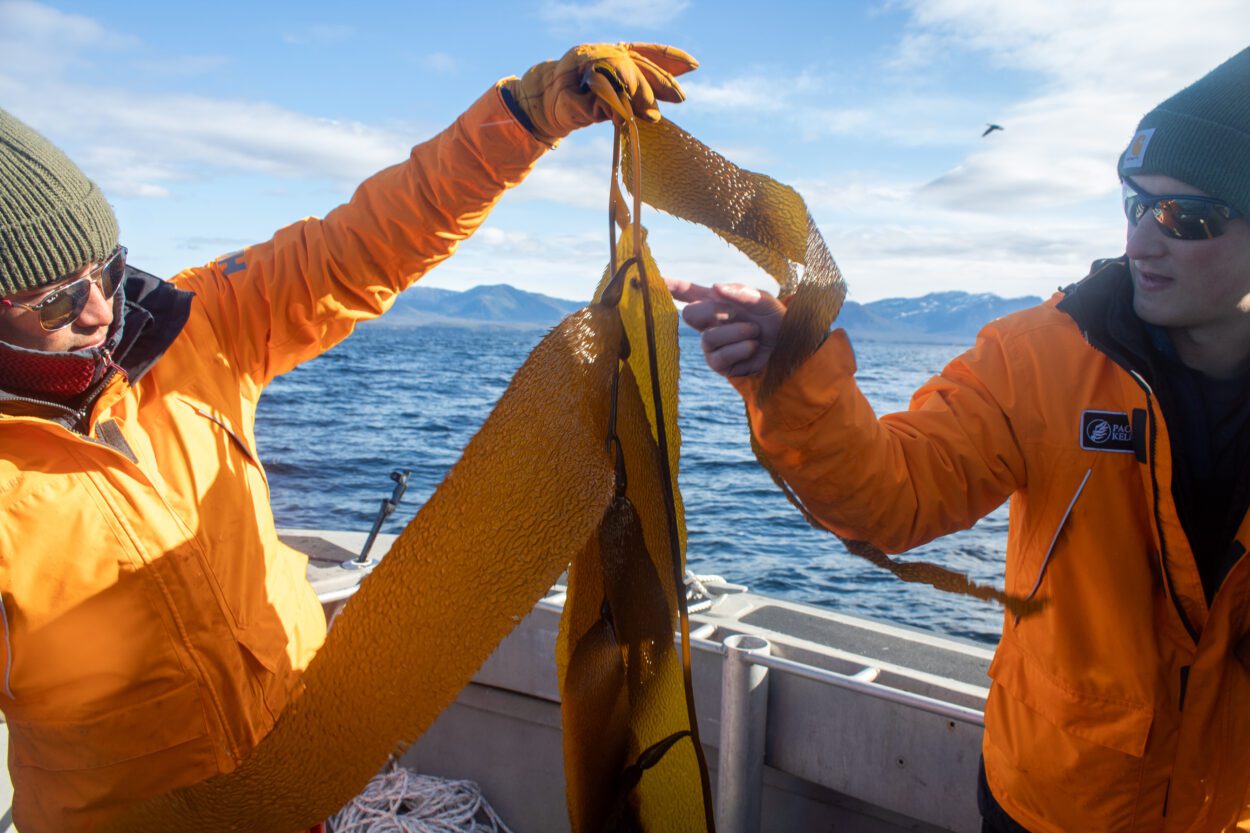
As the boat drifted ahead, his business partner Nick Stern noticed a kelp strand within reach. Using a gardening rake, he pulled it on board, cut off a few feet and threw the rest back. As Stern held up the shiny seaweed for a photo op, Smet explained the basic anatomy of Macrocystis pyrifera, the species known as giant kelp.
“So you have the blade, pneumatocyst, which is the little air pocket, and then stipe,” Smet said.
Giant kelp is probably what you picture when someone says “kelp,” those flowing golden-brown towers that fish dart through and sea otters like to sleep on top of. And this species is what brought the two entrepreneurs to Ketchikan.
After working several years in New York finance, the college friends decided to quit their jobs and start a company that could be both profitable and good for the planet. Stern grew up working on a garlic farm, so Smet said they wanted to focus on agriculture.
“We looked at a lot of different businesses, things like spirulina, or on-land-aquaculture, mushrooms, greenhouses, vertical farming,” Smet said. “And we thought that kelp was by far the most environmentally beneficial. And we thought, ‘Oh, there could really be a business here.’”
They settled on giant kelp because it’s one of the world’s fastest growing organisms, at up to two feet per day. That means their new company Pacific Kelp Co., can grow more biomass in a given area, making for a more efficient business model. They just got permitted to start a giant kelp farm in the waters off of Duke Island, and they plan to begin planting this summer.
Kelp farming is still a young industry in Alaska, but one that’s created a lot of excitement. Farmers throughout the state’s coastal communities can grow high quality kelp, a type of seaweed, but they’ve been hampered by a lack of local processing and insufficient demand for their products.
The Pacific Kelp founders think they can help address both of those issues.
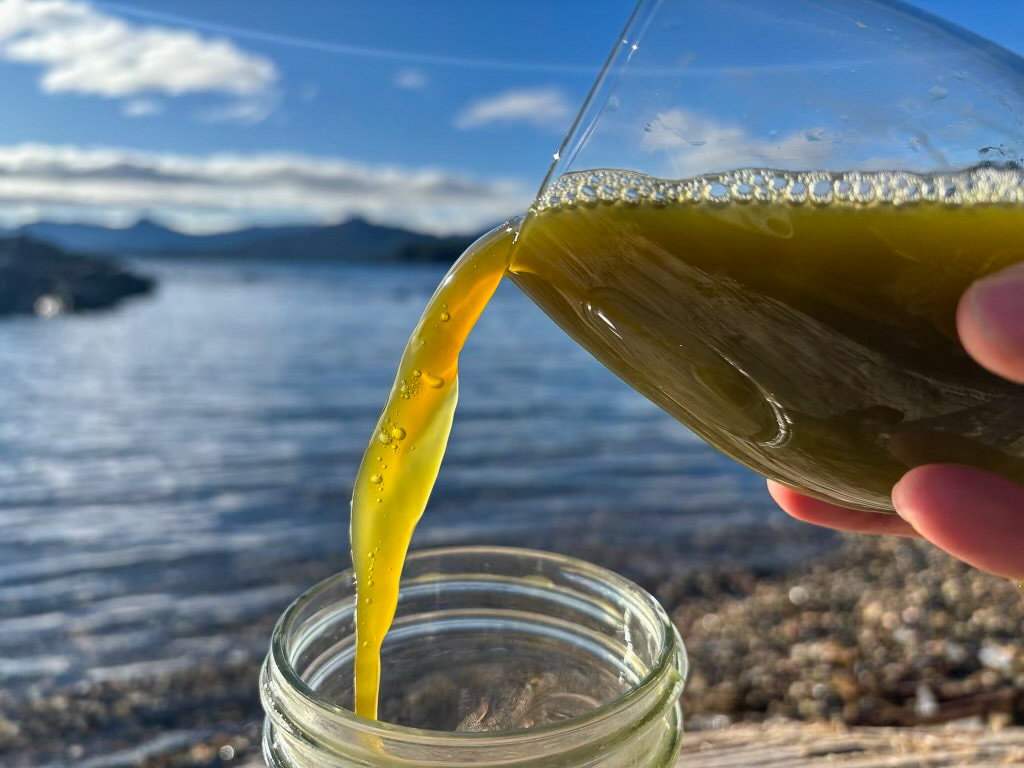
They’ve been refining giant kelp into a liquid extract that they think can have big implications for the terrestrial farming world. They just received a grant to work with two universities, studying the benefits their extract has on growing wine grapes and grass. If it’s proven to work as they hope, it could drive up demand for kelp throughout Alaska.
And Pacific Kelp Co. will soon have something else to help their industry neighbors: a processing facility. Back on dry land, Stern stood inside a warehouse just south of downtown Ketchikan.
“With the equipment we have today, we can do about 1,000 kilograms or 2,200 pounds of raw kelp per day,” Stern said, pointing to their shredder and other machinery.
The company is sharing the space with local dive fisherman, but say they have plenty of room to process kelp from other regional farms and their own. Alaska currently has very few kelp processors, which makes it difficult and expensive to get the cumbersome raw product to markets in the Lower 48. Stern said that’s an industry gap they’re trying to fill.
“We’ve had talks with kelp farmers up in Kodiak and Juneau, over in Prince of Wales,” Stern said. “So once we’re up and running, [we can] buy their product, process it for them, and distribute and sell it into markets that we have been spending the better part of the last two years trying to cultivate and build.”
Part of that market cultivation process is proving that their liquified kelp extract can be an effective biostimulant, a specialized type of fertilizer. Kyle Wickings is one of two researchers they’ve partnered with to conduct field trials to demonstrate the value of their product. He’s a Cornell biologist who studies grass (officially called “turfgrass”) and he thinks Pacific Kelp’s fertilizer could help make grass, or any number of other plants, more resistant to stressors like drought and pests. And as bans on certain insecticides go into effect, Wickings said this extract could help farmers replace them.
“When you’ve got the potential for a product like a seaweed extract to sort of up regulate those defenses and stress tolerance of the plant, that’s, I think, what drives a lot of the interest across the whole range of different agricultural sectors,” Wickings said.
The $500,000 research grant comes from the Southeast Conference, a regional economic development organization. The goal of the project is to strengthen Alaska’s mariculture industry while contributing to broader agricultural sustainability efforts. Stern hopes the research will stir up demand for kelp products by showing that they can save farmers money on things like irrigation and synthetic fertilizer.
“If every school in the country is spraying kelp on their turf grass, they’re using a lot less water and fertilizer, but they’re also using a lot more Alaskan kelp,” Stern said.
Pacific Kelp plans to get their extract certified as a basic fertilizer and onto shelves in the next few months. The research project over the next two years will help the company complete the much more rigorous process to register as a specialized biostimulant.

Alaska
Alaska Sen. Dan Sullivan’s primary challenger who has the same name is eligible for ballot, judge rules

A man with the same name and party affiliation as Alaska Republican U.S. Sen. Dan Sullivan is eligible to challenge the senator in the August primary, a judge ruled Friday.
Superior Court Judge Thomas Matthews’ ruling overturns a June 15 decision by Division of Elections Director Carol Beecher to disqualify the challenger and keep him off the primary ballot. Matthews’ ruling can be appealed to the state Supreme Court.
Attorneys for the state have said Tuesday is the deadline for a final ruling so that ballots for the Aug. 18 primary can be printed.
The judge ruled that the division’s decision to exclude Dan J. Sullivan because his candidacy was not “in good faith” was not based on the Constitution, Alaska law or the division’s own regulations. The retired teacher from the small fishing community of Petersburg filed to challenge the incumbent.
“Instead, the decision was based upon a new, previously unstated, ‘good faith’ criteria,” the judge wrote.
The division is appealing the decision, Sam Curtis, a spokesperson with the state Department of Law, said by email Saturday. Jeffrey Robinson, an attorney for Dan J. Sullivan, said in an email he expected the division to appeal and couldn’t comment until the Alaska Supreme Court rules on the case.
The controversy over the two Dan Sullivans has underscored the stakes involved in the incumbent’s reelection campaign. The Alaska race is one of about half a dozen U.S. Senate races expected to be highly competitive in the fall, and the seat is one Democrats are trying to flip in their efforts to try to regain the majority. But it’s expected to be an uphill battle in a state that President Trump won by 13 points in 2024.
The senator and allies, including the National Republican Senatorial Committee, have condemned the challenger’s efforts to join the race, arguing his presence could confuse voters. Republican Lt. Gov. Nancy Dahlstrom earlier this month opened an investigation into the non-Senator Sullivan’s candidacy.
Under Alaska’s election system, the top four candidates from the primary, regardless of party, move on to the ranked-choice November general election.
The senator has accused the challenger Sullivan of working with Democrats and the campaign of Democratic former U.S. Rep. Mary Peltola — who is considered the senator’s main opponent — to cause confusion and boost Peltola’s chances. The sitting senator brought the situation to reporters’ attention at the Capitol earlier this month, accusing Democrats of being “complicit in trying to trick Alaskans” to “rig an election in their favor.”

Peltola’s campaign and state Democrats have denied the allegation, as has the challenger.
Sen. Sullivan and Peltola are the highest-profile candidates in the crowded race and the only ones to report raising any money.
Beecher has said she determined the challenger Sullivan is not eligible to run because his candidacy was not filed in good faith and instead was done with an intent to confuse voters. She said he had registered to vote as Daniel J. Sullivan Jr. and, in conjunction with his candidacy, changed his party affiliation to Republican. She also cited similarities between his campaign website and the senator’s, and his work with a consultant whose clients have included some Democrats. She did not mention finding any evidence of alleged coordination.
In arguing to keep the challenger disqualified, attorneys for the state pushed back on suggestions the ballot could be designed in a way to reduce voter confusion over two candidates with the same name and party running for the same office.
“The Constitution does not require States to place a sham candidate on the ballot and then attempt to mitigate the damage through design choices,” attorney Rachel Witty, with the Alaska Department of Law, and outside attorneys Christopher Murray and Michael Francisco wrote in court filings.
Attorneys for the challenger Sullivan argued that the Constitution lays out three exclusive qualifications for the Senate, addressing only age, citizenship and residency. They said Beecher lacked the legal authority to boot their client off the ballot.
The challenger Sullivan has said that sharing a name and party affiliation with the incumbent gave him “an instant megaphone.” But the 69-year-old retired teacher and former U.S. Forest Service employee said he had considered a run for some time and had grown frustrated with the senator.
He initially was certified on the state’s candidate list as Dan J. Sullivan, with the senator listed as Dan S. Sullivan and identified as the incumbent.

America 250 Baked Alaska
Delmonico’s
In the conversation about the world’s greatest steakhouses, Delmonico’s is always among the shortlist of names.
The Lower Manhattan institution is a destination for New Yorkers and tourists alike, an attraction as much as a restaurant. First opened in 1837, it is widely recognized as America’s first fine-dining restaurant. It was here that dishes that have become cultural symbols of this country as much as they are cuisine were born: the Delmonico Steak, Lobster Newberg, Eggs Benedict, and perhaps most famously, Baked Alaska.
Now, as the United States prepares to celebrate its 250th birthday, Delmonico’s is giving one of its signature creations, a dessert that’s as much a cultural symbol as it is a sweet ending, a patriotic makeover.
On July 4, the restaurant will debut the America 250 Baked Alaska, a reinterpretation of the classic dessert that celebrates both the nation’s history and North America’s native ingredients. The striking red, white, and blue confection has already earned the nickname “America’s Birthday Cake.”
The dessert was created by acclaimed pastry chef Miro Uskokovic of Hani’s Bakery + Cafe in the East Village, who also serves as Delmonico’s consulting pastry chef. While his interpretation is rooted in the original version, he has reimagined it with a distinctly American theme.
Pawpaw, the largest fruit native to North America, becomes a rich ice cream. Wild blueberry lemonade sorbet adds a bright, tart layer, while pecan cake- made with the only major tree nut indigenous to North America- forms the base. Mixed berry jam, toasted meringue, and fresh seasonal berries complete the dessert.
The cone-shaped presentation also pays tribute to history.
The original Baked Alaska dates to 1867, when the legendary French chef Charles Ranhofer, who headed the kitchen at Delmonico’s in the late 19th century, created the dessert to commemorate the United States’ purchase of Alaska from Russia. Epicurean lore goes that Ranhofer originally called the dessert “Alaska, Florida,” highlighting the contrast between frozen ice cream and warm toasted meringue. He later featured elaborate mountain-shaped versions in his 1894 cookbook, “The Epicurean.”
Today, nearly 160 years later, Delmonico’s is revisiting that theatrical presentation while looking ahead to its next chapter.
“This dessert is a piece of American history,” says Dennis Turcinovic, owner and executive culinary partner of Delmonico’s Hospitality Group. “Delmonico’s has never just served food. For nearly 190 years, it has served hope, opportunity, and the American dream. Today, we’re celebrating that with our red, white, and blue Baked Alaska.”
For Uskokovic, it’s both a history lesson and a celebration.
“America’s 250th anniversary presents an opportunity to celebrate not only our nation’s history, but the evolution of American cuisine,” he said in a release announcing the dessert. “We wanted to revisit one of the most important desserts in Delmonico’s history while showcasing ingredients that are uniquely American.”
According to a release, the dessert will be available as a serving for two for $40, with production limited to just 10 each day because of its labor-intensive preparation. Larger versions serving 10 to 12 guests can also be ordered for private celebrations.
The best part? For non-New Yorkers clamoring for a chance to try the dessert, the America 250 Baked Alaska is here to stay as a permanent fixture on the menu. And when Delmonico’s Reserve, the brand’s upcoming Midtown Manhattan restaurant, opens next year, New Yorkers and visitors alike can order it there.
Alaska
Man with same name as US Sen. Dan Sullivan is eligible for Alaska’s primary ballot, judge rules – WTOP News

JUNEAU, Alaska (AP) — A man with the same name and party affiliation as Alaska Republican U.S. Sen. Dan Sullivan…
JUNEAU, Alaska (AP) — A man with the same name and party affiliation as Alaska Republican U.S. Sen. Dan Sullivan is eligible for the August primary and can appear on the ballot, a judge ruled Friday.
Superior Court Judge Thomas Matthews’ ruling overturns a June 15 decision by Division of Elections Director Carol Beecher to disqualify the challenger and keep him off the primary ballot. Matthews’ ruling can be appealed to the state Supreme Court.
Attorneys for the state have said Tuesday is the deadline for a final ruling so that ballots for the Aug. 18 primary can be printed.
The controversy over the two Dan Sullivans has underscored the stakes involved in the incumbent’s reelection campaign. The Alaska race is one of about a half dozen U.S. Senate races that are expected to be highly competitive in the fall, and the seat is one Democrats are trying to flip in their efforts to try to regain the majority.
The senator and allies including the National Republican Senatorial Committee have condemned the challenger’s efforts to join the race, arguing his presence could confuse voters. Under Alaska’s election system, the top four candidates from the primary, regardless of party, move on to the ranked choice November general election.
The senator has accused the challenger Sullivan of working with Democrats and the campaign of Democratic former U.S. Rep. Mary Peltola — who is considered the senator’s main opponent — to cause confusion and boost Peltola’s chances. Peltola’s campaign and state Democrats have denied the allegation, as has the challenger.
Sen. Sullivan and Peltola are the highest-profile candidates in the crowded race and the only ones to report raising any money.
Beecher has said she determined the challenger Sullivan is not eligible to run because his candidacy was not filed in good faith and instead was done with an intent to confuse voters. She said he had registered to vote as Daniel J. Sullivan Jr. and in conjunction with his candidacy changed his party affiliation to Republican. She also cited similarities between his campaign website and the senator’s, and his work with a consultant whose clients have included some Democrats. She did not mention finding any evidence of alleged coordination.
In arguing to keep the challenger disqualified, attorneys for the state pushed back on suggestions the ballot could be designed in a way to reduce voter confusion over two candidates with the same name and party running for the same office.
“The Constitution does not require States to place a sham candidate on the ballot and then attempt to mitigate the damage through design choices,” attorney Rachel Witty, with the Alaska Department of Law, and outside attorneys Christopher Murray and Michael Francisco wrote in court filings.
Attorneys for the challenger Sullivan argued that the Constitution lays out three exclusive qualifications for the Senate, addressing only age, citizenship and residency. They said Beecher lacked the legal authority to boot their client off the ballot.
The challenger Sullivan has said that sharing a name and party affiliation with the incumbent gave him “an instant megaphone.” But the retired teacher and former U.S. Forest Service employee, who is 69, said he had considered a run for some time and had grown frustrated with the senator.
He initially was certified on the state’s candidate list as Dan J. Sullivan, with the senator listed as Dan S. Sullivan and identified as the incumbent.
Copyright
© 2026 The Associated Press. All rights reserved. This material may not be published, broadcast, written or redistributed.
-

 New York19 minutes ago
Metropolitan Diary Challenge Day 1: What Is Your N.Y. Story?
-

 Los Angeles, Ca26 minutes ago
LASD releases video of man shot by deputy after allegedly charging them with knife
-

 Detroit, MI44 minutes ago
Rick Mahorn returns to coaching Detroit basketball with BIG3 Amps
-

 San Francisco, CA56 minutes ago
Suspect arrested after shooting near San Francisco Pride events, police say
-

 Dallas, TX59 minutes ago
Dallas shooting injures 2 as police search for suspect
-

 Miami, FL1 hour ago
Colombia wins Group K after 0-0 draw with Portugal in Miami Stadium; both teams advance to World Cup knockouts
-

 Boston, MA1 hour ago
Beyond the frame: ‘Where’s Boston?’ revisited through new oral histories – Boston News, Weather, Sports | WHDH 7News
-

 Denver, CO1 hour ago
Arizona Cardinals will face Denver Broncos QB Bo Nix for 1st time

