Finance
Trillion-Dollar Fusion: AI And Crypto Rewiring Finance


human hand taking bitcoin from robotic hand
Your money never sleeps. Before the world wakes, artificial intelligence (AI) driven systems are already scanning markets, seizing opportunities, and securing profits. This isn’t the future—it’s happening now.
AI and blockchain—the twin engines of autonomous finance—aren’t just digitizing money; they’re rewiring finance itself. Blockchain is the trust engine, enforcing transparency and enabling atomic settlement—no middlemen required. AI is the intelligence engine, continuously learning, predicting, and executing trades in real time through autonomous agents.
These agents optimize capital flows with unmatched speed, but their rapid evolution introduces structural risks—algorithmic instability, security vulnerabilities, regulatory blind spots, and the potential for cascading failures if safeguards aren’t in place. Retail investors now tap into hedge-fund-grade strategies—but they’re also vulnerable to flash crashes that can erase savings in an instant.
The result? A financial system that never stops learning, adapting, and executing—reacting to market shifts at speeds no human can match.
Finance’s power dynamics are shifting as Wall Street titans and nimble disruptors leverage these technologies to gain an edge. Institutional investors deploy algorithms that execute optimum trades, while tech-first banks dramatically cut operational costs. Traditional wealth managers accustomed to relationship-driven finance must now adapt to a world where algorithms make split-second decisions.
Trillion-Dollar Upheaval
The financial services market is staggering: $100 trillion in asset management, $240 trillion in global payments, $200 trillion in banking, and trillions trading in repo markets daily. AI is surging toward $1.8 trillion, crypto is cementing its $2 trillion foothold, and tokenization is set to unlock $16 trillion in liquid assets by 2030.
At this scale, efficiency gains—such as instant settlements and the removal of intermediaries—don’t just cut costs. They create new profit centers for incumbents and unlock high-value opportunities for investors and entrepreneurs, reshaping the financial landscape.
For centuries, financial power was concentrated in the hands of a few—banks with rigid hours, brokers with steep fees, and investment firms with high barriers to entry. That dominance is fading. AI and blockchain aren’t just making finance faster; they’re making it accessible. Hedge fund-grade strategies, real-time insights, and automated portfolio management are no longer reserved for institutions. From fraud detection to high-speed execution, intelligent systems eliminate inefficiencies and redefine financial participation. The gates are no longer locked—anyone with an internet connection can enter.
Industry Giants Are Paying Attention
Traditional finance (TradFI) sees the shift—AI and blockchain are no longer experimental; they’re becoming the backbone of financial infrastructure. But adoption isn’t instant. Financial institutions, entrenched in compliance and legacy systems, must tread carefully—yet they aren’t sitting idle. They recognize the potential and are actively integrating AI’s paradigm-shifting capabilities in advanced analytics and dramatic operational efficiency gains while methodically exploring blockchain for settlement and tokenization.
Meanwhile, Silicon Valley’s tech titans—Microsoft, Amazon, Meta, Google, OpenAI, and Nvidia—are unleashing powerful AI innovations, building the infrastructure they believe will underpin entire industries, finance included. With total investments approaching the trillion-dollar mark, these tech giants are betting big on AI’s transformative potential across the entire economy.
BlackRock, managing a jaw-dropping $10 trillion, sent shockwaves through Wall Street by launching its first tokenized fund on Ethereum. Suddenly, blockchain wasn’t just for crypto diehards—it was institutional finance’s next big move. Fidelity and Schwab are building institutional crypto custody and trading services. Meanwhile, crypto’s early disruptors like Coinbase and Kraken have evolved into AI-powered financial powerhouses, integrating real-time fraud detection and high-speed execution that outpaces legacy markets.
The Living Market: Finance’s New Nervous System & Digital Workforce
Together, AI and blockchain create an ecosystem where automation isn’t just about speed but about trust, security, and predictive intelligence. A new financial nervous system is emerging—one that doesn’t just automate but actively thinks, learns, and adapts. This evolving network integrates security, adaptability, and intelligence seamlessly. Blockchain serves as the backbone, while AI functions as the cognitive layer—transforming static rules into dynamic learning. This isn’t just a faster version of today’s financial systems; it’s an entirely new species.
Traditional finance relies on centralized controls and human intervention. This new ecosystem makes autonomous decisions, self-corrects vulnerabilities, and optimizes in real-time. The implications extend beyond efficiency—we’re entering an era where capital moves with real-time intelligence, reacting instantly to opportunities and risks.
This shift isn’t about 24/7 markets—it’s about superhuman markets. AI-driven trading reads millions of signals at once, hedges risks in milliseconds, and fine-tunes strategies faster than any human trader could dream of.
Fintech world map
The AI-Blockchain Nexus: Reshaping Financial Infrastructure
The convergence of AI and blockchain isn’t just an incremental upgrade—it’s a fundamental shift in finance. At their intersection, these technologies unlock capabilities neither could achieve alone, reshaping trading, payments, security, and infrastructure.
Trading & Investment Platforms
Coinbase and Kraken use machine learning to detect fraud in microseconds while analyzing complex market patterns beyond human capability. Fidelity is expanding institutional-grade custodial and trading services, while Charles Schwab’s blockchain-backed ETFs offer mainstream investors a gateway to digital assets. SoSoValue, an AI-powered trading platform, launched SSI on Base Chain, enabling users to hold algorithmically rebalanced crypto baskets, like on-chain ETFs. With 30M registered users and 1M DAUs in 2024, it hit $200M TVL within weeks of staking launch. Its top index tokens, MAG7.ssi and USSI (hedged MAG7.ssi for funding rate earning), rank among Uniswap Base’s top 5 liquidity pools.
Payment & Settlement Systems
AI-driven fraud detection and transaction optimization are transforming payments. PayPal’s AI systems have cut fraud rates by 30% while processing over $1.5 trillion annually—all without customers noticing. Stripe enhances payment routing with machine learning, reducing costs for merchants. Visa is piloting AI-powered cross-border settlements, while Ripple’s AI-enhanced payment systems analyze transactions in real-time, improving security and slashing settlement times.
Security & Risk Management
Aave and Compound use AI-driven predictive models to dynamically adjust lending rates and mitigate liquidity risks. OKX integrates multi-party computation (MPC) wallets, reinforcing cryptographic security. Layer-2 networks like Polygon and Optimism are experimenting with AI-enhanced smart contract audits, minimizing vulnerabilities in decentralized applications. WhiteBIT is a thoroughly audited crypto exchange, with security certification (CCSS Level 3) and PCI DSS certification. Security measures include multi-user approval protocols, cold storage for 96% of funds, and advanced encryption for private keys. CER.live includes it among its top five exchanges for security. Through institutional partnerships and its Barcelona sponsorship, WhiteBIT continues advancing mainstream crypto adoption.
Infrastructure & Development
JPMorgan is deploying AI-driven analytics to optimize blockchain-based settlements, while Goldman Sachs is exploring AI applications in tokenized asset management. ConsenSys and Polygon are developing AI-enhanced smart contract infrastructure to improve governance efficiency and scalability in decentralized ecosystems. Meanwhile, Circle is embedding AI into compliance systems, simplifying regulatory processes for digital assets. ForU AI pioneers Real-World AI (RWAI), enabling users to create AI-DIDs and train autonomous AI Agents for on-chain economies. These agents, guided by goals, KPIs, and tokenized incentives, drive real economic activity while ensuring transparency and accountability. By merging AI with blockchain’s decentralized coordination, ForU AI is redefining automation—empowering communities to govern, build, and optimize shared financial and social ecosystems.
The shift from human-managed finance to AI-powered financial ecosystems is no longer theoretical—it’s already in motion. The future of finance isn’t just about speed—it’s about autonomy, adaptability, and continuous evolution.
The AI-Blockchain Dilemma: Hype Meets Hard Reality
AI and blockchain are rewriting finance, but they come with real risks.
Regulators struggle to keep up with borderless AI-driven markets, where oversight gaps can allow hidden risks to pile up. Algorithmic volatility is another wild card—just look at the 2010 Flash Crash when high-frequency trading erased nearly $1 trillion in minutes. Regulators worldwide, from the SEC to the European Commission, are actively assessing how to oversee AI-driven markets, but no global framework yet exists.
And while blockchain promises decentralization, AI’s massive computing demands could shift power to those with the biggest infrastructure, reinforcing financial gatekeeping instead of breaking it.
The biggest unknown? Financial stability. Traditional markets have circuit breakers and central banks to stop crises from spiraling out of control—but in AI-powered, blockchain-driven finance, who steps in when things go wrong?
These challenges aren’t theoretical—they’re already shaping global regulatory debates. The future of AI-driven finance depends on how we balance innovation and control.
Your Place in the Financial Revolution
Finance is at an inflection point, undergoing an infrastructure overhaul with profound, far-reaching effects. For centuries, financial expertise has been locked behind exclusive credentials and privileged access. AI and blockchain are dismantling these walls, making advanced financial tools available to everyone. Make no mistake: this isn’t some distant future to contemplate—it’s a financial tsunami already reshaping the shore. Finance is diverging: the old system, built for a slower, human-driven market, and the new frontier—optimized for instant, AI-powered decision-making.
As you read this, billions are flowing through AI-driven systems—relentless, autonomous, and unstoppable. The tide is shifting. Ride the wave, or get left behind.



DULUTH — The Duluth Homegrown Music Festival is seeking both new operational leadership and a solution to financial filing issues that caused the organization to lose its federal tax-exempt status, which it has not held since 2022.
The organization is currently operating as a taxable nonprofit, confirmed Don Ness, the former Duluth mayor who serves as president of Homegrown’s
board of directors.
Ness and the board are working to discern whether there might be any outstanding tax liabilities in the wake of an apparent filing lapse.
“It’s a serious matter that requires diligence to do things right, and to correct past oversight, and to make sure that we are in full compliance with all tax and regulatory requirements,” Ness said. “The board is 100% committed to that course of action.”
As the Duluth Monitor first reported, Homegrown had its federal tax-exempt status revoked in 2022 after failing to make required financial reports for three years. The Monitor also reported that Minnesota Attorney General Keith Ellison’s office has notified the organization it may be in violation of state law requiring the proper registration of soliciting charities.
Clint Austin / Duluth Media Group file photo
“All but one of us have been on for less than a year,” Ness said of the current board members. “We’ve been committed to saying, ‘hey, we need to improve the points of accountability.’”
The organization will also require new operational leadership. Co-directors Cory Jezierski and Dereck Murphy-Williams resigned earlier this month, after leading Homegrown through four successful festivals.
“My contract ended at the end of May, and I knew a few days later that I did not want to continue in that position,” Jezierski said. “Simply put, it was the best thing for my mental health. It’s a job that requires many, many hours and a lot of work, and it can be very stressful as well.”

Amy Arntson / Duluth Media Group file photo
Murphy-Williams did not respond to an interview request for this article, nor did preceding Homegrown director Melissa LaTour. According to LaTour’s
LinkedIn profile,
she was Homegrown director from 2016 to 2022.
Jason Beckman, a recent president who is no longer serving on the board, responded to a News Tribune email but did not provide an interview availability before this article went to press.
Ness does not believe the reporting lapses were due to any ill intent. He praised Jezierski and Murphy-Williams for their success managing festival operations. “They cared deeply about the festival,” he said. “It’s amazing to see that our community continues to support this really unique and special festival.”
“Those guys run a hell of a festival,” said Scott Lunt, festival founder and a current board member. “I think they needed help with bookkeeping.”

Clint Austin / Duluth Media Group file photo
By Jezierski’s account, issues with the festival’s tax status became apparent shortly after he became co-director. “We went to file taxes, they were rejected,” Jezierski said. “At that time we, of course, didn’t know why right away, but once we started pulling on that thread, we unraveled a whole lot of the problems that were going on.”
Jezierski said “it took a long time to try to get any sort of help” from the board, but said that by the time he and Murphy-Williams left the organization, “everything had been turned over to be reconciled” with a financial professional.
Ness, like Lunt, was deeply involved with Homegrown in its first decade but had not had an official role with the festival since then. After launching the festival in 1999 and running it on his own for several years, Lunt was “burnt out,” Ness remembered.

Derek Montgomery / Duluth Media Group file photo
After a transition period during which the festival was run in partnership with the Ripsaw newspaper, Homegrown established a nonprofit organization in 2006 with Ness as festival director. Ness subsequently stepped down when he was elected mayor in 2007.
By 2025, Ness was in his current position as executive director of the Ordean Foundation.
“I was approached by a couple of longtime music scenesters,” Ness recalled. “They said, ‘There are questions about (Homegrown’s) nonprofit status. There are questions about some governance issues. We’re concerned.’”
Ness agreed to join the board, and became president. The 2026 festival ran smoothly from an operational standpoint, but Ness found the financial reporting to be lacking.

Clint Austin / Duluth Media Group file photo
“The last board meeting that we had prior to the (co-directors’) resignations was intended to be an overview of the festival that was a month before,” Ness said. “I certainly felt very uncomfortable with how little financial information we were receiving.”
Lunt also joined the board in 2025, marking his first time serving in that capacity. He said the new board has been spending significant time addressing the accounting and reporting issues.
“Every year at Homegrown time I’m like, ‘I should get more involved,’ and then I don’t,” Lunt said. “Then this board thing came up, and it was kind of sold to me as, like, four meetings a year. I was like, ‘Oh, that’s perfect.’ And now we’re meeting weekly.”

Clint Austin / Duluth Media Group file photo
Although it’s unclear how the organization’s finances will look when the accounting and reporting issues have been fully addressed, along with any outstanding tax liabilities, both Ness and Lunt said they are confident the annual festival will continue without interruption.
“The organization will continue,” Ness said. “The festival will continue. Homegrown is in no danger in terms of its viability.” The financial documentation Ness initially received indicated budgeted revenues of about $140,000, against about $130,000 in expenses.
“Financially, I think we’re in a great spot. We have the money to hire the (financial) professionals, and we have (done so),” Lunt said. “We were hoping that we could get all this sorted out before it had to become more public.”
“We poured countless hours into this festival, and this is how it ends, with everyone talking about this,” Jezierski said. “It’s rough.”
“There’s a DIY ethos that is really at the core of Homegrown,” reflected Ness. “We’re throwing a music festival that isn’t waiting for some famous band from the East Coast to bless us with their presence. We are doing this on our own.”

Clint Austin / Duluth Media Group file photo
That DIY spirit also means “you’re kind of passing wisdom down from person to person, and sometimes that’s imperfect.” Ness continued. “The ways that we do things evolve over time, because it’s not a buttoned-down corporate sort of thing. That can create its own set of challenges.”
“It’s self-supporting,” said Lunt about the festival. “It’s widely volunteer-run. You do need to pay a couple people, obviously, to keep track of some things, but it’s going to be strong into the future. It’s gone through its bumps before.”

While most AI in financial services remains advisory, LUMIQ has built the layer that owns the decision — autonomous, auditable AI agents making regulated calls in production at leading banks, insurers, and capital markets firms. Today, LUMIQ serves clients across India, the United States, and Southeast Asia — leading institutions across insurance, banking, and capital markets.
NEW YORK and SINGAPORE, June 19, 2026 /PRNewswire/ — LUMIQ, an AI-native financial services company, today announced a strategic funding round to scale auto-decisioning for financial institutions across the United States and Southeast Asia. The round was led by Bajaj Finserv, one of India’s largest and most diversified financial services groups, with participation from existing investor Info Edge Ventures.
Right now, thousands of customers are waiting for a policy to be issued, a loan to be disbursed, a claim to be adjudicated, because somewhere an FSI employee is drowning in decisions, held back by the risk of getting it wrong. Today, when e-commerce delivers the same day, banks and insurers still decide in weeks. We built LiteCone to take that burden: AI decides the routine cases, completely and accountably, so humans spend their judgment on the one case that actually needs it. This round lets us bring that to every financial institution in the markets that matter most.
Shoaib Mohammad, Co-founder and CEO, LUMIQ
From AI that assists to AI that decides
For decades, financial institutions have bought technology that made their people faster — faster data, faster scoring, faster copilots. The decision still landed on a human. LUMIQ is changing that. Through its LiteCone platform, the company deploys AI agents that read the file, apply the institution’s own guidelines, and reach the decision end to end — escalating only the cases that genuinely require human judgment. The output is not a recommendation. It is a decision, with full reasoning attached, cross-referenced to policy, and defensible under audit.
The results in production speak clearly. At a leading life insurer, LUMIQ’s LEO agent decides 75–80% of underwriting cases with zero human touch, reduced policy issuance cost by roughly 25%, and compressed turnaround from days to under eight minutes — running 24×7 with complete auditability. Across its client base spanning insurance, banking, and capital markets in India, the US, and Southeast Asia, LUMIQ now processes millions of decisions annually.
LiteCone turns a real financial-services role into a working AI agent in weeks. Every agent we deploy is consistent, explainable, compliant, and auditable by design — not as an afterthought. This capital lets us go deeper on the platform and broader across roles. And through our cloud and AI lab partnerships, institutions will increasingly find LiteCone already embedded in the platforms they run today.
Vaibhav Dobriyal, Co-founder and Chief Product Officer, LUMIQ

Consumer confidence has plunged among traditionally optimistic younger adults amid fears for their personal finances and the wider economy, figures show.
GfK’s long-running Consumer Confidence Index remained unchanged at an overall score of minus 23 in June.
However, the analyst said this was was “misleading as, beneath the surface, there are new signs that confidence is weakening”.
Neil Bellamy, consumer insights director at GfK, said: “The biggest fall this month is among those aged 16 to 29, traditionally one of the most optimistic groups.
“Here confidence has dropped 11 points over the past month to minus two, the lowest level seen for two years, driven by large falls in views on both their own personal finances and the wider economy.
“More broadly, there are now no demographic groups with a positive confidence score, including higher-income households earning £50,000 or more, who have slipped back into negative territory as of June.
“Confidence remains subdued and vulnerable to further economic or political uncertainty.”

Overall, confidence in personal finances over the coming year remained flat at minus two, four points lower than this time last year.
The measures of both personal finances and the economy over the previous 12 months were both slightly down, by two points and three points respectively, “reflecting the sense that things have been extremely tough over the last year for so many”, GfK said.
The only measure to increase was expectations for the wider economy over the next 12 months, up two points to minus 36 but still eight points below this time last year.
The major purchase index, an indicator of confidence in buying big ticket items, remained at minus 20, four points lower than June last year.
-

 Health4 minutes ago
Measles-infected traveler may have exposed passengers at LAX and nearby hotel, health officials warn
-

 Sports11 minutes ago
World Cup Red Cards: 2026 Has More Red Cards Than Each Of Last 2 World Cups
-

 Technology14 minutes ago
China’s brain chip breakthrough raises big questions
-
 Business19 minutes ago
Ranch lovers can soon travel with a TSA-friendly kit of the popular American dressing
-
 Entertainment26 minutes ago
At the Fonda, Jane Remover’s violent yearning heralds a new kind of stardom
-
 Lifestyle29 minutes ago
Beer, with a twist? SoCal dads find solidarity through an unexpected activity
-
 Politics34 minutes ago
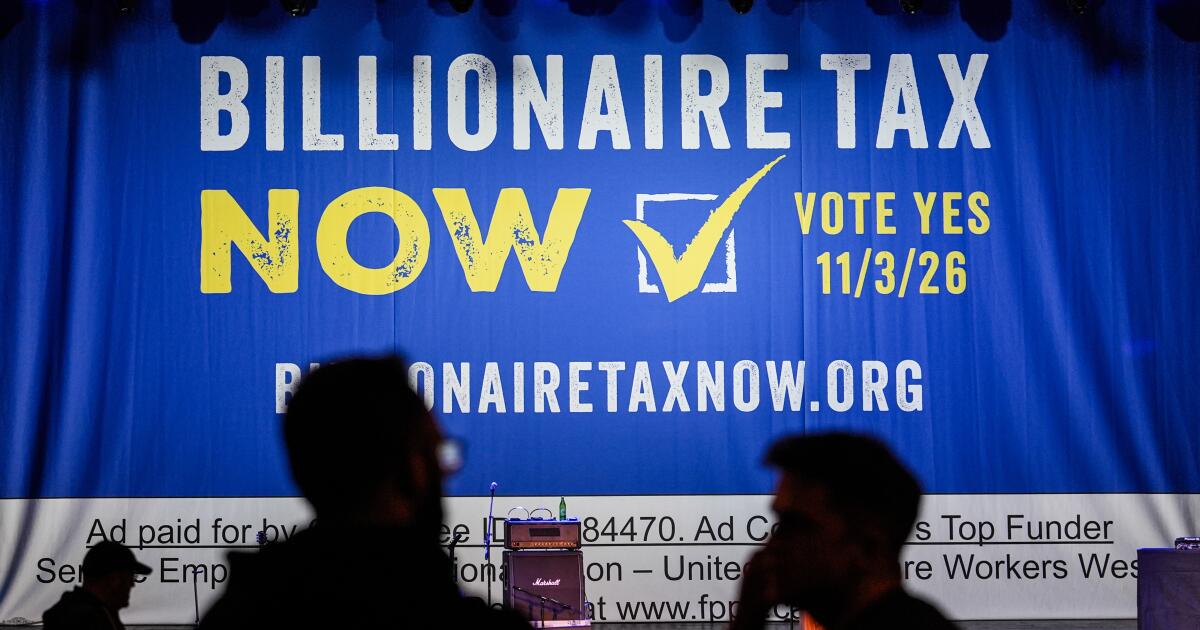
Billionaire tax proposal faces hurdles as it moves closer to November ballot
-
 Science41 minutes ago
Here’s why the Lincoln Memorial Reflecting Pool went green so fast

