Lifestyle
This hidden L.A. stargazing party is 'more interesting than going to a bar'

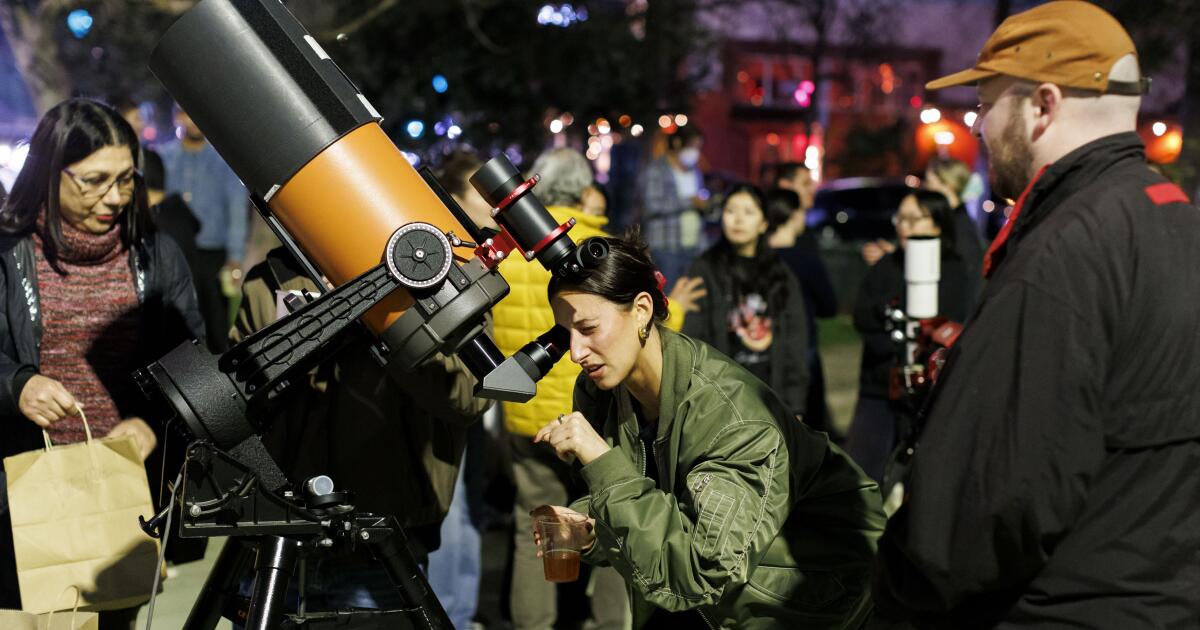
When Dylan Anderson was eight years old, he discovered an old telescope of his grandfather’s. The pirate-esque rig was dusty from years in the garage, but Anderson was instantly intrigued.
“I was like, ‘Hey, what’s this?’ ” the now-18-year-old member of the Los Angeles Astronomical Society said. “I saw Jupiter and its four moons, and I was hooked.”
You’ll hear similar stories from a lot of astronomy enthusiasts, who say that seeing their first big planet was what sparked a lifelong enchantment with the stars. So perhaps it should come as no surprise that the line to see Jupiter, with its milky stripes and four moons, seemed to never end last Thursday evening at the Los Angeles Astronomical Society’s (LAAS) monthly Star Party Silverlake.
The premise for the party is simple: members of the 100-year-old society set up their personal telescopes; community members can circle through and gaze at whatever is on view that night.
This month’s event featured free wine and live music — singer and gayageum player Joyce Kwon accompanied by two harpists. It was also the first time LAAS co-hosted Star Party with Usal Project, an outdoors club dedicated to “newfound nature enthusiasts.” With the additional draw from Usal’s network, over 200 people came to the Sunset Triangle Plaza in Silver Lake to, as LAAS encourages, “look up.”
“We walk around with the pressures of the world, but there’s a lot of reward in just looking up at the universe,” said Bobby Cabbagestalk, 37, an LAAS member who created Star Party in October 2024.
Keith Armstrong, left, president of LAAS, stands with Bobby Cabbagestalk, who created the party.
(Carlin Stiehl / For The Times)
“The idea of ‘looking up’ really translates from an ethos standpoint for the whole reason we both started our projects,” said Michael Washington, 34, the founder of Usal Project. “Being curious, stepping outside your comfort zone, and trying something new.”
Cabbagestalk joined LAAS last summer after running into a group of members stargazing at the Sunset Triangle Plaza, a Thursday night tradition which began in the fall of 2023. The experience immediately sent him back to growing up stargazing with his mom — he recalled that on his 12th birthday, she woke him up in the middle of the night to watch the 2001 Perseid meteor shower. After getting involved with the group, he decided to expand the weekly gatherings with a party once a month, complete with music, drinks and programming, such as happy hour provided by the restaurant Pine and Crane. Cabbagestalk said he hopes guests will have the same sense of childlike wonder that he had when they come to these events.
And if the chatter from the animated crowd was any indication, Star Party was successful in accomplishing its mission.

Anjalika Lobo looks at Mars.
(Carlin Stiehl / For The Times)
“Can I ask a really silly question? … What’s a nebula?”
“Is this the line for Jupiter?
“It better change my life.”
“They should have this here every night!”
Anjalika Lobo, 33, walked from her apartment to the event where she met her friend Katy Maravala, 35. Both women expressed that in a city that can feel so “sceney,” Star Party offered a “low-key” opportunity for community.
“I feel like this is the event that so many people have been craving,” Lobo said. “It’s like that mythical third space that everyone has been whining about.”
“It’s more interesting than going to a bar,” said Maravala. “It’s nice to be surrounded by people who are just as interested in doing something different on their Thursday night.”
“We needed this!” the women laughed.

Usal Project founder Michael Washington, left, talks with fellow stargazers.
(Carlin Stiehl / For The Times)
That same sense of joy in community has buoyed membership of LAAS, which skyrocketed from 300 to 900 members during the pandemic, and now sits at around 1,100 members, according to the president Keith Armstrong.
“We’re all just kinda like orphans, who didn’t have friends and family who were into it, so we all kinda found each other,” said Armstrong, 47. “Because of that, it’s easy to make friends here.”
Armstrong explained that the society is made of everyone from tech bros to actual scientists to astrophotography nerds — and everyone got into it for a different reason. For Alex Vidal, 46, the owner of the telescope that was trained on Jupiter, joining LAAS was about sharing the night sky with as many people as possible; for Justin Hawkins, 40, whose great uncle designed astronaut helmets, exploring astronomy was inevitable as soon as he could budget for his first telescope; for Nasir Jeevanjee, 68, the joy comes from taking long exposure photographs of the stars from his backyard.

The California Nebula imaged by Nasir Jeevanjee, a longtime LAAS member, who photographs the stars from his backyard in Lake Balboa.
(Nasir Jeevanjee)
But for Armstrong, it always comes back to community: even if the weather conditions are poor and the planets aren’t visible, it’s still a chance for the stargazing regulars to grab a beer together on Thursday nights.
“For every unit of energy I put into this thing, I get a unit and a half back,” he said.
At this star party, Jupiter and its moons, Mars, and constellations like Orion, were visible despite Los Angeles’ light pollution. Like Cabbagestalk had hoped, people spilled into the plaza from nearby establishments like El Condor or the Win-Dow to try something different. For most, the wait to see Jupiter was worth it.
“It’s a good reminder that there’s things bigger than us,” said Emily Guarin, 26, whose far-flung group of friends had reconnected specifically for the event. “I was staring at the lines of Jupiter, and it’s like I am here and Jupiter is there, and it doesn’t even know I’m looking at it.”

Stargazers gather to look at the celestial bodies at the Star Party.
(Carlin Stiehl / For The Times)


Lifestyle
L.A. Affairs: It’s hot when a man drives to me. But would this new guy make the trek from the Valley?

I met Dan on Hinge.
He lives in Woodland Hills, and I live in Venice. In Los Angeles, this is considered a long-distance relationship. In another city it might be nothing. Here, it’s a factor.
But I believe that with the right person, you can make anything work, so I stay open. I’m a native New Yorker, and if I were living in Brooklyn and a guy lived on the Upper West Side, that would be a 45-minute subway ride, which is truly nothing in New York. So with that same logic, I try to have flexibility with men in L.A.
When we started planning our first date, Dan suggested three options: a hike on mushrooms, a wine tasting or a walk on the beach.
A hike on mushrooms is something I’d only do with someone I already trust, not someone I just met online. I don’t do first-date hikes because I don’t like feeling trapped if the guy’s a dud. So I chose the wine tasting.
Then I learned the wine tasting was in West Hills.
On a Friday night, driving there from Venice would be insane. So I said I didn’t want to meet there because of the traffic. He suggested Malibu. That was also not ideal on a Friday.
I was getting annoyed — this was a pink flag because in my dating world, the guy is supposed to come to the woman’s neighborhood in the early days. I’ve gone out with plenty of men from the Valley who effortlessly suggested they come to me. It’s not rare or impossible.
I suggested he come to the Westside. I didn’t specifically say Venice, and in hindsight, I probably should have. He landed on Brentwood, which was manageable for both of us. On our first date, we met at an Irish pub on Wilshire Boulevard. He was cuter and more interesting than I had expected, and with the Guinness flowing, we had fun.
When I got home, he texted me: “Well, I like you 🙂 Less the tik tok and the lack of rock music in your life, but it’s not a deal breaker — there are other qualities 🙂 What are your thoughts?”
I noticed the slight negativity but was mostly dazzled that a man texted immediately after the date to say he liked me. In the modern dating economy, this felt rare.
The next day, both of our evening plans fell through, so we made a last-minute date. The wine tasting he originally suggested still sounded like fun, and although it meant me driving to the Valley, I was up for it now that we’d met.
We sipped flights at Malibu Wines & Beer Garden in its airy, romantic courtyard and played a flirty version of Truth or Dare. Halfway through, he dared me to kiss him.
We ended with sushi on Ventura Boulevard and a short make-out session in his car. He invited me to Thanksgiving at his uncle’s, which felt too soon, but also sweet.
After the second date, he texted and said he had his kids that week and was also hosting an event on Thursday, so his only day to meet was Wednesday. I said great.
On Tuesday night, he checked if we were still on, and I said yes.
Then he texted: “I’m flexible on time but not on location. I have a big event on Thursday, hopefully you can come to me again.”
My stomach tightened. This again?
So I texted back: “I drove to you last time, which was a bit of an exception for me especially in the early days, but the wine tasting location sounded special. Usually guys come to my area. How about we switch it up this time?”
He replied: “I appreciate the effort! Because of my event, I’d rather be close to a computer just if needed … Here is what i offer:
— I’ll come to your area anytime next week/end
— Lunch/dinner on me
I want to continue where we stopped last time 😉 No pressure of course, but let’s snuggle”
I responded: “Ok let’s meet next week. Snuggles sound nice … let’s see what happens …”
Then he wrote: “So I won’t see you tomorrow?”
I replied: “Unless you wanna come to me and bring your laptop along, let’s rain check until you have more flexibility.”
He said: “Dang, you are hard. I’ll let you know tomorrow around midday if it’s ok.”
And then — surprise — he decided to come.
He drove to Venice for a 5 p.m. date. He said his ETA was 5 p.m., and it ended up being 5:25 p.m., typical 405 Freeway.
When he showed up, he was in a cranky mood. On our way to KazuNori in Marina del Rey, I thanked him for picking me up and told him I think it’s hot when the guy comes to the girl.
“You’re just saying that because you want me to come to you more,” he said, not playfully, but aggressively.
That was basically the end for me. But there I was, in his car, heading to dinner. So I stayed pleasant and tried to make the best of it.
I shared that in the early stages of dating, I find it’s good etiquette for the guy to come to the woman’s neighborhood. He immediately disagreed and started ranting about how dating rules are ridiculous and how they swing in women’s favor. He resented paying for dates and declared he wasn’t looking to “sponsor a woman’s life.”
“If women want equality and equal rights,” he said, “then it should apply all across the board, including dating, and the man shouldn’t have to pay.”
I said women don’t actually have equal rights because we get paid less than men and often receive lower salaries than men in the same position.
I tried to change the subject and reset the mood, but he insisted we keep hashing it out.
I tried to explain masculine/feminine dynamics: providing and protecting, giving and receiving.
“What does the man get out of this arrangement?” he asked.
It was like watching someone’s personality warp into Mr. Hyde. Then he brought up another point: He’s a single dad of two kids, so he gets tired; and because I don’t have kids, that should factor into who drives where.
At this point, I was barely engaging and focused on eating my hand rolls, and I couldn’t wait to get home.
The check came, and I happily split it, wanting nothing further from him.
In the car back to my place, he remarked: “It’s obvious we’re never gonna see each other again.”
Obvious, but did it need to be stated?
Then he showed me a Spotify playlist he’d made for me of his favorite electronic music, because he knows I like EDM.
“Oh, that’s sweet,” I said.
“Yeah, that’s how I show interest. Through things like this, not who drives to who,” he replied.
When I got out of the car, we wished each other luck, and I headed inside and shut the door.
Two hours later, he sent me the playlist. I’ve yet to listen to it.
It wasn’t the distance that ruined it. It was the resentment. I’m not looking for a man who feels burdened by the effort. I’m looking for a man who sees the value of courting a woman in the first place.
The author is a writer, comedian and former psychologist who lives in Venice. She is the creator of the new vertical series “Manfari.” She’s on Instagram: @solange_neue and @manfari.show.
L.A. Affairs chronicles the search for romantic love in all its glorious expressions in the L.A. area, and we want to hear your true story. We pay $400 for a published essay. Email LAAffairs@latimes.com. You can find submission guidelines here. You can find past columns here.

Lonnie Bunch III is the 14th Secretary of the Smithsonian. He’s pictured above in September 2017.
J. Scott Applewhite/AP
hide caption
toggle caption
J. Scott Applewhite/AP
In a memo addressed to staffers sent Tuesday, the secretary of the Smithsonian, Lonnie G. Bunch III, defended the institution after the White House issued a 162-page report that characterizes the National Museum of American History as a place which has become “subject to institutional capture by a radical, activist ideology that is fundamentally opposed to telling the noble, honest story of the great country we know and love.”
In his email, which NPR has obtained, Bunch wrote in part: “While there will always be room for improvement, this report is not a fair characterization of the work and totality of the National Museum of American History. At the Smithsonian, our work is driven by scholarship, accuracy and an uncompromising commitment to tell the fullness of America’s story. As public servants and the keepers of this institution, we are charged with helping a nation find understanding, hope and clarity and as part of that duty, we are dedicated to excellence, reflection and growth.”

He continued: “We remain focused on what grounds us: a steadfast commitment to scholarship, nonpartisanship, independence, accuracy and integrity. For nearly 180 years, the Smithsonian has worked alongside partners across government — from the White House to Congress to our governing Board of Regents — guided by our enduring mission to increase and diffuse knowledge. That purpose remains: to pursue knowledge with rigor and to serve the American public with clarity and care.”
The White House report was issued on July 4 by the Domestic Policy Council under the title “Saving America’s Story: How Ideological Capture at the Smithsonian Institution’s National Museum of American History Erases Our Heritage.”

The council faults the National Museum of American History on a multitude of fronts, saying it underemphasized the Founding Fathers and early colonial and Revolutionary history; was not sufficiently celebratory of the country’s 250th anniversary; and that it engaged in “anti-white,” “illegal alien” and transgender activism.
It also accuses the museum of trying to “indoctrinate” teachers and students through its exhibitions, programming and teaching resources.
In the report, the council also specifically criticizes museum director Anthea Hartig, who has led the National Museum of American History since 2019 and is concurrently the president of the Organization of American Historians, calling her “an activist advancing an ideological agenda contradictory to the museum’s founding purpose of fostering patriotism.”

The Trump administration has made the Smithsonian museums one of its primary targets in its efforts to reshape cultural narratives to align with its viewpoints. In August 2025, the White House requested a “comprehensive internal review” of eight Smithsonian museums, including the National Museum of American History, following an executive order issued by President Trump in March 2025 in which he called for the removal of “improper ideology” from the Smithsonian’s offerings.
According to the Smithsonian’s charter, all of its 21 museums, 14 education and research centers, and the National Zoo are meant to be run independently of the federal government. The Smithsonian is overseen by Bunch and a board of regents, which includes Vice President Vance, Supreme Court Chief Justice John Roberts and other members appointed by Congress.
In an interview with NBC’s Meet the Press on Sunday, Bunch spoke about the Smithsonian’s 250th anniversary special exhibition at the Smithsonian Castle, which is called “American Aspirations.”
He told NBC: “It’s really important for people to understand that America is much an ideal as it is a place, that it’s a series of aspirations that have really shaped who this country is. And so for me, what is so powerful is to say, ‘Let us honor the words of Thomas Jefferson and the founders, but let us use those to challenge us to be better.’”
Jennifer Vanasco edited this story.

-

 Crypto4 minutes ago
What Are KOLs Discussing About the Cryptocurrency Market Today?
-

 Finance11 minutes ago
From Love Island to Precious Metals, Prediction Markets Are Changing Finance | PYMNTS.com
-

 Fitness14 minutes ago
80-year-old fitness icon Joan MacDonald reveals her simple exercise for a stronger, more stable core
-

 Movie Reviews26 minutes ago
‘Gail Daughtry and the Celebrity Sex Pass’ Review: We’re Off to Hump the Wizard
-

 World34 minutes ago
Backlash on ethanol-blend fuel intensifies in India, puts carmakers in the dock
-
Politics44 minutes ago
Crews Drape Tarp Over White House in Latest Trump Restoration
-

 Health59 minutes ago
GLP-1 Users’ Guide to Protein Snacks: Here’s What a Dietitian Actually Recommends
-
Lifestyle1 hour ago
‘The Invite’ is a marriage comedy with sex and heart

