Politics
The Death of Competition in American Elections


President Trump’s return to Washington has tested the bounds of presidential power and set off alarms among Democrats, historians and legal scholars who are warning that the country’s democratic order is under threat.
But a close review of the 2024 election shows just how undemocratic the country’s legislative bodies already are.
After decades of gerrymandering and political polarization, a vast majority of members of Congress and state legislatures did not face competitive general elections last year.
Instead, they were effectively elected through low-turnout or otherwise meaningless primary contests. Vanishingly few voters cast a ballot in those races, according to a New York Times analysis of more than 9,000 congressional and state legislative primary elections held last year. On average, just 57,000 people voted for politicians in U.S. House primaries who went on to win the general election — a small fraction of the more than 700,000 Americans each of those winners now represents.
Increasingly, members of Congress are not even facing primary challenges. About a third of the current members of the House ran unopposed in their primary. All but 12 of those districts were “safe” seats, meaning 124 House members essentially faced no challenge to their election.
The absence of primaries is even more striking in state legislatures. More than three-quarters of those primary races in 2024 were uncontested, according to voting data from The Associated Press.
Lawmakers who do face primaries are often left beholden to a small number of ideologically aligned, fiercely partisan voters — a group all too willing to drag elected representatives to the fringes and to punish them for compromise with the other side.
“Most members of both parties, liberal and conservative, they’re more worried about losing their primary than losing the general election,” said Haley Barbour, a onetime aide to President Ronald Reagan and a former chair of the Republican National Committee.
Competition has been on the decline in elections for both Congress and state legislatures over the past century, according to academic studies. But the meager number of competitive elections in 2024 points to a problem that is far from being fixed, and may be growing worse.
This reality has helped Mr. Trump expand his ranks of loyal lawmakers in Congress and crush nearly all dissent in his party. In recent months, he and his allies have repeatedly wielded the threat of primary challenges to keep Republican lawmakers toeing the Trump line on issues like federal funding and the president’s cabinet nominations.
But the fear of a primary challenge can also twist local politics, where state power brokers and well-funded interest groups can push lawmakers to take broadly unpopular positions.
For example, in Idaho, where just four out of 105 state legislative races were competitive in November, lawmakers declined for six years to consider expanding access to Medicaid. When the issue finally got on the ballot in 2018, six in 10 voters endorsed it.
The lack of competition in elections has contributed to Americans’ cratering trust in government. A recent Times/Ipsos poll found that 88 percent of adults believed the political system was broken and that 72 percent saw the government as mostly for elites. Just 25 percent viewed government as mostly working for the good of the country.
“They’ve lost track of their voters,” Rory Duncan, 65, a Republican and a retired military veteran from Washington County, Md., said of his local government. “They’ve gerrymandered everything. We used to have a Republican, but they’ve gerrymandered it so much that there’s no way a Republican can get elected.”
‘More extreme candidates are winning’
Far fewer Americans vote in primaries than in general elections. Last year, roughly 30 million voters cast a primary ballot in a congressional election (that figure does not include Louisiana, which has a unique primary method). The total turnout in the general election was more than 156 million.
Uncontested and low-turnout primaries plague both red and blue states. In Georgia, a battleground controlled largely by Republicans, 10 of the state’s 14 members of the U.S. House did not face a primary challenge. In deep-blue New York, 21 of the state’s 26 House members ran unopposed in their primary.
Incumbency still gives politicians a huge advantage come election season. But incumbents are increasingly tempting targets for primary challenges because those races are largely ignored — making it easier to mount an outsider campaign that targets a few faithful voters.
Of the 59 House members who have lost re-election contests since 2020, nearly half — 28 — were defeated in primaries. In state legislatures, more incumbent lawmakers lost re-election in the primaries than in the general election last year, according to the political database Ballotpedia.
“One thing incumbents worry about is that it’s pretty easy for someone who doesn’t like you to pull together a super PAC and get money,” said Robert G. Boatright, an elections scholar at Clark University, in Worcester, Mass., who in 2013 literally wrote the book on congressional primaries.
Two decades ago, Mr. Boatright said, incumbents lost primaries because of scandal, age or national issues that overrode local loyalties. Today, they are felled by ideological opponents or issue-oriented interest groups often backed by wealthy patrons or legions of small donors with few ties to the races they are financing.
For much of the 2010s, one of the most powerful forces in Texas politics was a group called Empower Texans, the political project of a handful of oil-and-gas billionaires. The group’s political action committee poured millions into replacing more moderate Texas Republican politicians with social conservatives, generally by backing insurgents in primary races.
Though the group’s track record was spotty, Texas politics today is dominated by right-wing leaders, like Lt. Gov. Dan Patrick, who were early beneficiaries of its millions.
On the left, groups like Justice Democrats have had an outsize impact by almost exclusively backing more progressive working-class candidates against more traditional Democrats in a relative handful of carefully chosen primary contests. The group’s first slate of candidates in 2018, funded largely with small contributions from donors nationwide, included Alexandria Ocasio-Cortez, a Democratic Socialist who ousted a 10-term incumbent in that year’s primary and who has since become one of the most prominent House Democrats.
While the Justice Democrats believe they are pushing the party’s centrist policies to the left, extremism is not simply a matter of liberals versus conservatives, according to the group’s communications director, Usamah Andrabi. “Our primaries are not left versus right. They’re bottom versus top,” he said. “If we have to scare corporate politicians into fighting for working people, then they should be scared.”
Nevertheless, Steven Rogers, an expert on state politics at Saint Louis University, in Missouri, said politicians who edged closer to the political fringes were less likely to face primary challenges.
“It’s becoming increasingly clear that over time, more extreme candidates are winning at both state legislative and congressional levels,” he said.
A mirage of meaningfulness
Even contested primary elections can sometimes be a mirage, offering little threat to an incumbent or to the candidate in a state’s dominant party.
Michael Podhorzer, a strategist and the former political director of the A.F.L.-C.I.O., recently analyzed election data to determine how many state legislative primaries last year were competitive and “meaningful” — decided by 10 percentage points or fewer, and with the winner prevailing in the general election.
He found that in the 35 states that held elections for both state legislative chambers last year, just 287 of more than 4,600 primaries met that definition.
That leaves many voters without real representation: The districts that did not have meaningful primaries or general elections last year have roughly 158 million citizens, Mr. Podhorzer said, while those with meaningful primaries have only about 10 million.
Experts are quick to point out that beyond gerrymandering, the political “sorting” of like-minded voters moving into the same communities has exacerbated the lack of competition.
Linda Sacripanti, 58, a Democrat who lives in the deep-red northern panhandle of West Virginia, has experienced both of these political realities.
Participating in primary elections, she says, simply means that “I have some choice in which Democrat is going to lose.”
But for roughly 20 years, Ms. Sacripanti, who works in sales, lived in North Carolina, near Charlotte. She recalled voting for Jeff Jackson in Democratic state legislative primaries, when Mr. Jackson represented a deeply blue district in the State Senate. He parlayed that into a run for Congress in 2022, winning a similarly blue seat by 18 points.
“Charlotte itself is pretty, pretty blue, so my vote had even more weight during the primaries,” Ms. Sacripanti said. “So I do think that it mattered.”
In early 2024, Republicans in North Carolina won a legal challenge that allowed them to redraw the congressional and state legislative maps, wiping away Mr. Jackson’s district and effectively forcing him to resign (he is now the state’s attorney general). Last year, only 10 of the state’s 170 legislative seats had a meaningful primary, including just a single State Senate seat out of 50, according to data from Mr. Podhorzer.
“It was just, ‘Change up the districts and get him the heck out of there,’” Ms. Sacripanti said. “When you look up ‘gerrymander’ in the dictionary, it goes right to North Carolina.”



NEWYou can now listen to Fox News articles!
Democratic Gov. Wes Moore of Maryland, whom pundits consider a potential 2028 presidential contender, is one step closer to winning re-election this year.
Moore on Tuesday captured the Democratic gubernatorial nomination in the solidly blue Mid-Atlantic state, the Associated Press reports.
Moore and his running mate, Lt. Gov. Aruna Miller, easily dispatched a primary challenge from Eric Felber and his running mate, LaTrece Hawkins Lytes. Felber, a physician, unsuccessfully challenged Democratic Rep. Jamie Raskin in the 2024 primary in the state’s 8th Congressional District.
DEMOCRACY ’26: STAY UP TO DATE WITH THE FOX NEWS ELECTION HUB
Maryland Gov. Wes Moore speaks during an announcement at the South Court Auditorium of the Eisenhower Executive Office Building at the White House in Washington, D.C., on Jan. 16, 2026. (Valerie Plesch/Bloomberg via Getty Images)
Candidates for governor and lieutenant governor run on the same ticket in Maryland.
The Democratic ticket will face the winners of a nine-way Republican primary field.
Moore is running for re-election this year amid speculation that he also is eyeing a run for the White House in 2028, in the race to succeed term-limited President Donald Trump. Democrats are expected to field a large and competitive field in the race for their party’s presidential nomination.
The governor has consistently ruled out running for the White House in 2028, saying that his political focus is on his home state and his 2026 re-election.
But regardless, Moore remains a top Democratic Party surrogate in national politics. And Moore, a 47-year-old Army veteran, who is also a Rhodes Scholar and was CEO of the charitable organization the Robin Hood Foundation during the coronavirus pandemic, is viewed as a rising star in the party.
Maryland Gov. Wes Moore and President Donald Trump are pictured together in a split image. (Nathan Howard/Getty Images; Anna Moneymaker/Getty Images)
Moore, the nation’s only Black governor, has had a combustible relationship with Trump, which has included very public feuds and verbal sparring, and clashes over policy.
CLICK HERE TO DOWNLOAD THE FOX NEWS APP
Earlier this year, Trump initially excluded Moore from a National Governors Association dinner at the White House, charging that the governor was “not worthy” of attending.
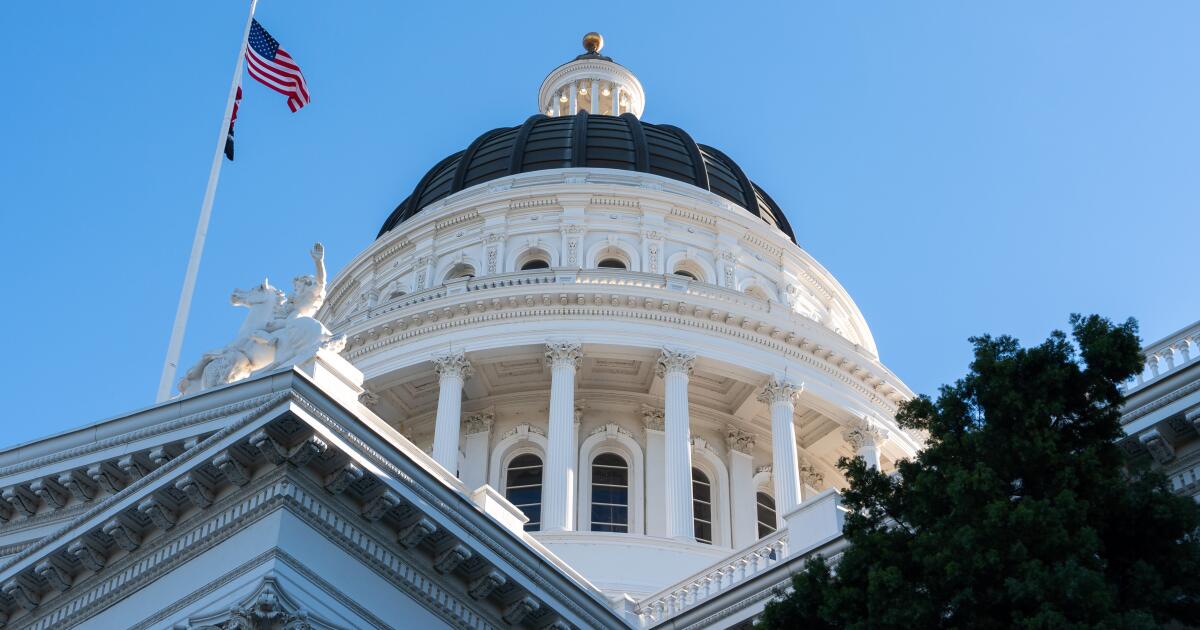
SACRAMENTO — Gov. Gavin Newsom and Democratic leaders of the California Legislature plan to approve a proposed constitutional amendment this week that would ask voters to give them more flexibility over state spending and allow them to save money that could otherwise go back to taxpayers.
The proposal seeks to exempt deposits into state savings accounts from a spending limit that voters adopted through a series of ballot measures dating back to the late 1970s and to increase the share of tax revenue that can be put into the rainy day fund.
“Putting money aside to protect ourselves from future uncertainties isn’t just good government; it’s common sense,” Newsom said in a statement. “California is strong and resilient, but we’re not immune to economic headwinds. At a time when our essential services are under pressure, we have a responsibility to safeguard the programs and investments that Californians rely on.”
Assembly Constitutional Amendment 20, which Democrats are calling the “Save for California’s Future Act,” could receive push back from taxpayer advocates.
Under an existing state appropriations restraint, also known as the Gann limit, lawmakers cannot spend more than an amount determined by a formula that takes into consideration annual tax proceeds and changes to the population and cost of living. Tax revenue above the limit must be divided between schools and refunds to taxpayers.
With few exceptions, the limit applies to most appropriations of tax revenue, including money that lawmakers tuck away into the rainy day fund and other reserves. California voters have also capped the amount of money lawmakers can set aside in the rainy day fund to 10% of general fund proceeds in a given year.
Since taking office, Newsom has argued that it doesn’t make sense for savings to count as spending under state law.
State budget revenue is subject to dramatic swings from year to year based on stock market activity. The law, Newsom has said, prevents the state from saving more money in good years to stave off cuts to programs in bad years.
The proposed changes would exempt deposits into the rainy day fund and a short term reserve, called the “Projected Surplus Temporary Holding Account,” from the state appropriations limit. The cap on the rainy day fund would grow from 10% of general fund tax revenue to 20%.
“Californians live by a simple, bipartisan truth: set money aside when times are good so you’re ready when they’re not,” Assembly Speaker Robert Rivas (D-Hollister) said in a statement. “The Save For California’s Future Act is what responsible leadership looks like — and future taxpayers will thank us for it.”
The measure could incentivize Democrats to save more money because funds tucked away in the rainy day fund would no longer be considered expenditures counted toward the spending limit. By allowing lawmakers to set aside more money that is not subjected to state spending limits, it could also allow them to hold onto money that would be returned to taxpayers under current law.
The measure is slated for a vote Thursday. If approved by two-thirds of lawmakers, voters will consider the proposal on the November ballot.
Politics
Social media erupts over Mamdani’s silence after Brooklyn coffee shop bans Jewish congressman

Socialists push progressive agenda in NYC primaries
Fox News national correspondent Bryan Llenas reports on the New York City primary, highlighting the influence of socialists. Candidates backed by Zohran Mamdani advocate for abolishing ICE and all deportations, even for convicted murderers.
NEWYou can now listen to Fox News articles!
New York City Mayor Zohran Mamdani is facing swift backlash after declining to condemn a local coffee chain that told a Jewish congressman with pro-Israel views that he was not welcome.
Mamdani has remained silent after the Williamsburg, Brooklyn-based Poetica coffee shop posted — and later deleted — a message on social media telling Rep. Dan Goldman, D-N.Y., not to return after he stopped by the shop with his daughter Monday. The mayor declined to comment through a spokesman when contacted by The New York Times on Monday.
“Shameful,” Fox News Radio analyst Josh Kraushaar wrote on social media in response to a section of The Times story detailing that Mamdani declined to comment.
“Well folks, we’ve reached the stage of antisemitism where Jews are being publicly barred from businesses,” the CEO and co-founder of the antisemitism-focused nonprofit Boundless Israel said on X. “A coffee shop in Mamdani’s New York City told Jewish Congressman Dan Goldman he wasn’t welcome in their store.”
Zohran Mamdani announces new members of his team at the Brooklyn Public Library Greenpoint Branch in Brooklyn on Dec. 17, 2025. (Shawn Inglima/New York Daily News/Tribune News Service via Getty Images)
MAMDANI SKIPS ISRAEL DAY PARADE DESPITE JOINING OTHER CULTURAL CELEBRATIONS
“The café is implementing Mamdani’s wishes,” journalist Melissa Braunstein said.
Fox News Digital reached out to Mamdani’s office for comment but did not immediately hear back.
In a since-deleted social media post, Poetica Coffee said it would have declined to serve Goldman had staff recognized him in the store. Goldman has notably declined to characterize Israel’s war in Gaza as a genocide and has received financial contributions from the pro-Israel lobby AIPAC, drawing criticism from some on the progressive left.
“Hey Congressman Dan Goldman, we see that you stopped by our shop today for a coffee. Do you see how it doesn’t taste like genocide juice? Or are you still having a hard time telling the difference?” the post said.
“See, here at Poetica, we don’t serve racists, fascists, homophobes, genocide enablers, or anyone in between,” the post continued. “Too bad we didn’t recognize you right away, or we would have turned you away. We issued you a refund—we don’t need your money (it’s probably coming from AIPAC anyways). Enjoy your loss on Tuesday. Don’t ever come to Poetica.”
The coffee chain has since deleted its Instagram page amid social media backlash.
Mamdani’s silence comes as he is working to unseat Goldman, despite the incumbent lawmaker being a leading Trump critic and embracing an array of leftist legislative proposals. Goldman notably did not endorse Mamdani’s mayoral campaign, citing concerns about how his administration would approach Jewish New Yorkers.
A Brooklyn, N.Y., coffee shop refunded a purchase made by Rep. Dan Goldman, D-N.Y., over the weekend over his support for Israel, saying the company doesn’t serve “genocide enablers.” (Getty Images; Google Maps)
The mayor publicly backed former New York City Comptroller Brad Lander to represent Goldman’s district, which spans Lower Manhattan and deep-blue, wealthy pockets of Brooklyn.
Democratic voters will decide whether to hand Goldman a third House term during the Empire State’s primary elections on Tuesday.
NY DEM WOULDN’T BACK MAMDANI FOR MAYOR — NOW MAMDANI IS BACKING HIS CHALLENGER
Since both men largely hold the same policy stances, the bruising primary battle has revolved around support for Israel — with Lander vowing to elevate the Palestinian cause if elected to the House.
Goldman has notably supported military aid to Israel following Hamas’ Oct. 7, 2023, attacks and distanced himself from inflammatory rhetoric used by some on the left to criticize Israel.
Goldman offered a tempered response after the coffee chain effectively banned him from their storefronts.
“I’m sorry to see this post,” he said. “The barista could not have been nicer to my 7-year-old daughter and me—allowing her to use the bathroom even though we had not purchased anything. I made sure to buy a coffee in return for her kindness. I hope you at least make sure she gets the tip that she deserved.”
New York City Mayor Zohran Mamdani speaks in support of Brad Lander, Democratic candidate for Congress in New York’s 10th Congressional District, in Carroll Park in the Carroll Gardens neighborhood of Brooklyn on June 14, 2026. (Shuran Huang/For The Washington Post via Getty Images)
CLICK HERE TO DOWNLOAD THE FOX NEWS APP
Assistant Attorney General for Civil Rights Harmeet Dhillon said Tuesday her office has opened an investigation into the matter.
“Federal law prohibits public accommodations such as coffee shops from discriminating against patrons based on their race, religion, or national origin,” Dhillon wrote. “These actions are not only reprehensible, they’re potentially illegal.”
-

 Technology46 seconds ago
The best robot vacuum deals available during Prime Day
-

 World6 minutes ago
Turkey detains over 200 suspects, including alleged ISIS militants, in sweeping raid ahead of NATO summit
-

 Politics13 minutes ago
Trump foe wins crucial Dem primary as 2028 presidential speculation swirls
-

 Sports21 minutes ago
Wizards select AJ Dybantsa first overall in 2026 NBA Draft
-
Business31 minutes ago
SpaceX stock returns to Earth after record IPO
-
 Entertainment36 minutes ago
This is why the Madonna biopic starring Julia Garner isn’t happening after all
-
 Lifestyle43 minutes ago
‘Worth every penny’: This is how much fans spent to attend the World Cup in L.A.
-
Politics46 minutes ago
Democrats want California voters to give them more flexibility over spending


