Science
‘The Interview’: Ed Yong Wants to Show You the Hidden Reality of the World


The science journalist and author Ed Yong likes to joke that during the first wave of Covid-19 in 2020, the impact and reach of his reporting for The Atlantic turned him into “a character in the season of ‘Pandemic.’” Indeed, his Covid journalism — which documented the earliest stages of the pandemic and made him one of the first chroniclers of long Covid — established Yong as a key and trusted public interpreter of the illness and its many ripples. It also won him a Pulitzer Prize. (Additionally, Yong’s 2022 book about animal perception, “An Immense World,” became a best seller. A young reader’s edition will be published on May 13.)
But despite having achieved a level of success and attention that most writers can only dream of, Yong’s immersion in Covid left him feeling as utterly depleted as many of the health care professionals and patients he was covering. So much so that in 2023, he decided to leave his prestigious perch at The Atlantic. Since then, in addition to working on a new book, he has found a measure of salvation, even transcendence, in birding, a pastime that he, like so many others, took up in the wake of those grim days of social distancing and time stuck inside.
So as we approach the fifth anniversary of the U.S. pandemic lockdowns, I wanted to talk with Yong about his Covid lows, his hopeful response to those struggles and his perspective on the lessons we learned — or maybe more accurate, didn’t learn — from that strange and troubling time.
I want to start with a subject that a lot of people can relate to: burnout. How did you realize that you had given all that you had to give? I remember talking to public-health experts for a story and hearing people say that they were feeling depressed, anxious, they couldn’t sleep, and thinking, Man, that feels very familiar. That was in June of 2020. By the middle of 2023, I realized that I was doing my best work at severe cost to all of the other parts of myself. I actually dislike the word “burnout.” It creates this image that the person in question did their job, the job was really hard and after a while they couldn’t stand how hard it was and they stopped doing it. Which I don’t think is correct. A lot of the health care workers I spoke to said that it wasn’t that they couldn’t handle doing their job. It was that they couldn’t handle not being able to do their job. They saw all of the institutional and systemic factors that prevented them from providing the care that they wanted to provide. For them, it was more about this idea of moral injury, this massive gulf between what you want the world to be and what you see happening around you. At some point that becomes intolerable. I think that’s much closer to my experience of pandemic journalism too.
Do you have any answers for how to contextualize your feelings in a world where people are struggling for subsistence or with the threat of violence? I often think, when I’ll be low, What right do I have to complain? I’m sure you must have had similar thoughts. This is a great point because you don’t even have to go to that extreme of folks who are struggling to get by, folks who are in the middle of war zones. Let’s just talk about the people whose stories I’m trying to tell. What right do I have to say, “I have listened to your stories, and I’m trying to write about them, and that, for me, is too hard”? Doesn’t that sound a little bit pathetic?
There is something absurd about it. One hundred percent there is.
And yet, the feelings are real. Right. I’ve had this conversation with friends and with my therapist a lot. I think that if we as journalists do our job correctly, what we end up doing is extending as much empathy as we can to the people we are writing about, so that we can correctly characterize and convey their experiences to the world. Empathy really does mean, for me, spending days listening to the worst moments of dozens of people’s lives, having them run through my head again and again so that I can turn them into something that might shift the needle in someone who has never thought about those experiences. I’m sitting here still questioning myself about whether it’s ridiculous to say that that’s hard, but what I can tell you is that I know it’s hard because I felt it. I think that’s enough.
You’ve been clear in saying that Covid has not gone away. You ask people to wear masks at your events. But that attitude is not necessarily where the rest of the world is. How do you think about continuing to take precautions and advising others to do so when it feels as if society has moved on? I do it for a bunch of reasons. Firstly, I have learned that I enjoy not being sick. I know that the cost of long Covid is real and substantial, and I don’t want to run that risk lightly. I also know that I have many friends and people I’m close to who are immunocompromised. So for the sake of the people around me, I also don’t want to get sick. When I do events, I wear a mask for those reasons, and because I know that every time I do a talk, while the vast majority of people in the audience have probably moved on, there are going to be other people who haven’t. I think it makes a huge difference to them to have the person at the front of the stage wear a mask. It tells them, It’s not weird. So I do it for that reason, too. In terms of holding this line at a point when a large swath of society has moved on, I have written a lot about the panic-neglect cycle.
What’s that? The idea is, a crisis happens. Let’s say a new epidemic. Attention and resources flow toward that, people take it seriously, freak out, and then once the problem abates, so, too, does everything else. The resources dwindle, the attention goes away and we lapse into the same level of unpreparedness that led to the panic in the first place. This is real. I’ve seen it through my reporting. I’ve seen it for Ebola, for Covid — you name it.
Bird flu? Sure, why not? All of which is to say, for all of those reasons, I don’t feel self-conscious about still being cautious at a time when most people aren’t. I personally don’t want to lapse into the neglect phase, because I don’t think it’s warranted.
This has been blaring in the back of my mind the whole time we’ve been talking: How worried are you about a bird-flu pandemic? I try not to answer questions on things I haven’t specifically reported on because it is hard to make sense of all this. I didn’t come to these views on Covid lightly. So, specifically how worried am I about bird flu? On a scale of 1 to 10? I don’t know.
I’ll rephrase the question: How worried should I be about bird flu? That’s an even harder question. What I will say is that it is a threat that we should absolutely take seriously. In all likelihood the next pandemic will be a flu one, whether it’s H5N1 or something else. So the specifics of my level of worry about this particular pathogen are subsumed in this ambience of worry about everything. We live in a world where new viruses will have an ever easier time of jumping into us, and where the infrastructure of our societies continues to be poorly suited to handling those threats. If you think about what happened with Covid, why did the U.S. fare so badly? There’s all of these things that people rarely think of in terms of pandemic preparedness: It’s social stuff and, crucially, a lack of trust in government and one another that turns a pandemic into a true disaster. All of those problems are still with us, and, I would argue, are worse than they were in early 2020. The way that it’s often framed is: “Tell me, on a scale of 1 to 10, how worried you are that H5N1 is going to go pandemic.” I think the more important question is, if it does, how screwed are we? And the answer is: really.
So you were dealing with the feelings we talked about earlier, and you got to a point where you decided your life had to change. One of the things that then changed your life was birding. How did you find it? In the spring of 2023, just before I left The Atlantic, I moved to Oakland from D.C., and one thing that happened was I started paying attention to the birds around me. They were omnipresent in a way they weren’t before. On my first day in my new house, there was an Anna’s hummingbird in the garden. I would go for walks and hear birdsong: the melodious sound of a Pacific wren in a nearby redwood forest. I bought a pair of binoculars and would take it with me on neighborhood walks or hikes. I would have Merlin while I was working and look up occasionally and go: “Oh, that’s interesting. It’s an oak titmouse. I’ve never seen one before.” To me, the difference between being casually bird-curious and being an actual birder is making a specific effort to go and look at birds.
Going from passive to active. Exactly. So early September of 2023 was when I made my first trip to a local wetland to specifically look at birds and nothing else. That was, honestly, a life-changing moment.
Can you put me back in that moment? I went to a place called Arrowhead Marsh. It’s this relatively small stretch of wetland that has a boardwalk sticking out into this little chunk of bay, and on that day, I saw all these creatures. I’ve been writing about animals since I’ve been writing about anything, but a lot of my knowledge of the natural world, if you want to be reductive, it’s just trivia. Whereas the knowledge I gained from birding, that started on that boardwalk, feels rooted in the lives of the birds themselves in time and space. I look at the birds, and I see how they behave. Small things that I would never have noticed if I was just reading scientific publications. Those two halves, the academic side and the more lived knowledge, beautifully interact with each other. And the thing that I felt palpably at that place on that day, that I still do every time I go birding, is this incredible sense of being present.
When you’re watching birds — and this could apply to the natural world writ large — there is so much going on that is basically beyond our comprehension. Because of our sensory capabilities as human beings, we are condemned to having only an ankle-deep understanding of what it is to be alive on Earth. To me, that’s humbling and mind-blowing. What do you think? I fully agree. I mean, that is a beautiful précis of basically my entire body of work.
Nailed it! [Laughs.] I can go home now, right? All of it is about the idea that much of the world is hidden from us, that we don’t perceive it and don’t understand it, and that it is worth understanding and it is necessary to understand. I’m now working on Book 3, and I see them as a trilogy that all touch on this theme. “I Contain Multitudes,” the first book, was about the microbes that live inside our bodies and those of other animals, and the enormous influence they play in our lives. “An Immense World” is about how other creatures perceive things that we miss, and about how each of us is perceiving only a thin sliver of the fullness of reality, which is a wonderfully humbling concept. The book that I’m currently working on takes those themes and runs with them. The book is called “The Infinite Extent,” and it is about life at different scales. It is about what it is like to be the size of a blue whale or the size of a bacterium, to live for millennia like a bristlecone pine, or for just a few hours like a mayfly. It’s about these extremes of experience and existence.
I have a curmudgeonly question. Developing an awareness of the magic that’s happening all around us at any given moment, and understanding that there’s this vast cosmic dance playing out — in the abstract, I can see how internalizing those perspectives might change one’s perspective. Sometimes I’m able to get to that place. But the way I’m picturing it in my head is like, I blow up a beautiful balloon. I’m carrying that balloon around and looking up at the balloon: What a beautiful balloon I’m carrying with me. Then I get to the office, and the balloon pops on the halogen light, and I’m back in the [expletive]. Did your understanding of the bigger existential stuff you were writing about actually help you in the moments when you were struggling? I can say that thinking about these ideas constantly really helped me. It felt like a salve to all of that moral injury and despair that I was feeling. It doesn’t cure it, but it fills my life with wonder and joy, and that acts as a buffer against all the other existential dread and fear that we have to grapple with. One thing I’ve said about science as a field is that it is one of the only areas of human endeavor that take us out of ourselves. We exist at a time when we are being crunched ever inward. Whether it’s through a novel virus, or frayed social connections, or algorithms that feed us more of what we already were seeking out. There is a kind of implosive effect of the modern world, and the science and nature writing that I’m prioritizing, and the birding that I do, are all counters to that. They are a way of radiating your attention outward. I’m still wrestling with the curmudgeonly question that you asked. Like, does any of that matter? Sometimes when I go out and look at birds, there’s a voice in my head that says, Is this really the best thing you could be doing with your time?
It’s a dropout solution. Totally, because often people talk about birding as escapism, and there’s something about the word “escapism” that has a slight negative connotation. I had a conversation with a good friend about this, and what she said was, “I think it’s more important than ever to be out in the world.” I agree with that. We need to replenish ourselves, and it matters, because for those of us who care about biodiversity and diversity and the environment and equality, we need to be connected to the thing that we are fighting for. And if we don’t do that, then the work, the fights, become abstract.
So, putting work aside, one could reasonably feel a sense of moral injury just as a result of living in the world right now. We can change our work situation, or at least try, but changing the bigger problems is beyond our scope. Any advice for how to get through that feeling? A nice softball question! There are three ideas that come to mind. One is a quote from the amazing Mariame Kaba, who says, “Hope is a discipline.” She argues that hope is not this nebulous, airy thing. It is a practice that you cultivate through active effort. I think of a line by the great and late global-health advocate Paul Farmer, who said that he “fought the long defeat.” By which he meant that he was often swimming against forces that were extremely powerful, and he knew that he was going to suffer defeats and setbacks, and that he was going to fight nonetheless. Then the third one is an idea called the Stockdale paradox, which was named after Vice Adm. James Stockdale, who was a prisoner of war. When he was finally released, after a long time in captivity, he was asked how he managed to survive what he endured, and he talked about how he made it because he was able to hold two seemingly contradictory ideas in his head at the same time. One was the full and brutal realization of his situation, combined with the indomitable hope that things could get better. These three ideas anchor me in these moments when it feels like the gulf between what we hope the world should be and what it actually is seems vast and growing. That gulf is agonizingly difficult to bear, but we bear it nonetheless.
I’d like to wrench the conversation away from heavier topics. Tell me a cool scientific fact that you learned while you were researching your next book. Something that gave you delight. You know, I’m writing a section of the book that is about hummingbirds. The fact that hummingbirds have iridescent colors that are especially vivid at certain angles. The Anna’s hummingbird is a great example of that. In some angles it looks like this vivid capital-“M” magenta jewel. Then it might turn its head and look black and dark. Those colors are not inherent to the feathers themselves. They occur because the feathers have rows of tiny disc-shaped structures that are arranged perfectly at the nanoscale. The light they reflect interferes with and amplifies each other specifically in red wavelengths, and specifically at certain angles. I think about all that I’ve learned through scientific papers and talking with scientists, but I also know the things I’ve learned from watching hummingbirds as a birder. They are small bundles of sass and fury, and I love them for that. This is sort of what I meant when I said that my world now is this mix of the academic and the experiential. It’s all these sides of nature colliding in every single experience — and it’s wonderful.
This interview has been edited and condensed from two conversations. Listen to and follow “The Interview” on Apple Podcasts, Spotify, YouTube, iHeartRadio, Amazon Music or The New York Times Audio app.
Director of photography (video): Aaron Katter



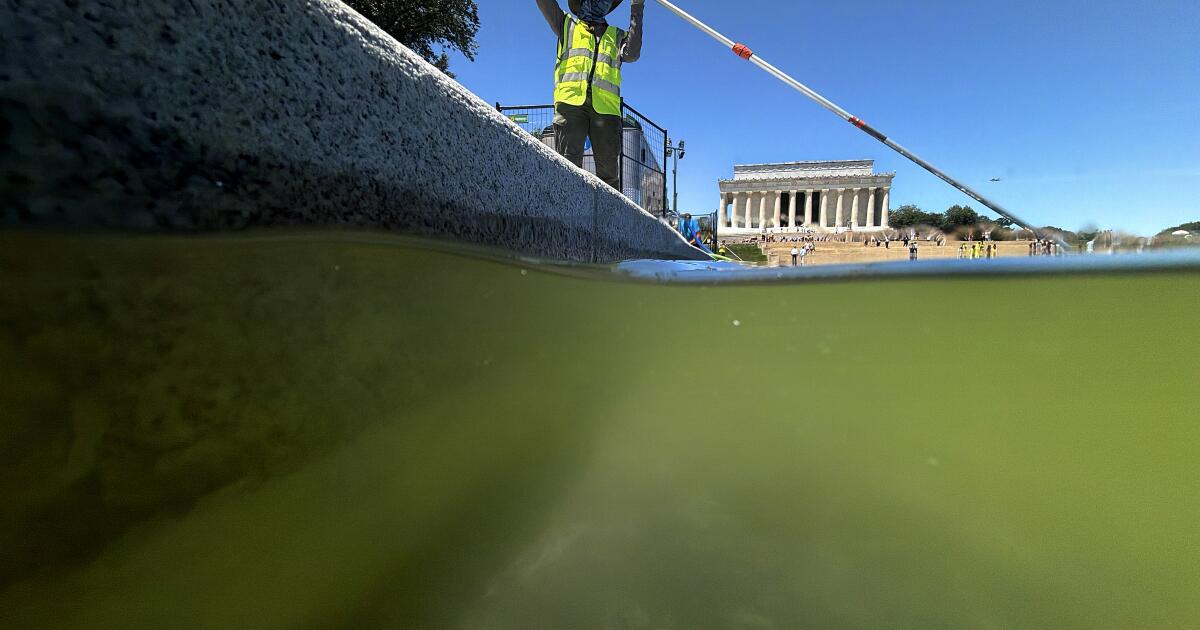
Just days after the Trump administration completed millions of dollars in renovations on the Lincoln Memorial Reflecting Pool to make it American flag-blue, residents and online users noted it had turned a phosphorescent green.
Here’s why:
The calm, still waters of the Reflecting Pool make it an ideal nursery for algae growth. Algae need nitrogen and phosphorus to grow, and the Reflecting Pool is primarily fed by the Potomac River, which gets heavy doses of those nutrients from nearby urban and agricultural lands.
The Potomac also absorbed one of the largest sewage spills in U.S. history earlier this year when a pipe burst five miles upstream of Washington, although that event probably happened too long ago to contribute to the algal bloom today.
Untreated sewage is high in nitrogen and phosphorus. When nutrient levels are high, feasting algae can quickly reproduce.
The Department of the Interior said when the algae first appeared that it was “residual,” from the supply lines to the pool.
Experts also speculate that the darker blue color may be helping the Reflecting Pool absorb more heat. The higher temperatures promote algae growth by allowing their metabolisms to shift into overdrive.
Summer temperatures in D.C. aren’t helping. This week, temperatures are as high as 95 degrees in the city, prompting a heat alert.
The combination probably explains the excessive growth, turning the water surface an opaque green and preventing onlookers from seeing the new blue hue of the concrete basin.
Algae are important and beneficial organisms when the ecosystem is in balance. They’re the base of the aquatic food chain, fed on by herbivores of all shapes and sizes, including shrimp and juvenile fish, which in turn feed organisms higher up the food chain. The single-celled organisms use the power of the sun to produce energy through photosynthesis, similar to houseplants on your balcony.
In an effort combat the algae in the Reflecting Pool, employees of the National Park Service were seen pouring in gallons of hydrogen peroxide, a chemical commonly used in pool maintenance.
The Department of the Interior also is employing a “high-tech nanobubble ozone technology” to destroy the cells of the algae.
Ozone — yes, the same irritant that is in smog — is a gas composed of three oxygen molecules, and the small size of the bubbles allow the most gas transfer into the water, where it can damage algal cells, similar to how it irritates our lungs.
This only treats the symptoms, however. Generally, ozone nanobubbling is effective as a temporary solution for algae blooms. Longer-term fixes would have to address what makes the Reflecting Pool so ideal for algae, such as its depth, darker color and inflow of nitrogen and phosphorus.
In California, ozone nanobubbles also have been used in a project to improve water quality in the Tijuana River. The 120-mile river that runs near the border in northern Mexico and Southern California was the site of a pilot study in 2025. The U.S. section of the International Boundary and Water Commission reported that the nanobubbling reduced “odors and bacteria,” but the project concluded prematurely after a flood swept some of the instrumentation into the river.

A plant extract that’s gaining popularity as a pain cure-all and has been associated with multiple California deaths in its concentrated, synthetic form has been approved for research as a treatment for opioid addiction by the federal government.
Kratom is derived from the leaves of Mitragyna speciosa, a tree native to Southeast Asia, and is commonly made into a powder or pill.
Researchers say people in the U.S. are using kratom to alleviate anxiety, treat chronic pain or as a remedy for the symptoms associated with quitting opioids, due to its ability to bind with opioid receptors in the body. But recently, public health officials have raised alarms about a component of the leaf called 7-hydroxymitragynine, also known as 7-OH, an alkaloid that has the potential for abuse and addiction in high doses.
Last year, the Los Angeles County Public Health Department linked the deaths of six county residents to the use of 7-OH mixed with other substances. The toxicology screens for some of the deceased revealed both kratom and 7-OH, leading to a countywide crackdown of products with either compound because they’re unregulated.
Although there is no scientific consensus on whether kratom has therapeutic value, the Food and Drug Administration has recommended that its potent 7-OH form be classified as a controlled substance. Consumers who use 7-OH as a pain reliever expecting an experience similar to consuming kratom are at risk, said Dr. Mason Turner, president-elect of the California Society of Addiction Medicine.
“I have a couple of patients that I work with who use 7-OH for chronic pain management, not realizing the potential of the medication, and then developed an opioid use disorder,” Turner said. “I think in that case it was very clear they were seeking it for the chronic pain, not to get high, not to have some kind of experience, but really to reduce their pain.”
About two decades ago, Turner said, the healthcare industry started acknowledging the limits and risks of prescribing opioids for chronic pain. Some doctors pulled back on prescriptions, recognizing the potential for abuse.
That led some patients to find alternative solutions, he said.
“Maybe they don’t get a good benefit, or maybe the benefit from some of the other treatments is not as robust as what they got from opioids,” Turner said. “So they seek out some of these illicit products … or they look for kratom or 7-OH to be able to mitigate the pain.”
Turner said he supports further research into kratom and regulation because “it could be worth exploring as a treatment for chronic pain.”
On June 1, the National Institutes of Health announced that researchers from the University of Florida would begin the first phase of clinical trials on kratom to evaluate it as a potential treatment for opioid addiction. The research would be done with the FDA’s approval, according to officials.
“This … is a major step toward expanding treatment options for the millions of Americans struggling with opioid use disorder, which has contributed to historically high overdose mortality rates,” said Dr. Nora Volkow, director of NIH’s National Institute on Drug Abuse, in a statement.
Interest in kratom surged in the last couple of years as users have reported consuming the compound in the form of a pill, powder or tea to treat various ailments. A John Hopkins survey conducted in 2020 reported that 91% of respondents used kratom to treat chronic pain, 67% to treat anxiety, 64% for depression and 41% to treat opioid dependence.
A more recent study by the University of Michigan and Texas State University found that more than 5 million people in the U.S., including more than 100,000 children ages 12 to 17, have used kratom, the compound experts say is growing in popularity with young adults.
In the study, which analyzed data from the National Survey on Drug Use and Health collected between 2021 and 2024, researchers say that despite numerous state-level bans on kratom across the nation, its use is at an all-time high and is increasing.
People between the ages of 21 and 34 said they used kratom at least once and 1% said they used it in the last year. The share of children ages 12 and older who said they had used kratom increased from 1.6% in 2021 to 1.9% in 2024.
The FDA has stated that neither kratom nor 7-OH are approved as drug products, dietary supplements or food additives, but that hasn’t stopped storefronts and companies from selling them as such.
Up until November you could find kratom and 7-OH products in smoke shops and specialty stores in California, but that has stopped.
“Until kratom and its pharmacologically active key ingredients mitragynine and 7-OH are approved for use, they will remain classified as adulterants in drugs, dietary supplements and foods,” the California Department of Public Health told The Times via email.
Kratom “Feel Free Classic” liquid products are displayed at a smoke shop in Los Angeles in 2024 before they were banned.
(Michael Blackshire / Los Angeles Times)
In May, the California Department of Public Health and Atty. Gen. Rob Bonta filed a complaint against Ashlynn Marketing Group Inc., accusing the company of repeatedly flouting the state’s regulations on kratom products.
The filing, submitted in the San Diego County Superior Court, seeks a judge’s order to condemn and destroy the embargoed kratom products, halt ongoing unlawful manufacturing and impose civil penalties.
The California Department of Public Health “is pursuing legal action because Ashlynn’s continued manufacture and sale of these products pose a clear and preventable public‑health risk and violates state and federal law,” said Dr. Erica Pan, the department’s director and state public health officer. “7-OH and kratom-derived products have been associated with addiction, serious health harms, overdose and death.”
The state is alleging its inspectors visited Ashlynn Marketing Group’s facility in Santee in May 2025 and found kratom powders, capsules, liquids and chewable tablets being manufactured and held for sale.
During the visit, inspectors issued an embargo to prohibit the sale and distribution of all kratom-related materials on-site, according to the complaint.
Public health inspectors conducted follow-up visits at the facility in October and April, “collecting evidence at both inspections that indicated embargoed kratom products had been moved, tampered with and repackaged,” according to public health officials.
“In addition, investigators observed evidence of continued manufacturing and distribution of kratom materials,” officials said. “The firm’s owner continues to manufacture kratom products and ships orders weekly.”
To date, the California Department of Public Health has seized more than $5 million worth of kratom and 7-OH products, a spokesperson for the department told The Times.
California and Los Angeles County are considering whether to tighten regulations or ban the compounds altogether.

NEW YORK — Scientists have unearthed communities of marine life — including jellyfish, tubeworms and brittle stars — thriving on a whale graveyard that is millions of years old.
These graveyards form when whale carcasses fall to the sea floor, becoming a sustaining snack for nearby critters. This one, located up to 23,000 feet below the surface of the southeastern Indian Ocean, spans the largest area and is so far the deepest and oldest found.
A whale’s sheer size and the unique chemistry of its bones are the keys to forming these unique underwater neighborhoods, said Xikun Song, a biologist with the Chinese Academy of Sciences’ Institute of Deep-sea Science and Engineering.
“At the same time, the very nature of the deep ocean makes these sites exceptionally difficult for scientists to locate,” Song, who was involved with the latest find, wrote in an email.
Researchers explored the remains during multiple deep-sea submersible trips in 2023, collecting samples and mapping the extent of the necropolis. They found five carcass sites and fossils, including skulls belonging to beaked and baleen whales. The oldest bones date back 5.3 million years.
Feeding and living on the carcasses were myriad creatures, large and small, including sea cucumbers, squat lobsters and saltwater clams. Many of them are likely species that have never been documented, according to findings published Wednesday in the journal Nature.
“The potential number of specimens is just astounding,” said paleontologist Stephen Godfrey with the Calvert Marine Museum in Maryland, who wasn’t involved in the research.
Many factors likely conspired to preserve the bones for millions of years, according to the study authors. They’re dense enough to outlast attacks from bone-eating worms, and located deep enough in the ocean to avoid getting buried by dust and loose particles. The bones also were coated with a light layer of minerals from the surrounding seawater, which may have prevented them from degrading.
Why did so many whales die here? Maybe they were already living in the area and died of natural causes. A few could have perished from exhaustion or illness caused by deep-sea diving. The area’s shape, akin to the letter V, could also have funneled the remains to their resting spot, the authors wrote.
Such discoveries are important because they clue scientists into the vibrant communities that find a way to live even in remote, hard-to-reach environments.
Studying the whale graveyards “is important for understanding how life can adapt to such extreme conditions, not only due to the lack of light and oxygen but also to the incredibly high pressure,” said study co-author and paleontologist Giovanni Bianucci with the University of Pisa in Italy in an email.
Ramakrishnan writes for The Associated Press.
The Associated Press Health and Science Department receives support from the Howard Hughes Medical Institute’s Department of Science Education and the Robert Wood Johnson Foundation.
-
 Lifestyle34 minutes ago
James Burrows, director of classic shows ‘Cheers’ and ‘Friends,’ dies at 85
-

 Technology42 minutes ago
Nothing cancels this year’s CMF phone due to RAM prices
-

 World49 minutes ago
Two-train crash leaves at least 1 dead, 89 injured as emergency crews rush to chaotic scene
-

 Politics52 minutes ago
Double endorsement drama: Trump backs second candidate in red state’s GOP gubernatorial runoff
-

 Health57 minutes ago
Measles-infected traveler may have exposed passengers at LAX and nearby hotel, health officials warn
-

 Sports1 hour ago
World Cup Red Cards: 2026 Has More Red Cards Than Each Of Last 2 World Cups
-

 Technology1 hour ago
China’s brain chip breakthrough raises big questions
-
 Business1 hour ago
Ranch lovers can soon travel with a TSA-friendly kit of the popular American dressing

