Lifestyle
L.A.'s gone all in on hyper-specific bumper stickers — the weirder the better


Jeanne Vaccaro, a scholar and curator from Kansas, always wanted to become a bumper sticker person. For years, she collected stickers from artists, musicians and bookstores, but she kept them away from her vehicle, afraid that they’d damage the paint.
“It’s like a tattoo,” Vaccaro told me in Echo Park this past December. “Your mom tells you not to. It’ll, quote, ruin my car, unquote.”
But when she saw a scratch on her newly-purchased silver 2020 Subaru Impreza, she decided to cover the blemish with a sticker that said “All I want for my Bat Mitzvah is a Free Palestine,” the last two words large and bubbly, and filled with green and red to emphasize its political message.
It opened the floodgates. Now she has more than 25 stickers on the rear. There’s so many, they wrap around the sides, blasting colorful messages above the tires.
Jeanne Vaccaro.
(Renée Reizman)
“Next came, ‘HONK IF YOU LOVE RELATIONAL AESTHETICS,’” said Vaccaro, who was dressed in a Betty Boop T-shirt and leopard print jeans the day we met. She gestured to a simple, black-and-white sticker in sans-serif font that reads “I’D RATHER BE CRYING TO ENYA.”
The collection has since become quite varied. It includes a red-and-white bumper sticker that declares “I’d rather be withholding my labor,” which was designed by a poetry small press called Spiral Editions. (It’s technically a replacement; the first one was stolen from her car.) Her favorite is “Keep Honking! I’m thinking about the incomparable pool scene from Paul Verhoeven’s underappreciated 1995 erotic drama ‘Showgirls,’” a black sticker with white text that features lead actress Elizabeth Berkley’s lean profile.
“But I just have so many more that I can’t fit,” she said.
In August, Vaccaro took a sabbatical from the University of Kansas to curate the exhibition “Scientia Sexualis” at the Institute for Contemporary Art, Los Angeles. In the brief time she spent in the area’s Arts District, her vehicle became a local celebrity.
“I’ve had a lot of people send me photos from Instagram,” she said. “Friends of theirs saw my car, and people know that it’s me. I think that’s so special.”
Though some of her stickers are political, Vaccaro doesn’t believe her car ruffles any feathers.
“I have not experienced any road rage or anger, and I’ve driven across the country many times,” Vaccaro said. Instead, she notices people through her rearview mirror, smiling. “It makes me happy that my car is bringing joy to the world.”
It’s hard to drive anywhere in L.A. right now without seeing an irreverent bumper sticker. In my own neighborhood of Echo Park, there’s “My other car is a Spirit Halloween,” which incorporates the brand’s grim reaper mascot; “Let me merge, my dad is dead” on a contradictory glittery, bubblegum pink background; and “KEEP HONKING! I’m Sitting In My Car Crying To The Cranberries 1993 Hit Single, ‘LINGER’” in a smattering of different-sized fonts.


Mara Herbkersman and Emily Bielagus, co-founders of the lesbian bar, The Ruby Fruit, sell branded bumper stickers that read: “keep honking. i’m listening to THE INDIGO GIRLS” for $5 each online. (Chiara Alexa / For The Times)
Cars have been emblazoned with advertisements and political messages ever since they came on the market, but the first adhesive bumper sticker can be traced back to 1946, when Forest P. Gill combined two wartime inventions, sticky paper and fluorescent paint. The first message Gill used for his discovery is lost to time, but his invention had sticking power. Political organizers were enthusiastic early adopters, and in 1952, Dwight D. Eisenhower’s presidential campaign became the first to embrace the art form. His supporters proclaimed “I LIKE IKE” on the back of their Cadillacs.
Bumper stickers quickly became a permanent fixture in popular culture. Over the last 80 years, Gill’s company would churn out millions of stickers for politicians and tourist traps. They often communicate personal ideology, ranging from a hippie’s transmission of peace and love to a veteran’s pride for his country. Or taste: In the 1970s, classical music die-hards in L.A. adorned their cars with the phrase “MAHLER GROOVES,” to show appreciation for the Austro-Bohemian Romantic composer and conductor Gustav Mahler. (Which the Los Angeles Philharmonic recreated this year to promote a Mahler-themed festival this winter.)
In 1991, a Supreme Court case, Cunningham vs. State, ruled that bumper stickers were protected under the 1st Amendment, which made cars one of the few places where people could widely, but semi-anonymously, make bold political statements.

Claire L. Evans of Yacht.
(Chiara Alexa / For The Times)
In recent years, the creation of colorful, highly-specific bumper stickers have exploded, especially in the car culture capital of Los Angeles. At between $5 to $10 a pop, they’re an economical tool to communicate personal values. This new wave of stickers, however, is more concerned with cracking self-deprecating jokes or aligning with a niche fandom. There’s a bumper sticker for everybody. You can profess your love for John Cage, neon art or frogs. You can declare your other car is a poem, ask drivers not to stress out your dog or claim to be a silly goose.
“It used to be about expressing something universal,” says Claire Evans, an artist, writer and musician most known for being half of the synth-pop duo Yacht. “Now it seems to be a signal of one’s membership in a niche musical, artistic or internet subculture.”
Evans has been documenting bumper stickers in Los Angeles for years, and has built a reputation as a bumper sticker expert and connoisseur. In an attempt to innovate upon the artform, Evans even designed a suite of miniature stickers for phone cases.
Many of today’s amusing slogans play off classic formulas like “Keep honking, I’m [oblivious to the world because I’m listening to something obscure], or “Honk if you love [a quirky interest or interesting activity] or “I’d rather be [bleak statement confronting one’s mortality] or “My other ride is a [creative vehicle alternative].”
The familiar templates allow people to endlessly iterate upon the genre and invite a conversation on any topic. Creators start with a broad concept, then fine-tune every word within the sentence, dialing in the message until it’s personalized to their unique taste. Local businesses, like Silverlake lesbian bar The Ruby Fruit, have printed their own iterations to cater to their clientele. (Theirs, which sells for $5 online, reads: “keep honking, i’m listening to THE INDIGO GIRLS.”)


Claire L. Evans’ bumper stickers.
(Chiara Alexa / For The Times)
“You want to put a sticker on your car that’s so obscure that whoever finds it funny is destined to be your friend,” Evans said.
Perhaps no bumper sticker accomplishes what Evans describes better than, “Keep Honking! I’m Listening to Alice Coltrane’s 1971 Meteoric Sensation ‘Universal Consciousness.’” The yellow and black declaration designed by Echo Park-based artist Christopher DeLoach in 2020, arguably kicked off the current trend of esoteric car accessories.
DeLoach came up with the Coltrane sticker while working at Texino, a tech startup that sold luxury camper vans. The company asked him to make merchandise that would suit the vehicles, and he naturally gravitated towards bumper stickers. The design — simple Arial black text on a yellow background that changes size and position in different parts of the phrase — was inspired by a vintage pro-life bumper sticker a friend found from a small church in Mississippi.
The feedback DeLoach received on the bumper sticker, as he puts it, was: “No one is going to understand this.” So DeLoach decided to sell it through his social media under the moniker “thatscoolthankyou.” It took off in 2021 and he estimates that he has since sold at least 3,000 of the Coltrane stickers, and has given away thousands more for free.

Artist Christopher DeLoach in his studio in Echo Park.
(Chiara Alexa / For The Times)

(Chiara Alexa / For The Times)
When I met DeLoach at his garage studio in Echo Park, he was sitting behind a retro Steelcase desk in a gray diamond-patterned blazer and black, collared shirt. In front of him were a stack of pre-addressed manila envelopes full of stickers that would soon be shipped off to people around the U.S. Also on the desk was a framed photo of a young DeLoach, who was born in Brooklyn, N.Y., posing with New York City’s former mayor, the infamous Rudy Giuliani. In front of the portrait, a nameplate read “Christopher DeLoach. Bumper Sticker Magnate.”
Despite the humorous tone of his creations, DeLoach has a surprisingly dark explanation for his bumper stickers’ success.
“The grave reality is that, in America, we exist in the most propagandized civilization of all time,” DeLoach said. “Everywhere you look, there’s branding and advertising. It has the secondary or tertiary effect of causing people to then want to act out and propagandize themselves.”
Since the success of the Coltrane sticker, DeLoach has come up with more than 120 designs. They appeal to every type of fandom, from followers of mega stars like Taylor Swift to devotees of the shoegaze pioneers Cocteau Twins. His second-most popular sticker is another one I spot regularly in bar bathrooms: a spoof of the famous interfaith “Coexist” bumper sticker of the mid-aughts. In DeLoach’s version, the religious symbols spell out “Cointelpro,” which refers to a covert operation led by the FBI to undermine radical political organizations.
There’s seemingly a sticker for everybody. But if you can’t find what you’re looking for, it’s easy to design your own. When Catalina Elias, an engineer living in Wrightwood, Calif., couldn’t find any stickers dedicated to flugelhorn player Chuck Mangione, she hopped onto Canva and made one that says, “Go ahead, keep honkin! I’m listening to Chuck Mangione’s 1977 hit ‘Feels So Good.’ ”

Catalina Ellis, of Wrightwood, CA, designed the bumper sticker that says “Go ahead, keep honkin! I’m listening to Chuck Mangione’s 1977 hit Feels So Good.”
(Catalina Ellis)
Though they’ve never met, Elias’s phrasing was inspired by DeLoach’s Coltrane sticker, which she had seen on Instagram.
Elias ordered 75 stickers, hoping she’d sell them, but never got around to it. Instead, she started giving them away for free. One day, she was hosting a yard sale and playing the song on repeat. It caught a neighbor’s attention.
“Some guy rode by with a really cool bike, and we gave him a bumper sticker, and now he’s one of our best friends,” she said.
The stickers also helped psychotherapist Jack Lam build camaraderie. Like Vaccaro, Lam put their “Honk if you’re a silly goose” sticker on their Toyota Prius to hide a scratch, but it’s also sentimental. A friend gave them the sticker because they knew they loved waterfowl.
For Christmas, Lam bought stickers as gifts for their group of friends, choosing phrases that best fit everyone’s unique personality.
“It’s whimsical and cute,” Lam said. “Now we all have a sticker, which is kind of beautiful.”
In a city that frequently isolates people into their car-shaped boxes, Evans believes that spying a relatable sticker can remind people of their shared humanity.

(Chiara Alexa / For The Times)
“Sometimes this hyper specific bumper sticker is a way of reaching across the highway and making a connection with another person.”
Do you have a favorite bumper sticker? Share it here.

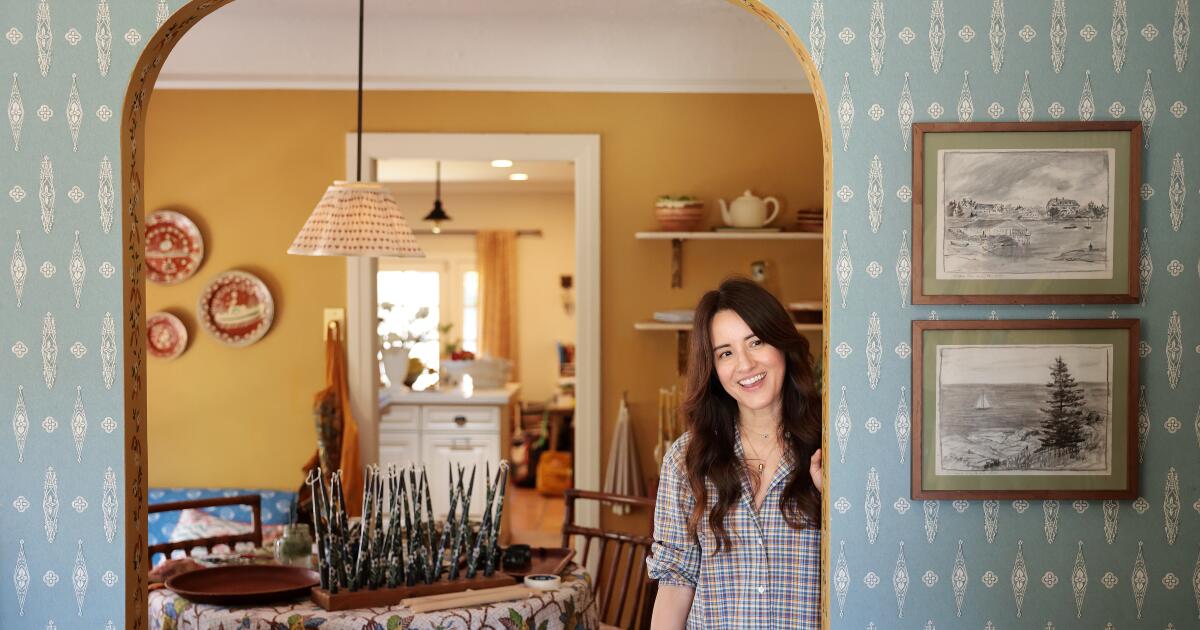
It was after the death of her son, Laith, that Esme Saleh decided to become a folk artist.
She had always been creative, experimenting with watercolors and learning to sew and embroider at a young age.
“I had a creative inkling,” she said, “but I never pursued it.”
Everything changed on Aug. 17, 2013.
In this series, we highlight independent makers and artists, from glassblowers to fiber artists, who are creating original products in and around Los Angeles.
When Saleh was nine months pregnant, she woke up with stomach pains and presumed she was in labor. She and her husband, Nasim, immediately went to the hospital, where doctors checked her and put the baby on a heart monitor. Saleh’s blood pressure was high, however, and the baby’s heart rate kept dropping. After about an hour, his heartbeat stopped. Doctors rushed her in for an emergency C-section, but it was too late. Laith did not survive.
Saleh lost a tremendous amount of blood and developed postpartum HELLP syndrome, a dangerous form of preeclampsia, but doctors were able to stabilize her.
When she woke up, the first thing she asked was, “How’s my baby?”

After losing her son in 2013, Esme Saleh left her job as a television producer. Since then, she has sold her hand-painted candles to local designers in Los Angeles and to LVMH in Paris.
“Aug. 17, 2013, was the most difficult day of my life, and Aug. 22 was the second most difficult, the day we drove home with an empty car seat,” she said of her and her husband’s new reality.
They named their son Laith Finn Saleh.
“His first name means ‘lion’ in Arabic. His middle name is an ode to Huckleberry Finn — sharp wit, kind heart, strong moral compass — all the attributes he’s imparted on us in spirit,” said Saleh, 45.
After such a devastating loss, she found it difficult to trust the world again. “It was hard to trust anything,” she said. “The medical system. Myself. It made me realize the fragility of bringing anything to life. We take so much for granted.”
So after years of working as a television producer, Saleh left broadcast journalism and leaned into her creative spirit.
She grew up in San Diego. Her mother was raised on a farm in Mexico, and her father moved from Tijuana to Los Angeles to be near her mother, who started working for a family in Sherman Oaks at 16. They eventually settled in San Diego, where Saleh’s father, now a church deacon, worked as a car salesman.


“The word Mystic has also become a driving force of what this journey means to me,” Saleh says. “A magical, otherworldly journey that has led me to some beautiful friendships, projects and unlimited well of curiosity. When I paint each pair of candles, it feels like I’m imparting a piece of that magic.”
“He always wanted to be a weatherman on TV,” she said, explaining how he hoped to get his big break on television by doing a weather report from the car lot.
Saleh wanted to be a broadcast journalist as her father had. After graduating from San Diego State, she interned in the sports department at CBS affiliate KFMB-TV although she didn’t know much about sports. She enjoyed sharing information with people, learned how to write plays of the week and felt she had found the right career.
But during a summer class at Mesa College, she started to think journalism might not be for her.


Saleh’s home is filled with her artwork. “My home expresses a lot of the things that I do,” she says. “If it works here, then I feel like I can put it out in the world.”
“I’m an empath — a sensitive soul — so when I was reading news about death and destruction, my eyes could not lie,” she said. Her professor told her, “This may not be your thing.” But when she arranged flowers on camera, she really came alive. She decided to work behind the scenes as a producer.
Her professor helped her get her first network news job in 2003, and she moved to Los Angeles, working on hard news and entertainment coverage.
After losing Laith a decade later, she couldn’t keep doing red-carpet interviews and acting like everything was fine. “It all felt so different, superficial and hard,” she said. “I felt like there was a bigger purpose out there for me. It’s in the small things that we find the big things.”
She started by painting folk art-inspired invitations for a friend’s baby shower. She painted delicate flowers, oranges and leaves on glass, leather and even lampshades. She created a logo. “I was just trying to say yes to things that were really scary,” she said. “Laith gave me the courage to do that.”

“I was just trying to get out of hole,” Saleh says of taking up painting after her son died.
Her first son, she said, became “a catalyst for painting.”
Then, at the first Thanksgiving during the COVID-19 pandemic when people could gather again, she had a light-bulb moment. “I was setting the table and didn’t have flowers or anything to add to decorate, so I thought, ‘I have these candles. I’m going to paint them and make them fancy,’ ” she said.
Her guests were impressed.
As time went on, painting taper candles helped her find joy again, and others noticed too.
“The one thing I hear when people pick up a pair of my candles is, ‘This makes me so happy. It makes me feel like there’s life here,’ ” she said.
1

2

3

1. Saleh sometimes leads painting workshops where participants can decorate items like ornaments and lampshades.
2. Leather napkin rings Saleh has painted for Nathan Turner. 3. Saleh’s hand-painted candles retail for approximately $42 to $50.
One of the hardest parts of losing a child “is that you’re not just grieving the person, you’re grieving the future you imagined with them,” said Chicago-based grief specialist Carla Harvey. “A lifetime of love suddenly has nowhere to go. Creating art doesn’t erase grief, but it can become a way to carry it.”
Saleh created her brand Mystic by Esme in 2021, but it took her some time before she could gather the courage to try to sell them.
When she brought a shoebox full of samples to Nickey Kehoe, the L.A. store agreed to carry her candles. “I was beside myself,” Saleh said.
“Her candles were absolutely beautiful, and she had a fantastic spirit that made selling them a no-brainer,” said interior designer Todd Nickey, co-founder of Nickey Kehoe.

Saleh gets a surprise kiss from her dog Olive while painting candles at her dining room table.
Saleh viewed her new side project as a way to earn extra money for piano lessons for her 11-year-old son Linus, who is an entrepreneur like his mother. “I felt proud painting the candles while he was in lessons in the next room,” she said. “It became this circular economy, and it led to bigger opportunities for me.”
Last year, luxury conglomerate LVMH commissioned Saleh to paint 465 pairs of candles, or 930 candles in total, for its Chaumet jewelry brand. The collection was unveiled at an elaborate event at the Abbaye des Vaux de Cernay, just outside Paris.
“It was fun,” Saleh said about the process, which took six months from conception to delivery. “I felt like I was dressing my candles up for a party.”
Always a hard worker, which she attributes to being a first-generation child of immigrant parents, Saleh has now created a candle collection for Pierce and Ward in Los Feliz, leather napkin holders for interior designer Nathan Turner and pomegranate wrapping paper for Olive Ateliers. The candles retail between $42 to $50 for a pair, and recently, she developed a handsome pewter candle shaver that will be released in the winter.

Her dining room can sometimes feel like “an assembly line,” Saleh says.

Saleh holds a pair of candles she has embellished with florals.
Occasionally, she leads painting workshops, and she loves helping others tap into their creativity. The most meaningful one for her was an ornament workshop attended by several victims of the 2025 Los Angeles wildfires. “Without saying anything, we understood each other,” she said. “I understood that they were trying to create memories.”
Saleh knows what it means for things not to last — “impermanence,” she calls it — whether it is homes, candles or life itself.
She paints every day in the art-filled dining room of her home (unless it’s Little League season), surrounded by her family, candles and her two dogs, Lennon and Olive. ”Painting is like meditation,” she said. “You can sit in your dining room and tune everything out and just be in the moment.”

Even the family’s summer bucket list receives an artistic flourish.

An arch inside Saleh’s home receives a personalized touch.
She knows painting candles isn’t new, but she believes her motivation and the care she puts into each candle makes them special beyond their looks.
She has learned to look at the world that way, that painting in her dining room has offered her healing and joy, that she can trust herself and her body, that continuing to be inspired by her two boys — “one in spirit and the other here on Earth” — means that Laith will always be with her.
Many people think healing means moving on, said grief specialist Harvey, but “it’s really about finding ways to move forward while keeping the people we love woven into our lives. That’s what I see in her candles, not an ending, but an ongoing relationship with her son.”
“I feel like my son is channeling through this medium,” Saleh said, her voice breaking as she painted a taper. “He’s whispering to me, ‘Mom, this is your path.’ That has been my driving force. We’re going to grow this together.”
Lifestyle
Terry Tempest Williams on why women with big ideas get labeled ‘crazy’ : Wild Card with Rachel Martin
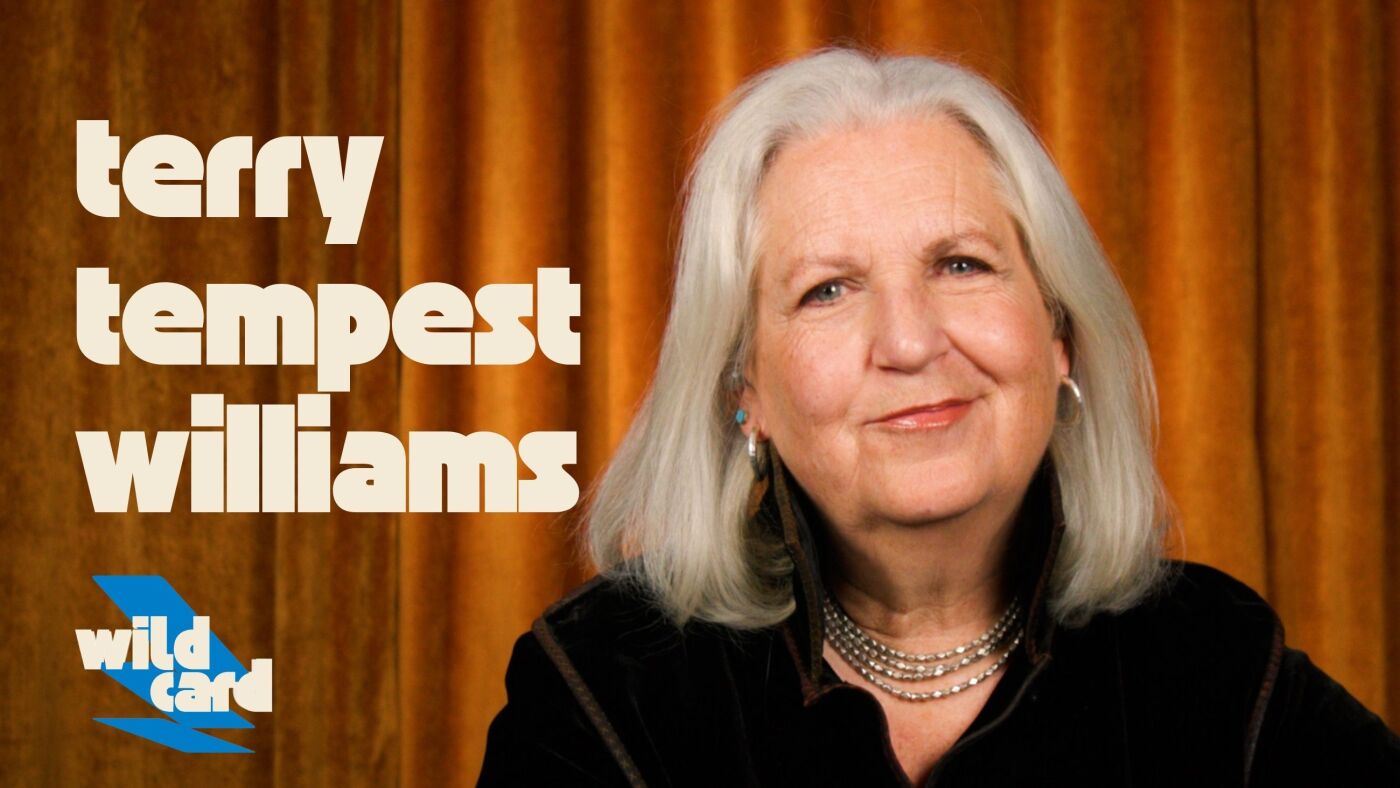
A note from Wild Card host Rachel Martin: I met Terry Tempest Williams about 25 years ago at a writer’s conference in Yosemite Valley. I was a young reporter who was there to do a story about how literature was addressing climate change and she made such a huge impression on me. I had never heard someone talk about the natural world the way Terry did and she had a spiritual depth I hadn’t encountered in my life at that point.
To this day, Terry’s writing always reorients me towards what is good, what is beautiful, and what is true. Her newest book is called “The Glorians.”

For its upcoming Los Angeles venue, experiential art firm Meow Wolf will focus on the art of storytelling, with a specific eye toward skewering our city’s moviemaking magic. To help bring that vision to life, Meow Wolf has entered into a creative partnership with Titmouse, one of L.A.’s most renowned independent animation houses.
The Hollywood-based studio behind popular series such as “Big Mouth” and “Star Trek: Lower Decks” will create animation that will be shown throughout the West L.A. venue, which is on target for a late 2026 opening at the Howard Hughes entertainment complex.
It’s a move that represents a shift for Santa Fe, N.M.-based Meow Wolf. Over the last decade-plus, the art collective has grown beyond its anything-goes, punk-meets-psychedelic roots into an organization with full-scale, maximalist installations in its hometown, Denver, Las Vegas, Houston and the Dallas suburbs. In the past, Meow Wolf kept most of its media in-house.
As part of its larger-than-life participatory art installations, Meow Wolf L.A. will feature a mix of live action and animation, the former filmed by Meow Wolf in its Santa Fe studio. Meow Wolf’s James Stephenson, a senior VP with the company and its creative director of emerging media, said the degree to which the L.A. exhibition will lean into various animation styles necessitated an outside partner. Titmouse’s work, in development by a number of directors with contrasting tones, will be shown on a variety of formats, ranging from cinema screens to full-room projections.
“I really believe in animation as an art form, and I know the Titmouse folks do too,” Stephenson says. “Animation is made by artists. It’s made by artists with their own hands. It’s something that is still very rooted in craft.”
Meow Wolf’s L.A. space is set in a former cinema complex, and will champion its location, taking guests on a journey through a converted movie house and beyond, into a sci-fi-inspired fantasyland with sentient spaceships and a 30-foot-tall mushroom tower. Meow Wolf creatives have spoken of the fantastical movie theater as one that will feature animated, self-aware candy before attendees enter the main exhibition space, making Titmouse’s work some of the first art guests will encounter. Titmouse co-founder Chris Prynoski has said the studio has lined up at least six directors for the exhibit.
An in-progress art installation destined for Meow Wolf L.A. at the art collective’s Santa Fe, N.M., headquarters. The L.A. exhibition will feature animation from Titmouse.
(Gabriela Campos / For The Times)
Titmouse, says Stephenson, is the right partner because “they’re known less for a house style, and more for a house vibe.” Over the years, Titmouse has been behind such diverse shows as “Scavengers Reign,” owning a Jean Giraud influence rooted in French and Spanish surrealism, the lively “Jentry Chau vs. the Underworld,” with an unique color palette that took inspiration from anime and Chinese mythology, the exaggerated comic book feel of Adult Swim’s “Metalocalypse,” and the approachable yet expressive tone of “Star Trek: Lower Decks.”
“Meow Wolf’s vibe is similar to Titmouse’s vibe,” Stephenson says. “It’s artist-first, artist-driven, independent and kinda edgy. They are always trying to find the edge of what’s possible. They try to see how far they can go, and it’s done for fun and in the spirit of taking risks.”
Prynoski says working with Meow Wolf will give Titmouse a sense of artistic freedom it doesn’t always have when delivering content for more traditional Hollywood partners. He says the multi-director approach is a callback to the early days of Warner Bros. Animation, when individual creators put their own stamp on Looney Tunes material.
“I use Bugs Bunny as an example,” Prynoski says. “You’ve got a Friz Freleng Bugs Bunny short. You’ve got a Chuck Jones Bugs Bunny short. You’ve got a Tex Avery Bugs Bunny short. They’re all different versions of Bugs Bunny, and people who are really paying attention can tell which director directed each one. Even though to the layman, these are all Bugs Bunny, but if you lined them up, they are drawing in different styles, sensibilities and techniques.”
Prynoski says that was a centerpiece of his pitch to Meow Wolf, noting that characters will reappear in multiple installations, each handled by a different artist. Meow Wolf L.A., in fact, will be the firm’s most character-driven exhibition, as guests will follow the storylines of three main protagonists throughout the space.
In announcing the partnership, Meow Wolf and Titmouse released an image from an animated work directed by Luca Vitale. It features a key character having a moment with a hummingbird and it’s done in an elegant, slightly anime-influenced style. It’s an image full of movement, reflecting a character in transition with inviting pastels and bold dashes.
“I like that image because I think it captures some of the sense of wonder that we want people to feel,” Stephenson says. “The character is having an encounter with the elusive nature of creativity and reality in a way that makes them have a different perspective of what’s possible.”
Other contributing animation directors to Meow Wolf L.A. include Space Dawg, Felix Colgrave, Alexander Vanderplank and Phimémon Martin, and Jun Ioneda.
Titmouse’s partnership with Meow Wolf will extend beyond the L.A. exhibition. The two will be working on the development of Meow Wolf New York, which is slated to open some time after Los Angeles, and are collaborating on a planned animated series, which Prynoski is spearheading.
Meow Wolf exhibits are the result of sometimes hundreds of disparate artists coming together in a shared space. Distilling that into a signature, singular style for a series could be a challenge. Stephenson pinpoints some guiding principles.
“You really need to feel the hand of the artist,” he says. “You need to feel a DIY aesthetic. You need to feel the materiality. Those are very specific to what we are.”
-

 Health5 minutes ago
Parasitic infection causing ‘explosive’ stomach illness exceeds 1,000 cases in northern state
-

 Sports8 minutes ago
London descends into disorder as Morocco fans flood streets after World Cup elimination by France
-

 Technology13 minutes ago
Google turns old phones into cloud servers
-
 Business20 minutes ago
Waymo is starting robotaxi service in San Diego
-
 Entertainment23 minutes ago
‘Children of Blood and Bone’ author won’t see film after feud with star Amandla Stenberg
-
Lifestyle28 minutes ago
After her son’s death, she found a new purpose. ‘He’s whispering: Mom, this is your path’
-
 Politics35 minutes ago
Iran ceasefire is ‘over,’ Trump says, and orders additional strikes
-
 Science38 minutes ago
Diarrhea-causing cyclosporiasis exceeds 1,000 cases in U.S. What Californians should know

