South
Trump's visit to small-town North Carolina brings hope to hurricane survivors who lost everything

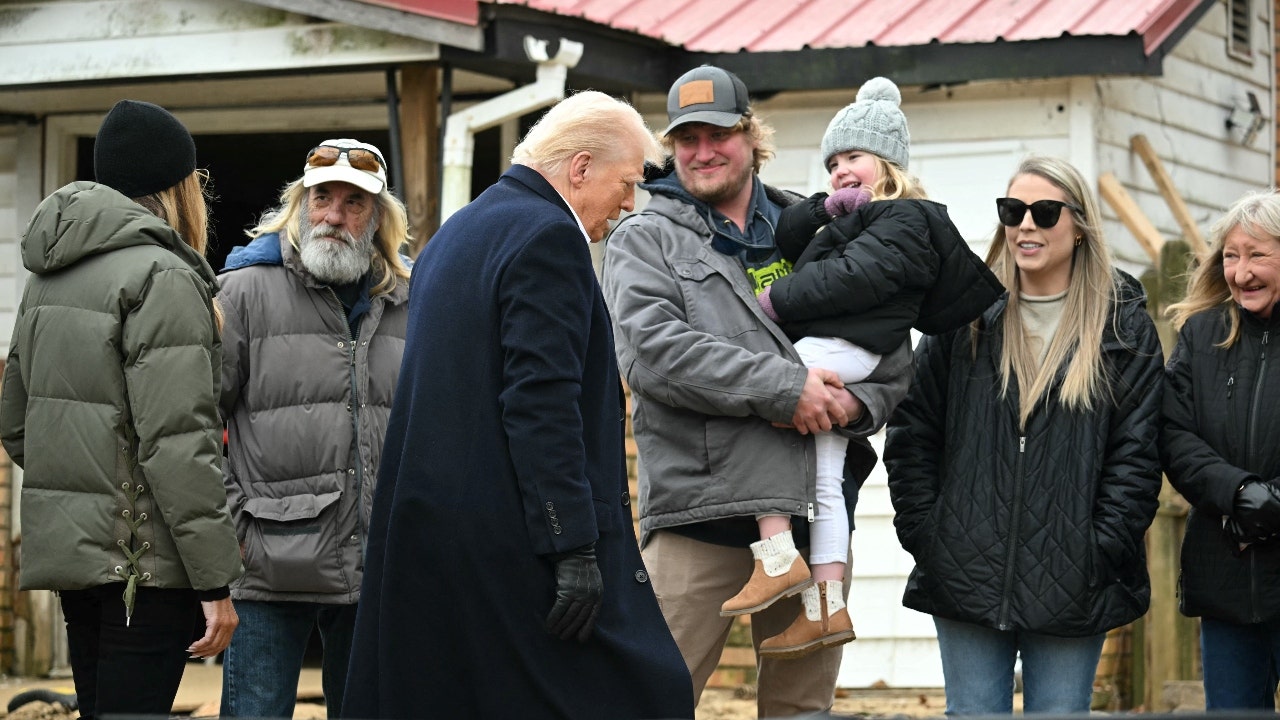
ASHEVILLE, N.C. – President Donald Trump’s Jan. 24 visit to western North Carolina — his second since Hurricane Helene destroyed large swaths of the Southeast on Sept. 27 and his first visit since becoming president — brought hope to survivors on Friday.
Fox News Digital spoke with multiple locals during Trump’s visit to hard-hit Swannanoa, where houses along the Swannanoa River were literally swept downstream during the destructive hurricane exactly four months ago Monday.
“It’s been hell,” Swannanoa resident Michelle, who wanted to be identified only by her first name, told Fox News Digital.
Michelle lives in a makeshift camper park off a main road in Swannanoa, where she and about seven or eight other locals whose homes were destroyed in the hurricane are living in campers and tents donated by different charitable organizations.
HURRICANE SURVIVORS WHO MET TRUMP IN NORTH CAROLINA SHARE PRESIDENT’S WORDS THAT STUCK WITH THEM
North Carolinians living in a row of privately donated campers in Swannanoa. (Fox News Digital)
Many people are still struggling to find secure housing, Michelle said, noting that many families with children have received tiny home donations from charities, but they would not be enough for those families to live long-term.
Along with housing, many locals lost their jobs in the hurricane when warehouses and businesses were destroyed by flooding or other damage.
‘A BIG RELIEF’: NC RESIDENTS DESCRIBE MEETING WITH TRUMP AFTER FEELING ‘IGNORED’ POST-HURRICANE
Emily Russell was seven months pregnant when her home near the river flooded up to her chest. She and her dog sat on a floating mattress and waited for help because there was no other way out.
Emily Russell was seven months pregnant when her home near the river flooded up to her chest. She and her dog sat on a floating mattress and waited for help because there was no other way out. (Fox News Digital)
“It’s just really been crazy since then. No help, really, except for volunteers and churches that we’ve been grateful for,” Russell told Fox News Digital. “They’ve come, and they really helped us a lot because we had to gut the house and rebuild it. And then, like I said, I was pregnant at the time, so we had to hurry and try to get it at least livable before the baby came.”
“Of course, I applied for FEMA [aid] and different government assistance, but none of that really came through to help in any way,” Russell added.
TRUMP TO VISIT BATTERED NORTH CAROLINA TOWNS STILL SUFFERING MONTHS AFTER HELENE: ‘TREATED BADLY BY DEMOCRATS’
A tent and camper in Swannanoa, North Carolina. (Fox News Digital)
Many locals who spoke to Fox News Digital on Friday said that while they have received some help from the Federal Emergency Management Agency (FEMA), it is not enough, and there is too much red tape in applying for and actually receiving help, whether it be monetary or housing assistance.
Numerous people across western North Carolina are still sleeping in tents and campers more than 100 days after the storm hit the area in the early morning hours of Sept. 27. Most campers on private property have been donated by local and national charities, such as Samaritan’s Purse and Cajun Navy, which is working with Emergency RV to donate used and new campers. Others are staying in campers donated by the agency on specific FEMA-designated sites.
TRUMP WARNS FEMA FACES RECKONING AFTER BIDEN ADMIN: ‘NOT DONE THEIR JOB’
A Trump campaign sign posted to a telephone pole in Swannanoa, North Carolina, on Jan. 24, 2025. (Fox News Digital)
Russell said she and other locals were excited that Trump was making his second visit to the town, which has a population of about 5,000.
“We’re hopeful. I just really think that he’s the one that can make the big difference, and we’re just excited.”
“The fact that he has come back, especially to Swannanoa … little nowhere town, and he’s here … it just makes you feel hopeful that we are going to start getting some help and see a big change,” Russell said. “We’re glad he’s here. We’re hopeful. I just really think that he’s the one that can make the big difference, and we’re just excited. This little town has needed a little bit of help, so that’s really cool.”
TRUMP WARNS FEMA FACES RECKONING AFTER BIDEN ADMIN: ‘NOT DONE THEIR JOB’
President Donald Trump, with first lady Melania Trump, visits a neighborhood affected by Hurricane Helene in Swannanoa, North Carolina, on Jan. 24, 2025. (Mandel NGAN / AFP)
A Swannanoa resident who wanted to be identified only as Vicky, who also lost her home and is now living in a camper donated by a church group, told Fox News Digital that she was “excited” about the president’s visit.
“I hope that he sees how bad it still is and sticks to his word and does something about it.”
“He was here in October, and he wasn’t even president then,” Vicky noted.
When asked what locals need most, Vicky said more “housing would be great,” or the financial means to get housing.
Vicky’s home was swept downriver during Hurricane Helene, and she is now living in a donated camper on her property. (Fox News Digital)
“We did get our FEMA money, and we’re putting it towards all this, which is nowhere near enough to cover everything,” she explained. “We were out of debt. And as of right now, we’re going to be back in debt for a home because we have no choice.”
Danny Bailey, or “Uncle Danny,” as locals know him, also believes the new administration will help hurricane survivors get some relief.
FEMA EXTENDS TRANSITIONAL HOUSING PROGRAM FOR NORTH CAROLINA RESIDENTS DISPLACED BY HURRICANE HELENE
“Even if he just helps us financially, or he gets people in here to say, ‘OK, we’re going to build you a house’ … because what FEMA’s done was good, but it wasn’t good enough,” Bailey said. “And the fact that he came here after the flood shows that he cares enough that he’s gonna do something.”
A Trump campaign flag posted to a tree in Helene-devastated Swannanoa, North Carolina, on Jan. 24, 2025. (Fox News Digital)
Bailey lost his home and said two charitable organizations donated two campers for him to use and live in after the storm. Another man from Mexico who now lives in North Carolina helped clear debris on his property for free, Bailey said.
The president spoke in two North Carolina towns during his Friday visit and asked a group of Swannanoa residents to take the mic and share their stories on his last stop before heading to California to visit wildfire-affected areas.
HURRICANE SURVIVORS WHO MET TRUMP SHARE WHAT PRESIDENT’S VISIT MEANT TO THEM:
“I’ll also be signing an executive order to begin the process of fundamentally reforming and overhauling FEMA, or maybe getting rid of FEMA,” Trump told reporters in North Carolina on Friday morning. “I think, frankly, FEMA is not good.”
Trump also promised his administration would step in and assist North Carolina to fix the damage quickly, vowing to “do a good job” for the state.
AMERICANS SPENDING THANKSGIVING IN TENTS AS HEAT, ELECTRICITY, FOOD STILL HARD TO FIND
President Donald Trump speaks while visiting a neighborhood affected by Hurricane Helene in Swannanoa, North Carolina, on Jan. 24, 2025. (MANDEL NGAN/AFP via Getty Images)
“We’re going to fix it, and we’re going to fix it as fast as you can,” Trump said. “It’s a massive amount of damage. FEMA has really let us down. Let the country down. And I don’t know if that’s Biden’s fault or whose fault it is, but we’re going to take over. We’re going to do a good job.”
CLICK HERE TO GET THE FOX NEWS APP
Hurricane Helene created billions of dollars worth of damage when it destroyed homes, farms and critical infrastructure like roads, bridges and power lines. Parts of highways connecting North Carolina and Tennessee have been closed since late September.
More than 100 people died as a result of the hurricane in North Carolina alone, and the total death count is more than 230 across six states, including South Carolina, Tennessee, Virginia, Georgia and Florida.


DALLAS – Thunderstorms will roll through parts of North Texas on Friday. Thankfully, none should be severe. Mother’s Day could be a different story.
Friday Forecast

According to FOX 4 Weather Meteorologist Berkeley Taylor, a cluster of thunderstorms will work their way east across the Dallas-Fort Worth Metroplex on Friday morning.
Everything is well below severe limits, just with lots of lightning!
Scattered showers and thunderstorms will move in and out through the day on Friday. Coverage is about 20%.
An isolated strong storm or two can’t be ruled out, but the overall threat is low.
Temperatures will be in the 50s and 60s for the morning, before climbing into the 80s by the afternoon.
Weekend Forecast
Saturday will look similar, with even lower coverage expected.
Sunday presents the best chance to find rain and storms – about 50% as a cold front moves through North Texas.
North Texas is under a Level 2 out of 5 risk for severe weather. The biggest concerns will be with wind and hail.
Timing-wise, the front looks to move through in the afternoon/evening.
7-Day Forecast
Once the front is south of North Texas on Mother’s Day, the rain should come to an end, and it will stay dry into next week.
Temperatures will start to warm into the upper 80s and low 90s by midweek next week.
The Source: The information in this story is from the FOX 4 Weather team and National Weather Service.

The search for missing 16-year-old Benjamin Braithwaite is over. Atlanta police announced just before midnight Thursday that he had been located, more than a week after he vanished from his Regency Trace home.
The department shared the update on social media but did not release additional details about where he was found or the circumstances surrounding his recovery.
Braithwaite had been missing since the night of April 27, when he was last seen around 9 p.m. at his home in Atlanta. His family said they had no contact with him during the entire time he was gone.
The disappearance of the KIPP Atlanta Collegiate High School sophomore and basketball team member had galvanized the Atlanta community. His family, teammates, Atlanta police officers and neighbors gathered at the school last week to raise awareness about his disappearance. Hartsfield-Jackson Atlanta International Airport, where his mother works, joined the search effort — asking the public to watch for him at MARTA stops and fast food restaurants.
A $10,000 reward had been offered for credible information leading to his safe return.
“Even small details matter. Your awareness could make the difference,” the airport wrote in an Instagram post earlier this week.

AUGUSTA, Ga. (WJBF) – The Richmond County Sheriff’s Office is searching for a wanted man.
35-year-old Oniel Gary Cameron is wanted for an incident that occurred on Bridgewater Drive in Augusta Thursday.
Authorities say his charges include:
- Cruelty to children 3rd Degree
- Criminal Damage to Property 1st Degree
- Possession of a Firearm by a Convicted Felon
Cameron reportedly has warrants on file with RCSO and is known to drive a black Toyota Seqoia with a Georgia tag of D-E-E-8-6-7-2.
He is believed to be Armed and Dangerous.
Anyone that comes into contact with Cameron or has any information on his location is urged to call the Richmond County Sheriff’s office at 706-821-1020 or 706-821-1080.
-

 Detroit, MI30 minutes ago
Approval poll: Do you approve of Lions GM Brad Holmes? (post-2026 draft)
-

 San Francisco, CA42 minutes ago
Where to watch Pittsburgh Pirates vs San Francisco Giants: TV channel, start time, streaming for May 8
-

 Dallas, TX48 minutes ago
Dallas Weather: Thunderstorms in the forecast for Friday & Mother’s Day
-
Boston, MA60 minutes ago
Where to watch Tampa Bay Rays vs Boston Red Sox: TV channel, start time, streaming for May 8
-

 Denver, CO1 hour ago
11 Denver Restaurants For Anyone Missing Their Southern Roots – Tasting Table
-

 Seattle, WA1 hour ago
Offseason Checklist: Seattle Kraken
-

 San Diego, CA1 hour ago
San Diego Padres celebrate Puerto Rican heritage with local artist
-
Milwaukee, WI1 hour ago
Food trucks in Milwaukee brace for new curfew

