Lifestyle
'I wanted to buy her time': A mother looks back on her daughter's terminal cancer


Sarah Wildman and Orli, photographed in early summer 2021. Orli was finishing a second round of chemotherapy after her liver cancer had metastasized when she was asked to participate in a project chronicling the beauty of baldness.
Abby Greenawalt/Sarah Wildman
hide caption
toggle caption
Abby Greenawalt/Sarah Wildman
In 2019, Sarah Wildman’s daughter, Orli, was just 10 when she was diagnosed with hepatoblastoma, a rare form a liver cancer. Over the next few years, Wildman chronicled Orli’s illness for The New York Times, where she is a staff writer and editor for the Opinion section.
Wildman’s articles detailed Orli’s bout with several rounds of chemo, a liver transplant, two brain surgeries and a tumor that pinched her spine, leaving her unable to walk. Orli died in March 2023, at the age of 14.
“I thought I understood pain, but she was facing a kind of pain I realized I really had never encountered,” Wildman says. “She would sometimes ask me, ‘What do you think I did to deserve this?’ And of course, that’s not an answerable question.”
Wildman also wrote about the expert medical care Orli received — and the unwillingness of some doctors and nurses to speak openly and realistically about what she was facing. Wildman believes the medical establishment tends to view the death of a child as a failure. As a result, she says, “there is a reluctance to face the idea that medicine has limits. … Children’s hospitals really are always advertising that they will cure children.”

Wildman says that Orli’s illness and death made her question her own Jewish faith: “I had to redefine what God meant to me. It couldn’t be waking up and saying a prayer in the morning or praying for something specific. … I had to really see it in the divinity of people who went out of their way to help us and that weren’t afraid of us.”
Orli would have turned 16 on Jan. 13. To mark the occasion, Wildman and her younger daughter, Hana, spent the weekend doing things that they thought Orli would have enjoyed doing.

“I think one of the really difficult things about facing a parent who has lost a child … is that you cannot make it better. There is no betterment of this,” she says. “What’s easier, though, is when people aren’t afraid of mentioning her name or reminding me of a story or telling me something I didn’t know that she’d told them or that she’d done for them.”
Interview highlights
On interviewing Orli on Instagram
I wanted people to see what it meant to be a kid in cancer care, a really articulate kid, a kid who was really grappling with it and thinking about it and considering it, especially at a time in the mid-pandemic where people were weary of lockdown, really feeling quite sorry for themselves. And what Orli does in that interview, in addition to sort of winning over everyone who watches it, is to sort of realign the way people are thinking about their own sadness, their own sense of isolation, and to show how she was so joyful even during extremely hard experiences.
On the questions Orli and her sister Hana asked that Wildman struggled to answer
At one point we had a very severe experience where Orli ended up in the ICU in Hawaii. We were on a Make-A-Wish trip. It was brutal and terrifying. And Hana said, “Do you think God doesn’t love us?” The kinds of questions that they asked during this really showed my hand, if you will. I was not able to really offer a concrete answer to any of these things. I would say I don’t think that there is a God that is that activist in this way — because there is so much pain around the world and we are experiencing this. But I don’t think it’s about God not loving us. You have to see divinity in the people who are helping us. I would try to turn it into thinking, “How can we see good in the situation?” But sometimes I was really stymied.
On parenting a child with a terminal illness
It really challenged parenting. … I didn’t know how to discipline in this space when all the rules seemed to have been thrown out the window. I didn’t know how to put limits on things. How do you put limits on phone use when you have so little outside interaction? How do you say you have to really focus on algebra when you don’t know actually if any of it will matter? It’s really difficult. And I once said to her, “Well, isn’t it good that we have so much time together, we really get to bond?” And she said, “This is the time I’m supposed to be breaking away from you.” She was hilarious and cynical and tenacious and would often really try to push the boundaries of permissibility when she could.

Orli (third from left) poses with her parents and sister Hana on her 13th birthday in 2022.
Miranda Chadwick/Sarah Wildman
hide caption
toggle caption
Miranda Chadwick/Sarah Wildman
On maintaining hope and optimism throughout Orli’s treatment
I think hope can be a form of denial. It can also be a motivating force. It can mean that you do seek out treatments that do give you days, months, maybe even years. I think that the hope is essential because cancer care is grueling. It can be demoralizing to face the consequences of cancer care. It can be the cancer care that itself comes with pain. It comes with nausea. It comes with hair loss. I can come with all sorts of indignities. …
It was brutal because she really tried to live each moment in such an enormous way. She really, really loved living and she would try to make life different in the hospital. I mean, she made every single nurse do TikTok dances with her. She would make the music therapists sing Lizzo and Olivia Rodrigo and Taylor Swift, and she would play Taylor Swift and Lizzo in every operating room. And she had many, many surgeries. She would force people again and again to see her not as a patient, but as a person.
I wanted to give her everything. I wanted to buy her time.
Monique Nazareth and Susan Nyakundi produced and edited this interview for broadcast. Bridget Bentz, Molly Seavy-Nesper and Beth Novey adapted it for the web.

Lifestyle
The BoF Podcast | Decoding Paris Haute Couture: Wonder, Restraint and the Call of the Void


Lifestyle
L.A. Affairs: It’s hot when a man drives to me. But would this new guy make the trek from the Valley?
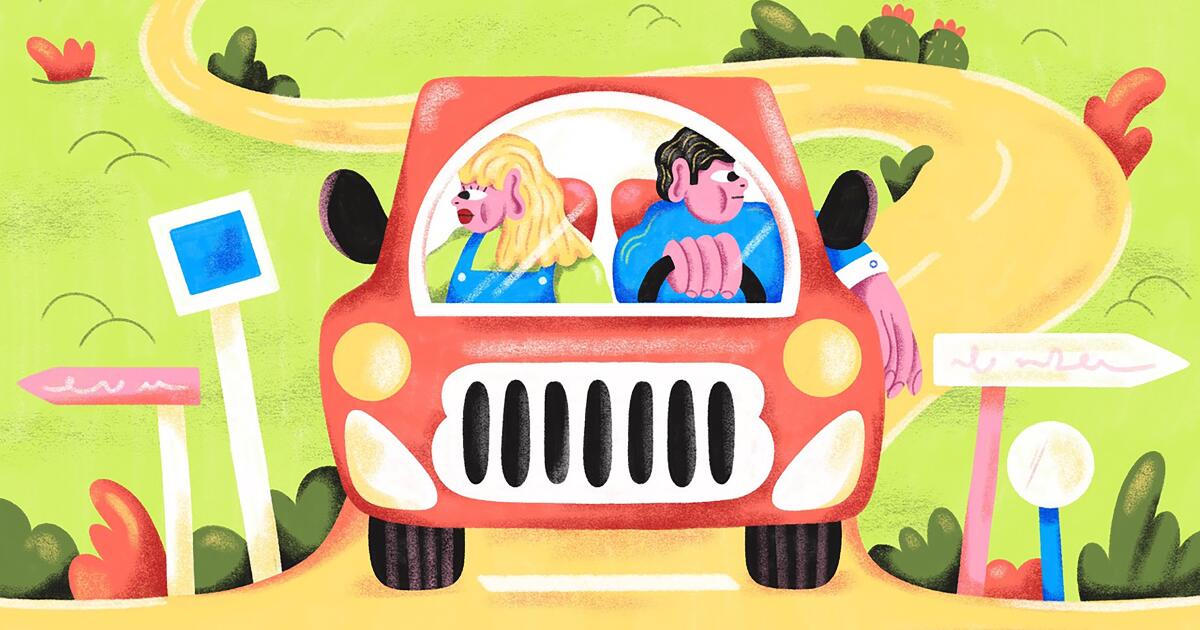
I met Dan on Hinge.
He lives in Woodland Hills, and I live in Venice. In Los Angeles, this is considered a long-distance relationship. In another city it might be nothing. Here, it’s a factor.
But I believe that with the right person, you can make anything work, so I stay open. I’m a native New Yorker, and if I were living in Brooklyn and a guy lived on the Upper West Side, that would be a 45-minute subway ride, which is truly nothing in New York. So with that same logic, I try to have flexibility with men in L.A.
When we started planning our first date, Dan suggested three options: a hike on mushrooms, a wine tasting or a walk on the beach.
A hike on mushrooms is something I’d only do with someone I already trust, not someone I just met online. I don’t do first-date hikes because I don’t like feeling trapped if the guy’s a dud. So I chose the wine tasting.
Then I learned the wine tasting was in West Hills.
On a Friday night, driving there from Venice would be insane. So I said I didn’t want to meet there because of the traffic. He suggested Malibu. That was also not ideal on a Friday.
I was getting annoyed — this was a pink flag because in my dating world, the guy is supposed to come to the woman’s neighborhood in the early days. I’ve gone out with plenty of men from the Valley who effortlessly suggested they come to me. It’s not rare or impossible.
I suggested he come to the Westside. I didn’t specifically say Venice, and in hindsight, I probably should have. He landed on Brentwood, which was manageable for both of us. On our first date, we met at an Irish pub on Wilshire Boulevard. He was cuter and more interesting than I had expected, and with the Guinness flowing, we had fun.
When I got home, he texted me: “Well, I like you 🙂 Less the tik tok and the lack of rock music in your life, but it’s not a deal breaker — there are other qualities 🙂 What are your thoughts?”
I noticed the slight negativity but was mostly dazzled that a man texted immediately after the date to say he liked me. In the modern dating economy, this felt rare.
The next day, both of our evening plans fell through, so we made a last-minute date. The wine tasting he originally suggested still sounded like fun, and although it meant me driving to the Valley, I was up for it now that we’d met.
We sipped flights at Malibu Wines & Beer Garden in its airy, romantic courtyard and played a flirty version of Truth or Dare. Halfway through, he dared me to kiss him.
We ended with sushi on Ventura Boulevard and a short make-out session in his car. He invited me to Thanksgiving at his uncle’s, which felt too soon, but also sweet.
After the second date, he texted and said he had his kids that week and was also hosting an event on Thursday, so his only day to meet was Wednesday. I said great.
On Tuesday night, he checked if we were still on, and I said yes.
Then he texted: “I’m flexible on time but not on location. I have a big event on Thursday, hopefully you can come to me again.”
My stomach tightened. This again?
So I texted back: “I drove to you last time, which was a bit of an exception for me especially in the early days, but the wine tasting location sounded special. Usually guys come to my area. How about we switch it up this time?”
He replied: “I appreciate the effort! Because of my event, I’d rather be close to a computer just if needed … Here is what i offer:
— I’ll come to your area anytime next week/end
— Lunch/dinner on me
I want to continue where we stopped last time 😉 No pressure of course, but let’s snuggle”
I responded: “Ok let’s meet next week. Snuggles sound nice … let’s see what happens …”
Then he wrote: “So I won’t see you tomorrow?”
I replied: “Unless you wanna come to me and bring your laptop along, let’s rain check until you have more flexibility.”
He said: “Dang, you are hard. I’ll let you know tomorrow around midday if it’s ok.”
And then — surprise — he decided to come.
He drove to Venice for a 5 p.m. date. He said his ETA was 5 p.m., and it ended up being 5:25 p.m., typical 405 Freeway.
When he showed up, he was in a cranky mood. On our way to KazuNori in Marina del Rey, I thanked him for picking me up and told him I think it’s hot when the guy comes to the girl.
“You’re just saying that because you want me to come to you more,” he said, not playfully, but aggressively.
That was basically the end for me. But there I was, in his car, heading to dinner. So I stayed pleasant and tried to make the best of it.
I shared that in the early stages of dating, I find it’s good etiquette for the guy to come to the woman’s neighborhood. He immediately disagreed and started ranting about how dating rules are ridiculous and how they swing in women’s favor. He resented paying for dates and declared he wasn’t looking to “sponsor a woman’s life.”
“If women want equality and equal rights,” he said, “then it should apply all across the board, including dating, and the man shouldn’t have to pay.”
I said women don’t actually have equal rights because we get paid less than men and often receive lower salaries than men in the same position.
I tried to change the subject and reset the mood, but he insisted we keep hashing it out.
I tried to explain masculine/feminine dynamics: providing and protecting, giving and receiving.
“What does the man get out of this arrangement?” he asked.
It was like watching someone’s personality warp into Mr. Hyde. Then he brought up another point: He’s a single dad of two kids, so he gets tired; and because I don’t have kids, that should factor into who drives where.
At this point, I was barely engaging and focused on eating my hand rolls, and I couldn’t wait to get home.
The check came, and I happily split it, wanting nothing further from him.
In the car back to my place, he remarked: “It’s obvious we’re never gonna see each other again.”
Obvious, but did it need to be stated?
Then he showed me a Spotify playlist he’d made for me of his favorite electronic music, because he knows I like EDM.
“Oh, that’s sweet,” I said.
“Yeah, that’s how I show interest. Through things like this, not who drives to who,” he replied.
When I got out of the car, we wished each other luck, and I headed inside and shut the door.
Two hours later, he sent me the playlist. I’ve yet to listen to it.
It wasn’t the distance that ruined it. It was the resentment. I’m not looking for a man who feels burdened by the effort. I’m looking for a man who sees the value of courting a woman in the first place.
The author is a writer, comedian and former psychologist who lives in Venice. She is the creator of the new vertical series “Manfari.” She’s on Instagram: @solange_neue and @manfari.show.
L.A. Affairs chronicles the search for romantic love in all its glorious expressions in the L.A. area, and we want to hear your true story. We pay $400 for a published essay. Email LAAffairs@latimes.com. You can find submission guidelines here. You can find past columns here.
-

 Technology9 seconds ago
No, Flock isn’t threatening people for debating surveillance
-

 World3 minutes ago
Israel signals readiness for another Iran strike as Trump declares ceasefire over
-

 Politics8 minutes ago
Kelley Paul: America’s Founders were the ‘first civil rights heroes’
-

 Health15 minutes ago
Your resting heart rate could reveal more about your health than you think, doctors say
-

 Sports18 minutes ago
Shohei Ohtani ruled out of MLB All-Star Game as Dodgers plan to manage nagging injury
-

 Technology30 minutes ago
Fake VA shoe offer targets veterans
-
 Business33 minutes ago
Los Angeles hotels saved by last-minute surge in World Cup bookings
-
 Entertainment38 minutes ago
Emily Ratajkowski’s viral essay on sex life as a single mom scores her a seven-figure book deal

