Politics
With her city in flames, L.A. Mayor Karen Bass' political future hangs in the balance

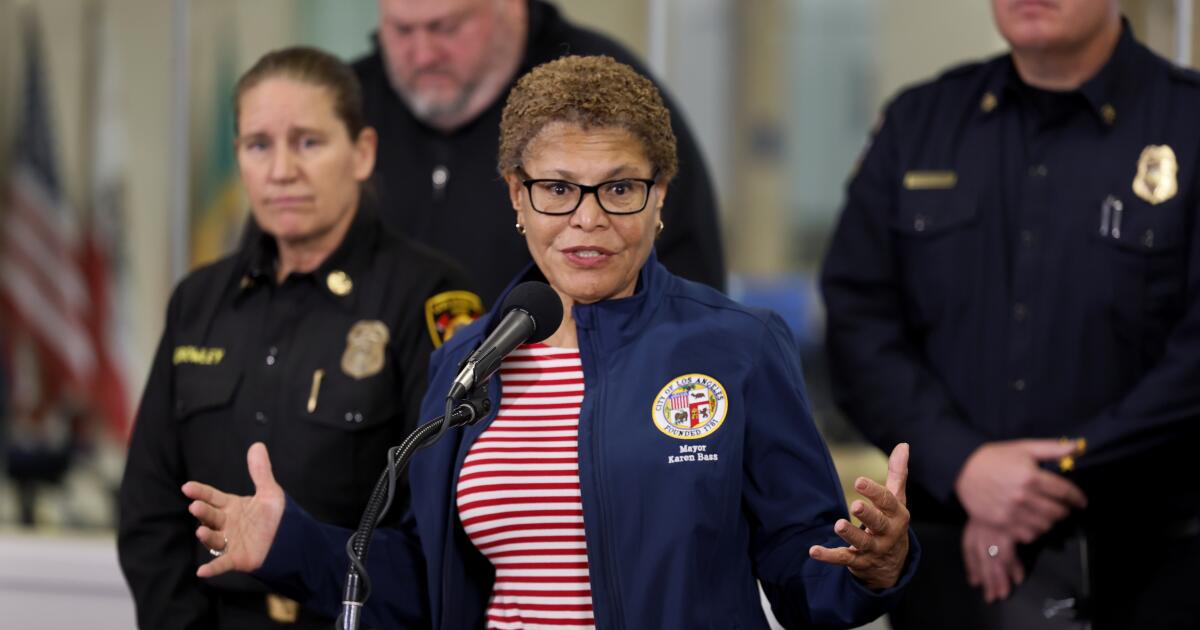
Apocalyptic fires had been ravaging Los Angeles for more than 24 hours when Mayor Karen Bass stepped off a plane and into a now-viral encounter that may come to define her mayoralty.
As an Irish reporter who happened to be on her flight hurled questions at her, the mayor of the nation’s second-largest metropolis stood silent and seemingly paralyzed.
“Do you owe citizens an apology for being absent while their homes were burning?” No answer.
“Do you regret cutting the fire department budget by millions of dollars, Madame Mayor?” No answer.
“Have you nothing to say today?”
Bass stared forward, then down at her feet, before pushing her way down the sky bridge and out toward her smoldering city.
She had left Los Angeles on Jan. 4, as the National Weather Service intensified warnings about a coming windstorm, to attend the inauguration of Ghanaian President John Dramani Mahama. She remained out of the country as the Palisades fire ignited, then exploded, with other fires soon erupting in and around the city.
She returned Wednesday to public outrage about her whereabouts and questions about empty hydrants, an empty reservoir and, according to some, insufficient resources at the Fire Department. Her handling of questions in the days that followed has only intensified some of that criticism.
Bass has also battled extraordinary dissension in her own ranks, with Los Angeles Fire Chief Kristin Crowley in interviews Friday characterizing the department as understaffed and underfunded and implying that Bass had failed her. False rumors that night that Bass had fired Crowley added to the chaos and sense that Bass was not entirely in control.
Now — while Bass navigates a calamity that will redefine the city — her political future also hangs in the balance.
In a moment of anguish where people desperately want heroes and villains to make sense of their own pain, Bass has undoubtedly become a punching bag for portions of the city.
Her absence, combined with an unsteady early performance and the unprecedented attack from her fire chief, have only intensified her vulnerabilities. And on X, she has become a much-maligned conservative meme.
But only time will reveal the severity of the political fallout. There will be investigations into whether fire and water officials failed and whether City Hall missed opportunities to make communities more fire resilient. Such answers will take months, if not years, to sort out.
In a belligerent California landscape only provisionally tamed by human hands, fire is an inevitability. Many of the seeds for destruction were sown long before Bass took office — rising temperatures that left hillsides dry and poised to explode with intense winds, planning decisions from generations ago that placed homes inside vulnerable, brush-covered canyons.
Even before last week’s unprecedented firestorms, climate change was reshaping California in terrifying ways, with fire leveling entire communities in places like Santa Rosa and Paradise.
And the hard work of rebuilding is just beginning.
“For all Angelenos, we are hurting, grieving, still in shock and angry. And I am too,” Bass said during a briefing Saturday morning. “The devastation our city has faced. But in spite of the grief, in spite of the anger, in spite of the shock, we have got to stay focused until this time passes, until the fires are out.”
Bass, who declined to be interviewed, pledged a “a full accounting of what worked and especially what did not” once the flames have receded.
Elected in November 2022, the first-term mayor has spent her initial years in office focused on the city’s sprawling and complex homelessness emergency. She has made some incremental progress on homelessness, but had also faced few external crises until last week.
Before the fires, even as Angelenos expressed frustration with the direction of the city, residents still largely approved of her job performance.
But that goodwill is dissipating.
In recent days, the hits have come from all sides, with her 2022 challenger, billionaire mall mogul Rick Caruso, castigating Bass in the media for her absence and handling of the fire.
Caruso, whose Palisades mall survived the conflagration with the help of private firefighters, told The Times last week that Bass’ “terrible” leadership had resulted in “billions of dollars in damage because she wasn’t here and didn’t know what she was doing.”
A Change.org petition demanding her resignation has received more than 120,000 signatures.
Bass, 71, has also been blasted over cutbacks in Fire Department operations, with those attacks coming from both the right and the left. Kenneth Mejia, the city controller and progressive darling, has been particularly critical on social media.
Bass and the city’s budget analysts have pushed back on that budget cut narrative, pointing out the department was projected to grow significantly this year — well before the fires broke out, thanks in large part to a package of firefighter raises.
On Monday morning, Dr. Patrick Soon-Shiong, the owner of The Times, said it was “a mistake” for the paper to have endorsed Bass in 2022 in an interview on “The Morning Meeting,” a YouTube-based politics show. (Endorsements are made by The Times’ editorial board, which operates separately from the newsroom.)
Critics have also harped on Bass’ lack of visibility outside of official briefings, saying the former six-term congresswoman has appeared more like a legislator than a chief executive during a moment when residents desperately want to feel reassurance from their leader.
Gov. Gavin Newsom, several members of the county Board of Supervisors and City Councilmember Traci Park, who represents Pacific Palisades, have been more visibly present than the mayor in affected communities and on local news.
But the real crucible for the mayor is only just beginning to take shape, with her political prospects inextricably tied to the almost unfathomably knotty recovery ahead.
In a place long circumscribed by disaster, Bass is facing a catastrophe with financial and logistical burdens that will likely dwarf the combined fallout from the 1994 Northridge earthquake and the 1992 civil unrest. She will also be responsible for a mammoth environmental cleanup effort and the challenge of housing thousands of newly homeless Angelenos in an already supercharged housing market. All of this will have to happen as she prepares for the massive footprint and operational challenges of the coming 2028 Olympics.
Before swaths of the city immolated, the Democratic mayor of an overwhelmingly Democratic city was widely expected to sail into a second term with no serious opponents in the 2026 election.
Potential challengers may now “smell blood in the water,” as one local political consultant put it, and reassess the viability of mounting their own campaigns amid a rapidly shifting political landscape.
A representative for Caruso, a Republican-turned-Democrat who spent more than $100 million of his personal fortune on his 2022 campaign, did not respond when asked if he planned to run again. Jane Nguyen, a spokesperson for Mejia, said the city controller was “focused on the job right now” and had not made any decisions about future races.
“I don’t think this is a fatal situation yet for her reelection chances,” said Ange-Marie Hancock, a former USC political science and international relations department chair, who now leads Ohio State University’s Kirwan Institute for the Study of Race and Ethnicity.
There is still time for the former South L.A. community organizer to pivot back to the political brand she is known for, defined by “a deep sense of care for the community,” Hancock said.
But it won’t be easy.
Even some political allies have looked askance at the mayor’s handling of the snowballing critiques last week, with several expressing disbelief at the viral airport interview and her tone on followup questions in the days following.
The mayor, who has long brushed off questions she casts as politically motivated with an air of annoyance, was combative and defensive in news conferences when pressed about her trip. It took days for her to publicly acknowledge the level of raw fury being expressed about the city’s fire response.
Only a portion of the lethal conflagrations are within city boundaries, though Bass has also battled blame for the response to the Eaton fire, which is well outside her purview.
Others have condemned Bass’ critics as political vultures who are only hurting the city in an already perilous moment.
“It is not warranted,” Steve Soboroff, a former president of the Los Angeles Police Commission and longtime supporter of the mayor, said of the criticism. “It’s just convenient and easy for people who want to spend their time pointing fingers instead of looking forward. This was an act of God. This was a force majeure. This was beyond anybody’s control.”
Bass obviously does not control the wind, nor can she see the future. And an obliteration of this magnitude required a perfect storm of factors that few would have predicted several days ahead of time.
Still, before Bass left town, the regional branch of the National Weather Service was predicting critical fire conditions, verbiage that shifted to “extreme fire weather conditions” on Jan. 5. By late last Monday morning, they had issued an urgent warning for a “life-threatening & destructive windstorm,” raising nagging questions about the mayor’s priorities and why she did not leave Ghana sooner.
“I don’t understand how they did not cancel her trip,” a senior staffer for another local elected official said, explaining that their office had begun viewing the coming wind event as a grave threat during the preceding weekend. “It was political malpractice.”
The staffer, who was not authorized to speak publicly, said it was common practice for Los Angeles politicians to cancel, or prepare to cancel, prearranged events during severe weather events.
Still, Bass is not the first California political leader to lead in absentia during a moment of exigent crisis.
Former Mayor James Hahn was on a lobbying trip to Washington, D.C. on Sept. 11, 2001, and unable to return to the city for several days with air travel suspended. When the Watts riots erupted in 1965, then-Gov. Pat Brown was famously vacationing in Greece; his absence helped cement his ouster by challenger Ronald Reagan the next year.
In a city of more than 4 million people, TMZ happened to find two prominent Bass supporters — actors Kym Whitley and Yvette Nicole Brown — exiting a San Fernando Valley grocery store on Saturday. They fervently defended Bass in a seemingly impromptu interview.
They implied that Bass was being held to a higher standard as a Black woman and unfairly blamed for a natural disaster.
“When smear campaigns begin against her with a political motive, she’s not the kind to fly her own flag,” Brown said Sunday of the mayor, who typically eschews public political fights. “And more importantly, this is not the time for anyone to be trying to position themselves for the next election.”
The mayor’s quiet style and penchant for soft power, which some have found lacking in this moment of roaring catastrophe, could also be a strength in the months to come.
Bass’ dexterity as a coalition builder and the deep federal relationships that she used as a selling point during her campaign make her particularly well poised to succeed in leading the city’s recovery, Soboroff said.
As other state and local leaders took showboating shots at President-elect Donald Trump, Bass publicly sought to defuse the friction, saying she had been in conversation with representatives of the incoming administration and was not worried about any alleged lack of communication.
“During disasters, we look for someone to blame. But it’s also that our politics have become polarized and nationalized, so this gets used as an excuse to bash on California for a variety of reasons,” said Manuel Pastor, director of the USC Equity Research Institute.
Pastor, who served on Bass’ transition team, cited the echo chamber of disinformation on X and right-wing political actors seizing on the crisis for their own ends.
“She will be judged on the rebuilding, and she will be judged on whether or not the city can get itself in shape for the Olympics,” Pastor said.
Times staff writer David Zahniser contributed to this report.

Politics
Trump takes unusual step, lets bipartisan housing bill become law unsigned amid SAVE pressure campaign

NEWYou can now listen to Fox News articles!
A bipartisan housing bill became law Saturday at midnight after President Donald Trump declined to sign it, capping a weeks-long saga over whether the president would veto the measure amid frustrations with Congress over his stalled agenda.
Trump refused to sign the 21st Century ROAD to Housing Act — legislation aimed at expanding the nation’s housing stock and lowering costs — in an attempt to pressure Congress to pass the SAVE America Act, despite the housing bill clearing both chambers with overwhelming majorities.
“I will not sign the Housing Bill, which has been fully approved by Congress and sent to the White House, in PROTEST over the fact that the United States Senate is not capable of passing THE SAVE AMERICA ACT, which is polling at 97% with the Republican Party, and very high with the non-politician Dumocrats,” he declared on Truth Social Friday morning.
The Trump-backed election measure, which would require proof of citizenship to vote in federal elections and impose voter ID requirements, has struggled to overcome the Senate’s 60-vote threshold.
Meanwhile, the House has not passed a version of the bill that includes the president’s proposed crackdown on mail-in voting and banning men from women’s sports.
President Donald Trump speaks in the Oval Office of the White House, Wednesday, June 3, 2026, in Washington. (Alex Brandon/AP)
HOUSE CONSERVATIVES DERAIL GOP AGENDA IN SAVE AMERICA ACT SHOWDOWN
Under the U.S. Constitution, Trump had 10 days, not including Sundays, to sign or veto the housing measure after the House formally transmitted the legislation to the White House in late June. The president ultimately chose neither option, allowing the measure to become law without his signature.
Though Trump declined to veto the legislation, he sharply criticized elements of the bill and argued it should not have been a legislative priority in recent weeks.
“It’s so unimportant … compared to the SAVE America Act,” Trump told reporters in the Oval Office in late June. “I think the SAVE America Act is exactly what it says. It’s saving America from crooked elections.”
Trump went on to call the housing bill “a yawn,” adding, “compared to the SAVE America Act, just about everything is a big yawn.”
It would have taken a two-thirds majority in both chambers to override a veto — a margin the House and Senate exceeded when they passed the legislation. However, it remains unclear whether so many Republicans would have defied the president had he vetoed the bill.
Trump also appeared to criticize the bill over a provision restricting Wall Street investors from purchasing single-family homes — a policy he first proposed during his January State of the Union address and later urged Congress to pass. Trump previously argued the investor ban would give individual homebuyers a leg up against private equity firms in the housing market.
“I don’t want to hurt people that own houses, too,” Trump later told reporters, appearing to reference the provision. “These people, for the first time in their lives, they have valuable houses. They’ve become rich. I don’t want to hurt them either. What you want to do is what’s good for everyone, get the interest rates down.”
The law also aims to boost housing supply by streamlining federal environmental reviews, loosening rules around the construction of factory-built homes, and incentivizing local governments to modify their zoning laws to allow more housing, among roughly 60 provisions.
Trump’s souring on the legislation created headaches for Republicans, who touted the bill as an affordability win as voters grapple with high housing costs.
“It’s irresponsible to postpone signing the Housing bill due to the SAVE Act,” Sen. Bill Cassidy, R-La., a retiring lawmaker who lost re-election to a Trump-backed challenger, wrote on social media. “We need to start delivering relief to people for the high cost of housing ASAP!!”
Construction workers stand on the roof of homes under construction at a new housing development on June 24, 2026, in Valencia, Calif. (Justin Sullivan/Getty Images)
WARREN TELLS TRUMP TO ‘SIGN THE DAMN BILL’ AS BIPARTISAN HOUSING PACKAGE REMAINS STALLED IN WASHINGTON
Trump abruptly canceled a signing ceremony for the legislation at the U.S. Capitol in June with GOP leaders. The stage had already been set, with at least one senior Republican arriving unaware the president had called off the event shortly before it was scheduled to begin.
The president then declared he would not sign the legislation until Congress passed the SAVE America Act, despite Senate GOP leaders insisting the votes do not exist to advance the measure.
Trump has also expressed frustration with the Republican-controlled Senate for declining to weaken the legislative filibuster, which requires 60 votes to advance most legislation in the upper chamber.
“GET SMART REPUBLICANS, IF YOU DON’T, YOU WON’T BE IN OFFICE FOR LONG!” Trump wrote in a Truth Social post on Sunday.
Before Trump came out against the bill, White House Press Secretary Karoline Leavitt called it “one of the most significant pieces of housing affordability legislation in American history” and said it included an array of policies “long championed” by Trump.
House Speaker Mike Johnson, a Republican from Louisiana, speaks during a news conference at the U.S. Capitol in Washington, D.C., on Oct. 15, 2025. (Eric Lee/Bloomberg via Getty Images)
Meanwhile, Trump political operative James Blair touted the legislation for including the president’s Wall Street investor ban, which he referred to as a “signature commitment.”
House Speaker Mike Johnson, R-La., has argued that Republicans will still promote the landmark housing bill ahead of November.
CLICK HERE TO DOWNLOAD THE FOX NEWS APP
“We’ll still celebrate it, but he’s trying to make a point, and I think he’s making it very effectively,” the speaker recently told reporters, referring to Trump. “And the fact that you all ask me every three steps down the hallway illustrates that he has achieved the desired objective, and that is to make SAVE America the number one thing, because if we don’t get that right, everybody’s concerned about what happens next.”

The Trump administration has signed off on a company’s plan to convert an oil and gas pipeline to pump groundwater from the Mojave Desert to thirsty California cities for the first time, a lucrative venture that critics say threatens natural springs and wildlife.
The federal Bureau of Land Management released documents Thursday saying that Cadiz Inc.’s plan to repurpose 162 miles of the pipeline to transport water “will not significantly affect” the environment.
“We’re excited to achieve this pivotal milestone. After many years of planning and environmental review, the project has now reached the construction stage,” said Susan Kennedy, chair and chief executive of Cadiz.
Environmental advocates and leaders of Native tribes, who have been fighting the project, criticized the decision.
“This groundwater mining proposal would drain the desert and rob the Mojave of its rare springs and wildlife habitat,” said Chance Wilcox, California desert associate director of the National Parks Conservation Assn. “It’s indefensible that the Trump administration would once again try to revive the pointless Cadiz project, by defying decades of scientific warnings and refusing to conduct an environmental review of the groundwater mining.”
The application for the federal authorization was filed by the Fenner Gap Mutual Water Co. The documents say the company plans to build seven pump stations, three of them located on federal land managed by the agency.
The 30-inch steel pipeline runs underground from Cadiz’s desert property, near the town of Amboy, northward to the town of Mojave.
The BLM said in its authorization that repurposing the pipeline for water “would comply with all applicable statutes and regulations.” The agency said it has “reasonably determined that the impacts of groundwater withdrawal associated with Cadiz’s groundwater extraction project are outside the scope of analysis.”
Cadiz’s attempts to export water from its property 200 miles east of Los Angeles have drawn controversy for decades.
In 2019, Gov. Gavin Newsom signed legislation that requires the project to undergo scientific study and gain approval from the State Lands Commission before it can take water from the Mojave and sell it to California cities.
Activists opposing the company’s plans include civil rights leader Dolores Huerta.
“Cadiz spells destruction for water, sacred lands, and the desert economy,” Huerta said in a statement. “It is exactly this type of greed and injustice that I have dedicated my life to oppose.”
Leaders of nearby tribes have also objected to Cadiz’s plans to pump from the desert aquifer near the Mojave Trails National Monument and Mojave National Preserve.
“It is the living heart of the desert,” said Daniel Leivas, chairman of the Chemehuevi Indian Tribe. “To drain it would be to drain the life out of the entire desert. No profit is worth such desecration.”
Chairman Timothy Williams of the Fort Mojave Indian Tribe said the company’s plan “to pump and sell 25 times more groundwater each year than the aquifer can replenish would desecrate our traditional territories.”
“Pumping more groundwater than is sustainably replenished is not only negligent, but dangerous to the American Desert Southwest,” he said in the joint statement with other opponents of the project.
For years, while pursuing its plan to sell water far away, the company has been using wells on its property to irrigate nearly 2,000 acres of farmland growing lemons, grapes and other crops. It has drilled more wells in anticipation of being able to export water once the government approved its pipeline.
The company intends to pipe water to communities in San Bernardino County and says it’s “expected to provide one of the lowest-cost sources of new water in the drought-plagued Southwest.” It says the federal permit “marks a key milestone as we finalize project financing with prospective investors.”
Cadiz bought the 220-mile pipeline from El Paso Natural Gas in 2020. Once construction is completed, the company says the pipeline will be able to transport up to 25,000 acre-feet of water per year — about 5% of what Los Angeles uses each year.
The Los Angeles-based corporation is also seeking to build a new pipeline along a railroad right-of-way to transport water to the south.
Environmental groups have repeatedly filed lawsuits challenging the project.
Ileene Anderson, a senior scientist at the Center for Biological Diversity, called the Trump administration’s decision “a green light for environmental destruction.”
She said six of the proposed pumping stations slated to be built are in the habitat of desert tortoises, a species in decline.
“We’ve successfully fended off this project before and we’ll continue to fight to stop this zombie from coming back,” Anderson said.
In 2021, the Biden administration reversed a Trump administration decision that had cleared the way for Cadiz to pipe water across public land. In 2022, a federal judge scrapped the pipeline permit that the Trump administration had issued.
But during President Trump’s second term, the company has again made headway on its plans. In February, Cadiz announced that the federal Environmental Protection Agency had invited it to submit an application for a $194-million low-interest loan for the northern pipeline project.
The company said in May that it reached an agreement with the federal Bureau of Reclamation to provide funding for a review of its potential role in “augmenting water supplies” along the shrinking Colorado River.
The company has also been lobbying the Trump administration. The group Public Citizen said in a recent report that Cadiz, through its nonprofit Fenner Gap Mutual Water Co., enlisted former Interior Secretary David Bernhardt’s new lobbying firm, the Bernhardt Group, and has spent at least $330,000 on lobbying in 2025 and 2026.
Records show lobbyist Luke Johnson has repeatedly accompanied Kennedy at meetings with Interior Department officials.
“The extensive influence of David Bernhardt’s boutique lobbying firm on the agency he formerly led highlights how insider firms staffed with former Trump officials have grown in recent years,” said Alan Zibel, a research director with Public Citizen. He said Bernhardt and his lobbyists “have learned how to master influence-peddling in the anything-goes era of Trump 2.0.”
Earlier this month, an Arizona water agency announced it signed an initial “memorandum of understanding” agreement to buy up to 10,000 acre-feet of water per year from Cadiz’s Mojave Groundwater Bank. The Central Arizona Irrigation and Drainage District provides water to farmlands in Pinal County, where growers are dealing with water cutbacks.
The company said that for this to happen, it would need to build pipelines and reach deals to exchange water across state lines.
Members of California’s congressional delegation have raised concerns. In a recent letter to Interior Secretary Doug Burgum, California Sens. Adam Schiff and Alex Padilla called for a thorough environmental review, saying that federal agencies and peer-reviewed scientific analyses have “warned of the significant and irreversible impacts that Cadiz’s project could have on federal lands and surrounding communities.”
Rep. Raul Ruiz (D-Indio) said in a letter to Burgum that he is concerned about the company’s long-standing effort to extract and export groundwater.
“The area I represent cannot afford to absorb the long-term costs of a commercially driven groundwater export scheme,” Ruiz said.
President Trump has promoted a chain of newly rebranded gas stations across the Philadelphia area with lower gas prices. The New York Times has not been able to get detailed information about who is behind the stations. The Trump administration says it did not fund or subsidize the company.
-

 Boston, MA2 minutes ago
Tall Ships begin historic Boston parade of sails
-

 Denver, CO9 minutes ago
Lakers Proposed to Land Peyton Watson in Massive 9-Player Blockbuster Trade
-

 Seattle, WA12 minutes ago
Cyclists fill backroads for annual summer Seattle-to-Portland ride
-

 San Diego, CA17 minutes ago
So you want to create a hummingbird habitat? Here’s how.
-

 Milwaukee, WI24 minutes ago
Milwaukee dives into the Global Swimmable Cities Alliance
-

 Atlanta, GA27 minutes ago
Atlanta Starting Lineup: July 2026 (NASCAR O’Reilly Series) – Racing News
-

 Minneapolis, MN32 minutes ago
Former Obama press aide accused of stealing cash, credit cards, from Minneapolis coworkers to buy kratom
-

 Indianapolis, IN39 minutes ago
Woman killed in downtown Indianapolis hit-and-run crash

