Lifestyle
L.A.'s most intimate theater experience? You're the only guest at this thrilling show

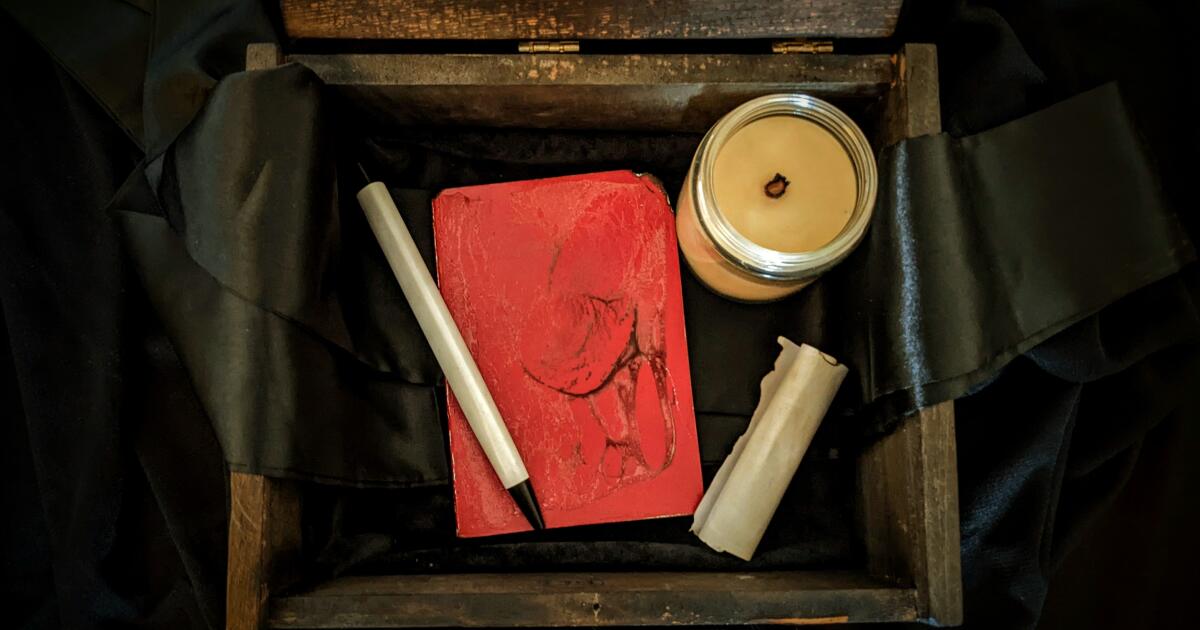
Last summer I had a chance to strike a deal with the devil.
I sat, contemplating my choice — what I could live without to acquire the one thing I most desired. This was no arbitrary crossroads. Over the past 40 or so minutes I had confessed long-held goals and romantic yearnings while revealing details of my most intimate relationships. They were now being weighed against me. All, I was told, could be mine, minus what I would sacrifice. The contract would be binding, necessitating a drop of blood.
I was left alone, a tiny lancet sitting before me. The barely audible cackle of candle kept me company in a stark warehouse room, a setting that felt illicit while the small flame’s fragility reminded me that I needed to make a decision.
I was here because I had booked a session with Yannick Trapman-O’Brien’s “Undersigned,” a show he bills as a “psychological thriller for one.” Each production is personal, and highly individualized to its participant — plot points detailed here may not unveil for every guest. Know, however, there is no talk of dooming oneself to a fantastical afterlife. “Undersigned” is grounded in our reality, a conversation we have over our wants and needs, and, at least for me, what aspects of my personality or social circle I would forgo to achieve them. Love and various relationships were on the table as I fiddled with the lancet and considered puncturing my finger.
This was not a decision I would make lightly. Trapman-O’Brien’s performance, after all, had created an atmosphere of damning seriousness. And I hadn’t even seen him.
For most of the show I was blindfolded as he sat across from me, and he had left the space while I raced through my life and the future I was starting to imagine for myself. It’s rare to partake in “Undersigned” — after bringing it to L.A. last August, when I experienced it, Philadelphia-based Trapman-O’Brien is back with a smattering of dates this month. Limited tickets, at the time of writing, remain.
Despite being comfortable with vulnerability and having a tendency at times to overshare, I went in to “Undersigned” with trepidation. No topic, unless specifically requested, is off limits. Our relationship to money, sex, religion, love, power and more are all fair game, and the subjects are discussed in a setting that nods to the occult. Yet “Undersigned” ultimately became something akin to a therapy session, as I was prompted to analyze my strengths and weaknesses in matters of romance and faith.
Trapman-O’Brien, 32, has a unique ability to improvise, to quickly twist my words and use them against me. There were no cards or magic tricks here. “Undersigned” is purely a meeting of the minds, and those who treat it seriously will find it most revealing.
My session was a tug-of-war between empathetic and selfish tendencies; I wanted no deal, I said, unless all those potentially affected were happy, but such a request necessitated taking a figurative scalpel to other areas of contentment. Thus it became a work of self-examination. If rewriting history and one’s life were possible, how much could I accept while still looking at myself in the mirror?
Only everything started to become twisted. I had gone in expecting to share some of my professional and romantic dreams. As the show progressed, however, a fear that I would never achieve them set in.
“There is an enormous act of care in providing people a place where they can be confronted by themselves,” Trapman-O’Brien says. “For all that the themes and origins of this story are rooted in traditions and in things that are bad and sinister, I actually find it to be an incredibly affirming piece to do. I am gobsmacked by people’s generosity, and courage to stare down a scary thing. I’ve had people say something and then immediately say, ‘Oh, I don’t like that that’s true.’”
Trapman-O’Brien is careful with his words. A promise of “Undersigned” is that what is spoken of during the performance will never again be discussed. He will reveal, only broadly, the topics that have been broached. A veteran of the East Coast participatory theater scene, Trapman-O’Brien’s prior show, “The Telelibrary,” was born out of the COVID-19 pandemic, a whimsical yet open-hearted telephone-based performance in which vocal prompts led us either to literary reflections or to recollections left behind by other callers.
“Undersigned” started in 2019 as a commission for a patron’s Halloween party. Trapman-O’Brien balked, not wanting to create a horror-themed show, but then became intrigued by exploring the concept of making a deal with the devil. “Undersigned” only works because the choices don’t feel like an arbitrary thought experiment; that is, it’s not a game of accepting, say, untold billions by giving up a pet or a limb. Throughout, the blindfolded conversation with Trapman-O’Brien dials in on our emotional wants and needs, and then needles away at them in search of their root.
Yannick Trapman-O’Brien has performed “Undersigned” about 300 times, each time asking guests to potentially offer up a personal and emotional sacrifice. The abstracted bargains of past guests are on display for participants.
(Todd Martens / Los Angeles Times)
The goal? To emotionally disarm guests by creating, in Trapman-O’Brien’s words, a “nonjudgmental space.”
“One of the problems is the second you open up the idea of a deal with the devil, people expect that they’re going to get screwed,” Trapman-O’Brien says. “I find people negotiate against themselves. One of the most impactful things of the piece is talking to people about why they keep accepting less than they want. Like, ‘I don’t need my dream job. I just need a good job.’ But I told you that you could have anything you want. Have your dream.”
The vulnerability inherent in the show extends to its payment structure. An “Undersigned” performance asks for a “down payment” of $100, with slightly cheaper options for students and creative professionals. At the end of the show, guests are presented with a notebook to write something personal to leave behind for others to read, and an envelope containing 30% of their initial investment in cash — a recognition, reads “Undersigned’s” fine print, of “the gamble” guests are taking with such an openly revealing, potentially unnerving show.
“I think the best way to ask for something is to invite,” Trapman-O’Brien says. “And the best way to invite people into vulnerability is with vulnerability of your own. We’ve talked about how heavy the show is. And I believe a big part of what makes people willing to share is that I try to find as many places as possible to stick my neck out. “
Trapman-O’Brien says he regularly hears from those who participate, sometimes months later, with updates on their agreement. For me, I sat in the warehouse’s lobby — the show is run out of Hatch Escapes in Arlington Heights — for a good 45 to 50 minutes, contemplating how easily I was willing to offer up professional ambitions and personal connections for something I believed would make me happy.
“There’s a non-zero number of participants,” Trapman-O’Brien says, “who will reach out and say, ‘I know I’m not supposed to discuss it, but it did happen.’ Well, those rules are about your safety and mine, so I can say, ‘I don’t know what you’re talking about.’ But that to me is what it means to do a piece in which you say things that you need. Some of them might surprise you.”
Arguably, the biggest revelation for me with “Undersigned” is how true it all felt. About six months after I partook in the production, there are moments I’ll catch myself thinking about the show and the choice I was presented with. Should that future I imagined for myself ever become a reality, a not insignificant part of me will wonder what other forces were at play.
For when I departed “Undersigned,” I also left a part of me behind: a drop of blood, and a signed deal with the devil.


Lifestyle
L.A. Affairs: It’s hot when a man drives to me. But would this new guy make the trek from the Valley?

I met Dan on Hinge.
He lives in Woodland Hills, and I live in Venice. In Los Angeles, this is considered a long-distance relationship. In another city it might be nothing. Here, it’s a factor.
But I believe that with the right person, you can make anything work, so I stay open. I’m a native New Yorker, and if I were living in Brooklyn and a guy lived on the Upper West Side, that would be a 45-minute subway ride, which is truly nothing in New York. So with that same logic, I try to have flexibility with men in L.A.
When we started planning our first date, Dan suggested three options: a hike on mushrooms, a wine tasting or a walk on the beach.
A hike on mushrooms is something I’d only do with someone I already trust, not someone I just met online. I don’t do first-date hikes because I don’t like feeling trapped if the guy’s a dud. So I chose the wine tasting.
Then I learned the wine tasting was in West Hills.
On a Friday night, driving there from Venice would be insane. So I said I didn’t want to meet there because of the traffic. He suggested Malibu. That was also not ideal on a Friday.
I was getting annoyed — this was a pink flag because in my dating world, the guy is supposed to come to the woman’s neighborhood in the early days. I’ve gone out with plenty of men from the Valley who effortlessly suggested they come to me. It’s not rare or impossible.
I suggested he come to the Westside. I didn’t specifically say Venice, and in hindsight, I probably should have. He landed on Brentwood, which was manageable for both of us. On our first date, we met at an Irish pub on Wilshire Boulevard. He was cuter and more interesting than I had expected, and with the Guinness flowing, we had fun.
When I got home, he texted me: “Well, I like you 🙂 Less the tik tok and the lack of rock music in your life, but it’s not a deal breaker — there are other qualities 🙂 What are your thoughts?”
I noticed the slight negativity but was mostly dazzled that a man texted immediately after the date to say he liked me. In the modern dating economy, this felt rare.
The next day, both of our evening plans fell through, so we made a last-minute date. The wine tasting he originally suggested still sounded like fun, and although it meant me driving to the Valley, I was up for it now that we’d met.
We sipped flights at Malibu Wines & Beer Garden in its airy, romantic courtyard and played a flirty version of Truth or Dare. Halfway through, he dared me to kiss him.
We ended with sushi on Ventura Boulevard and a short make-out session in his car. He invited me to Thanksgiving at his uncle’s, which felt too soon, but also sweet.
After the second date, he texted and said he had his kids that week and was also hosting an event on Thursday, so his only day to meet was Wednesday. I said great.
On Tuesday night, he checked if we were still on, and I said yes.
Then he texted: “I’m flexible on time but not on location. I have a big event on Thursday, hopefully you can come to me again.”
My stomach tightened. This again?
So I texted back: “I drove to you last time, which was a bit of an exception for me especially in the early days, but the wine tasting location sounded special. Usually guys come to my area. How about we switch it up this time?”
He replied: “I appreciate the effort! Because of my event, I’d rather be close to a computer just if needed … Here is what i offer:
— I’ll come to your area anytime next week/end
— Lunch/dinner on me
I want to continue where we stopped last time 😉 No pressure of course, but let’s snuggle”
I responded: “Ok let’s meet next week. Snuggles sound nice … let’s see what happens …”
Then he wrote: “So I won’t see you tomorrow?”
I replied: “Unless you wanna come to me and bring your laptop along, let’s rain check until you have more flexibility.”
He said: “Dang, you are hard. I’ll let you know tomorrow around midday if it’s ok.”
And then — surprise — he decided to come.
He drove to Venice for a 5 p.m. date. He said his ETA was 5 p.m., and it ended up being 5:25 p.m., typical 405 Freeway.
When he showed up, he was in a cranky mood. On our way to KazuNori in Marina del Rey, I thanked him for picking me up and told him I think it’s hot when the guy comes to the girl.
“You’re just saying that because you want me to come to you more,” he said, not playfully, but aggressively.
That was basically the end for me. But there I was, in his car, heading to dinner. So I stayed pleasant and tried to make the best of it.
I shared that in the early stages of dating, I find it’s good etiquette for the guy to come to the woman’s neighborhood. He immediately disagreed and started ranting about how dating rules are ridiculous and how they swing in women’s favor. He resented paying for dates and declared he wasn’t looking to “sponsor a woman’s life.”
“If women want equality and equal rights,” he said, “then it should apply all across the board, including dating, and the man shouldn’t have to pay.”
I said women don’t actually have equal rights because we get paid less than men and often receive lower salaries than men in the same position.
I tried to change the subject and reset the mood, but he insisted we keep hashing it out.
I tried to explain masculine/feminine dynamics: providing and protecting, giving and receiving.
“What does the man get out of this arrangement?” he asked.
It was like watching someone’s personality warp into Mr. Hyde. Then he brought up another point: He’s a single dad of two kids, so he gets tired; and because I don’t have kids, that should factor into who drives where.
At this point, I was barely engaging and focused on eating my hand rolls, and I couldn’t wait to get home.
The check came, and I happily split it, wanting nothing further from him.
In the car back to my place, he remarked: “It’s obvious we’re never gonna see each other again.”
Obvious, but did it need to be stated?
Then he showed me a Spotify playlist he’d made for me of his favorite electronic music, because he knows I like EDM.
“Oh, that’s sweet,” I said.
“Yeah, that’s how I show interest. Through things like this, not who drives to who,” he replied.
When I got out of the car, we wished each other luck, and I headed inside and shut the door.
Two hours later, he sent me the playlist. I’ve yet to listen to it.
It wasn’t the distance that ruined it. It was the resentment. I’m not looking for a man who feels burdened by the effort. I’m looking for a man who sees the value of courting a woman in the first place.
The author is a writer, comedian and former psychologist who lives in Venice. She is the creator of the new vertical series “Manfari.” She’s on Instagram: @solange_neue and @manfari.show.
L.A. Affairs chronicles the search for romantic love in all its glorious expressions in the L.A. area, and we want to hear your true story. We pay $400 for a published essay. Email LAAffairs@latimes.com. You can find submission guidelines here. You can find past columns here.

Lonnie Bunch III is the 14th Secretary of the Smithsonian. He’s pictured above in September 2017.
J. Scott Applewhite/AP
hide caption
toggle caption
J. Scott Applewhite/AP
In a memo addressed to staffers sent Tuesday, the secretary of the Smithsonian, Lonnie G. Bunch III, defended the institution after the White House issued a 162-page report that characterizes the National Museum of American History as a place which has become “subject to institutional capture by a radical, activist ideology that is fundamentally opposed to telling the noble, honest story of the great country we know and love.”
In his email, which NPR has obtained, Bunch wrote in part: “While there will always be room for improvement, this report is not a fair characterization of the work and totality of the National Museum of American History. At the Smithsonian, our work is driven by scholarship, accuracy and an uncompromising commitment to tell the fullness of America’s story. As public servants and the keepers of this institution, we are charged with helping a nation find understanding, hope and clarity and as part of that duty, we are dedicated to excellence, reflection and growth.”

He continued: “We remain focused on what grounds us: a steadfast commitment to scholarship, nonpartisanship, independence, accuracy and integrity. For nearly 180 years, the Smithsonian has worked alongside partners across government — from the White House to Congress to our governing Board of Regents — guided by our enduring mission to increase and diffuse knowledge. That purpose remains: to pursue knowledge with rigor and to serve the American public with clarity and care.”
The White House report was issued on July 4 by the Domestic Policy Council under the title “Saving America’s Story: How Ideological Capture at the Smithsonian Institution’s National Museum of American History Erases Our Heritage.”

The council faults the National Museum of American History on a multitude of fronts, saying it underemphasized the Founding Fathers and early colonial and Revolutionary history; was not sufficiently celebratory of the country’s 250th anniversary; and that it engaged in “anti-white,” “illegal alien” and transgender activism.
It also accuses the museum of trying to “indoctrinate” teachers and students through its exhibitions, programming and teaching resources.
In the report, the council also specifically criticizes museum director Anthea Hartig, who has led the National Museum of American History since 2019 and is concurrently the president of the Organization of American Historians, calling her “an activist advancing an ideological agenda contradictory to the museum’s founding purpose of fostering patriotism.”

The Trump administration has made the Smithsonian museums one of its primary targets in its efforts to reshape cultural narratives to align with its viewpoints. In August 2025, the White House requested a “comprehensive internal review” of eight Smithsonian museums, including the National Museum of American History, following an executive order issued by President Trump in March 2025 in which he called for the removal of “improper ideology” from the Smithsonian’s offerings.
According to the Smithsonian’s charter, all of its 21 museums, 14 education and research centers, and the National Zoo are meant to be run independently of the federal government. The Smithsonian is overseen by Bunch and a board of regents, which includes Vice President Vance, Supreme Court Chief Justice John Roberts and other members appointed by Congress.
In an interview with NBC’s Meet the Press on Sunday, Bunch spoke about the Smithsonian’s 250th anniversary special exhibition at the Smithsonian Castle, which is called “American Aspirations.”
He told NBC: “It’s really important for people to understand that America is much an ideal as it is a place, that it’s a series of aspirations that have really shaped who this country is. And so for me, what is so powerful is to say, ‘Let us honor the words of Thomas Jefferson and the founders, but let us use those to challenge us to be better.’”
Jennifer Vanasco edited this story.

-

 Kentucky2 minutes ago
Affordable Care Act rates rate hikes could strain Kentucky families, WKAS warns
-

 Louisiana7 minutes ago
Moncus Park gets helping hand from 260 youth volunteers across Louisiana
-

 Maine14 minutes ago
Maine’s high court keeps transgender athlete referendum off 2026 ballot
-

 Maryland17 minutes ago
MD woman sentenced to 2 years, $6.8M restitution in multi-million-dollar laundering scheme
-

 Michigan29 minutes ago
Harmful algal blooms reported on 2 large West Michigan lakes
-

 Massachusetts32 minutes ago
Insider tips for navigating the Brimfield Antique Flea Market
-

 Minnesota37 minutes ago
Northwest Minnesota Foundation awarded $200,000 for child care economic development
-

 Mississippi44 minutes ago
Family of Mississippi teen Nolan Wells demand investigation into son’s death

