Business
TikTok and Government Clash in Last Round of Supreme Court Briefs


The two sides in the momentous clash at the Supreme Court over a measure that could shut down TikTok made their closing written arguments on Friday, sharply disputing China’s influence over the site and the role the First Amendment should play in evaluating the law.
Their briefs, filed on an exceptionally abbreviated schedule set last month by the justices, were part of a high-stakes showdown over the government’s insistence that ByteDance, TikTok’s parent company, sell the app’s operations in the United States or shut it down. The Supreme Court, in an effort to resolve the case before the law’s Jan. 19 deadline, will hear arguments at a special session next Friday.
The court’s ruling, which could come this month, will decide the fate of a powerful and pervasive cultural phenomenon that uses a sophisticated algorithm to feed a personalized array of short videos to users. TikTok has become, particularly for younger generations, a leading source of information and entertainment.
“Rarely if ever has the court confronted a free-speech case that matters to so many people,” a brief filed Friday on behalf of a group of TikTok users said. “170 million Americans use TikTok on a regular basis to communicate, entertain themselves, and follow news and current events. If the government prevails here, users in America will lose access to the platform’s billions of videos.”
The briefs made only glancing or indirect references to President-elect Donald J. Trump’s unusual request last week that the Supreme Court temporarily block the law so that he can address the matter once he takes office.
The deadline set by the law for TikTok to be sold or shut down is Jan. 19, the day before Mr. Trump’s inauguration.
“This unfortunate timing,” his brief said, “interferes with President Trump’s ability to manage the United States’ foreign policy and to pursue a resolution to both protect national security and save a social-media platform that provides a popular vehicle for 170 million Americans to exercise their core First Amendment rights.”
The law allows the president to extend the deadline for 90 days in limited circumstances. But that provision does not appear to apply, as it requires the president to certify to Congress that there has been significant progress toward a sale backed by “relevant binding legal agreements.”
TikTok’s brief stressed that the First Amendment protects Americans’ access to the speech of foreign adversaries even if it is propaganda. The alternative to outright censorship, they wrote, is a legal requirement that the source of the speech be disclosed.
“Disclosure is the time-tested, least-restrictive alternative to address a concern the public is being misled about the source or nature of speech received — including in the foreign-affairs and national-security contexts,” TikTok’s brief said.
The users’ brief echoed the point. “The most our customs and case law permit,” it said, “is a requirement to disclose foreign influence, so the people have full information to decide what to believe.”
The government said that approach would not work. “Such a generic, standing disclosure would be patently ineffective,” Elizabeth B. Prelogar, the U.S. solicitor general, wrote on Friday.
In a brief filed last week in the case, TikTok v. Garland, No. 24-656, the government said foreign propaganda may be addressed without violating the Constitution.
“The First Amendment would not have required our nation to tolerate Soviet ownership and control of American radio stations (or other channels of communication and critical infrastructure) during the Cold War,” the brief said, “and it likewise does not require us to tolerate ownership and control of TikTok by a foreign adversary today.”
The users’ brief disputed that statement. “In fact,” the brief said, “the United States tolerated the publication of Pravda — the prototypical tool of Soviet propaganda — in this country at the height of the Cold War.”
TikTok itself said the government was wrong to fault it for its failure to “squarely deny” an assertion that “ByteDance has engaged in censorship or manipulated content on its platforms at the direction of” the Chinese government.
Censorship is “a loaded term,” TikTok’s brief said. In any event, the brief added, “petitioners do squarely deny that TikTok has ever removed or restricted content in other countries at China’s request.”



President Trump on Thursday said he will invoke Cold War-era emergency powers to direct a nearly $700-million investment into the waning coal industry, including construction of a new West Coast coal export terminal in Oakland.
Speaking from the White House, Trump said he will use the Defense Production Act, a 1950 law that grants the president emergency authority over domestic industries deemed critical to national security, to construct a new export terminal on the West Coast for the first time to move supplies overseas. He also announced the upgrading of 13 existing coal plants across the country, the construction of two new coal plants in Alaska and West Virginia, and restarting a shuttered coal plant in Maryland.
“Today we’re taking historic action to bring down the price of energy and the cost of living for all Americans with the power of clean, beautiful coal,” Trump said. He was joined by U.S. Interior Secretary Doug Burgum, U.S. Energy Secretary Chris Wright, Environmental Protection Agency administration Lee Zeldin and other top officials.
Trump and his energy advisors have said coal power is a matter of national security because of rising energy costs, primarily from the growth of artificial intelligence data centers. He declared a national energy emergency on his first day back in office, which was aimed at boosting domestic fossil fuel production.
High energy costs have also become an issue for voters, with residential electricity bills increasing nearly 11% since Trump resumed office in January 2025, according to the latest available data from the U.S. Energy Information Administration.
The effort to establish a West Coast coal export terminal revives a fight that has played out repeatedly in recent years.
Beginning around 2010, the coal industry began pushing for new export sites in California, Oregon and Washington that would deliver coal from landlocked western states to energy-hungry markets in Asia. Those plans met fierce opposition from environmental groups and local communities concerned about climate impacts, coal dust, rail traffic and other potential downsides.
The plans were eventually abandoned, leaving the West Coast without a major U.S. coal export terminal — until now.
“Starting this summer, the West Gateway project will break ground and by summer 2028, over 12 million tons of clean beautiful coal per year will be shipped to countries all around the world,” Trump said.
While the administration leaned on coal as an energy cost solution, opponents said the move will actually increase soaring electricity prices — noting that renewables are generally cheaper than coal when it comes to new power generation in the U.S. A recent report from the nonpartisan think tank Energy Innovation found that 99% of all U.S. coal plants are now more expensive to run than replacement by new local solar, wind or energy storage.
“President Trump’s continued attempt to bail out the coal industry endangers public health and leaves Americans footing the bill for more expensive power,” said Shannon Baker-Branstetter, senior director for climate and energy policy at the Center for American Progress.
Baker-Branstetter noted that coal use has been declining for years due to market forces. At the same time, she said pouring taxpayer dollars into a new export facility “means there is no benefit at all to U.S. consumers, while the export terminals would burden communities next to the port with deadly soot pollution.”
The burning of coal is one of the largest drivers of air pollution, releasing fine particles known to be harmful to respiratory and cardiovascular health. At the same time, coal is a leading driver of human-caused climate change, responsible for about 40% of global greenhouse gas emissions from fuel combustion.
The move also follows the Trump administration’s ongoing efforts to slow U.S. investment in renewable energy, particularly offshore wind power, electric vehicle initiatives and federal funding for solar projects.
“We wouldn’t have the buildings, the factories, the industry, the electricity grid we have today without the critical contribution of coal, the largest source of global electricity for 125 years in a row, and will be for decades to come,” said Wright, the U.S. Energy Secretary.
But investing in coal in 2026 is akin to “a taxpayer bailout to build new phone booths,” said Kit Kennedy, managing director for power at the nonprofit Natural Resources Defense Council.
“The Trump administration’s claim that this has to do with national security is just another false pretext,” Kennedy said. “Instead of bailing out dirty energy, why don’t they end their attacks on cheap, plentiful wind and solar power? That’s the surest way to cut our bills and end our dependence on volatile global energy markets.”
Kennedy added that the latest action from the White House will result in higher bills and dirtier air for Americans.
“The best thing for the air, the climate and our utility bills is to let these plants retire peacefully,” she said.

Google took internet searches to the next level. Could it do the same for mosquito control?
The Silicon Valley-based tech giant is seeking to release up to 64 million sterilized male mosquitoes in California and Florida over two years, according to a notice in the Federal Register. It’s part of an ambitious effort to curb the diseases the insects spread.
Google says it can harness technology to optimize a concept that’s been around for decades, but hasn’t been successfully scaled with mosquitoes to rein in disease.
For example, the process often involves separating the insects by sex to isolate the males. Currently, that’s done manually and can be time consuming. Google says it’s “developing new technologies that combine sensors, algorithms and novel engineering to take advantage of unique aspects of mosquito biology to quickly and accurately sort males from females.”
The company also says it’s building software and monitoring tools to guide releases of sterile males, and its scientists and engineers are creating sensors, traps and software to decide which areas need to be treated and treated again.
-
Share via
Called Debug, the project targets Aedes aegypti mosquitoes, which are native to Africa but have infiltrated nearly half of California’s counties since first being detected in the state in 2013. Not only do they drive residents nuts with itchy bites, but they can carry a number of potentially serious diseases, including dengue, Zika, chikungunya and yellow fever.
The plan is to infect males — which don’t bite — with a bacteria called Wolbachia, which effectively renders them sterile. They are then released to seek out wild females and mate. Females will lay eggs but these won’t hatch, which experts say drives down the population over time.
There are other methods to sterilize male mosquitoes. Vector control districts serving Los Angeles, Orange and San Bernardino counties have irradiated males and released them in recent years.
Early results are promising. Two neighborhoods treated by the Greater Los Angeles Vector Control District saw a more than 80% reduction in the female Aedes aegypti population in 2024 and 2025.
But as the Greater L.A. district seeks to expand its operations, cost poses a problem. Last year, business owners signaled they weren’t willing to shell out more every year to make it happen. District officials are still hoping to sway them.
If Google moves forward, it wouldn’t be the first time it has been involved in such an effort. In 2018, the company conducted a large-scale trial in Fresno County, releasing 14.4 million Wolbachia-infected males in three neighborhoods.
“At peak mosquito season, the number of female mosquitoes was 95.5% lower in release areas compared to non-release areas, with the most geographically isolated neighborhood reaching a 99% reduction,” a 2020 paper reported.
Google has applied for a permit from the Environmental Protection Agency to carry out the releases in California and Florida, for which the federal agency is currently seeking comments before deciding whether to grant approval.
The company aims to release up to 16 million Wolbachia-infected males in California, and the same in Florida, per year for two years, the Federal Register announcement said, for a total of 64 million.
Urgency to tamp down the invasive mosquito population in California has increased since 2023, when the state logged its first locally acquired dengue cases — meaning people were infected in their communities, not while traveling. The following year, the number of locally acquired cases ballooned to 18, with 14 of them in Los Angeles County.
A study published last week in “The Lancet Regional Health — Americas” found that approximately 18.2 million Californians — primarily in the Central Valley, L.A. and San Diego areas — live in regions where conditions are probably suitable for local dengue transmission.
“Under moderate scenarios of climate warming and urban expansion, an additional 4.1 million residents may be at risk by mid-century,” according to the study led by UC Berkeley’s Lisa Couper. Researchers note the current and future risk of transmission remains low except during summer in the Central Valley and Southern California.
“I’m pretty much in favor of whichever [sterile insect technique] approach gets us the disease prevention and nuisance control we need and at the lowest price,” Susanne Kluh, general manager of the Greater L.A. County Vector Control District, said in an email.
She said her district went with radiation because it was the only approved technique when they wanted to launch their pilot, and that it’s “also the only one where some company does not make a profit in the middle.” However, she wouldn’t rule out using Wolbachia if it turned out to be the most affordable option.
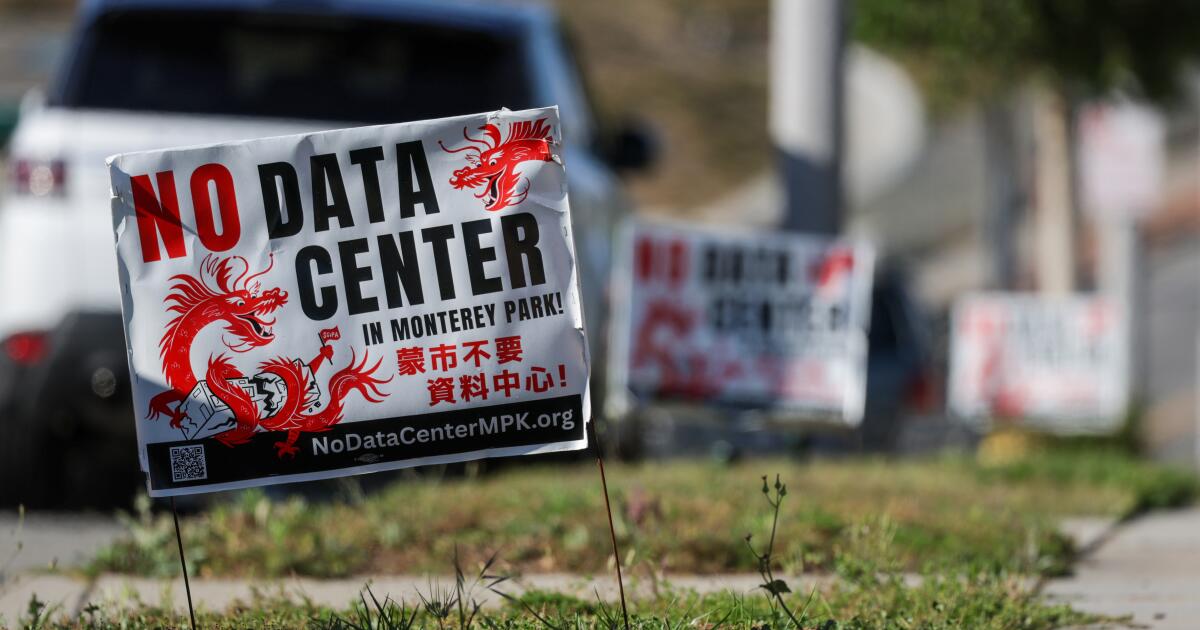
Residents of Monterey Park voted overwhelmingly to ban data centers on election day, making the San Gabriel Valley city the first in the nation to do so by public vote.
As of Wednesday, 86% of votes were in favor of Measure NDC, the city ban, according to the Los Angeles County registrar-recorder/county clerk.
Other cities and towns have passed moratoriums on data centers, as a wave of opposition sweeps the country. But the Monterey Park vote can only be overturned by another ballot measure, making it the most permanent data center ban in a jurisdiction.
Monterey Park’s City Council had already banned data centers by ordinance, after a proposed 247,000-square-foot data center met an outpouring of public anger and concern. The developer withdrew that plan.
That facility would have been less than 500 feet away from the nearest home, and would have used three times the electricity of the entire 60,000-person city. Residents said it would have caused noise and air pollution and driven up electricity rates.
“This ensures long-lasting protections for current and future generations,” Amy Wong, co-founder of the group San Gabriel Valley Progressive Action, said of the vote. “It means that future city councils cannot overturn a data center ban, even if data center developers wanted to spend money to fund pro-data center candidates.”
The measure had no formal opposition. The developer of the proposed facility, investment firm HMC StratCap, said it wouldn’t engage in the ballot fight when it withdrew in March.
The Data Center Coalition, an industry trade group, expressed disappointment in the vote.
“It sends a signal that the area is closed for business, both for data centers and for other significant economic development projects,” state policy director Khara Boender said.
“It deprives local residents of the opportunity to compete for jobs and investment, while also causing the area to relinquish substantial long-term economic investment, high-wage jobs, and critical tax revenue to neighboring areas or other states.”
SGV Progressive Action worked with hyperlocal groups including No Data Center Monterey Park to rally support for the measure.
The group is now focused on stopping data center proposals in the City of Industry and fighting a move by City of Industry, Santa Fe Springs, Vernon and City of Commerce to welcome data centers and other industry with fast-tracked permitting and tax incentives.
City of Industry, in the San Gabriel Valley, and Vernon, south of downtown L.A., are primarily industrial areas, each with around 300 permanent residents. They are employment centers, and tens of thousands of workers commute in daily.
There has been little vocal opposition to data centers among the few residents of these cities. Wong said the protest is primarily coming from the surrounding neighborhoods.
“If a data center gets built in City of Industry, residents across the region would bear the brunt of pollution and increased utility costs,” Wong said, noting that it is surrounded by 16 other cities and unincorporated communities.
Data center proposals have been limited in California compared to Virginia, Texas, Georgia, Illinois and Arizona, which sit at the center of a recent boom in hyperscaler facilities to power artificial intelligence.
California has the third-most data centers in the country, with 300, but high electricity rates, expensive land and regulatory hurdles mean that fewer, and smaller, facilities are currently planned than in other hotspots.
That doesn’t mean opposition hasn’t been fierce. In Coachella and Imperial County, residents are showing up in droves to protest local proposals.
In the San Gabriel Valley, Montebello, El Monte and Baldwin Park have all enacted temporary moratoriums, and Alhambra recently banned data centers as part of a zoning code update.
Wong said she hoped the ballot measure vote would galvanize the opposition. “The vote is a testament to the people power of our region,” she said. “Our region is worth protecting, and we won’t let data centers determine our future.”
-

 Politics1 minute ago
Video: Jan. 6 Rioter Hired by Pentagon
-
 Lifestyle31 minutes ago
‘How to Rule the World’ explores education and power at Stanford University
-

 Technology43 minutes ago
Cyberdecks used to look like little laptops, but now they’re getting more personal
-

 World46 minutes ago
Pete Hegseth warns narco-terrorists as U.S. backs Bolivia’s government amid coup warnings
-

 Politics51 minutes ago
Democrats split over Tlaib’s Lebanon measure as Republicans seize on Hezbollah omission
-

 Health58 minutes ago
Popular weight-loss diet shows surprising impact on serious mental health condition
-

 Sports1 hour ago
NBA bans two fans for life after court invasion during Knicks-Spurs Game 1
-

 Technology1 hour ago
Charter breach warning: What customers should know

