Lifestyle
12 energetic and restorative wellness activities in L.A., one for every month of the year


This stands to be an interesting year — if not a potentially stressful one — as we transition leadership in this country. Just remember to care for yourself.
With that top of mind, here’s a calendar of wellness activities, each tied to the mood and cadence of the month. There’s a high-energy trampoline fitness routine, an affordable facial, a supermoon hike, a sound bath in a dome designed for time travel and more.
Feel free to mix up the order of these activities (hey, do them all in January, if you want!) or simply use them as inspiration to chart your own wellness path. But do prioritize self-care this year to stay healthy, grounded and strong.
January: Roast on salt rocks, soak in hot water and shed your skin

Wi Spa’s salt therapy sauna.
(Wi Spa)
Los Angeles has a rich Korean bathhouse culture. But my favorite — and I’ve tried them all — is Wi Spa. The spa is open 24/7, for starters, and has a coed floor with five progressively hot saunas (one offers “salt therapy”; another, “medicinal” clay). There’s a wall-length bookshelf of loaner manga, a rooftop terrace and a surprisingly good Korean cafe (try the spicy buckwheat noodles or the shaved ice with red beans, fresh fruit and ice cream). The soaking tubs and saunas are included with the cost of entry. But consider adding on a scrub and sloughing off a layer or two of skin — it’s my favorite way to enter the new year. I always leave feeling rejuvenated, not to mention just a little bit lighter. ($30 entry)
February: Consult a tarot reader
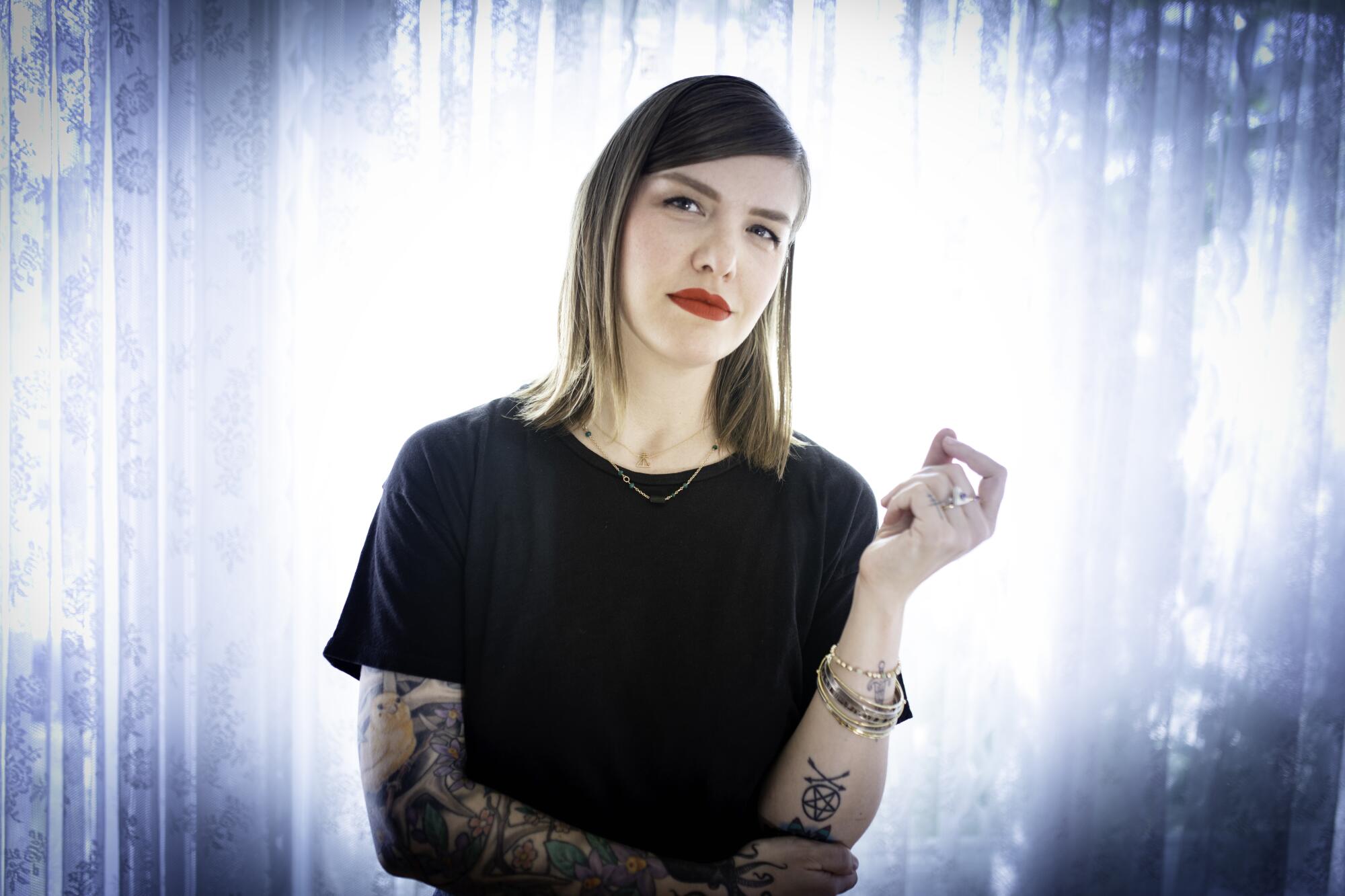
Melinda Lee Holm.
(Tyler Curtis)
Valentine’s Day may be consumerist crap, but it’s inescapable — chocolate, flowers and dating app ads abound! It’s hard not to think about the state of your love life in February. Whether you’re single and searching or coupled and working on things — or anywhere in between — why not get some guidance? Tarot reader Melinda Lee Holm, who’s based in L.A., has been reading cards for more than 30 years. She’s authored several books, most recently “Your Tarot Guide: Learn to Navigate Life With the Help of the Cards.” Contact her for a private reading or attend one of her free tarot readings, held weekly, on Instagram. She also performs staged versions of her Instagram Live events, for free, typically at the Philosophical Research Society. And she’ll be releasing a series of Instagram videos in 2025 about “love spells.” (Private session: $200; live events: free)
March: Enjoy a springtime tea ceremony

Miwa Morishita, a student of Yuko Uyesugi, at Yusuian tea room.
(Deborah Vankin / Los Angeles Times)
There’s no shortage of places to enjoy tea rituals in Los Angeles, including at Alhambra’s Tea Habitat, which offers a gong fu cha service, or the Arts District’s “tea meditation” space, Tea at Shiloh. But Yusuian takes it to the next level. The traditional Japanese tea room is situated on a cliff overlooking the ocean in Malibu. Guests sit on tatami mats with a view of a Japanese garden with a waterfall. Owner Yuko Uyesugi is an expert in the centuries-old Chado tea ceremony, which is the ritualistic preparation of green tea, meant to provide a relaxing break from everyday life. She holds classes there and, twice yearly, opens up the tea room for visits. Bonus: In spring, the garden is bright with flowers, and you may just find a cherry blossom on your plate of sweets. ($85 for a single visit; address upon RSVP)
April: Get heady

Reporter Deborah Vankin receives a Chinese scalp treatment from Tou Dao Tang Head Spa.
(Dania Maxwell / Los Angeles Times)
April is tax season. Which equals one massive headache from — for me, anyway — poring over receipts. Even the score at a head spa. We visited both Japanese and Chinese head spas in the area. At both, the luxury treatment begins with a detailed scalp analysis followed by a neck and shoulder massage and repeated shampooings and conditionings. At Cai Xiang Ge in San Gabriel, the 60-minute, $95 treatment also includes a warm foot bath and a blowout over tea and sweets. At Head Spa En in Pasadena (there are also Beverly Hills and Newport Beach locations), the 60-minute, $150 treatment instead includes a slow, 35-minute Shiatsu head massage with a moisturizing scalp gel. Practitioners claim head spas aid circulation as well as detoxify and hydrate the scalp. Wherever you go, getting your noggin scrubbed for an hour is transformative — in both cases, I nearly fell asleep. Now that’s a worthy benefit. ($95 and $150)
May: Bounce

A class at Ritual Fitness.
(Michael Newstead)
As the weather warms up and we look to summer, it’s a good time to restart (or just start) your fitness routine. Take a trampoline fitness class at LEKfit in Mid-City, Ritual Fitness in Highland Park or Trampoline Trim in Hollywood. Yeah, we know it’s all about strength training these days. But aerobic exercise is still crucial, and working out on a trampoline is low-impact. The studios actually use “Rebounders,” a type of mini-trampoline that has a gentler bounce than a large trampoline; it uses bungee cords instead of metal springs to better absorb impact, making the workout easier on your joints. The dance-like moves are good for coordination, balance and calorie-torching, and rebounding is said to stimulate the lymphatic system, which helps clear toxins from the body. All three studios incorporate elements of strength training, stretching and toning using bands and weights as well. Plus, there’s something to be said for pure, unadulterated, childlike play. (Trampoline Trim, $29; LEKfit and Ritual Fitness, $35)
June: Meditate
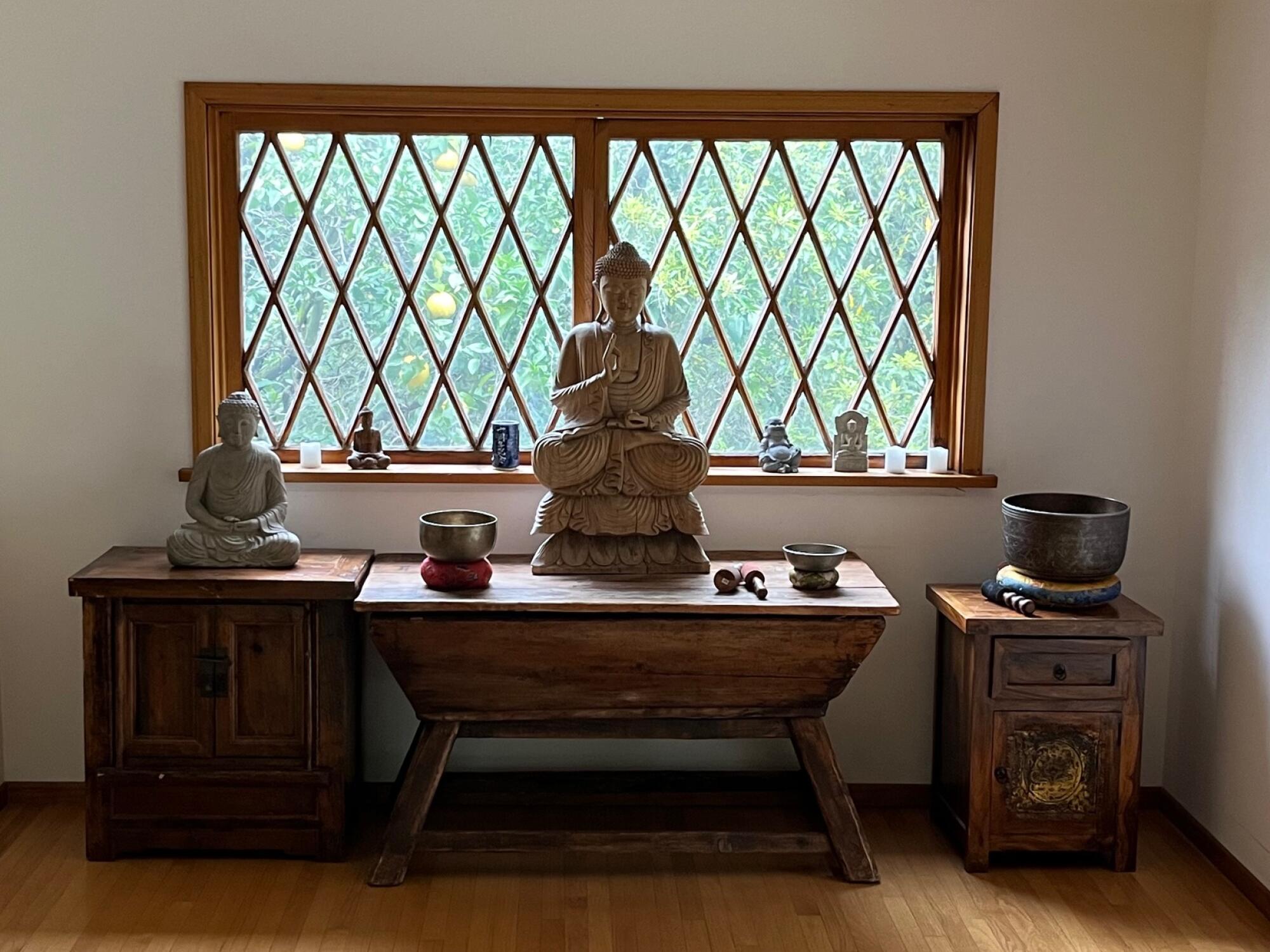
Insight L.A.’s Benedict Canyon retreat.
(Deborah Vankin / Los Angeles Times)
OK, we’re midway through the year. How are things going? Check in with yourself and meditate. Amid the hustle of summer vacations, barbecues and road trips, take some time out to get grounded. If you enjoy the community ritual of “sitting” en masse, my two favorite public meditation spaces are Insight L.A.’s Benedict Canyon retreat, which hosts ongoing meditation events, and the Hammer Museum’s Thursday afternoon Mindful Awareness Meditations. Insight L.A., a nonprofit, has a Santa Monica location and also holds overnight retreats with Big Bear Retreat Center. But its Benedict Canyon space is magical — a hillside haven filled with fruit trees, towering pines and fragrant lavender bushes. Its events are pay-what-you-can, with no one turned away for lack of funds. The Hammer’s free 30-minute meditations, co-presented by UCLA Health, are a dependable respite in the heart of Westwood. Meditations are livestreamed on the museum’s website too. (Free and by donation)
July: Rage

Mia Magik during a Rage Ritual.
(From Mia Magik)
July is hot. It’s crowded and trafficky in L.A. And you may still be reeling from the election (perhaps more so). If meditation didn’t do it for you, try a Rage Ritual. Intuitive advisor Mia Magik will hold several events in L.A. this month. One of them, on July 12, is a daylong retreat in the forest in Topanga. Among the many activities that day will be a Rage Ritual, during which participants collectively scream and thrash around enormous sticks as Magik guides them in releasing pent-up emotions. Or stop by one of L.A.’s Rage Rooms to unleash your fury. At both Rage Ground in downtown L.A. and the Break Room Los Angeles in Van Nuys, visitors don protective gear while smashing glass and ceramic objects. Really, truly friggin’ furious? At both establishments you can book a session to wreck an entire automobile — windows, doors, headlights and all. (Retreat: $150. Rage Ground, from $70 for 45 mins; Break Room Los Angeles, from $45 to $65 for 20 or 30 minutes)
August: Attend a transcendent ‘silent’ piano concert by the sea

Murray Hidary performs a live-to-headphones “silent” piano concert meditation on the Santa Monica beach.
(Ona’ Photography)
Imagine the sun setting over Santa Monica Beach. There’s a large grand piano on the sand, surrounded by enormous upright sunflowers. Hundreds of attendees lie on blankets, wearing wireless headphones rimmed with aqua lights. As it gets darker, the lights glow brightly against the night sky. This is one of Murray Hidary’s MindTravel events, a fusion of live music and meditation — he’ll hold several in the L.A. area in late summer. The experimental music composer and mindfulness teacher performs on an electronic keyboard inside the sculpture of a grand piano, and the music is moving, an improvised mix of contemporary and classical that’s silent to passersby who aren’t wearing headphones. Each concert has a theme, which Murray riffs on, whispering into attendees’ headphones as he plays. The night I went in 2023, the theme was “Courage,” which one attendee had spelled out in candlelight on the sand. (Average: $100; check website for dates)
September: Trek to the desert for the ultimate sound bath

A sound bath inside the Integratron.
(The Integratron)
September always feels extra busy, with back-to-school activities and the shift to fall. Center yourself at the ultimate sound bath, a short road trip away near Joshua Tree. The Integratron, a “fusion of art and science,” is a ’50s-era wood dome that was designed to be an “electrostatic generator for the purpose of rejuvenation and time travel.” It’s situated in Landers in a spot in the desert that its architect, George Van Tassel, claimed is sparking with geomagnetic forces. You can take a deeply relaxing, mind-melding, hour-long sound bath in the dome. It includes a history of the building to start, followed by a live performance, on 22 quartz crystal singing bowls, by a sound healing artist. You may not travel back in time, exactly, but you will most likely be transported. ($58)
October: Worship the supermoon during a Griffith Park night hike

People walk in front of a rising supermoon at Griffith Observatory.
(Richard Vogel / AP)
Oct. 7 is the date of the enormous, glowing Hunter’s moon this year. Watch it rise in the sky from the Griffith Observatory, which has free public telescopes as well as coin-operated ones. Or go DIY and view the moon from one of the park’s highest peaks, Mt. Hollywood, which we like to hike to from the Riverside trailhead at the Greek Theatre. Luckily, Oct. 7 is a Tuesday, which means the Sierra Club Angeles Chapter will be leading free night hikes, with groups divided by skill level. The hikes, which take place every Tuesday and Thursday evening year-round, barring rain, are roughly two hours long and leave at 7 p.m. from the park’s Upper Merry-Go-Round parking lot. The Hunter’s moon takes its name, in part, from its brightness — said to make hunting easier in the dark. No matter which peak you choose to view it from, it surely will illuminate your way. (Free)
November: Trek the length of Wilshire Boulevard

Participants fill Pershing Square during the 2018 Great Los Angeles Walk.
(Michael Schneider)
If moving our bodies, observing our environment and connecting in person with other people are tenets of wellness, then the Great Los Angeles Walk has it all. And this year marks its 20th anniversary. The event, started by journalist and walking aficionado Michael Schneider, has hundreds of Angelenos trekking the length of an iconic boulevard every November on the Saturday before Thanksgiving. Some join individually, others come in groups. Participants are encouraged to “go slow” and stop, repeatedly, along the roughly 14- to 16-mile journey, exploring the landmarks, public art and architecture that they’d otherwise speed past in a car. The event provides much-needed exercise before the holiday festivities, but it’s as much a social happening, bringing together a cross-section of the city. (Free)
December: Prepare for holiday parties with an affordable facial

L.A. is a city with various facial options. Here, Times reporter Amy Kaufman receives a facial at the Shani Darden Studio in Beverly Hills. Facials at the Raven Spa, another city spot for beauty and wellness, are relatively affordable.
(Patrick T. Fallon / For The Times)
The intimate, bohemian-feeling Raven Spa — with locations in Silver Lake and Santa Monica — doesn’t have a large menu of facials. But its signature Radiant Raven Facial is a solid deal in L.A., where facials run $150 to $300 on average (never mind the $1,400 oxygen facial at the Spa at Maybourne Beverly Hills!). The Raven’s is 60 minutes and $110. It’s a custom facial, tailored to your skin’s needs, and all the products used are paraben-free and cruelty-free. It includes a face steam, extractions and face massage along with a brief neck and shoulder massage while a moisturizing mask is being applied. Go ahead, put your best face forward for the holidays. ($110)

Lifestyle
The BoF Podcast | Decoding Paris Haute Couture: Wonder, Restraint and the Call of the Void


Lifestyle
L.A. Affairs: It’s hot when a man drives to me. But would this new guy make the trek from the Valley?

I met Dan on Hinge.
He lives in Woodland Hills, and I live in Venice. In Los Angeles, this is considered a long-distance relationship. In another city it might be nothing. Here, it’s a factor.
But I believe that with the right person, you can make anything work, so I stay open. I’m a native New Yorker, and if I were living in Brooklyn and a guy lived on the Upper West Side, that would be a 45-minute subway ride, which is truly nothing in New York. So with that same logic, I try to have flexibility with men in L.A.
When we started planning our first date, Dan suggested three options: a hike on mushrooms, a wine tasting or a walk on the beach.
A hike on mushrooms is something I’d only do with someone I already trust, not someone I just met online. I don’t do first-date hikes because I don’t like feeling trapped if the guy’s a dud. So I chose the wine tasting.
Then I learned the wine tasting was in West Hills.
On a Friday night, driving there from Venice would be insane. So I said I didn’t want to meet there because of the traffic. He suggested Malibu. That was also not ideal on a Friday.
I was getting annoyed — this was a pink flag because in my dating world, the guy is supposed to come to the woman’s neighborhood in the early days. I’ve gone out with plenty of men from the Valley who effortlessly suggested they come to me. It’s not rare or impossible.
I suggested he come to the Westside. I didn’t specifically say Venice, and in hindsight, I probably should have. He landed on Brentwood, which was manageable for both of us. On our first date, we met at an Irish pub on Wilshire Boulevard. He was cuter and more interesting than I had expected, and with the Guinness flowing, we had fun.
When I got home, he texted me: “Well, I like you 🙂 Less the tik tok and the lack of rock music in your life, but it’s not a deal breaker — there are other qualities 🙂 What are your thoughts?”
I noticed the slight negativity but was mostly dazzled that a man texted immediately after the date to say he liked me. In the modern dating economy, this felt rare.
The next day, both of our evening plans fell through, so we made a last-minute date. The wine tasting he originally suggested still sounded like fun, and although it meant me driving to the Valley, I was up for it now that we’d met.
We sipped flights at Malibu Wines & Beer Garden in its airy, romantic courtyard and played a flirty version of Truth or Dare. Halfway through, he dared me to kiss him.
We ended with sushi on Ventura Boulevard and a short make-out session in his car. He invited me to Thanksgiving at his uncle’s, which felt too soon, but also sweet.
After the second date, he texted and said he had his kids that week and was also hosting an event on Thursday, so his only day to meet was Wednesday. I said great.
On Tuesday night, he checked if we were still on, and I said yes.
Then he texted: “I’m flexible on time but not on location. I have a big event on Thursday, hopefully you can come to me again.”
My stomach tightened. This again?
So I texted back: “I drove to you last time, which was a bit of an exception for me especially in the early days, but the wine tasting location sounded special. Usually guys come to my area. How about we switch it up this time?”
He replied: “I appreciate the effort! Because of my event, I’d rather be close to a computer just if needed … Here is what i offer:
— I’ll come to your area anytime next week/end
— Lunch/dinner on me
I want to continue where we stopped last time 😉 No pressure of course, but let’s snuggle”
I responded: “Ok let’s meet next week. Snuggles sound nice … let’s see what happens …”
Then he wrote: “So I won’t see you tomorrow?”
I replied: “Unless you wanna come to me and bring your laptop along, let’s rain check until you have more flexibility.”
He said: “Dang, you are hard. I’ll let you know tomorrow around midday if it’s ok.”
And then — surprise — he decided to come.
He drove to Venice for a 5 p.m. date. He said his ETA was 5 p.m., and it ended up being 5:25 p.m., typical 405 Freeway.
When he showed up, he was in a cranky mood. On our way to KazuNori in Marina del Rey, I thanked him for picking me up and told him I think it’s hot when the guy comes to the girl.
“You’re just saying that because you want me to come to you more,” he said, not playfully, but aggressively.
That was basically the end for me. But there I was, in his car, heading to dinner. So I stayed pleasant and tried to make the best of it.
I shared that in the early stages of dating, I find it’s good etiquette for the guy to come to the woman’s neighborhood. He immediately disagreed and started ranting about how dating rules are ridiculous and how they swing in women’s favor. He resented paying for dates and declared he wasn’t looking to “sponsor a woman’s life.”
“If women want equality and equal rights,” he said, “then it should apply all across the board, including dating, and the man shouldn’t have to pay.”
I said women don’t actually have equal rights because we get paid less than men and often receive lower salaries than men in the same position.
I tried to change the subject and reset the mood, but he insisted we keep hashing it out.
I tried to explain masculine/feminine dynamics: providing and protecting, giving and receiving.
“What does the man get out of this arrangement?” he asked.
It was like watching someone’s personality warp into Mr. Hyde. Then he brought up another point: He’s a single dad of two kids, so he gets tired; and because I don’t have kids, that should factor into who drives where.
At this point, I was barely engaging and focused on eating my hand rolls, and I couldn’t wait to get home.
The check came, and I happily split it, wanting nothing further from him.
In the car back to my place, he remarked: “It’s obvious we’re never gonna see each other again.”
Obvious, but did it need to be stated?
Then he showed me a Spotify playlist he’d made for me of his favorite electronic music, because he knows I like EDM.
“Oh, that’s sweet,” I said.
“Yeah, that’s how I show interest. Through things like this, not who drives to who,” he replied.
When I got out of the car, we wished each other luck, and I headed inside and shut the door.
Two hours later, he sent me the playlist. I’ve yet to listen to it.
It wasn’t the distance that ruined it. It was the resentment. I’m not looking for a man who feels burdened by the effort. I’m looking for a man who sees the value of courting a woman in the first place.
The author is a writer, comedian and former psychologist who lives in Venice. She is the creator of the new vertical series “Manfari.” She’s on Instagram: @solange_neue and @manfari.show.
L.A. Affairs chronicles the search for romantic love in all its glorious expressions in the L.A. area, and we want to hear your true story. We pay $400 for a published essay. Email LAAffairs@latimes.com. You can find submission guidelines here. You can find past columns here.
-

 Technology1 minute ago
No, Flock isn’t threatening people for debating surveillance
-

 World4 minutes ago
Israel signals readiness for another Iran strike as Trump declares ceasefire over
-

 Politics9 minutes ago
Kelley Paul: America’s Founders were the ‘first civil rights heroes’
-

 Health16 minutes ago
Your resting heart rate could reveal more about your health than you think, doctors say
-

 Sports19 minutes ago
Shohei Ohtani ruled out of MLB All-Star Game as Dodgers plan to manage nagging injury
-

 Technology31 minutes ago
Fake VA shoe offer targets veterans
-
 Business34 minutes ago
Los Angeles hotels saved by last-minute surge in World Cup bookings
-
 Entertainment39 minutes ago
Emily Ratajkowski’s viral essay on sex life as a single mom scores her a seven-figure book deal

