Massachusetts
Maura Healey says Massachusetts is ‘not a sanctuary state,’ shelter costs will decrease


Gov. Maura Healey pledged that the cost of running emergency shelters housing migrants and locals would decrease from its historic levels and pushed back on conservatives who have labeled Massachusetts a “sanctuary state” harboring illegal immigrants.
In an end-of-year interview with the Herald ahead of her third year in office, Healey cast blame on the federal government for immigration issues in the Bay State, but said the expected $1 billion tab taxpayers are set to carry in each of the next several years will eventually deflate.
“It’s going to go down,” she said from inside the State House. “This is not a permanent situation, and it certainly is not sustainable, which is why I felt comfortable making the policy decisions that I have made to ratchet down the numbers.”
Only migrants who are legally allowed or paroled into the United States can access the emergency shelter system, which Healey has placed a set of increasingly restrictive changes on ever since she declared a state of emergency in August 2023 amid an influx of migrants.
The restrictions, including a 7,500 family cap on the system and limiting length of stays, appear to have had some effect. State officials reported spending less on state-run shelters in fiscal year 2024 than originally anticipated — $856 million rather than $932 million.
The cost is still above the $325 million the state has historically spent on emergency assistance shelters, which were set up under a 1980s law to house homeless families with children and pregnant women.
Arriving migrants and the money spent to take care of them have become a flashpoint on Beacon Hill, where Republicans routinely tried this year to implement residency requirements on shelters and cut back spending.
Top budget writers working for Healey are expected to ask the Legislature to approve another round of spending early in the new year to cover shelters for the remainder of fiscal year 2025. Without another injection of cash, money is expected to dry up in January, officials have said.
Sen. Ryan Fattman, a Sutton Republican, said even though new arrivals “forced” Healey to cut shelter costs and reduce the number of families relying on state aid, that has not stopped her from asking for more dollars to fund the system.
“The cost is overwhelming,” he told the Herald in an interview this past month. “In my opinion, what cost containment looks like is reforming the amount of time that people from out of state coming into the state can stay. You want to say 30 or 60 days? Okay, that’s a good reform.”
Healey said the measures she has taken are working — though they have faced harsh criticism from some advocates — and are buoyed by the fact that 65% of families who have recently sought shelter from the state are from Massachusetts.
“We’re not a sanctuary state,” Healey said. “We have a limited budget, and the emergency shelter system really was meant for Massachusetts families who were experiencing homelessness or housing insecurity and needed a place to go that was temporary.
“We’re trying to get to that place where emergency shelter is temporary and that it’s really there just for a limited purpose for a family,” the governor added.
But even as Healey touts her changes to state-run shelters, she has started to face a wave of conservative criticism for running what Republicans say is a “sanctuary state” just as President-elect Donald Trump has promised to undertake mass deportations when he takes office next year.
The term “sanctuary state” generally refers to a state or municipality’s willingness to offer more protection to undocumented immigrants.
But just because a city or town in Massachusetts considers itself a “sanctuary” does not mean there is no federal immigration enforcement, said Sarah Sherman-Stokes, associate director of Boston University’s Immigrants’ Rights and Human Trafficking Clinic.
“There are gaps between some of the statewide laws and city policies that remain vulnerable and will still feed non-citizens into ICE custody,” Stokes told the Herald.
In Massachusetts, many point to a 2017 ruling from the Supreme Judicial Court that bars state and local police from detaining a person solely on the basis of their immigration status, a decision that has since been used to prohibit interactions with federal immigration officials.
Healey said she believes “violent criminals should be deported if they’re not here lawfully” and that local, state, and federal law enforcement should work together to investigate and prosecute crimes and remove people from the country who are criminals.
But the first-term Democrat said she does not back “showing up at a hotel, and rounding up groups of people who are suspected to be here unlawfully, who are here working, and just deporting all of them without a process.”
Healey said, “I think what we need to do is work together here in Massachusetts to do both things: investigate, hold accountable, deport as necessary folks who are here unlawfully, who’ve engaged in criminal activity, absolutely, and also stand up for and protect the people who have been working here, going to school here, raising kids here, to ensure that they are not scared to go to the doctors or drop their kids off or school or go to work.”



BOSTON (WWLP) – The Healey-Driscoll Administration and the Massachusetts Department of Conservation and Recreation announced the opening of 24 swimming pools for the summer season across the state.
This initiative includes the return of its free Learn to Swim Program for children and expanded lifeguard services at 30 DCR swimming areas. Registration for the free swimming lessons begins on Monday, June 22, providing children between the ages of 4 and 12 the opportunity to learn life-saving skills.
The DCR’s efforts aim to provide residents, visitors and families with safe places to swim and cool off during the summer. This commitment to water safety is supported by extending lifeguard coverage to seven days a week, which began last Saturday, running from 10:15 a.m. to 5:45 p.m., though continued coverage is subject to staff availability.
DCR Commissioner Nicole LaChapelle emphasized the importance of aquatic education. “Every child deserves the opportunity to learn how to swim. Swimming is more than a summer activity –it’s a life-saving skill that helps children safely enjoy our pools, lakes and beaches with confidence,” LaChapelle said. “By offering free swimming lessons at pools across Massachusetts, we’re helping remove barriers for families while helping more children safely enjoy the outdoor spaces that belong to all of us.”
The Learn to Swim Program will be offered at 19 DCR pools throughout Massachusetts and is structured into three sessions during the summer. Each session consists of eight half-hour group swim classes tailored for beginner-level swimmers and organized by age.
The curriculum for the classes is based on the American Red Cross and focuses on water safety and basic swimming skills. Registration is required and will operate on a first-come, first-served basis, closing once classes at each facility are full.
Participating DCR pools for the program are located in Agawam, Boston, Cambridge, Chelsea, Chicopee, Clinton, Fall River, Fitchburg, Hyde Park, Lawrence, Malden, Melrose, Milford, Somerville, Springfield, Watertown and Worcester.
The DCR is also actively recruiting certified lifeguards for its beaches and swimming pools for the current summer season. Positions are available through Labor Day and offer competitive hourly wages ranging from $22 to $27, depending on the position and associated certifications. More information about lifeguarding opportunities and application details are available on the agency’s lifeguarding webpage.
Beyond lifeguard services, the DCR maintains water safety at its state beaches and waterfronts through regular water quality testing at all 79 designated swimming areas. These areas are equipped with ropes and buoys to delineate swimming sections. Safety signage, which can be translated into nine languages including Spanish, Portuguese, Vietnamese and Traditional Chinese via a QR code, is also present.
To enhance safety, life rings are available for public use at both guarded and unguarded swimming areas in case of an emergency. All DCR swimming pools are equipped with chair lifts to provide water access. Several pools also feature ramps or zero-depth entry and select pools and spray decks offer beach wheelchairs for use.
All facts in this report were gathered by journalists employed by WWLP. Artificial intelligence tools were used to reformat information into a news article for our website. This report was edited and fact-checked by WWLP staff before being published.
Local News Headlines
WWLP-22News, an NBC affiliate, began broadcasting in March 1953 to provide local news, network, syndicated, and local programming to western Massachusetts. Download the 22News Plus app on your TV to watch live-streaming newscasts and video on demand.

If you watch a movie, send an email, or put your photos in the cloud, there is a data center involved. With the rise of AI, there is more need for data storage and that means more power and more water. So, more Massachusetts communities are saying they don’t want them.
Data centers are growing increasingly unpopular. How unpopular? Polling shows people would rather live near a nuclear power plant. A Gallup poll found 71% of Americans would oppose a data center being built near their home and 53% would oppose a nuclear reactor.
Communities across the country have been fighting to stop the construction of mega sized data centers used to power the future of artificial intelligence.
In Massachusetts, several projects have been put on hold. The city of Lowell recently passed a one-year moratorium to stop the building or expansion of data centers. Lowell is the site of the largest data center in the state.
Markley data center in Lowell
The Markley data center is a mammoth building. It was built by Markley in 2015 on the site of an old Prince Spaghetti factory. Markley cleaned up the lot, painted the building black and set up a complex digital warehouse which stores data from more than a hundred customers ranging from hospitals to universities to police stations.
Like all things data center, this one comes with controversy. Jake Fortes lives in his childhood home where he takes care of his elderly parents. The data center, about 100 feet away, dwarfs his home.
Fortes says the building has nicknames including the “dungeon” and the “Death Star.”
“It’s nicknamed by a lot of residents in the neighborhood the dungeon,” Fortes said. “Because it seriously is just this black building that looms over us.”
Fortes said the rows of industrial air conditioners on the roof of the data center constantly hum and he claims exhaust from the four metal chimneys that rise from the data center’s emergency generators flow toward his bedroom windows.
“You will hear the A/C units. That’s a constant. And it’s worse in the summer,” Fortes said.
Markley has two data centers in Massachusetts. They built their first on top of Macy’s in downtown Boston in 2013.
From Lowell to Los Angeles, there are coast to coast concerns about what these data centers can do to the environment. From the massive amount of energy they use, to the incredible amount of water they need to keep the equipment from overheating. Some large data centers can use up to five million gallons of water every day. But the owners of the Lowell data center say it is not a drain on resources.
WBZ-TV’s David Wade asked Markley for tour of the data center, which they never do, and they agreed. They have grown frustrated with the negative narrative of data centers across the country and wanted to show they are different than the huge data centers built solely for AI companies.
Markley’s corporate VP Adam Burnham took him around the 350,000 square foot facility. The front entrance is teeming with a few dozen people, filled with colorful artwork and a TV monitor showing old video of a train that used to run through the property.
Beyond that there are long hallways with white tile floors and white walls that lead to rooms full of loud machines taking in, transforming and distributing large amounts of electricity throughout the building. How much electricity? Markley doesn’t say. Most data centers don’t. It’s why some lawmakers like Senator Elizabeth Warren are calling for more transparency from all data centers. But Markley’s Boston location boasts up to 30 megawatts of power, which is comparable to what tens of thousands of homes could use at any given time.
“Many petabytes” of data
There is a constant hum from the air conditioning machinery that helps to cool down the racks of servers.
How many servers are in the building? “There must be thousands,” Burnham said. “From hundreds of different customers.”
And how much data is that? “It would be hard to even quantify it. To use technical terms, it would be petabytes,” Burnham said. “Many petabytes for many customers.”
You have heard of megabytes and gigabytes but what is a petabyte? Well, just one petabyte is equal to roughly 250 million high resolution photos or the storage capacity of 250,000 smartphones or 13 years’ worth of continuous high-definition movies.
Markley says it stores data from all different types of companies. Financial companies, life science companies, universities, public safety companies. All those servers need lots of water to feed the system that keeps them cool.
How much water is used?
Some data centers use millions of gallons of water every single day. Markley says over the past year, they have used between 60,000 and 120,000 gallons of water per day. Those numbers match up with some of their water bills that WBZ was able to obtain.
Besides the effect on water and power, another criticism of data centers is once construction is done, they don’t create many jobs. Markley brought Lou Antonellis, a representative from the IBEW, an electrical workers union, to our shoot. Wade asked how many union workers he had working inside the building.
“Right now, it’s a little bit of a slow period. Probably about a dozen,” Antonellis said. That’s it. A dozen. Antonellis said there were also another dozen pipe fitters inside. He said there can be 80-100 workers when there’s a big project on site.
Hopes to expand in Lowell
But Antonellis and the IBEW say they really want Markley to expand. New buildings mean new construction jobs. WBZ learned Markley has been buying more land nearby with hopes of expanding, including an old power plant up the road. But they have a problem. The city of Lowell recently voted for a one-year moratorium on data centers. It means no new building, and no expansion.
On the final stop on the tour, the Markley people wanted to show the emergency generators that neighbors have complained about.
An hour earlier, Jake Fortes, the neighbor who calls the building the Death Star, had predicted they would take David Wade to the generators, and it would be less noisy than usual.
“Usually when they detect that there’s a reporter coming, they will turn it off and it will go very quiet and you will hear the birds,” Fortes said.
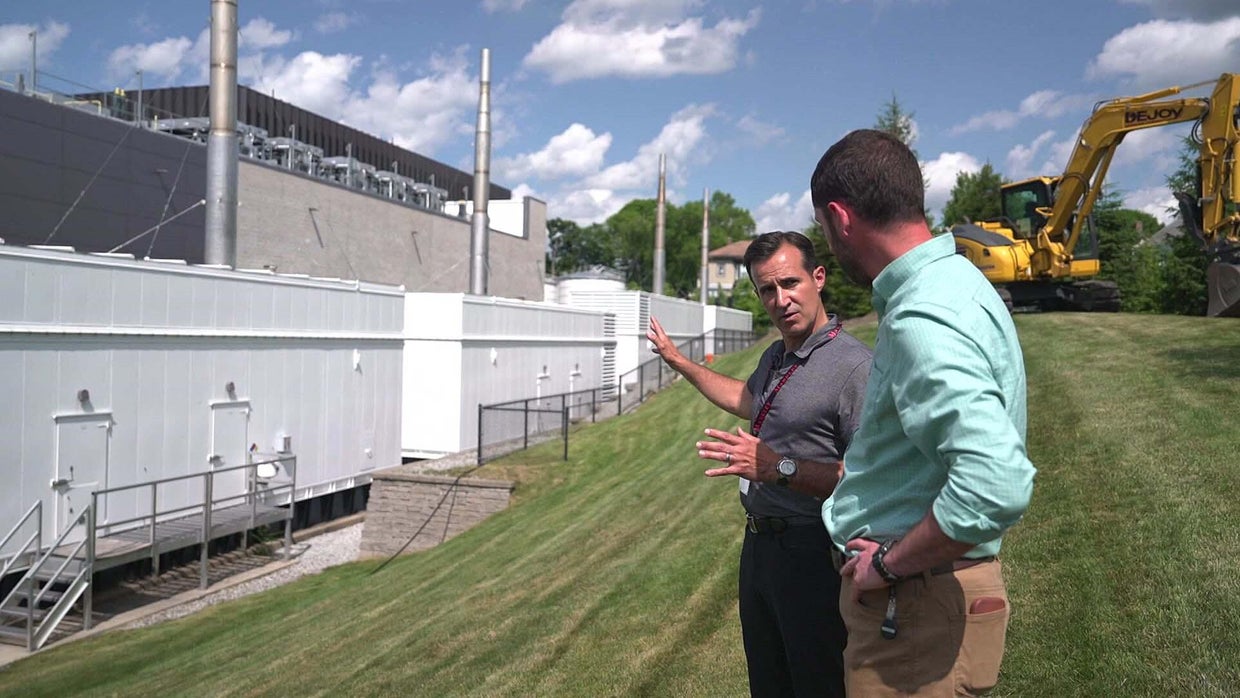
When they took David Wade to the emergency generators, which they fire up for a test every week for five minutes, you could barely hear the machines over the sounds of chirping birds.
“So, it’s not under a complete load, but this is the typical noise you’re going to get,” Burnham said.
Wade asked if the generators weren’t running at “full load” were they running at 20%, 50%, 80%? They couldn’t answer.
Then Wade asked if he thought neighbors had been exaggerating about the noise at the data center and the answer was clear. “I think they’re exaggerating, yes,” Burnham said.
If you have a question you’d like us to look into, please email questioneverything@cbsboston.com.

BOSTON (WWLP) – Gov. Maura Healey announced on Wednesday a comprehensive statewide initiative to reduce wrong-way driving incidents across Massachusetts.
The program combines advanced detection technology, enhanced roadway signage, infrastructure improvements and targeted safety upgrades to improve road safety and prevent tragedies.
The multi-year effort will focus on more than 500 high-risk locations across the state where drivers may be more likely to enter roadways in the wrong direction. Once complete, Mass. aims to have one of the strongest wrong-way prevention and detection programs in the country.
Jonathan Gulliver, undersecretary and state highway administrator, stated, “This plan combines detection, prevention and infrastructure improvements that are already underway and will continue over the next few years. Detection measures include technology that provides real-time alerts and warnings when wrong-way driving is identified, while enhanced signage and pavement markings will help clearly guide drivers and prevent these incidents from occurring in the first place.”
Gov. Maura Healey highlighted the human cost of wrong-way crashes. “We’ve seen firsthand the devastating impact that wrong-way driving crashes can have on families, law enforcement and communities across Massachusetts,” Gov. Healey said. “People deserve to be safe on our roads and we’re taking action. By investing in new technology, stronger safety measures and targeted infrastructure improvements, we’re working to prevent these crashes before they happen and help save lives.”
Lieutenant Gov. Kim Driscoll emphasized the safety benefits for all road users. “Every person who gets behind the wheel should be able to get where they’re going safely,” Lieutenant Gov. Driscoll said. “These investments will help us prevent wrong-way driving incidents, strengthen coordination with first responders and make our transportation system safer for drivers, passengers and families across Massachusetts.”
MassDOT will retrofit approximately 430 existing signalized intersections and mainline camera systems statewide. This new wrong-way detection technology will identify wrong-way movements and provide real-time alerts to transportation officials and law enforcement. New hardware will be installed within existing signal cabinets to enable data collection, detection and notification capabilities. Following installation, the systems will be integrated with activated warning measures, including illuminated signs with flashing LEDs designed to alert drivers before they enter a highway in the wrong direction.
Safety upgrades are also being implemented at highway ramps and interchanges statewide. These upgrades include enhanced WRONG WAY and DO NOT ENTER signage, improved pavement markings, directional arrows and lighting improvements designed to reduce driver confusion.
MassDOT is also piloting next-generation wrong-way detection technologies at locations without existing infrastructure. Data collected from these pilots will identify areas requiring more significant roadway improvements, such as curb and island realignment, ramp reconfiguration to clarify driving paths and channelization enhancements.
Senate Minority Leader Bruce Tarr, a Republican from Gloucester, noted the urgency of the action. “Today our state embarks on a mission to use those tools and make our highways safer for everyone who travels on them,” Sen. Tarr said. “While we are working toward the final passage of legislation to codify a state plan in statute, the steps announced today will begin making a difference as soon as they are taken.”
The initiative also acknowledges the severe impact of past incidents. Massachusetts State Police Colonel Geoffrey Noble spoke about the personal toll on law enforcement. “The Massachusetts State Police continue to mourn the loss of Trooper Kevin Trainor, who gave his life while attempting to stop a wrong-way driver,” Col. Noble said. “His sacrifice is a solemn reminder of the dangers our Troopers confront every day in their mission to protect the public. While our men and women continue to respond courageously to dangerous driving incidents, these roadway improvements and investments in technology will provide another critical tool to help prevent tragedies and ensure that everyone makes it home safely.”
Sen. Joan B. Lovely, a Democrat from Salem, mentioned specific local impacts. “Our district has felt the cost of wrong-way driving in the most painful way, with the loss of Trooper Trainor and a second trooper struck on the same stretch of Route 1 weeks later,” Sen. Lovely said. “I am grateful to Gov. Healey for taking real action. This plan reflects the prevention we fought for in the Senate’s FY2027 budget and I will keep pushing to bring these safety measures to corridors like Route 1 so other families are spared this grief.”
Brian Williams, president of the State Police Association of MA, praised the proactive approach. “Entering a divided highway in the wrong direction is a reckless, lethal act,” Williams said. “We appreciate Gov. Healey’s proactive leadership in launching this advanced early detection initiative. Combining this tech-driven approach with enacting an expanded Move Over law will create the comprehensive safety net needed to protect our members and everyone on Massachusetts roads.”
Retired Chief Michael Bradley Jr., executive director of the Massachusetts Chief of Police Association, also voiced support for the solutions. “Wrong-way driving incidents are among the most dangerous events on our roadways, often resulting in tragic consequences for motorists, passengers and first responders,” Bradley said. “The Massachusetts Chiefs of Police Association applauds Gov. Healey, MassDOT and our legislative partners for investing in proactive solutions that will help prevent these crashes and save lives.”
Improvements are already underway, with additional installations expected to begin in the coming weeks. The installations for the new detection technology will occur throughout 2026 and 2027. MassDOT will continue to evaluate roadway conditions, collect data and identify opportunities to further reduce wrong-way driving incidents across Massachusetts.
All facts in this report were gathered by journalists employed by WWLP. Artificial intelligence tools were used to reformat information into a news article for our website. This report was edited and fact-checked by WWLP staff before being published.
Local News Headlines
WWLP-22News, an NBC affiliate, began broadcasting in March 1953 to provide local news, network, syndicated, and local programming to western Massachusetts. Download the 22News Plus app on your TV to watch live-streaming newscasts and video on demand.
-

 Nebraska2 minutes ago
Nebraska Dept. of Agriculture proposes ban on food and beverages containing any amount of THC
-

 Nevada5 minutes ago
WOW Carwash touts year-round water conservation with recycling tech in Southern Nevada
-

 New Hampshire10 minutes ago
Concord celebrates 237 years of Constitution ratification with festivities – Concord Monitor
-

 New Jersey17 minutes ago
Is ICE giving up on Roxbury detention center? NJ leaders laud report
-

 New Mexico20 minutes ago
New Mexico leaders push funding to fight screwworm after 1 local case
-
North Carolina25 minutes ago
Rare whale shark sighting off North Carolina coast
-

 North Dakota32 minutes ago
NDSU, Dickinson State partner to expand nursing education
-
Ohio35 minutes ago
Court orders Ohio restrictions on kids’ use of social media restored


